Morning Ethics Warm-Up, 7/25/18: Bricks In The Wall [UPDATED]

1. Nah, that’s not a misleading title! An op-ed in the Times yesterday had the alarming header, “Trump’s New Target: Citizenship.” In fact, the piece was about the movement to end automatic U.S. citizenship for those born here of illegal immigrant parents, and the Trump administration policy of seeking to “denaturalize” foreign-born citizens who achieved citizenship status by withholding disclosure of previous crimes.

As with many aspects of the bizarre national immigration debate, support for continuing the first principle is hard to justify. It is a remnant of a time when there were no restrictions on U.S. immigration, so the birthright rule made sense. Now, when illegal immigration is a serious concern, the same principle creates a perverse incentive to break the law, and makes immigration law enforcement complicated and difficult. The second issue is more debatable. The New York Times has another “good immigrant” story, this time one that seeks sympathy for Norma Borgoño, a Peruvian immigrant who took the oath of citizenship in 2007. The Justice Department has moved to revoke  Borgoño’s citizenship, claiming that she committed fraud when she applied for it. She apparentlyfailed to disclose that she had taken part in a serious crime several years before her application, then four years later, in 2011, pleaded guilty when she was charged for helping her employer  defraud the Export-Import Bank of the United States of $24 million.

Writes the Times, “Since President Trump took office, the number of denaturalization cases has been growing, part of a campaign of aggressive immigration enforcement that now promises to include even the most protected class of legal immigrants: naturalized citizens.” That is a deceitful sentence, full of spin, as is the entire story. For “aggressive immigration enforcement” read “enforcement.” The U.S. has every right, and in fact a duty, to assess what kind of people it wants to allow to become citizens, and criminals need not apply—after all, we have enough of them already. The Times finds it significant that Borgoño hasn’t been charged with her crime when she  applied for citizenship, but she was still a criminal, and the crime wasn’t stealing a loaf of bread, either. It also spins that her aiding a massive theft was “to no benefit of her own.” Oh! Then that’s OK, then! Presumably there was the benefit of keeping her job with her boss the felon, at very least.

The Trump administration isn’t “targeting citizenship,” but rather naturalized citizenship that was improperly granted, based on false representations.

2. The irresponsible neglect of the national infrastructure continues. I could write about this every day, and maybe I should. A microcosm of the national crisis is illustrated in the recent news that the New York City subway system is still falling apart, and even after the city spent about $333 million on emergency repairs its condition has barely improved. Waiting until transit systems, bridges, roads, railroad track, waterways, sewer and water pipes,  airports, the power grid and the rest of the structures that support civilization start crumbling, stifling commerce and killing people is an idiotic and suicidal approach to a basic  function of government, but  that has been our national policy since the 1960s. President Trump has claimed that addressing this was a priority, and maybe it will be, but recent history suggests that nothing will be done of substance until there is a lot of sickness, death, and destruction. Continue reading

“McCarthy And Witch Hunts And Fear, Oh My!” PART II: Papa John’s Pizza Founder And Chairman John Schnatter

What befell Papa John’s Pizza founder John Schnatter is even a more  direct example of current day McCarthyism and Salem’s “He’s a witch!” method of personal destruction than the fate of James Gunn, discussed in Part I.

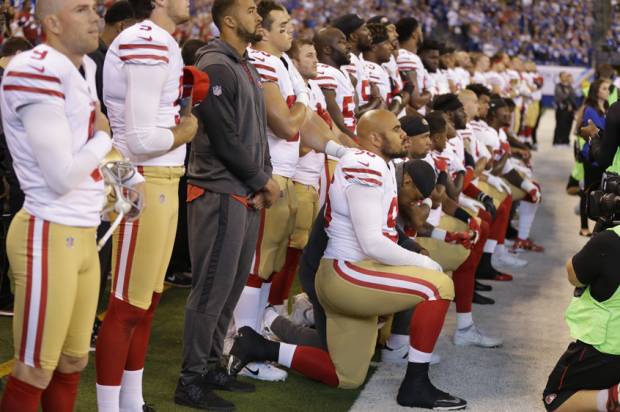
Schnatter was already on the progressive hit list because he had been openly critical of the NFL’s addled kneelers–you know, those astute social justice athlete-activists who honest-to-Pete weren’t protesting the National Anthem when they protested during the National Anthem and never have been able to clarify what exactly they are protesting, unless it was kind of everything, and who were exercising their sacred First Amendment free speech rights, but really weren’t, though they don’t understand that, not being familiar with the nation’s founding documents? Those guys—and was ripe for race-baiting. Then he had a fateful conference call with the chain’s marketing agency Laundry Service—That’s funny: I have a laundry service called “Marketing Agency”!— that wanted to hire rapper Kanye West to represent Papa John’s in ads. The call was also intended, reportedly,  as a role-playing exercise for Schnatter to deal with sensitive race issues and to learn how to avoid future public-relations botches.

In the course of explaining that he wasn’t a racist, Schlatter told the tale of  how KFC’s Colonel Sanders reportedly used the slur “nigger” often. Schnatter said he never would use that word — but GOTCHA! He had, in order to tell the Col. Sanders story!

WIIIIITCH!!!

Although Schnatter says he intended  to convey his antipathy to racism, some on the call found his language ” offensive,” and reported that he had “used” the taboo word. Nobody, apparently, claimed he had used the word as a slur; he just refused to use the baby-talk code “N-word,” which, you may have already noticed, is an example of particularly idiotic political correctness that impedes education, journalism, public debate and competent communication that I emphatically reject in writing this blog. Talking or writing about the word “nigger” is not using the word “nigger” in the fashion that makes it rationally offensive. If anyone finds using the word to discuss the word itself offensive, that person has a problem, and it is between his or her ears.

Schnatter, who was already in trouble at his company and had stepped down as CEO in the wake of his criticism of the knee-happy NFL players, initially capitulated to the latest barrage of criticism. “News reports attributing the use of inappropriate and hurtful language to me during a media training session regarding race are true,” he said in a statement. “Regardless of the context, I apologize. Simply stated, racism has no place in our society.” Then he resigned from the company board. Here is the infantile way Forbes announced the news:

“John Schnatter—the founder and public face of pizza chain Papa John’s—used the N-word on a conference call in May. Schnatter confirmed the incident in an emailed statement to Forbes on Wednesday. He resigned as chairman of Papa John’s on Wednesday evening.”

Now Schnatter is fighting his exile, gathering a legal team and sending the following letter: Continue reading

Morning Ethics Warm-Up, 7/23/2018: Look! A Trump And Biased News Media-Free Warm-Up!

Good morning.

The three days of heavy rain wouldn’t bother me so much if it didn’t make Rugby so miserable. You do NOT want to be cooped up with an unhappy Jack Russell Terrier. Trust me on this.

1. Baseball Ethics, Jerk Division. Watch this:

Yes, that guy deliberately took a baseball away from a kid who lost hold of it after it had been tossed to him by Cubs first base coach Will Venable during yesterday’s Cubs-Cardinals game. Apparently the child was given a replacement ball by the Cubs, and this one was autographed. The gesture also took some the inevitable heat off the jerk who snatched the ball. with the Cubs telling reporters that he had helped the same boy get a ball earlier in the game and wasn’t really a monster.

A few points:

  • That the kid ended up, as some commentators put it, “better off” because the jerk stole his ball is pure moral luck, and doesn’t make what the guy did any less wrong, cruel or despicable.
  • Neither is it mitigation that the same man—claims the Cubs—helped the kid get another ball earlier. What kind of ethical principle is that? “I helped you before, so this entitles me to steal from you now: all even, right?”
  • Please save some contempt for the woman the jerk gave the purloined ball to. She should have handed the ball right back to the child, She’s as big a jerk as her friend is.

2. Now consider this: what if the jerk was a federal judge nominated to fill a Supreme Court seat? Would that video be fair game to consider in evaluating his qualifications to be a SCOTUS justice? Let’s have a poll:

Continue reading

Sunday Evening Ethics Debriefing, 7/22/18: FISA, “Resistance” Jerks, Translator Ethics And More Problems With CVS

Good evening!

1.  Confirmation bias test? The big news today was that the  U.S. Department of Justice and FBI have released the 412 page FISA application used to gain a Title I surveillance warrant against Carter Page in 2016 while he was working as a low-level unpaid adviser for the Trump campaign. The document is heavily redacted in its more than 400 pages. Carter Page himself—he was never charged or interviewed , which seems rather damning in itself–said today,

“‘You talk about misleading the courts, it’s just so misleading… It’s literally a complete joke.'”

The full pdf is available here.

Once again, it is impossible to tell what is going on by following the news media’s reports. It sure seems, however that once you block out the spinning by the mainstream media, this post regarding Devon Nunes’ much attacked memo on the topic was verified.  Still, I have a low rate of patience for these things, and am not the best interpreter of documents like this, so I am only relying on second hand opinions by others who have plowed through the damn thing. I’ll wait to get some reliable readings.

It seems like the critics of the Mueller investigation and the conduct of Justice and the FBI feel confident that the materials show that indeed the warrants were acquired deceptively, meaning illegally, with the unsubstantiated Steele dossier being the crux of the justification for the warrants, also considering the fact that the Clinton campaign was behind the dossier was never revealed to the judges. [Here’s a recent example of the spin being applied to that argument. The judges were told that the dossier was paid for by a person with political motives, and the claim is that this was enough, that they could figure out that it was a tool of the Clinton campaign. I’ve never understood this argument. Why weren’t the judges informed directly, then? ] Ann Althouse commenter named Yancy Ward wrote, Continue reading

“McCarthy And Witch Hunts And Fear, Oh My!” PART I: Director James Gunn

I don’t care to live in a culture where law-abiding citizens can have their reputations and careers destroyed by people maliciously publicizing old or private communications to make them hated or distrusted, or worse, a culture where doing this to people is deemed virtuous. Such a culture is one based on perpetual fear, where individuals cannot express an opinion that they may change later, or make a joke to a select audience, or have a conversation expressing strong but spontaneous and transient feelings without risking personal destruction at the hands of someone who wishes them ill.

That is the U.S. culture, however, that extremists on both ends of the political spectrum are successfully constructing,  unles we stop them. Their tools are political correctness, invasions of privacy, abuse of technology, social media and its attendant mobs, and an utter disregard of fairness, decency and ethics.

Two recent example illustrate how serious the problem is. This post is about one of them.

Talented writer-director James Gunn, the creative force behind the  delightful  Guardians of the Galaxy movies was fired by Disney after his old tweets containing offensive jokes were uncovered and circulated on social media and the web. The tweets were deliberately sought by conservative blogger and activist Mike Cernovich,  to intentionally wreck Gunn’s career. Gunn’s real offense was that he has been a vocal “resistance” recruit and a prominent conservative-hater, so once Cernovich had the goods on him, the Right was happy to use them.

No doubt, Gunn’s old tweets included jokes that many would consider worthy of Roseanne Barr on a careless day, like

  • “Laughter is the best medicine. That’s why I laugh at people with AIDS.”
  • “I like when little boys touch me in my silly place.”
  • “The best thing about being raped is when you’re done being raped and it’s like ‘whew this feels great, not being raped!’”

Gunn, realizing that joking about pederasty, rape and AIDS was sufficient to get him Kevin Spaceyed for life, tried to explain:

Many people who have followed my career know when I started, I viewed myself as a provocateur, making movies and telling jokes that were outrageous and taboo. As I have discussed publicly many times, as I’ve developed as a person, so has my work and my humor. It’s not to say I’m better, but I am very, very different than I was a few years ago; today I try to root my work in love and connection and less in anger. My days saying something just because it’s shocking and trying to get a reaction are over. In the past, I have apologized for humor of mine that hurt people. I truly felt sorry and meant every word of my apologies. For the record, when I made these shocking jokes, I wasn’t living them out. I know this is a weird statement to make, and seems obvious, but, still, here I am, saying it. Anyway, that’s the completely honest truth: I used to make a lot of offensive jokes. I don’t anymore. I don’t blame my past self for this, but I like myself more and feel like a more full human being and creator today. Love you to you all.

I believe him. I believe him, though something nasty in me would love to know if he was telling friends that the Milwaukee Brewers should punish Josh Hader for the racist tweets he made in high school, because this whole phenomenon is a Golden Rule matter. That has been the Ethics Alarms position forever, including during the 2014 Donald Sterling Ethics Train Wreck, in which an NBA owner lost his team, millions in fines, and his reputation after his mistress taped an ugly conversation they had in his bedroom and circulated it. I reiterated this position most recently in May of this year:

The position of Ethics Alarms on these incidents, which also includes spurned lovers sharing private emails to the world in order to humiliate a correspondent, the Democratic Senators who leaked the President’s coarse rhetoric about “shithole” countries that took place during a meeting that was supposed to be private and confidential, and Donald Trump’s infamous “pussy-grabbing” statements, is simple. Once the embarrassing words are unethically made public, they can’t be ignored, Once the embarrassing words have unethically made public, they can’t be ignored. Neither should the circumstances of their making, or the unethical nature of their subsequent use was weapons of personal destruction.

There is not a human being alive who has not made statements in private meetings or conversations, whether  those statements be jokes, insults, rueful observations or deliberate hyperbole, that would be horribly inappropriate as public utterances. Thus the feigned horror at such statements by others is the rankest kind of Golden Rule hypocrisy. In addition, the opprobrium and public disgrace brought down on the heads of those whose mean/ugly/politically incorrect/vulgar/ nasty/insulting words are made public by a treacherous friend, associate or colleague erodes every American’s freedom of thought, association and expression, as well as their privacy.

And yes, to anticipate the objection, I do not regard social media posts by non-public persons who later become celebrities to be truly public communications. They are, in the minds of the foolish individuals who send them, personal messages aimed at friendly audiences, and not intended for public circulation. In reaching this position I am influenced by the legal ethics and judicial rule regarding what is public knowledge regarding a former client that can be used by a lawyer . Simply because information is included in a public document that anyone can access doesn’t mean it is considered public enough for a lawyer to reveal it if the information involves a client. Most people don’t know about those facts because they don’t know how to find them, where to look, or whether the information even exists. Information doesn’t become truly public until it is widely accessible and disseminated. Once Gunn (and Hader) became celebrities, their social media presence was public, but not before. True, both Gunn and Hader should have realized that what they posted when they were nobody special had suddenly become a matter of public interest, and true, people need to start thinking that way, but most of our newly famous just don’t. Continue reading

Ethics Dunce: ME. An Abashed Apology From Your Host…

It was the blog equivalent of coming home and finding that you left the bathtub water running.

At 6: 56 this morning, I read reader Marie Dowd’s comment that said,

“7: ‘This cover’ has no link and a search showed a cover with people in the spray of a fire hydrant?”

Initially I had no idea what she meant, and then, when it dawned on me, I rushed to check out yesterday’s Warm-Up while screaming “NOOOOOOOO!” in slow motion. Sure enough, I had never posted the New Yorker cover showing the President looking flat and arguably dead at the bottom of an escalator, and that was what I was writing about. Thus the post made no sense. Here, for anyone who cares, and apparently few did, is what was supposed to be shown. Does it make  sense now?

7. Is this New Yorker cover responsible?

It is perilously close to Kathy Griffin’s severed head: many read the image as the President being dead, and members of “the resistance” have openly alluded to Trump’s death or hope thereof over the past 18 months.  (Note the double thumbs up, however.) I rate the cartoon as well within the boundaries of political commentary, but, again, wonder what the reaction would have been if a similar image of President Obama was run on the cover…and it easily could have been, many, many times, with justification.

It’s fixed now, but 14 hours after I posted it. Continue reading

Saturday Ethics Warm-Up, 7/21/18: Seven Questions For A Rainy Day: UPDATED!

Good afternoon!

1. What did you expect? Following close on the heels of Scott Pruitt’s firing from the EPA as a result of blatant ethics violations, Commerce Secretary Wilbur Ross said last week that he would sell all of his stock holdings to “maintain the public trust” after the Office of Government and Ethics pointed out that his financial transactions could get him into legal trouble.

“I have made inadvertent errors in completing the divestitures required by my ethics agreement,” Ross said in a statement. “To maintain the public trust, I have directed that all of my equity holdings be sold and the proceeds placed in U.S. Treasury securities.”

To maintain that public trust. Right.

The culture of CEOs and business executives is so alien to ethics that this kind of thing was assured as soon as Donald Trump was elected President. I wouldn’t say the business culture is necessarily more unethical than the political culture, it is juts unethical different ways. However, President Trump brought this brand of malfunctioning ethics alarms with him, and we shouldn’t expect it to abate until he leaves the White House.

Then we will get back to the good old-fashioned political versions of unethical conduct we’re become numb to. Ah, those were the days!

2. A question of degree. Professor Brian McNaughton, a former professor at Colorado State University, is facing a felony charge for fabricating an outside job offer to get a higher salary. This meets the technical definition of fraud. Apparently he presented the school with fabricated offer letter from the University of Minnesota. McNaughton resigned his position and apologized, and returned the fruits of the ill-gotten  raise,  about $4,000 per year over four years.

He also says that he was urged to use the tactic by other faculty members, who said it was a standard ploy. When does the “I have other job offers” gambit cross the ethics line into fraud? Clearly when you use a forged letter, but short of that, it’s just lying—unethical, but not criminal.

Writes one idealistic commentator:

…if an employee is performing a job and is good at it, that person should be compensated for it accordingly and in line with individuals within the same organization at an equivalent level professionally (ideally pay should be bench-marked against similar-sized institutions in states or parts of the country with comparable income ranges). Does a job offer and the suggestion that the employee is desirable to another organization change how well that person is performing? Promotions and rewards should be directly related to performance and an individual’s contribution to the organization and to science.

Well, yes, but competition and reality interferes with this nice, fair but overly simplistic and impractical theory. In fields where employees are not fungible, basic economic theory comes into play: you can’t deny the influence supply and demand. The fact that there is competition for an individual’s services does increase that individual’s value. Just saying “it shouldn’t be that way” doesn’t change reality. That’s what makes McNaughton’s lie fraudulent: he’s misrepresenting his value, and using false means to do it.

3. Would you fire Dan Coats for this?

Naturally the anti-Trump mob loved it, and that was the director of national intelligence’s intent: he was playing to the mob and virtue signaling to the detriment of his boss. Either than, or he’s thoroughly unprofessional and can’t be trusted to be on TV. Washington Post reporter Dan Baltz is either foolish, naive or dishonest when he writes: Continue reading

Morning Ethics Warm-Up, 7/19/2018: The All-Denial Edition

Good Morning!

On this day in ethics, 1918: Washington catcher Eddie Ainsmith claimed that he should be deferred from the draft because he was a major league baseball player. Uh, nice try, Eddie, but no,  Secretary of War Newton D Baker ruled, as he tried to suppress uncontrollable eye-rolling..

1. “California, here I come!…here I come!…here I come!…” Oh. Never mind. The California Supreme Court took a measure off the ballot that would have allowed Californians to vote on whether the state should be divided into three smaller states, like this:

In its opinion, the Court argued that the changes demanded by the ballot measure exceeded California voters’ broad authority to enact laws by initiative, established in 1911. If enacted, the measure would have in effect abolished the state Constitution and all existing laws, which would have to be replaced by lawmakers  in the three new states. The measure would also alter the laws that define California’s boundaries, amending the state Constitution. That cannot be done by initiative, but instead requires approval by two-thirds of both houses of the Legislature to be placed on the ballot.

I know that the splitting up of California was a transparent effort to hijack the Senate by adding four more guaranteed Democrats. It was also doomed, since this plot would need to pass Congress and not be vetoed by the President. Still, wouldn’t something as obvious as violating the state Constitution arise before the wacko measure was placed on the ballot? How incompetent can you get? How much more incompetent can California get?

2. THIS will end well… Facebook claims that it will be removing false information from its pages when it threatens to cause violence, before it will cause violence. Sure, we all trust Facebook as an objective, trustworthy arbiter of speech, don’t we? Don’t we? Especially since they use the ever-reliable Snopes to check. During an interview with ReCode’s Kara Swisher, Mark Zuckerberg cited Holocaust denials as the kind of misinformation Facebook would allow to remain on the platform.  “At the end of the day, I don’t believe that our platform should take that down because I think there are things that different people get wrong,” Zuckerberg told Swisher. “I don’t think that they’re intentionally getting it wrong.”

He doesn’t? I’m not sure Holocaust denial is automatically eligible for Hanlon’s Razor; on the other hand, there are good faith idiots. Speaking of idiots, Zuckerman was surprised when his ignorant shrug sparked angry attacks like that of Jonathan Greenblatt, CEO of the Anti-Defamation League, who said, “Holocaust denial is a willful, deliberate and longstanding deception tactic by anti-Semites that is incontrovertibly hateful, hurtful, and threatening to Jews.Facebook has a moral and ethical obligation not to allow its dissemination.”  Continue reading

Look! Computer Professionals Have An Ethics Code!

A new Code of Ethics was recently released by the Association for Computing Machinery (ACM), a professional organization for programmers and technology companies that has aimed to set the tone for ethics in the industry for decades. Its previous ethics code was last updated in 1992, before social media, e-commerce, widespread GPS tracking, the epidemic pf network hacking, bots, trolls, artificial intelligence, and the proliferation of wired cameras on store fronts, house entryways, and family cars, just to name a few of the ominous new developments that has made expanding technology the single greatest ethical challenge in the history of mankind. Most professional codes of ethics have not kept pace with technology, but for a computer organization to be so far behind is embarrassing.

The ACM committee surveyed the international association’s approximately 100,000 members as part of its process. The result is a list of principles and guidelines rather than rules: there is no enforcement mechanism. Nor is there any way to force members to read the thing, much less use it. I’ll say this: the code is ambitious. For example, the Code addresses”The Terminator’s” Skynet scenario, urging members  to take “extraordinary” care to avoid the perils of artificial intelligence, and robots that learn from experience and modify their own actions without the need for re-programming by a human being.

The new code addresses the Big Data ethics issue, and holds that tech companies should collect only the minimum amount of personal information necessary for a task, protect it from unauthorized use, and give users the opportunity to give informed consent regarding their data’s use. This and other provisions in the Code I would mark as “aspirational,” or perhaps “cover” or even “pie in the sky.” Without enforcement, such “rules” amount to lip service at best, deception at worst.

As with most ethics codes, this one indulges in convenient vagueries that purport to give guidance, but really don’t. For example, the Code’s “first principle” states that  the primary obligation of all computer professionals is to “to use their skills for the benefit of society, its members, and the environment surrounding them.” And who determines THAT pray tell? The technicians who made Skynet thought that it would be a boon to humanity, and it ended up destroying humanity. “Benefits” is the most subjective of concepts. Similarly, the code exhorts the technical community to mitigate the negative effects of technologies they are responsible for, and if that can’t be done, perhaps to even  refrain from marketing some products.

Sure.

To help companies and tech workers apply the ethical code’s principles, ACM is launching an“Integrity Project,” which will produce case studies about particular ethical dilemmas, and an “Ask an Ethicist” advice column.

I’m available.


Ethics Analysis: My CVS Confrontation

As with many ethics problems, the most important question to answer  is “What’s going on here?”

This is what happened.

I take quite a few drugs, some of which keep me breathing. My doctor now e-mails the full slate, usually a three-month supply, but with automatic refills, after every check-up. This time, I actually witnessed the prescriptions being sent. From the start, however, there was a screw up. The first three drugs I tried to get refills for turned up expired: there was no record of the directive from my doctor. Each time, the same thing happened: the CVS pharmacy automated line said the order “was being filled;” when I arrived to get it, I was told that the prescription had expired; I explained that they had a glitch in their system; one of the staff agreed (“Ugh! This ticks me off! Someone is automatically cancelling these orders!”); and I eventually got my drug, sometimes after giving me a partial refill and my having the doctor call CVS to confirm. The last time, however, the prescription I sought was ready. (They all had been e-mailed at the same time.) They also offered me another drug, and extremely expensive one, that I didn’t need immediately. I said I didn’t care to spend the money just then, and they told me they would hold it.

Yesterday I needed that drug, the previous supply having run out the day before. I had no opportunity to go to the pharmacy until nearly 9 PM, but it shouldn’t have mattered: the pharmacy during the week is open until the CVS closes at 10 pm, and I knew the prescription was ready, because of my previous visit.

But it wasn’t. The pharmacist, a young woman, told me that I had no valid prescription. “Nope,” I said. “Wrong.” And I explained what had been happening with my drugs, how I was told that the system glitch had been fixed, and also that I actually saw the filled prescription I now needed when I picked up my last prescription. AND, I said, firmly, skipping a day was not an option. This drug was one of the ones I could not skip.

Then the excuses started. Continue reading