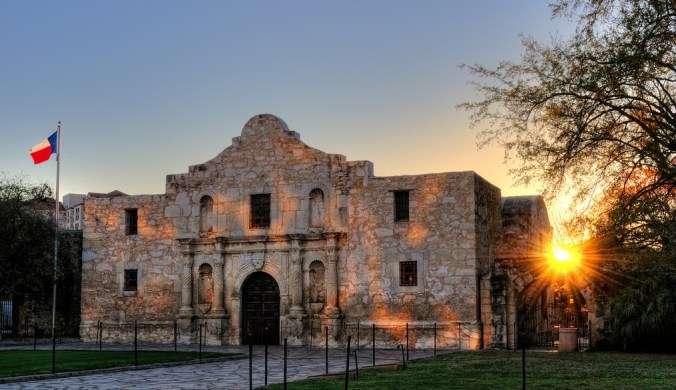
Michael West has been counting down the days of the Alamo Siege for us, which is generally regarded as beginning on February 3, 1836, and ending on March 6. That makes March 2, yesterday, the 9th day of the iconic historical event. (As Michael reminded us in an earlier post, 1836 was a Leap Year, so there’s an extra day in there.)
Reflecting on The Alamo is always appropriate, but perhaps more this year than usual. The siege of Ukraine has more than a little in common with the desperate stand of the Texans against another ruthless dictator, and the values at stake are the same. Travis, Bowie, Crockett, Dickinson, Bonham and the rest decided to stay and fight for what they believed in and also for those seeking to establish their independence, though they were outnumbered and surrounded. Ukraine’s president, Volodymyr Zelenskyy, resembles the Texas patriots in his determination to stay with his nation’s endangered citizens, because he knows his courage, sacrifice, and likely martyrdom, will be crucial in preserving his nation in the long run.
In many ways Zelenskyy resembles Davey Crockett, a celebrity known for his humor who found himself first thrust into politics and later in deadly fight that required him to rise to new heights of character.
My favorite Alamo history is “Three Roads to the Alamo” by William C. Davis, who makes the case that the mission’s story is a microcosm of the American saga. Each of the three major players in the drama, Travis, Jim Bowie and Crockett, embody an archetype of how the nation came to be. Crockett was the restless pioneer who ventured first into unsettled lands. Bowie, apart from being the bona fide frontier fighter that the public believed Crockett to be, was the land speculator, part of a group that brought business, finance, and corruption to the West. Finally, Travis was the law-maker and politician, who promised to build a civilized structure where families could thrive.
Indeed the Alamo and its participants would support a whole course that would teach young Americans about history, politics, war, human nature, ethics, economics, law and more. Teaching its many complexities and lessons would definitely be more enlightening and productive than focusing on slavery as the defining feature of U.S. culture.
Here’s Michael’s Comment of the Day on Day 9 of the Alamo story...
***
Continue reading →

 Ethics Alarms
Ethics Alarms is about ethics, not politics, but politics, especially in recent years, has increasingly been about the defining and flagging of unethical conduct. Typically elections have been an area in which both parties revel in accusing each other of dishonest and unethical conduct that they also engage in when it suits their needs; we recently saw, for example, the report on Democrats using “dark money” in the 2020 election cycle after condemning Republicans for their lack of transparency regarding campaign contributions, and either party climbing up on a metaphorical high horse over gerrymandering is laughable.
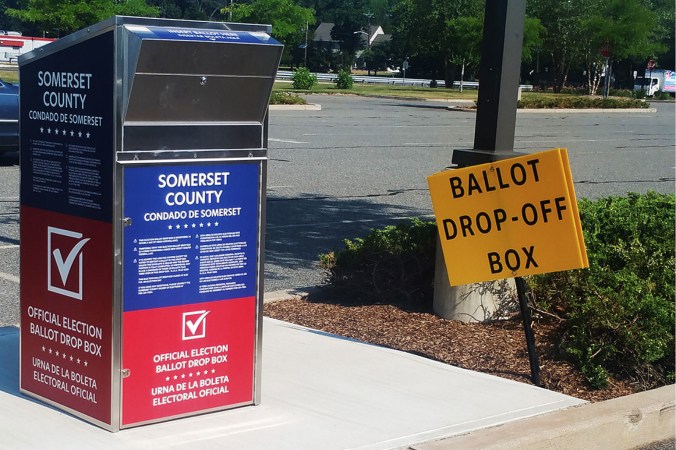
The accusations over the 2020 Presidential election are materially different, in part because 95% of the news media has taken a side the constitutes aggressive partisan activism: the claim that suspicions about the fairness and legitimacy of the vote count—in the absence of many safeguards that previous elections had made standard practice—were “disproven” and “groundless.” The use of ballot drop boxes, for example, raise the immediate specter of voter fraud, and one that is difficult to dispel. Did the actual voter drop off the ballot? Did that voter mark the ballot with his or her name on it? How secure is the box against tampering? The existence of such dubious devices in any close election guarantees public distrust, and should. Yet the news media is pushing the left’s false narrative that laws that ban drop-off boxes are “voter suppression.”
Here is Null Pointer on the matter, in the Comment of the Day on the post, “On ‘Decertification,’ Everybody’s Wrong (Or Lying)…”
One tip before you read: what is being described regarding elections is the condition Ethics Alarms dubs “Bizarro World Ethics.”
***
Let’s just look a some truths about the 2020 election and see if we cannot deduce what might be going on.
Truth #1: The Democrats got up to shenanigans in the 2020 election, and if the exact nature of those shenanigans were laid out to the people, the people would probably nearly unanimously agree the shenanigans amounted to cheating. The people would not unanimously ADMIT it was cheating, but they would know. The Democrats do not want the people on the left to know that they engaged in behavior that essentially amounts to cheating.
Truth #2: The election is not going to be undone. It was never going to be undone. Everyone who isn’t a complete moron knows it cannot be undone. Everyone who knows it cannot be undone is not going to admit that they know it cannot be undone, however, because a lot of people hate the Democrats and like to piss the Democrats off. Polling is useless.
Truth #3: The Democrats cheat. The Democrats have always cheated, at least at the regional level. Everyone on the right knows the Democrats cheat. Everyone on the left thinks a majority of people agree with them about everything, rendering cheating unnecessary. The people on the left would be shocked to find out that a huge percentage of the population does not agree with them.
Truth #4: The Republicans let the Democrats cheat. The Republicans have always let the Democrats cheat because political calculations produced an equation that said it was more politically expedient to let the Democrats cheat than to call them on it. The Democrats have escalated their cheating over time because they can. The Democrats accuse everyone else of cheating to keep the political calculations in their favor by confusing their base. Continue reading →