Hurricane Ethics: The Ultimate Betrayal

I can’t bear those photos of abandoned and abused animals, so here’s the never abused  Marshall dog, Rugby. He can trust us. (OK, we can’t always trust him, but he’s a Jack Russell. He has our informed consent to be unreliable.)

Authorities in Palm Beach County, Florida discovered dozens of dogs  left behind by owners who evacuated in advance of Hurricane Irma, leaving the pets tied up or trapped in cages or pens without any means to escape or survive the storm. Palm Beach County Animal Care and Control was able to rescue 40 such dogs before the storm struck Florida.  Director Dianne Sauve told USA Today that in cases where she can identify owners of these abused animals, she would press felony charges for animal cruelty. “There is absolutely no excuse” for leaving the dogs like that, she said, noting that there are two shelters that allow residents to bring pets along with them.

I don’t comprehend how a human being could do this to an animal that they have accepted the responsibility of caring for. The conduct is an ultimate betrayal of reliance and trust. Dogs always fulfill their ends of the ancient agreement between them and people. They provide companionship, unconditional love, support and comfort in exchange for care and shelter. Abandoning a dog like this—“Hey, what’s the big deal? They’re only animals!”—represents such a basic failure of responsibility, fairness, kindness and caring that no one who betrays a dog so heinously should be trusted in any other field of endeavor or social context. If you don’t respect the lives of animals, that’s fine, but then don’t have pets. Don’t make an animal love you, and then leave it to die in fear and pain. How hard is that? Continue reading →

Miss America Ethics: Know Your Place, Stupid Beauty Pageants!

Public policy experts all…

Your place, as anachronistic, culturally embarrassing meat shows, is to be as unobtrusive as possible while feminists and people of taste figure out a nice, fair way to wipe you off the face of the United States. But until that happens, you have a duty not to be deliberately annoying, not to wave your ignorance like it is a bloody shirt, and also not to make the undeniably stupid people who watch you even dumber than they already are.

Perhaps I am getting ahead of myself..

Two nights ago, we were treated to the finals of the inexplicably still-televised Miss America beauty pageant, the grandmommy of them all. The traditionally risible interview portion of the competition, which has for as long as there were turnips on earth featured open-ended general questions conducive to virtue-signalling blather, usually features puzzlers like (from a list of such queries)

What do you think is true beauty?

What would you do differently if you could start your life over?

Who is your greatest role model or hero?

What does it mean to be a beauty queen?

If you could be granted one wish, what would it be?

What is the greatest challenge facing humanity?

What makes you happiest?

…and so on. The idea once was that anyone with a mouth is capable of answering these questions relatively competently, and they are not traps or invitations to attract criticism. Oh, once in a millennium a finalist might answer “What would you do differently if you could start your life over?” with, “Well, I would sure skip all those years I was a crack whore,” or “If you could be granted one wish, what would it be?” by saying, “I’d wish for boobs the size of El Capitan!,”  but these are pretty easy questions to ace. They are also well within the intelligence levels and expertise of the pageant administrators, judges and the contestants, so employing them isn’t political, or divisive.

A beauty pageant should not be divisive or political, just like an NFL game shouldn’t be divisive or political. I shouldn’t even have to write that.

Miss America 2018 decided to ditch the tradition of one question per finalist in the final round of competition, and ask two questions of each. The final five questions to the last five finalists were all “serious,” we were told.

Here they are, with the answers they evoked, and my observations. Continue reading →

Morning Ethics Warm-Up, 9/12/17: Hurricane Reports, And Poor Charles M. Blow Needs A Vacation

Good morning.

1 There is supposedly a controversy regarding the on-the-spot hurricane reports: is it ethical for networks and news stations to place reporters and camera operators in mortal peril by having them scream into a mic while being buffeted by wind, rain and debris?

What’s the controversy? Of course it’s unethical. In addition to sending ridiculously mixed and self-contradictory messages—“I’m standing here in the storm telling citizens in the area that they shouldn’t be in the middle of this storm!”—it is also bad Ethics Chess. This stunt will continue until the first reporter is blown into a wall and sustains permanent brain damage, or is injured by a flying piece of debris that impales her, maims her, or cuts her in half. It is entirely predictable that this will happen eventually, and once it does, reporters will stop doing it. Why not stop this before a the inevitable tragedy occurs?

TV stations do it for ratings, that’s all. It’s great visual programming. It’s not necessary. Half the time, we can’t make out what the reporter is screaming, and what they are screaming is redundant and stating the obvious.

Apparently the first reporter to do this was Dan Rather.

Figures.

2. What is the mission of a pundit, a talking head, a columnist? It has to be—don’t you think?—to enlighten readers, to convey a constructive, useful analysis of complex issues, to reliably filter facts and controversies through a unique view-point without so completely tainting his or her output with bias that it actively misleads.

Yesterday New York Times columnist Charles Blow issued a column titled “Soul Survival in Trump’s Hell on Earth.” This was the apotheosis of the kinds of columns Blow has been writing almost exclusively now for months; at least I hope it’s that, for I can’t imagine where he goes from here. This column, like the others, is nothing, literally nothing, but a nearly fact free exposition on the theme, “I hate the President. I really do. I do so, so much. I know you do too, and if you don’t, I hate you too. ARRRGGGGHHH!”

The headline isn’t hyperbole; Blow, if he is to believed, really thinks Americans are living in Hell because Donald Trump is President. Not because there is a Great Depression hovering over the land, not because we are embroiled in a Civil War, or the existential threat of a world war, or the daily threat of an  international stand-off igniting into world-wide thermonuclear obliteration, but because a President was elected that offends the ideological and partisan sensitivities of Charles M. Blow.

Hell.

Seriously.

How can the New York Times continue to justify publishing the weekly primal screams of this pompous, doctrinaire, and now apparently deranged pundit? Exaggerating problems and pronouncing that we are all but doomed is not a service. It is harmful. The only readers who will be persuaded by a column like this are the ones who decide that something has to be done and that it’s time to build that bomb. Moreover, when a pundit reaches the stage that Blow has, where the simple act of a government not agreeing with his views and enacting policies that he does not favor launches him into hysteria, that pundit needs a vacation. Or maybe another career.

What are Blow’s arguments that justify his diagnosis that the United States is now Hell on Earth? Is it that a major party and its supporters have set out deliberately to undermine American institutions by rejecting a national election, seeking to remove an elected President by non-electoral means? Is it that the  international fumblings and ditherings of the previous administration are, as predicted, resulting in increased threats to the United States and the rest of the world? Is it that American journalism and its uniquely free news media, beyond question the app that makes democracy function, has now become, by its own abuses, so completely politicized and untrustworthy that it has become a threat to the nation, rather than its watchdog?

Nah, none of this appears to bother Blow at all; as far as I can detect, he approves of all of it. Here is his Bill of Biased Generalities that add up to Hell on Earth: Continue reading →

Morning Ethics Warm-Up, 9/11/17: Irma and Climate Change Hype; Democrats And Anti-Catholic Hypocrisy

Good Morning!

1 I’m in Boston to address a group of new admittees to the Massachusetts bar today.

2. Broadcast journalists were surprisingly restrained with Harvey, but the second major hurricane in less than two weeks is apparently too much for them, as it is for other climate change shills on social media and elsewhere (I’m looking at YOU, Jennifer Lawrence…which, I admit, isn’t all that unpleasant…)

Thus I am hearing (and reading) more and more claims that Hurricane Irma on top of Hurricane Harvey is the result of the nation’s failure to aggressively limit carbon emissions…as if two (or more) big storms in hurricane season is unprecedented, and didn’t, in fact, occur far more frequently when Al Gore was knee-high to a grasshopper. What does the cynical use of the 2017 storms as propaganda for the gullible and weak-minded tell us?

It tells us that the journalists don’t know beans about climate, weather and the science of global warming. It shows us that they are willing to mislead the public out of dishonesty, bias or incompetence, by spreading what amounts to junk science regarding an important policy issue. It tells us that they can’t resist using their position as reporters to boost what is for them a political agenda, for not one of them has first hand knowledge or genuine expertise regarding whether the earth is warming, how much, for how long, to what effect, and what will actually slow it down, and very, very few of them could explain a climate change model if their lives depended on it.

Finally, it tells us they are stupid. Every time it becomes obvious that the news media, elected officials and others are hyping this issue by using weather as an argument that climate change is occurring, they make skeptics more skeptical, and justly so. When advocates and activists resort to phony arguments and fake facts, it is  fair to assume that they don’t have sufficiently persuasive actual facts, and that they cannot be trusted not to cheat to get their way. Continue reading →

A DACA Popeye For NYT Pundit Paul Krugman

“That’s all I can stands, cuz I can’t stands no more!”

—Popeye, before downing a can of spinach and beating the crap out of someone who richly deserves it.

Readers often accuse me of being angry. I’m almost never angry about the stories I write; I just write that way. In this case, however, I am angry.

Paul Krugman, a nasty, smug, narrow-minded New York Times pundit who epitomizes the infuriatingly common progressive mindset of condescending to anyone who disagrees with his various, so often biased and ignorant positions on a plethora of issues he knows little about and understands less, used today’s op-ed column to call me a racist. Not just me, of course: all the various constitutional scholars and lawyers, elected officials—and Hillary Clinton, once upon a time—who don’t believe that the United States should be obligated to allow illegal aliens to stay in the United States however they got here, or who don’t believe Presidents should use edicts instead of the legal process described by the Constitution to pass laws, or who don’t believe it is responsible or sensible to create incentives for individuals to break our laws so their children will benefit. For they are all racists according to Krugman. And of course,the President is a racist. Krugman writes,

To yank the rug out from under the Dreamers … is a cruel betrayal. And it’s self-evidently driven by racial hostility. Does anyone believe this would be happening if the typical Dreamer had been born in, say, Norway rather than Mexico?

“Rug”: what rug? There was never a rug, just an incompetent  President who wrongly sent the false message that the United States wouldn’t enforce its sovereignty. What the “dreamers” had was a contrived loophole, and loopholes have a way of closing.

“Cruel” : enforcing a law isn’t cruel unless the law itself is cruel. A nation cannot permit illegal immigration, nor can it tolerate illegal border-crossers inflicting sentiment-inducing problems for the nation in which they have no justification for invading. Thus the law isn’t cruel.

“Betrayal” implies that someone has breached a duty on which another had a reason to rely. The United States has a duty to its citizens to enforce its laws. It owes no duty to law breakers, in this case  illegal immigrants whatsoever. If they relied on misrepresentations by cynical and self-serving politicians and activists, it is their own responsibility.

“Self-evidently driven by racial hostility.” When the progressive collective—you know, like Star Trek’s Borg—have no fair, substantive arguments left, crying racism (sexism, homophobia, xenophobia, Islamophobia…) is so routinely the default tactic that I’m amazed they can keep doing it without covering all their mirrors with towels. This is how low they have sunk: “If you don’t see it our way, you are an evil bigot.” That’s it. That’s all they have, when they run out of rhetorical bullets.

If Norwegians were sneaking into the country, using our resources,  hanging around in parking lots waiting to be hired to clean attics, mow lawns and pick fruit, while ducking law enforcement, voting illegally, forging documents, and some of them now and then raping and killing Americans after being depoter multiple times, yes, Paul, you race-baiting demagogue, this would still be happening. Continue reading →

From The Ethics Alarms “Law vs Ethics” Files: The Deadly Hexes Of Sally Quinn

In a newly published memoir, Sally Quinn, the famous journalist who married iconic Washington Post editor Ben Bradlee and became a D.C. society matron, then a religion columnist, reveals a lief-long obsession with mysticism and the occult. Ouija boards, pentagrams, witchcraft, charms, spells, seances, messages from the dead (like Ben), voodoo, the whole thing: Quinn writes that she has had an  “epiphany” revealing that “believing in magic is as legitimate as any religion or faith.”

I’ll buy that. I wouldn’t say that the next step is an application to Hogwarts, however.

So these are the people who presume to tell Americans what to think, eh? Good to know.

But I digress. In a recent Washingtonian Magazine profile contrived to puff the release of  “Finding Magic,” Bradlee’s widow says that she not only believes in hexes, she’s used them. And they work!

She reveals that, in her less mellow days, she put hexes on three people who promptly wound up having their lives ruined, or ended.

The first, cast in 1969, was spurred by old-fashioned jealousy. Some exotic beauty at a Halloween party inspired lust in Quinn’s beau at the time—and then killed herself just days after Sally cast her spell.

Her second victim was Clay Felker, the longtime editor of New York magazine who oversaw a brutal profile of Quinn in 1973, just before her catastrophic debut on the CBS Morning News. Quinn hexed Felker not long after flaming out at CBS and returning to Washington. “Some time afterward, Rupert Murdoch bought New York magazine in a hostile takeover, and Felker was out,” she writes. “Clay never recovered professionally. Worse, he got cancer, which ultimately caused his death.”

Target number three: a shady psychic who, the autumn after Quinn Bradlee was born, ran afoul of Sally’s maternal instincts. The woman dropped dead before year’s end.

This raises a classic ethics question that I nearly posed today as an Ethics Quiz. I didn’t, because I know the answer and have no doubts about it. (If it’s an ethics quiz, I at least have doubts.) The question would have been:

Ethically rather than legally, is there any difference between Sally Quinn and a murderer?

The answer is no.

I’d say that the first two victims make her the ethical equivalent of someone who is guilty of manslaughter, and the last one, after her first two hexes led to her targets’ deaths, was, again ethically rather than legally, premeditated murder.

Sally says that after the psychic dropped dead, she swore off her Death Hex. That’s admirable. The fact remains, however, the while believing an instrumentality would lead to harm when employed against specific individuals, she employed it, got her desired results, and believed that she was the cause of their subsequent deaths. She also doesn’t express any remorse or regret. Continue reading →

Comment Of The Day: “Deferred Action for Childhood Arrivals (DACA) Ethics”

I am very grateful for veteran commenter Extradimensional Cephalopod clarifying explanation regarding how and why adversaries on the “dreamer” issue so often talk past and around each other, with never the twain meeting. The first I heard of the “Honor vs. Compassion schism” was in this 2009 essay in The New Criterion by James Bowman. I should have referenced it before. He wrote in part,

Compassion is a virtue, but it is a private, a face-to-face virtue which almost invariably ceases to be one when it takes on a public dimension. An act of compassion by a government, in the full glare of publicity, is not a virtue but a bid to be given credit for moral superiority.

Bingo.

Here is Extradimensional Cephalopod‘s Comment of the Day on the post,Deferred Action for Childhood Arrivals (DACA) Ethics:

It’s a classic honor versus compassion schism. Honor represents orderly good, enforcing consistency and stability so that society may benefit from people knowing where they stand. Compassion represents chaotic good, making exceptions and doing things that cannot be expected or required so that society can benefit from such kindness. Both are necessary, but they must be balanced against each other.

Because your position is based on honor, and makes sense in that context, it’s impossible for people to rebut it in those terms. Instead, they assert that the harm allowed by not extending compassion outweighs the benefits provided by honor, or they reject the concept of honor entirely. They don’t really understand honor or the harm done by dismantling it. Maybe they never noticed the benefits of honor, and only saw its negative effects, or they were oppressed by an ill-conceived brand of honor. Continue reading →

Morning Ethics Warm-Up, 9/7/2017: Compromise, Competence, Verrit, A Congressional Jerk, And Democratic Crooks Don’t Matter…

Good Morning!

1 President Trump stunned the political world and particularly the left’s “I hate him” news media by crossing party lines and cutting a debt deal with Democratic leaders in defiance of his own hyper-partisan party. One reason they were stunned is because this is what competent Presidents do and are supposed to do in order to govern, and we have just finished eight years with a previous President who was unwilling and incapable of doing it.

This single episode doesn’t make Trump a competent President, but it does show that he is competent in at least one aspect of democratic leadership (Obama was competent at exactly two: appearing Presidential and speaking coherently), and has some guts. The demonstrated ability to negotiate and the willingness to act in the teeth of furious opposition were two characteristics that the advocates of his candidacy cited as justification for electing him.

It is also dawning on some that the structure of the DACA executive order may well be to fashion the measure as a bargaining chip to be cashed in later. This is also the kind of thing competent leaders do.

2. There is a new website called Verrit, which appears to be an openly, proudly, left-biased news source which purports to “verify” news stories, obviously based on its own progressive world view. Verrit founder and CEO Peter Daou told the news media,

“We’re in a time now where you just no longer trust anything that you’re reading,” Daou said. “Facts are now in question. Reality is now in question. So we want to do something where we rigorously vet these facts and we actually stand by our research and put an authentication code on every fact that we put up.”

And what qualifies Verrit as a fair and objective “authenticator”? Apparently it is the virtue of being hard-progressive and anti-conservative to the bone. Here is a recent Verrit collection of its “cards”:

Continue reading →

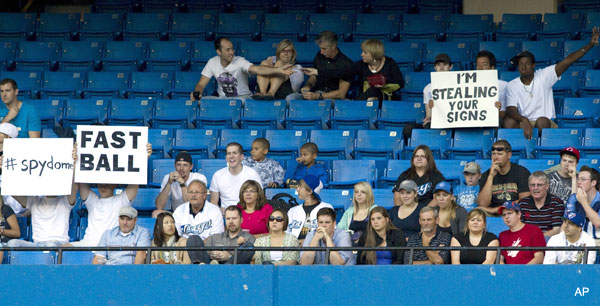
Ethics Alarms Baseball Ethics Special Report: The Boston Red Sox, Sign Stealing, Technology, And Cheating [UPDATED]

[I got the news about Major League Baseball’s announcement that the Boston Red Sox had admitted that some of the team’s employers and players had engaged in illegal sign-stealing about an hour before the Sox-Blue Jays game was scheduled. My intent was to write the post about it last night after the game. The game, however, went 19 innings and lasted 6 hours. (The Sox won, and absent this scandal, it would have been a big news story itself, one of the most important victories of the year and one that set several team records.) So the post didn’t get written, and believe it or not, I have occasional priorities and commitments that take precedent over my profit and income free ethics blog. Thus I consider the multiple e-mails and Facebook messages I have received accusing me of ducking the issue less than amusing, an unwarranted attack on my integrity. To all of those individuals, most of whom barely read the news reports, I say, “Bite me.”]

Yesterday afternoon the New York Times broke the following story, which reads in part:

Investigators for Major League Baseball have determined that the Red Sox, who are in first place in the American League East and very likely headed to the playoffs, executed a scheme to illicitly steal hand signals from opponents’ catchers in games against the second-place Yankees and other teams, according to several people briefed on the matter.

The baseball inquiry began about two weeks ago, after the Yankees’ general manager, Brian Cashman, filed a detailed complaint with the commissioner’s office that included video the Yankees shot of the Red Sox dugout during a three-game series between the two teams in Boston last month.

The Yankees, who had long been suspicious of the Red Sox’ stealing catchers’ signs in Fenway Park, contended the video showed a member of the Red Sox training staff looking at his Apple Watch in the dugout. The trainer then relayed a message to other players in the dugout, who, in turn, would signal teammates on the field about the type of pitch that was about to be thrown, according to the people familiar with the case.

Baseball investigators corroborated the Yankees’ claims based on video the commissioner’s office uses for instant replay and broadcasts, the people said. The commissioner’s office then confronted the Red Sox, who admitted that their trainers had received signals from video replay personnel and then relayed that information to Red Sox players — an operation that had been in place for at least several weeks.

As reported by ESPN, Baseball Commissioner Rob Manfred said in a statement,

“We actually do not have a rule against sign-stealing. It has been a part of the game for a very, very long time. To the extent that there was a violation of the rule here, it was a violation by one or the other [team] that involved the use of electronic equipment. It’s the electronic equipment that creates the violation. I think the rule against electronic equipment has a number of policy reasons behind it, but one of them is we don’t want to escalate attempts to figure out what a pitcher is going to throw by introducing electronics into that mix.To the extent there was a violation on either side, we are 100 percent comfortable that it’s not an ongoing issue, that if it happened, it is no longer. I think that’s important from an integrity perspective going forward.”

This is a complicated story, and part of not one complicated ethics category, but several: technology ethics, baseball ethics, cheating, and general ethics. In the interests of clarity, I’m going to cover the story in a series of short observations, each with a heading. At the end of this post, I have posted a long published essay I authored about baseball ethics within the culture of the game. Those who are not familiar with these issues, which are fascinating, might want to read that first. it is helpful background information.

Points and Observations:

  • Traditional sign-stealing in baseball is not regarded as cheating. This seems counter intuitive because of the word “stealing.” Sign-stealing refers to teams decoding the signals given by the catcher to the pitcher (regarding what kind of pitches to throw and where ), and the coach or the dugout to a batter or baserunner (in bunt and hit-and run plays). Theoretically, knowing the other team’s signals provides an advantage, as to a batter who knows that the next pitch will be a curve rather than a fastball. Usually, signs from the catcher to the pitcher are in jeopardy when there is a runner on second base. He can see the catcher’s signs as well as the pitcher can. Catchers use finger-signs in various combinations to ask for various pitches, and position their gloves to indicate where they want the balls thrown. If the runner at second can signal to the batter what the catcher has told the pitcher to throw, the batter may have an advantage.

This is why catchers often go to the pitching mound when a runner is on second base. They change the signs. The second baseman will often join them, because it is his job to know what pitch is being thrown so he can signal (usually behind his back, using his hand) to his team’s outfielders. An outside fastball makes it unlikely that the batter will pull the ball, for example.

Sign-stealing on the field, using just eyesight and hands, is what players call “the game within the game.” Joe Girardi, the Yankee manager, said in an interview yesterday that he just assumes every team is trying to steal signs, whether they are or not. Continue reading →

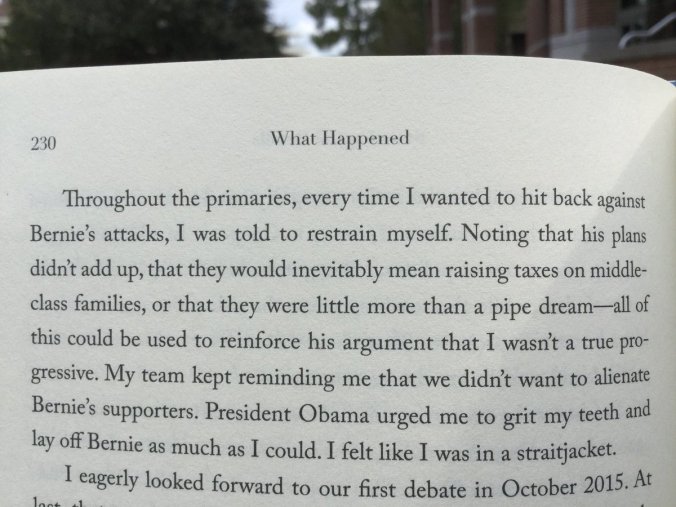
Ethics Quote Of The Month: Hillary Clinton In Her Upcoming Book, “What Happened”

You see the quote above. This is a section of one of the excerpts being doled out to the media and public to build interest in Clinton’s latest book. In the excerpt she blames Bernie Sanders, among others, for her defeat, saying that his attacks against her during the primary caused “lasting damage” and laid the foundation for “(Donald) Trump’s ‘Crooked Hillary’ campaign.”

Observations:

1 As with her earlier excerpt about how she wishes she had acted more assertively when Donald Trump was “stalking her” during a debate, Clinton displays the opposite of leadership instincts here. Although she was the one offering herself as the leader of the free world, she whines that she was rendered powerless by the advice of others and the recommendation of President Obama. Saying that she felt that she was “in a straitjacket” is simply admitting that she was indecisive and accepted the judgment of others over her own. However, that decision was hers; she was not in a straitjacket, and she is accountable for the ultimate decision to “lay off Bernie.” She can’t credibly blame anyone else.

2. Bernie Sanders was as inoffensive and respectful as opponent as Hillary could have possible drawn for the Democratic Party nomination. His obvious reason for running was to get a national platform for his far-left, Socialist positions. He was too old, he was eccentric, and he wasn’t even a Democrat. Like Barack Obama, who also ran against Hillary believing that he had no chance, Hillary’s lack of charisma, chilly public persona and inherent untrustworthiness suddenly made Sanders’ underdog candidacy viable. Nonetheless, as Ethics Alarms discussed during the campaign, Sanders never behaved as if he was committed to winning. Most remarkably (and unforgivably for his supporters), he gave a pass to Clinton on her e-mail server scandal, saying more than once that he didn’t care about her “stupid e-mails.” Since Clinton was lying about, double-talking around, spinning and ducking the issue almost daily, this was a gift that no other serious candidate would have given her. Yet she’s blaming Bernie now for not being even less competitive.

Incredible! Continue reading →