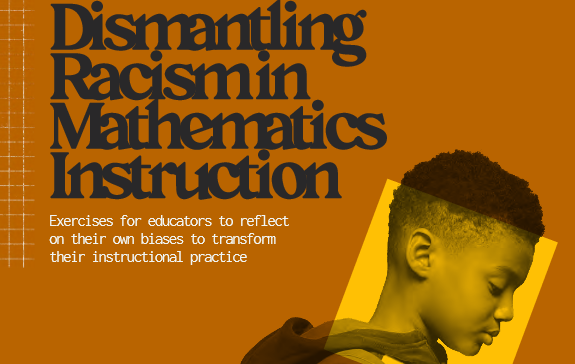
Guest Column: Mathematics As Indoctrination

Racism mathematics

by Mrs. Q

[This, a comment in last Friday’s Open Forum, which followed upon Steve Witherspoon’s directing our horrified gaze to Oregon’ teaching program that seeks to undo ‘racism in mathematics.’ The links are here, the here, and here, is presented as a Guest Column, not Mrs. Q’s first.]

This reminds me of Erika Mann’s discussion of mathematics education (Völkisches Rechnen or people’s arithmetic) under Nazi rule in the 1930’s, in her book School for Barbarians. Here’s an example (page 67):

“An airplane flies at the rate of 240 kilometers per hour to a place at a distance if 210 kilometers in order to drop bombs. When may it be expected to return if the dropping of bombs takes 7.5 minutes?“
-From National Political Practice in Arithmetic Lessons.

A question like this may not initially point to a scholastic propaganda problem until the other questions come into play, questions like:

  • “What was Germany’s population loss due to the Versailles Treaty?” What is the load capacity of four gas bombs?”
  • ” How many people can fit into a bomb shelter?”
  • “What percentage of the German population is home to “alien” Jews?”

It suddenly becomes more clear that these questions are preparing these kids for war…and compliance with the state.

Continue reading →

Ethics And The Never-Trumpers…

Lincoln Project

The Lincoln Project may have helped defeat Donald Trump; who knows? From the beginning it appeared to be a spiteful backlash by sore losers, class bigots and establishment bitter-enders who, like fellow Never-Trumpers George Will, the Bushes, Jennifer Rubin and Bill Kristol, made cutting of their noses to spite their faces into a declaration of virtue. Better to see the policies and principles one had spent a career opposing be inflicted on the nation for who-knows-how-long than to put up with a conservative President whom they couldn’t bear rubbing elbows with at a wine tasting.

The ethics of the Lincoln Project seemed shakier the more we learned about their founders and supporters. The most prominent of them, lawyer George Conway, felt it was acceptable to publicly insult and attack his wife Kellyanne Conway’s boss, for example, displaying the spousal concern and loyalty of a praying mantis. Not surprisingly, this public disloyalty combined with absentee parenting tore the family apart, leading to the Conway’s teenage daughter publicly insulting both parents and playing out her emotional crisis on social media. This, in turn, resulted in both Conways removing themself from political life in the middle of the campaign when they were needed most by their respective warring GOP factions. Good job!

Ah, but as Al Jolson liked to say, “You ain’t seen nothing yet!” The Lincoln Project’s leaders, who supposedly objected to Donald Trump because of his deficits of character, soon entered the Pot-Calling-The-Kettle-Black Masters in ethics hypocrisy.

First: John Weaver,a co-founder of the Lincoln Project, was accused by 21 men of sexually harassing them for years with unsolicited and sexually provocative online messages. His creepy solicitations included those he sent to a 14-year-old boy, asking salacious questions about his body while he was still in high school, then more suggestive comments after he turned 18.Weaver, who is married and has children, sent overt sexual solicitations to at least ten of the men, offering professional and personal assistance in exchange for sex. Last month, Weaver admitted his “inappropriate contacts” while playing the “deeply closeted” gay man card, and announced that he would not return to the Lincoln Project. Weaver had helped run Trump-Hater John McCain’s Presidential campaigns in 2000 and 2008 and Never Trumper John Kasich’s campaign in 2016.

Continue reading →

Ethics Cleansing, 1/27/2021: I’m Afraid This Edition Exceeds The Limit For Disturbing Stories…

Horrible text message

As a prelude, I don’t know why some commenters are arguing that the 1876 William Belknap impeachment trial is a valid precedent for trying a private citizen no longer in office on a charge that has no other purpose but to remove that individual from his or her federal office. It’s just a bad argument, which is why Belknap has only been raised by desperate anti-Trump zealots. As I pointed out in the comments, an unconstitutional act doesn’t change the Constitution. There have been many, many unconstitutional actions by our government that were allowed to occur in the past (President Jackson’s defiance of the U.S. Supreme Court to forec the Trail of Tears is an especially egregious one.\); they still can’t be cited as proof that the actions were Constitutional, or precedent for violating the Constitution again. Balknap, who had resigned as Grant’s Secretary of War just as he was about to be impeached by the House, submitted to the Senate’s unconstitutional trial. I have always assumed this was because he was certain that he would be acquitted, so he could later claim innocence. (He was incredibly guilty.) Since he was acquitted, there was no occasion to challenge the trial, the issue being moot.

The entire system was in chaos in 1876; if the Belknap trial is binding precedent that a private citizen can be tried by the Senate to remove him from office when he isn’t in that office, why not make the same claim about the unconstitutional deal between Republicans and Democrats to install the loser of the 1876 Presidential election (Hayes) in the White House in exchange for removing federal troops from the former Confederate states?

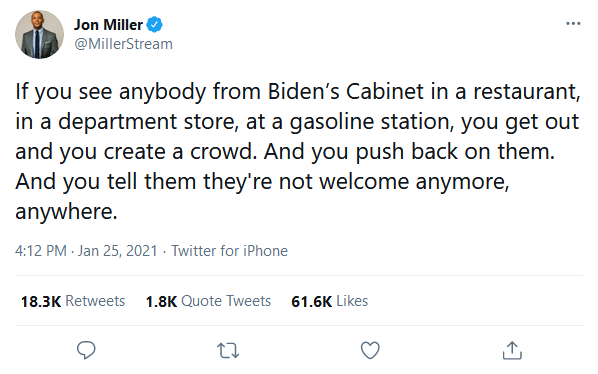
1. An example of ethical trolling, I think:

Ironic Tweet

Miller is getting all sorts of outraged responses from critics online who seem to have missed the critical fact that he was just quoting Maxine Waters’ call for harassment of Trump administration officials. Normally I regard deliberate posting of positions one doesn’t believe as unethical unless the poster makes the sarcasm or irony obvious. This one is obvious, unless the reader wasn’t paying attention to how irresponsible and vicious Democrats were in the past four years, and if the such a reader was that ignorant, he shouldn’t be involved in the discussion at all.

Continue reading →

Tales Of The Great Stupid: Wow…Who Could Have Seen THIS Coming?

Children are being bombarded by media and social media propaganda asserting that a vast number of people are trapped in bodies having the “wrong” sex organs, and celebrating the “T’s in the LGBTQ+ interest-group-of-convenience as the cool new martyrs. Thus an increasing number of these children convince their woke and irresponsible parents, and doctors who would rather be politically correct than “do no harm,” to divert their fates from the natural biological path to something else, because everybody is doing it, or everybody is saying it’s the right thing to do. It shouldn’t take much to figure out this is a terrible trend based on terrible reasoning, but there are so many such trends and ideas flourishing now that it’s hard to bat them all away.

And so we have the case of 23-year-old Keira Bell in Great Britain, who is suing a National Health Service gender clinic that she says should have challenged her decision to transition to male as a teenager. A tomboy as a child, Keira says her determination to switch gender gradually built up as she found out more about transitioning online, and “one step led to another.”

Continue reading →

Comment Of The Day: “Bizarro World Ethics: A Vicious Young Jerk’s Unethical Act Is Celebrated …..Part II: The Times And Its Readers

new yorktimes

Arthur in Maine earned the second Comment of the Day to end the year with his observations on the New York times aiding and abetting the savaging of Mimi Groves. Here is his COTD on the post, “Bizarro World Ethics: A Vicious Young Jerk’s Unethical Act Is Celebrated And His Victim Vilified In A Cautionary Tale Of What Happens When Society Allows Its Values To Be Turned Inside Out. Part II: The Times And Its Readers”:

Let me go further into my comment to Part 1, which boiled down to “the NYT acted most unethically of all.”

I chose not to expound then, anticipating this post, but I will now.It’s likely – indeed, even essential – to this story that the pitchfork-and-torches mobs on social media have a larger footprint than the New York Times. But THIS Facebook group, THAT Instagram “Influencer”, THOSE Twitter feeds – tend to be narrow channels of like-minded myrmidons (this is what social media has done to society, more effectively than any propagandist ever could: separated culture into armed camps).

Continue reading →

Bizarro World Ethics: A Vicious Young Jerk’s Unethical Act Is Celebrated And His Victim Vilified In A Cautionary Tale Of What Happens When Society Allows Its Values To Be Turned Inside Out. Part II: The Times And Its Readers

Mimi

In Part I, describing the horrific personal destruction of 18-year-old Mimi Groves (above)–the antiseptic term “unethical” does not adequately convey the pure viciousness and wrongfulness of the act—I attempted to clarify what the entire scenario represents, a near complete distortion of values and ethical norms with ominous implications. I mostly left out the enthusiastic participation of the New York Times in this destructive process, first, because it was not directly involved in Jimmy Galligan’s hateful and pernicious conduct, and second, because of space considerations. Thus we have Part II.

The Times signaled its sentiments and objectives in the headline of its feature, written by reporter Dan Levin: “A Racial Slur, a Viral Video, and a Reckoning.” “Reckoning” means, in this context, a settling of accounts, a judgment, or earned punishment. In the view of the Times writer and the editors who allowed it to be published, Mimi Groves was justly punished by her black classmate, who plotted–plotted is a fair description—to derail her education and future prospects, and did so. What was the conduct that earned the “reckoning”? Groves used a word, in a general context, that the social justice establishment has ruled, on its own authority, can never be uttered for any reason, or published in print—unless the individual responsible is black, in which case it may be rude or less than desirable, but otherwise it’s OK.

At the time the word “nigger” was used by Groves in a three second video on social media, and today, popular songs embraced by her age group and peer group used the same word repeatedly, and made millions of dollars as a result. At the time the word “nigger” was used by Groves in a three second video on social media, popular movies showed black characters calling other black characters that same word in jest, or affectionately, or for shock value.The actors playing those characters, notably Samuel L. Jackson, who has earned a bundle as the spokesperson for a major credit card,while using teh word “nigger” more times on screen that any actor in film history, have not faced any “reckoning.” The screenwriters who put those words in his mouth faced no “reckoning”; the directors who permitted the dialogue to be read and the studios that sent the wave of “niggers” into theaters and streaming services faced no “reckoning.”

Just this month, Netflix premiered an adaptation of August Wilson’s play “Ma Rainey’s Black Bottom,” directed by acclaimed social justice warrior director George C. Wolfe, an African American. When a stream of “niggers” was unleashed about ten minutes into the fim, never to stop, I was genuinely confused. How could this be, when I have a file of professors and teachers who faced sanctions, protests, suspensions, and professional destruction, not by referring to any black individual as a nigger, but by using the word in the context of discussing legal, ethical and cultural implications of language.

Yes, I was confused, and I am a lawyer, a writer, an ethicist and a teacher with more than four times as much experience in life as Mimi Groves when, as a child, she mistakenly thought a casual use of the word in a social media message wouldn’t upset anyone, much less put a dedicated life assassin on her trail.The the New York Times holds that Mimi deserved her “reckoning,” and made sure that if anyone inclined to tar her as a racist unfit for human association on this woke culture we are breeding didn’t know that she had to be punished and why, a major feature in the nation’s most read, circulated and quoted newspaper would spread word of her disgrace. The paper’s verdict is clear: Jimmy Galligan struck a blow against “systemic societal racism.” He’s a hero, even though literally nothing he did was ethical, fair, or just:

Continue reading →
Morning Ethics Warm-Up, 12/29/2020: Another Dark Date For Ethics

Becket-murder-2

December 29 is one of the bad days in ethics history, beginning with the 1170 murder of England’s Archbishop Thomas Becket as he knelt prayer in Canterbury Cathedral by four knights of King Henry II. The knights were not explicitly ordered to kill Becket, the King’s friend who had become a problem when he took his role as Archbishop of Canterbury to be a calling to defend the Church against royal efforts to constrain its power. Instead, Henry made his wishes known by making the public plea to his court,

“What a parcel of fools and dastards have I nourished in my house, and not one of them will avenge me of this one upstart clerk.”

This is often quoted as “Will no one rid me of this troublesome priest?” Either way, the idea of such an oblique request is to relieve a leader of responsibility for the actions of subordinates, giving the leader plausible deniability. It didn’t work for Henry, but it may have worked for, for example, President Obama, whose Internal Revenue Service illegally sabotaged Tea Party groups in advance of the 2012 election, greatly assisting Obama’s efforts to defeat challenger Mitt Romney. In truth, when a powerful superior makes his or her desires known, it may as well be an order. An order is more ethical however, because it does not require the subordinate to take the responsibility upon himself.

1. But The worst example of a U.S. ethical breach on this date is the Massacre at Wounded Knee in 1890, when the U.S. Cavalry killed at least 146 Sioux at the Pine Ridge reservation in South Dakota. It is definitely the most people killed because of a dance: the government was worried about a growing Sioux cult performing the “Ghost Dance,” which symbolized opposition to peaceful relations with whites, and was seen as inciting violence. On December 29, the U.S. Army’s 7th cavalry surrounded a band of Ghost Dancers under the Sioux Chief Big Foot near Wounded Knee Creek and demanded they surrender their weapons. A fight broke out between an Indian and a U.S. soldier, a shot was fired, and an unrestrained massacre followed. Of the estimated almost 150 Native Americans were killed (some historians put this number at double that number), nearly half of them women and children. The cavalry lost only 25 men. Many believe that the tragedy was deliberately staged as revenge for Custer’s Last Stand 14 years earlier, which seems like a stretch to me.

Continue reading →

Monday Morning Ethics Warm-Up, 12/28/20: Happy Birthday, Woodrow Wilson!

2020 end

As 2020 staggers to a conclusion, Ethics Alarms wants to express its gratitude to the core of devoted Alarmist commentators who kept the dialogue going during what is always an annual cratering of blog traffic. I appreciate it. I also appreciated the many kind holiday wishes, in what has been a muted Christmas for the Marshalls for a number of reasons I won’t bore you with.

In case you were among the missing, I draw your attention to…

…among other hopefully edifying and entertaining posts.

1. After signalling otherwise or perhaps just trolling, President Trump signed the truly awful pandemic relief and omnibus spending bill, really sending the national debt into orbit. One theory is that doing so was necessary to avoid a Democratic sweep of the two Senate seats up for grabs in Georgia. I will file the event as one more car on the Wuhan Virus Ethics Train Wreck, and one that will do more damage in the long run than most of them.

2. In Nevada, Gabrielle Clark filed a federal lawsuit against her son’s charter school last week for refusing to let him opt out of a mandatory class that promotes anti-white racism. It claims that Democracy Prep at the Agassi Campus forced William Clark “to make professions about his racial, sexual, gender and religious identities in verbal class exercises and in graded, written homework assignments,” creating a hostile environment, and subjecting he son’s statements ” to the scrutiny, interrogation and derogatory labeling of students, teachers and school administrators,” who are “still are coercing him to accept and affirm politicized and discriminatory principles and statements that he cannot in conscience affirm.” The lawsuit includes nearly 150 pages of exhibits documenting the curriculum in the graduation requirement “Sociology of Change,” which promotes intersectionality and critical race theory, in breach of what was promised when the Clark’s first sent their son to the school.

Continue reading →

Comment Of The Day: “The Throw-Away Puppy”

puppy-for-christmas

Here is JP’s Comment of the Day on the post, “The Throw-Away Puppy”

It seems like every holiday I see a post that is similar to this. Don’t give a new dog for Christmas. Don’t give rabbits/ducks for Easter. Don’t get turkey’s for Thanksgiving (apparently a thing out here in rural Missouri). So when my oldest son asked for a turtle for his birthday this year, I immediately said no. Of course, in his mind, this wasn’t fair. His younger brother had bought a beta fish with his birthday money. As such he thought he deserved something similar. I told him there was a big difference between a fish that lives for a few years at most and a turtle that can live up to 50+ years. If he was getting a turtle, he was in for a life-time commitment and he was too young to make that decision (at 37 I think I’m too young to make that decision).

Too many people live in the now. They want instant gratification. When that gratification wears off, they tend to move on to the next thing. This is the main reason why pets make terrible gifts: they are long term commitments. For context, lets look at how long.

The average life of a dog and a cat depending on a breed is 12 years. This assumes they are healthy for most of their life. For a horse 25-30 years. Rabbits are 10 year commitments. Hamsters and Guinea pigs fall into the 2-5 year range. Snakes, depending on the breed can live between 15-20 years. Goldfish are a lot harder to tell. Though most don’t live past a year, many have lived for decades with the oldest one in captivity living to 43. The lifespan off all of these pets illustrates the same thing: if you take on the responsibility, you should realize you are in it or the long haul.

Continue reading →

Comments Of The Day, As “The Monday Friday Open Forum” Became The Ethics Alarms Mailbag

Mail

For some reason, the most recent Ethics Alarms open forum attracted quite a few ethics quandaries for discussion. Here are two I thought were especially noteworthy…first, from The Shadow, which is ironic, since I thought The Shadow was supposed to know what evil lurked in the hearts of men…

This is something that happened in my neighborhood (that I’ve only lived in for 2 months, so I don’t know anyone involved) and I was just an interested observer.

A family had pickets knocked off their fence multiple times in the past few months, so they put up a security camera. The next time it happened, the camera caught teenagers ramming and kicking the fence, then running across the road into the back yard of a house. An older couple owns the house, but the have teenage grandchildren living with them. This family posted the video on the neighborhood Facebook group asking for advice; they didn’t want to go talk to the people across the street because “they didn’t want to start trouble”. Some suggested going across the street to talk to them anyway, some suggested calling the police. Another neighbor ended up talking to the grandparents and It turns out the culprits were friends of the teenagers living with them.

I don’t know the final outcome, but there are many good ethics angles here:

1) Should this family have posted the video to Facebook?
2) What should they have done with the information about the teenagers across the street?
3) Should the 3rd party have stepped in to talk to the people across the street (does “duty to confront” apply here)?
4) Once it was known the culprits were friends of teenagers living there, what should the grandparents have done?

Any other good ethics angles here?

I think this is a pure Golden Rule situation, which means not posting the video to Facebook, and not going to the police, at least initially. You have the courtesy of going to the elderly couple, and ask if they will take care of the issue by contacting their grandkids’ friends’ parents. If they won’t do anything, then the police are the next stop. One must do what is necessary to get compensated for the property damage, while doing as little damage to everyone else as possible.

Now here’s ethics puzzle #2, from Sarah B.:

Continue reading →