Comment Of The Day: “Ethical Quote Of The Week: Donald Trump”

Just as Barack Obama’s despicable quote came to my attention shortly after a post directly relevant to it, James Hodgson’s comment on that post was perfectly timed as further exploration of my follow-up post, which I put up seconds before reading what James had written. It’s fate! Kismet! I couldn’t resist making his fortuitous observations relevant to two posts, one of which he hadn’t read yet, a Comment of the Day.

***

“his admirers…regard his exaggerations, careless misstatements, and counter-factual pronouncements as trivial compared to his willingness to say out loud what other politicians and elected officials will not.”

Certainly the Leftist media will never give Trump credit even for just saying what everybody already knows about polls and how they are used.

Like many conservatives who ultimately supported Trump in 2016 (and again in 2020), I did so not because he was my first (or even second) initial choice but because he was the only candidate who seemed to grasp the degree of popular discontent with the Left, its consistent march toward socialism, and their impatience with the GOP’s tepid response to these efforts.

He was the only candidate who, although not a hard-core conservative himself, understood conservatives’ continuing (and expanding) dissatisfaction with the establishment GOP for hijacking the “Tea Party” movement and quietly smothering it to death, and the rise of the neocons, who like the country-club RINOs aren’t trying to conserve anything. Conservatives were (and are) well and truly pissed about widespread federal misfeasance and overreach, and Trump assured conservatives that they were right to be pissed. Then he told them what he intended to do about it. He was as successful as could be expected after being opposed and vilified 24/7 for his entire term by the united forces of the Left.

Continue reading

And The July 5 Comment Of The Day Trifecta Concludes With Arthur In Maine’s Delicious Analysis of “Your 4th Of July Ethics Quiz: Food Racism?”

鮟肝

Finally, in the last of today’s opening trio of outstanding and varied Comments of the Day, Arthur in Maine, whom I did not know until this comment was a former chef, whips up a filling and pleasurable examination of of the issues raised in “Your 4th Of July Ethics Quiz: Food Racism?”...

There’s no longer any doubt in my mind: people are actively looking for ways to be offended. In the case of BLM, for example, the belief is clearly simple-minded rage at the rank-and-file level, but among those further up the chain it’s obviously about power and the grift. Calibrate your outrage correctly, and one can lead quite a handsome life.

Racism (and its first cousins misogyny and homophobia) is the perfect charge to level to achieve this (lucky souls like Lori Lightfoot can, and do, score the trifecta by claiming all three).

As a recovering professional chef (I haven’t lifted a pan for a paycheck in more than 30 years, and still miss it almost every day) I can tell you that serious pro cooks may be able to wow you with the complexity of their offerings. But the foods most of them prefer to eat generally trace back to poverty foods – those developed in poor cultures, where most people ate what the rich folk wouldn’t.

Most Americans, regardless of when or how their ancestors first showed up, simply don’t understand that in most other parts of the world NOTHING goes to waste. We give our scraps to cats and dogs. But very few other places do that. Thus, it’s little wonder that someone figured out a way to make duck feet in a way that actually tastes good. For the record, I would order those in a heartbeat, with full knowledge, just to try them! But in a place like China centuries ago, wasting protein like that was unthinkable, so you did what you could to make them tasty and that’s what’s for supper.

This doesn’t mean I like everything – not by a long shot. I find tripe revolting, and it’s extremely popular in first-world France. As a true afficionado of sushi, I’ll try anything – and just about the only thing I’ve ever been horribly disappointed in at a great sushi bar was ankimo – which is steamed monkfish liver. [Above] It was described to me as the “foie gras of Japan,” and I can see why. But it was still vile. I like foie gras, but not when it’s overlayed with the aroma of a cod-liver-oil-based ointment my mother used to use on us when we were small.

Some cultures happily eat grubs – no thank you. Others eat various insects; again, I’ll pass, but you’re welcome to my helping. The fact is that every culture has its culinary oddities and we’ve all got different tastes. This doesn’t mean our distaste for something is racist. It merely means that it’s so far outside of our culinary comfort zones that we just can’t get our heads around the idea. Many cultures find the American fondness for huge slabs of meat served up with starch baffling, for a variety of reasons.

This, by the way, extends beyond ingredients. There are those only too happy to make accusations of “cultural appropriation” when it comes to food. It is not. When I cook Chinese or Thai or Indian or Mexican food, I do so as a student, not as an appropriator. I do it because I’ve had the good fortune to taste these wonderful cuisines done properly. I want to understand how they’re done, partly because cooking professionally makes you fascinated by differing techniques and ingredients, and partly because I love to eat them and access to these foods locally, prepared by those from that region, is sharply limited. In the case of Chinese, especially, Chinese-American food has been so heavily adapted to North American tastes that it bears little resemblance to the real thing – and almost all of the adaptation has been done by Chinese cooks and restaurant owners. I really want to try the real thing.

Far as I’m concerned, when I make up a dinner of low-country shrimp and grits, the last thing on my mind is contempt for the poor Blacks for whom this was subsistence food. Rather, I’m thinking “this is absolutely ingenious. They took cheap stuff (grits) and free stuff (shrimp) and whatever else they had lying around and made it transcendent!” For me to cook it is not appropriation – it is the deepest possible respect.

I could make a similar argument with music, but I think you folks get my drift. This is “The Great Stupid” and “A Nation of Assholes,” to use Jack’s terms, colliding head-on to form a Great Nation of Stupid Assholes. We’d better come up with a way to pull out of this dive, and quickly.

A Comment Of The Day Trifecta! First Up, Curmie’s COTD On “Independence Day Ethics Fireworks, July 4th, 2021: ‘The Stars And Stripes Forever,’ And Other Matters”…

Tenure

In yesterday’s Independence Day post, I challenged readers to present “an honest, factual, non-ideological defense” of the University of North Carolina’s decision to award a tenured faculty position in journalism to to New York Times race huckster and “1619 Project” propagandist Nikole Hannah-Jones. I did not expect a serious response, much less a persuasive one, as the challenge was, in my mind, akin to challenging someone to translate the Zodiac Killer’s code.

But reader Curmie has lived and worked in the world of academia whereas I only visited periodically, and understands why these things happen, and why, after a certain point in the process, have to happen. Here his his Comment of the Day on “Independence Day Ethics Fireworks, July 4th, 2021: ‘The Stars And Stripes Forever,’ And Other Matters,” Item #2.

I’m not sure if I can offer a “non-ideological defense” of the UNC Trustees’ reversal in the Hannah-Jones case. But I can say I’m one of the few people in the country who sees the decision as neither a triumph nor a capitulation. And I suppose that as one of the more liberal of your readers and as a veteran of three decades in tenure-track and tenured positions at colleges and universities, I might be the logical… erm… advocate?

So… Unless things work fundamentally differently in North Carolina than in the state university systems with which I’m more familiar, there are some things the average person might not completely understand.

Continue reading

Comment Of The Day: “Comment Of The Day: ‘Unethical Tweet Of The Month: The Portland Police Bureau'”

Police Trust

Woke up with a bang this morning at 4:45 remembering that I hadn’t posted this Comment of the Day on this Comment of the Day, (by Extradimensional Cephalopod ) regarding the Ethics Alarms commentary about the Portland police staving off another police shooting riot with a tweet saying, in essence, “It’s OK, the guy we shot was white!”

Here it is, by Humble Talent, who included a wistful nod to departed but not forgotten EA commenter Charles Green. This is, I believe, Humble Talent’s 35th Comment of the Day.

***

“The urge to do violence without having first gathered all relevant facts comes from fear, which comes from mistrust. In order to build trust, you first have to set mutual expectations, and then demonstrate you will fulfill them even when it’s costly.”

This is a great way to look at it. It’s kind of unfortunate that Charles Green left the site, because as stubbornly, blindingly, partisan as he is, he is literally in the business of building trust, and I think it would have been interesting to hear his take on what the first steps towards establishing trust would look like.

Continue reading

Comment Of The Day: “Comment Of The Day: ‘Ethics Heroes: The US Conference of Catholic Bishops’”

Socrates

We have a veritable Comment of the Day chain. Sarah B.’s COTD yesterday on the Ethics Alarms post applauding the U.S. Catholic Bishops for preparing to hold Joe Biden accountable for his open support of abortion had inspired two excellent questions, in sequence, from reader Curmie. Both were answered with brio by Ryan Harkins.

We’ve never had such a Socratic Comment of the Day exchange before, and maybe I should have a separate category for such delights, but I don’t. So I’ll just introduce this by saying, “Here is Curmie and Ryan Harkins collaborative Comment of the Day on the post,Comment Of The Day: ‘Ethics Heroes:The US Conference of Catholic Bishops.” (Curmie plays Socrates.)

Curmie: One question, or rather series of related questions, for Sarah B, from a long-lapsed Protestant:

As respects “grave matter,” is there an inherent element of volition in the act itself (it wasn’t an accident), and if so, is there a distinction between literally not knowing the sinfulness of an act (had no idea the Church forbids a certain action) and deciding for oneself that the act is innocent, despite Church doctrine? And, assuming any of these distinctions are relevant, are we talking about a disjunctive yes/no, or something along the lines of a continuum?

I’m thinking of the Ancient Greek and Shinto (to name two) concepts of pollution (as opposed to sin), and wondering if Catholicism is closer to the former than I had hitherto believed.
In a pollution-based theology, Oedipus is still guilty of incest despite his active attempt to avoid it. In today’s world, according to this idea, a driver who hits and kills a child who ran out into the street is still guilty, although the event was entirely accidental, and the driver did everything possible to avoid hitting the child.

Ryan Harkins: In backing up, the Catholic Church teaches that a sin is mortal if it meets three requirements: first, that it is grave matter; second that the sinner knows that it is grave matter; and third, that the sinner consents, or intends, to commit that act. Grave matter is grave because of the extent of damage it does, and this is regardless of intent. Killing someone is grave matter; they are just as dead if you didn’t intend for them to die. I think St. Paul encapsulates this idea in his letter to the Romans when he writes, “Sin indeed was in the world before the law was given, but is not counted where there is no law. Yet death reigned from Adam to Moses (Rom 5:13-14).” The point is that even though you don’t know that what you are doing is wrong, because the act itself is inherently wrong, it will still cause harm. So the gravity of an action is not a matter of volition.

Where volition enters the picture is in the second two conditions. A person might not know that an act constitutes grave matter, but this could either be an unintentional state, in which he is not culpable for his ignorance, or it could be willful ignorance on his part. One aspect of being Catholic is the assent to the Church as authoritative, infallible on matters of faith and morals. A Catholic then has an obligation not just to follow the Church’s instructions, but to learn what the Church actually instructs. This touches on what Sarah B was saying on primacy of conscience: we should follow our consciences, but we have a duty to properly form our consciences as well. On some matters where the Church has not made any official pronouncements, the faithful are allowed flexibility of opinions. But on many issues that are hot topics today, the Church has made pronouncements, and those are, as far as any Catholic is concerned, infallible and made so through the protection and guarantee of the Holy Spirit.

A Catholic does not evade culpability by concluding privately that an action the Church condemns is actually innocent. His rejection of Church authority would actually be itself grave matter, on the order of the great sin of the Devil, who said, “Non serviam.” The sin of pride has long been held as the father of all other sins. It is the sin by which we seek to supplant God as the arbiter of good and evil. For a Catholic, who ought to know that the Church claims infallibility on matters of faith and morals, to reject Church teaching, he either has to deny the Church, or he has to believe he has some higher authority than the Church.

As for whether we are speaking of a disjunctive or a continuum, my answer is both. When it comes down the end of the day, either you have committed a mortal sin or you haven’t. But because of the third condition for a sin to be mortal, the question of whether one actually committed a mortal sin can become murkier. Take an addict, for example. It is a sin of gluttony to engage in debilitating drug use. So the use of hardcore, recreational drugs like meth, cocaine, and heroin is grave matter. (The use of lesser drugs like caffeine, alcohol, nicotine, and a few others do not fall into this category because the impact of moderate use is not very large. Drugs that have practically no “moderate” dosage are the ones that would constitute to grave matter.) But an addict has lost a great deal of his capacity to resist temptation. As he tries to quit, his falling of the wagon and using is of lesser severity than someone taking those drugs the first time. As he progresses, and he regains control over his appetites, then his culpability in slipping up and using again increases.

So there can be debate over whether a sin was actually mortal, due to the degree in which a person consents to a wrong. If someone resists temptation for a long time, but is eventually worn out by the struggle, did he really consent when he finally gave into temptation? However, this line of questioning can be destructive. Overly scrupulous people can argue themselves into condemnation over the slightest of offenses, and any of the rest of us would really like to rationalize our sins into the venial category, given the opportunity.

Of course, any of this is tangential to the question of public support of abortion. On this the Church is very clear. Abortion is a grave evil, perpetuated against the most defenseless and the most innocent members of the human race. Any Catholic politician who advocates for expanding access to abortion is defending an intolerable evil, and any excuse of being personally opposed is insufficient. A politician is to be held to a higher standard in this regard than a private citizen because of his capacity to influence legislation one way or another. Since the Church has expressed all this, there should be no excuse for any Catholic politician.

Continue reading

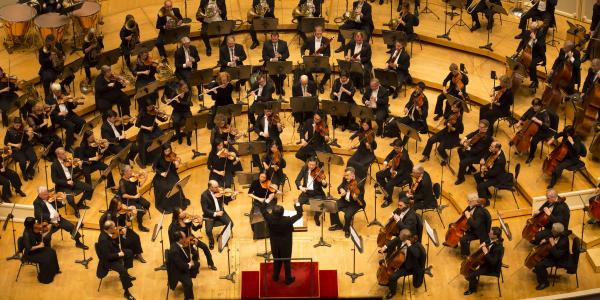
Comment Of The Day: “The Classical Music Critic Of The New York Times Thinks That Symphony Orchestras Should Choose Members According To Race, Gender, And ‘Other Factors’ That Have Nothing To Do With Music”

The Comment of the Day that follows by David Rohde is welcome for many reasons. First, he is a professional musician, and a skilled one. Second, he defends the author of piece I criticized vociferously (and will continue to). Third, I think this is an important issue. Fourth,, a new voice here is always welcome, and we haven’t been getting as many as I would like of late. Finally,, as required for COTD, it is well written and worthy of considerations and debate.

Not that I agree with it, but that has never been a criteria for Comment of the Day honors. Here’s David Rohde’s Comment of the Day. on the post,The Classical Music Critic Of The New York Times Thinks That Symphony Orchestras Should Choose Members According To Race, Gender, And “Other Factors” That Have Nothing To Do With Music.”(I’ll be back with my reaction at the end.)

***

It may be that using blind auditions has elevated the performance level of symphony orchestras. Or it may be serious overkill in an era of a supply-demand imbalance for classical musical talent. But either way, simply rolling this issue into what I know is this blog’s current obsession with – in other words, against – identity issues misses a lot that’s going on here.

First of all, you have to admit that hiring people without knowing who they are in ANY field is kind of strange. In particular, you certainly wouldn’t use blind auditions to cast people in a show, now would you? I know I know, different genres, different requirements. Roles in theater are individual, while 30 or 40 violinists in a symphony orchestra are doing much the same thing.

But I would argue that live classical music IS showbiz, and the sooner that people in that field realize it, the better. If the product is just “the music,” and many people assert that the overall technical performance level is higher than ever, then why is classical music struggling at all?

Second, I think you have to remember what the main impetus of blind auditions was in the first place. While I’m oversimplifying, the essential problem was (or shortly became) the inability of women to secure places in symphony orchestras. A quick check on YouTube of recent orchestra performances now versus 30 or 40 years ago will demonstrate the resulting change. Part of Tommasini’s argument is not to let solutions to problems become so institutionalized that they run past their sell-by date while different problems fester.

Continue reading

Comment Of The Day: “Dispatch From ‘The Great Stupid'”

nixon-tweet

I had a long list of topics I wanted to write about today, but I have been rendered mostly unproductive due to some malady or another. Luckily, and not for the first time, readers have come through with content at least as valuable as anything I could have generated. I already have backlog from the last two Open Forums, and some delayed Comment of the Day as well. I am very grateful.

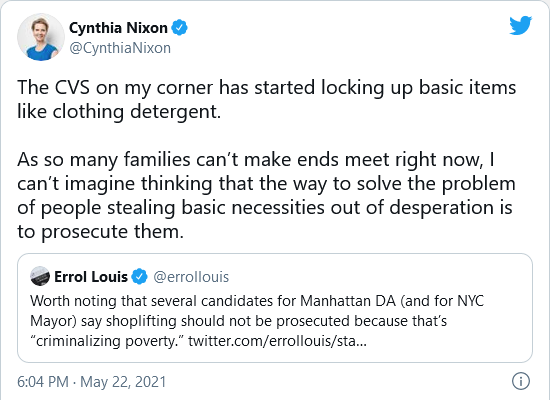
This Comment of the Day is another from the frequently history-minded (and often pessimistic) Steve-O-in-NJ, and his subject is the bad ideas, an evergreen topic, focusing on the tweet above, which is more representative of the current drift of progressive thought (it one is generous enough to call it that). Only one previous post had the “bad ideas” tag: this one, on “fertility equality.” I bet there are a hundred more that should have it, like anything about making Kamala Harris Vice-President.

Here’s Steve:

The U.S. and the world have hosted some pretty bad ideas over time.

The tulip bulb bubble, the ancient astronauts theory (remember “Chariots of the Gods?”), phrenology, New Coke, the XFL, and Boston selling Babe Ruth to the Yankees were some of the more benign ones. John Maxwell’s execution of the leaders of the Easter Rising, Mao’s Great Leap Forward, and the National Guard opening fire at Kent State were some of the ones that were not so harmless. The Reign of Terror, where the Committee on Public Safety sent who knows how many to the guillotine for any reason or no reason, Pol Pot’s Year Zero, in which towns, money, religion, and private property were abolished and execution by clubbing to death by a pick or a hoe, also for any reason or no reason,, Petrograd Order No. 1 (mostly now forgotten) which de facto stripped military officers of disciplinary authority, causing the Russian military to collapse like a deflated balloon in the face of renewed German offensives, and Hitler’s crackpot racial theories were examples of instant disasters.

Continue reading

Comment Of The Day: “Will The BBC’s Princess Diana Scandal Be A Tipping Point For Public Acceptance That The News Media Can’t Be Trusted?”

Princess Di

As he (and other veteran commenters) often do here, Steve-O-in NJ doesn’t merely comment on the post but elaborate and expand it, for which I am grateful. Literally by chance, my wife was watching a Netflix documentary on the Windsors, a British production that discussed the Bashir interview of the late Princess but spun it as an example of her vindictive and manipulative use of the press to strike back at the Royal Family. The producers did not, when it was written, know that Bashir had deliberately deceived Diana and her brother to provoke her.

One bit of rebuttal to Steve-O is, I think, required. Diana may have been “not too smart, not too stable” as Steve says, but like Donald Trump, who is also described that way by those who underestimate him, she had her own special genius and unique gifts. The most stunning quote in the documentary is Charles’ statement, in a letter to a friend before the wedding, that Diana was going to have a difficult time “always living in his shadow.” I am a stage director who has made a lifetime study of what gives an individual “presence” and star power, but it didn’t take an expert to discern that however young, naive and ignorant she may have seemed, Diana had blinding charisma. People with that particular gift cast shadows, they don’t get covered by them.

Here is Steve-O-in NJ’s Comment of the Day on the post, “Will The BBC’s Princess Diana Scandal Be A Tipping Point For Public Acceptance That The News Media Can’t Be Trusted?”:

So Bashir committed fraud and forgery, there’s no other way to describe it, and the BBC buried it. Generally speaking the elements of fraud are:

1. Misrepresentation of a material fact
2. Knowledge on the part of the accused that they were misrepresenting the fact
3. The misrepresentation was made purposefully, with the intent of fooling the victim
4. The victim believed the misrepresentation and relied upon it
5.The victim suffered damages as a result of the misrepresentation

Elements of forgery are:

1. False making – The person must have taken paper and ink and created a false document from scratch. Forgery is limited to documents. “Writing” includes anything handwritten, typewritten, computer-generated, printed, or engraved.
2 Material alteration – The person must have taken a genuine document and changed it in some significant way. It is intended to cover situations involving false signatures or improperly filling in blanks on a form.
3. Ability to defraud – The document or writing has to look genuine enough to qualify as having the apparent ability to fool most people.
4. Legal efficacy – The document or writing has to have some legal significance affecting another person’s right to something. A writing of social significance cannot be the subject of forgery.
5. Intent to defraud – The specific state of mind for forgery does not require intent to steal, only intent to fool people. The person must have intended that other people regard something false as genuine. A forgery is complete upon having created such a document with this requisite intent.

Sounds like both to me. Bashir should be in jail, but I’m sure the statute of limitations has long run. I’m disgusted reading this. He had written lies mocked up to fool Earl Spencer and Diana into believing that the Royal family was out to get her, to push her into spilling embarrassing facts and nasty attacks on her former in-laws. This would be criminal even if was just an ordinary woman having the ordinary problem of being dissatisfied with her marriage and not getting along with her former in-laws. It should get no pass because the people involved were public figures.

Continue reading

Comment Of The Day: “From The Increasingly Fantastic Annals Of The Great Stupid: Norton And The Philip Roth Biography”

_93215094_mkampforigdec15

Here is JP’s Comment of the Day on “From The Increasingly Fantastic Annals Of The Great Stupid: Norton And The Philip Roth Biography”. It tells the story of how a high school student learned what was wrong with banning books…any books.

I’ll add this as preface: “The Giver” is one of the most frequently banned books in public school libraries.

When I was in high school, I was a terrible student. I was averaging a 2.2 GPA and had no desire to do anything other than the absolute minimum of what was required of me (I think that is why my grammar is so bad).

Since I wasn’t doing too well academically and had failed a few classes, I was not on a path to graduate until, one day, in my sophomore year, the head librarian approached me. Apparently she was friends with one of the teachers I was pretty fond of, and they discussed ways to help me out. I was asked to be a the librarian’s personal Scout, a kind of \a teaching aid). The library had lots of Scouts, but I reported directly to her, and not the lady who supervised the rest of the scouts.

It was fun. I loved it. Then came the teaching. She gave me a book and wanted to know what I thought about it. She would tell me her favorite parts. She told me I reminded her of Sam. “Who’s Sam?” I asked. That was another boo, and that book turned into another book, and they kept kept on coming. That year I discovered a passion for reading. Pretty soon I was asking her for for new books and was leading the discussions.

Continue reading

Comment Of The Day: “Monday Ethics Meander, 4/26/2021: Oscar, Rachel, Ma’Khia And The ACLU” (Item #4: The Oscars)


I announced in a post today that I would no longer devote essays to the Academy Awards Show because it no longer has the cultural importance and influence to make it important, nor the integrity to make discussing its ethical issues worth the time to write about. I may not have been clear that this kills me. The annual Oscar broadcast was a big event in my family, and we almost always had seen all of the nominated films and performances. My dad, as a veteran, had privileges at Hanscom Air Base not far from Arlington, Mass., and at the movie theater on the base showed movies before general release. Tickets cost 25 cents for kids, 50 cents for adults, and there would be 5-6 different movies every week. It wasn’t unusual for the Marshalls to see three new films in some weeks. I used to care who won the Oscars: when John Wayne won Best Actor for “True Grit,” which my friends from high school and college knew I loved and had seen many times, I got phone calls from all over the country.

But in those days, political grandstanding was for acknowledged jerks like Marlon Brando: the Oscars were managed as a unifying feature of society, not a divisive one, as they should be. the hosts were middle-of-the road types like Johnny Carson and Bob Hope; the past was honored and respected. No doubt about it, the show and the industry was all-white, but that, like the rest of the nation, was changing. Destroying something in order to save it is almost always unethical, but that’s what they did to the Academy Awards, like so many other institutions. Most of them I don’t miss. I miss the Academy Awards, but they are officially toast, and the Academy did it to itself, with a big assist from Hollywood.

But A.M. Golden did an excellent job in his overview today after watching the Oscars so I wouldn’t have to. Here is his Comment of the Day on the Oscars section in Monday Ethics Meander, 4/26/2021: Oscar, Rachel, Ma’Khia And The ACLU“:

Prologue: Well, the only part of the Oscars I ever watch is the “In Memoriam” segment the day after so I can see who they left off. This year’s snubs:

David Prowse – Darth Vader
Jeremy Bulloch – Boba Fett
John Saxon – primarily known for TV but also appeared in a number of films.
Kenny Rogers – musician, yes, but starred in a movie.
Honor Blackman – Bond girl
Geno Silva
Annie Ross
Mac Davis – musician, again, but also starred in a movie
Stuart Whitman – primarily known for TV, but appeared in “The Longest Day” and “The Comancheros” with John Wayne.
Diana Serra Cary a.k.a. “Baby Peggy” –

They included late African-American actress Ja’Net Dubois, who was best-known as wacky neighbor Willona Woods in the tv sitcom “Good Times”, whose film work appears to be relatively insignificant. She died several days after last year’s Oscar telecast and wouldn’t have been included then anyway, but including her at all in the Oscar In Memoriam seems odd, especially in comparison to some of the above exclusions who had more prominent roles on film.

It’s not unusual for the Oscars (or the Emmys, for that matter) to pad their “In Memoriam” segments with performers who were best known for music or sports. I think the Oscars included Steve Jobs one year.

But I couldn’t shake the notion that they stuck Ja’Net in there to make sure there were some African-Americans in there. Kind of like the ridiculous extreme of Ricky Gervais’ 2020 Golden Globes joke about him refusing to allow an “In Memoriam” segment there because there wasn’t enough diversity in the people who died.

Continue reading