Morning Ethics Round-Up, 3/5/2018: An Oscar Hangover, A Panamanian Mess, An Australian Play, And A 7-11 Moment

Hello!

1 Let’s get the Oscars out of the way. I didn’t watch, choosing instead to finish streaming Netflix’s excellent “Seven Seconds.” I have skimmed the transcript and checked the reporting, however, and these items leap out..

  • On the “red carpet,” Ryan Seacrest was snubbed by the majority of the stars he tried to chat with them. Seacrest was accused of sexual harassment by his ex-personal hair stylist last year. His employer hired an independent counsel to investigate, and could not confirm her allegations, so he kept his job.Never mind: he was snubbed like a leprous skunk at a picnic anyway.

This is a flagrant Golden Rule fail. Not one of the over twenty stars who walked by him while he was trying to do his job would feel fairly treated if they had been in his position. It also is as perfect and example as there is of how the #MeToo movement is a witch hunt, not interested in facts, or fairness, just power and the ability to destroy without due process.

If I was going to watch the Oscars, the treatment of Seacrest in the pre-show would have changed my mind. These are awful people. To hell with them.

  • The disgusting and smug Jimmy Kimmel hosted, because he’s “America’s Conscience of America” despite seeking ratings by encouraging parents to be cruel to their own children for his amusement.

He began the night with a penis joke.

  • As I noted in yesterday’s Warm-Up, the Oscars are now part of the effort to divide the nation. Bigotry is good, as long as it’s trendy bigotry:

…Presenting the best director award, Emma Stone introduced the nominees as “these four men and Greta Gerwig.” Nice. Misandry is funny! (Gerwig lost. GOOD.)

Maya Rudolph assured the presumably racist white viewers, “Don’t worry, there are so many more white people to come.” Bite me, Maya.

…And, of course, “Get Out!,” the racist film that I have already written about more than it deserves, won Best Screenplay, because representing all white people as monsters is award-worthy.

  • In the past I have devoted whole posts to the Academy’s snubs in its “In Memoriam” segment, which is supposedly Hollywood’s final salute to film artists who made their final exits. At this point, I really don’t care what the Academy does, but the loved ones and fans of the snubees care, and that should matter to the Academy. Here is the complete list of omissions that at least someone has complained about. I’ve highlighted the ones who really should have been included:

Bill Paxton
Stephen Furst
Powers Boothe
Juanita Quigley
Ty Hardin
Francine York
Miguel Ferrer
Skip Homeier
Anne Jeffreys
Lola Albright
Lorna Gray
Dina Merrill
Conrad Brooks
Robert Guillaume
John Hillerman
Jim Nabors
Rose Marie
Adam West
David Ogden Stiers
Dorothy Malone
Della Reese
Dick Enberg
Tobe Hooper

The names fall into five categories. Bill Paxton is in one of his own: he was left out of the list due to a silly technicality: he died right before last year’s Oscars, so it was too late to include him in 2017, and some jerk decided that since he was a 2017 death, he couldn’t be honored this year either.  The second category is flat-out mistakes: Dorothy Malone won a Best Actress Oscar; if that isn’t enough to be listed, what is? Director Tobe Hooper was responsible for a film that revolutionized horror movies, “The Texas Chain-Saw Massacre,” and also directed “Poltergeist.” He was an important director. When two of your films launched sequels, remakes, sequels to remakes, and endless knock-offs, Hollywood should show some respect: it made millions because of Tobe Hooper.

Category 3: John Hillerman and Powers Boothe were successful and prolific film actors in some major movies, though both are remembered best for their TV work. There is no good argument for omitting them.  In the fourth category are TV actors who made a few mostly  forgettable films: West, Jeffreys, Merrill, Ferrer and Hardin. I can see the argument: they will be honored at the Emmys.

Stephen Furst deserves a category all his own. He played a memorable character in a classic, iconic film: “Flounder” in “Animal House.” That should have been enough to earn a place in the roll call.

That’s it for the 2018 Academy Awards.

Let us never speak of it again. Continue reading

Life Competence, Social Media, And Crisis Situations

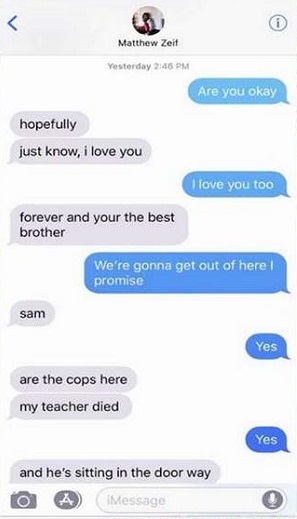
Cross the Parkland shooting with the ethical problems created by technology, and you get this..

One of our engaged readers sent me this story, about how real-time texting and tweeting have become standard fare during mass shootings and other crisis situations. The story is full of positive words for the phenomenon….

The texts hit a nerve with people because they’re so gut-wrenching and real, Pamela Rutledge, director of the Media Psychology Research Center, tells Yahoo Lifestyle. “They are highly emotional, and enable people to feel empathy and a connection to what the students were feeling at the time,” she says. Social media in particular is good for sharing these texts, Rutledge adds. “Removing the sense of mediation in connection is what social media does best,” she says. “It transports people into events and allows them to share the feelings more intensely.”

The messages are also stimulating to people and create a horror-story-type feeling — except they’re not made up, clinical psychologist John Mayer, author of Family Fit: Find Your Balance in Life, tells Yahoo Lifestyle. That can also make the experience more real. “They bring the reality of the dangers in the world into one’s life and right into your personal space,” Mayer says. “Therefore, it becomes even more frightening.”

The texts also allow people to experience the events vicariously, albeit from a safe distance, and can prompt feelings of gratitude and appreciation for the safety they do have, Rutledge says.

But these kinds of texts really resonate because they’re authentic and straight from the source. “They are real-time reporting of feelings and events,” Rutledge points out.

Well, it’s certainly nice that vivid reporting comes out of massacres! What would we do without social media and cell phones!

My reaction is completely different: Why are these people texting and tweeting in the middle of a crisis? Continue reading

Afternoon Ethics Warm-Up, 1/29/2018: Alexa, Hillary, The Grammys, And The LED Rocket Copters

Good afternoon.

(Where did the morning go?)

1 Regarding Alexa the Feminist: I had said that I would wait for 20 comment before revealing my own answer to the recent Ethics Quiz, which asked readers whether it was ethical for Amazon to  program its Artificial Intelligence-wielding personal assistant Alexa with the rhetoric and the sensibilities of a feminist. As usual, Ethics Alarms readers covered a full range of considerations, from the fact that consumers weren’t being forced to take a feminist robot into their homes, and could choose a non-woke personal assistant if they pleased, to the pithy,

“My screwdriver should not tell me it is a communist. My toothbrush should not tell me it is a Republican. My lamp should not tell me it is Hindu. My car should not tell me it likes polka music. My sunglasses should not ask me if I’ve heard the good news. My refrigerator should not tell me I should have more meat in my diet, and by no means should it be vegan.”.

I don’t trust the big tech companies, and the more I see them becoming involved in politics and culture, the less I trust them. It is unethical for Amazon to try to indoctrinate its customers into its values and political views, and if that isn’t what the feminist Alexa portends, it certainly opens the door. If there is a market for communist screwdrivers, however, there is nothing unethical about filling it.

As long as consumers have the power to reject AI-imbued tools with a tendency to proselytize, there seems to be no ethics foul in making them available.  It’s creepy, and since these aren’t women but pieces of plastic and metal, it’s absurd, but in the end, so far at least, Alexa’s feminist grandstanding is “ick,” not unethical.

2. If you think that there was nothing wrong with Hillary’s surprise cameo at the Grammys, you’re hopeless. Continue reading

An Apology To Bradford Dillman, And Introducing The Dillman Rule

I owe Bradford Dillman, the movie and TV actor who died on January 16, an apology. I hope I learn something from it.

If you had asked me during the Seventies and Eighties who I regarded as the epitome of a hack actor, it would have been Bradford Dillman. For most of the period he was a guest star on every TV drama imaginable, usually phoning in the same performance as a serious, tense, often nasty weasl or jerk. I came to believe that he was a serious, tense, often nasty weasel or jerk; otherwise, why would he only play such roles? Although Dillman’s career began well, with his portrayal of a fictional version thrill-killer Dickie Loeb in Compulsion, the film version of the Leopold-Loeb murder and trial. “Bradford Dillman emerges as an actor of imposing stature as the bossy, over-ebullient and immature mama’s boy, Artie,” A. H. Weiler wrote in a Times review. Dillman shared best actor honors with co-stars Dean Stockwell and Orson Welles at the Cannes Film Festival, and that was about the last honor he ever got. His career went downhill from there.

I never forgave him for appearing as John Wilkes Booth in 1977’s  horrible  “The Lincoln Conspiracy.” I am a Lincoln assassination buff, and looked forward to the movie, braving a blizzard to see it and dragging my bride to be along with me as one of our first dates. I was embarrassed.  The film was so bad I walked out of it, one of only five movies to force me out of the theater since I was a kid (The others, for the record: the original “Dawn of the Dead,” “The Silent Scream,” “JFK,” and “The Wicked Dreams of Paula Schultz.”)

As usual, it wasn’t that Dillman was bad, it was just that he was predicable, and the material he was acting in was lousy. Oh, now and then , a major film like “The Way We Were,” a couple of the Dirty Harry films, or a decent TV show like “Columbo” had a Bradford Dillman character, so they got, reasonably enough, Bradford Dillman to play him, but by then the cognitive dissonance scale—

—was working against Dillman. Bradford was already lodged at the bottom. If he was in it, whatever it was was pulled down below zero in my mind. Bradford Dillman? Yechhh.

This was a bias. I stopped really watching Bradford Dillman, and only reacted to him based on old grudges and assumption formed so long ago that I couldn’t even recite them. It was prejudice. It was unfair. It breached the Golden Rule. I never gave him a chance, for decades. Continue reading

Those “Dissent Is Patriotic” Signs

My Alexandria, Virginia neighbors are fond of simple-minded and obnoxious virtue-signalling signs, as I discussed here.

Another one has started popping up, this one proclaiming “Dissent is Patriotic.” As a general proposition, little of value can be stated in three words, especially those with “is” in the middle. “Dissent is Patriotic” is a gross generality, and a sign like this bolsters the delusions of smug absolutists and the historically ignorant.

The ACLU has been pushing this slogan (to sell T-shirts, it seems), and it had a re-birth thanks to the NFL kneelers, who are in truth a perfect example of when dissent isn’t patriotic. Incoherent dissent isn’t patriotic: it makes all dissent look bad. Dissent based on hate, lies, or a desire to divide isn’t patriotic: it’s hateful, dishonest and divisive, which is to say harmful, and thus unethical.

Speaking of dishonesty, many of these signs use the phrasing you see on the left, which is a fake quote attributed to Thomas Jefferson. Attaching a dubious assertion to a much-admired historical figure is an unethical propaganda tactic employing a dishonest appeal to authority.  (This is a famous example.)

As Ethan Epstein wrote in The Weekly Standard,

Few if any Americans are associated with more apocryphal quotes than Thomas Jefferson, but the false notion that he said, “dissent is the highest form of patriotism” is among the easiest to dispel. Because Jefferson never would have said something so idiotic. Of course dissent can be patriotic, but it isn’t inherently so. What one is dissenting from matters. Were members of the German American Bund, who protested the U.S.’s anti-Nazi policies in the 1930s and ‘40s, enacting the “highest form of patriotism?”

Continue reading

Morning Ethics Warm-Up, 1/5/2018: Brrrrrrr!… “Hey!”… Duh!… And “WHAT?”

G-g-g-good M-m-m-morning!

1 Enforcing societal standards in the cold. Today, as we ran errands in 13 degree weather and gusting winds to fetch my sick son some chicken soup and DayQuil, my wife witnessed the following episode at the 7-11. With a long line behind him, a man stood at the register meticulously picking lottery numbers. A woman in line confronted him directly, saying, “You came out in this cold just to waste your money on the lottery? You’re sick. Save your money. Be responsible. Get help”

Brava.

Driving home, we saw many parents walking their children to Alexandria schools (which delayed their opening here two hours.) At an intersection near the school across a parking lot from our home, my wife and I saw a young girl, maybe seven or eight, with her father, about to cross the street. The girl had a winter jacket on and a hat, but only thin leggings and—get this—sneakers with no socks. The wind chill outside here is estimated at -4.

We didn’t say anything to the father. Should we have? I think so.

2. More state lottery ethics. Speaking of unethical state lotteries, which could only become ethical if the states eliminated them, you will recall Item #4 in the 12/28/17 warm-up, about how South Carolina had bollixed up its lottery and is deciding whether to stiff the winners, since there were far too many of them thanks to computer programming error. That state needs to follow the ethical example of Connecticut.

After an error was discovered in how the drawing was handled—involving 100,000 tickets—the lottery posted a notice on its official website saying there was indeed a problem with the drawing, and that “due to an error in the range of tickets eligible for the Super Draw drawing, a second drawing will take place shortly. HOLD ALL TICKETS.” Later it announced,  through this statement from Interim Lottery President & CEO Chelsea Turner: Continue reading

The Unabomber, The Red Light, And Me [UPDATED!]

I ran a red light last night, and I’m feeling bad about it. Ted Kaczynski made me do it.

It was after midnight, and I was returning home after seeing the pre-Broadway production of the musical “Mean Girls,” based on the cult Lindsay Lohan comedy. I was late, my phone was dead, I knew my wife would be worried, and I was stopped at an intersection where I could see for many football fields in all directions. There were no cars to be seen anywhere.

Ted, , aka “The Unabomber” or “Snookums” to his friends, cited my exact situation as an example of how we have become slaves to our technology. Why do we waste moments of our limited lifespan because of a red light, when there is no reason to be stopped other than because the signal says to. Admittedly, this had bothered me before I read Ted’s complaint. Stop lights should start blinking by midnight, allowing a motorist to proceed with caution, as with a stop sign.  If one isn’t blinking, we should be allowed to treat it as if it is.

Last night, I ran the light. With my luck, there was a camera at the intersection, and I’ll get a ticket in the mail. But..

…whether I do or not doesn’t change the ethical or unethical character of my conduct. That’s just moral luck.

…it was still against the law to run the light, even it I was treating it as a blinking light, because it wasn’t

…breaking the law is unethical, even when the law is stupid, and

…there was no legitimate emergency that could justify my running the light as a utilitarian act.

So I feel guilty. Not guilty enough to turn myself in, but still guilty, since I am guilty.

But Ted wasn’t wrong.

Update: Let me add this; I was thinking in the shower.

On several occasions in the past, I have found myself stopped by a malfunctioning light that appeared to be determined to stay red forever. Is it ethical to go through the light then? The alternative is theoretically being stuck for the rest of my life. So we run such lights, on the theory the frozen stop light is not meeting the intent of the law or the authorities who placed it there, and to remain servile to the light under such circumstances is unreasonable. Yet running it is still breaking the law, and isn’t stopping for a light in the dead of night with no cars to be seen also not consistent with the intent of the law and the light? What’s the distinction?

“Next Time”… Our Thanksgiving Ethics Botch

Yesterday, faced with the prospect of a tiny Thanksgiving, which I find only reminds me of the former table-mates lost forever, and having the extra excuse of our wedding anniversary, Grace and I decided to take our increasingly otherwise occupied son and have Thanksgiving dinner at the Prime Rib, a ridiculously expensive restaurant. The meal was lovely and low stress for a holiday dinner, a feature especially welcome right now.

The restaurant was filled with family groups without kids, many in gowns and formal wear. Also filling the air was happy banter of the sort that holidays typically inspire. Over to my right, however, sat a well-dressed man in his late 60s or seventies, dining alone. I found myself thinking about him throughout the meal. What a lonely, solitary, depressing way to celebrate Thanksgiving, I thought. If I get to the state where I am so bereft of family and friends that I find myself in a five-star restaurant dining alone on Thanksgiving, just hit me over the head with cinder block. He looked a little like Alan Greenspan, and I still felt terrible for him.

After dinner, and he had left the restaurant, I mentioned all of this to my wife.

“I was thinking the same thing,” she said. “We should have invited him to join us.”

Ugh. I had considered that. But our family gets the opportunity to eat together so seldom, and this was an anniversary celebration too. My son also has a tendency to clam up around strangers, and he seemed relaxed and happy for a change. I had quickly talked myself out of even raising the possibility of inviting a fourth to our Thanksgiving/ 37th Anniversary table.

Yet of course that’s what we should have done, isn’t it? Isn’t it? Maybe the man was having a great time by himself. Maybe we would have embarrassed him. Heck, I don’t know. It’s also possible that he would have jumped at the chance. Who knows? All I do know is that I would have appreciated the offer, and will, unless someone gets behind me with the cinder block before I have the chance. It was still the kind, considerate, compassionate, ethical thing to do.

“Next time, let’s make sure we invite someone like that,” Grace said. I agreed.

Sure.

Next time.

Thanksgiving Morning Ethics Warm-Up, 11/23/17: All About Turkeys, Metaphorically Speaking

It’s Thanksgiving Morning!

1 It’s also my wedding anniversary. I am very thankful , and proud, frankly, that I am one of the very few people among my pretty large and diverse community of friends, acquaintances and colleagues still married (after 37 years…yes, I married at 13) to the same person I pledged to make a life with “til death do us part.” It’s not easy, for anyone, and determination and commitment, forgiveness and contrition, are a large, crucial, indispensable part of it. A lot of the journey is based on ethics, in other words.

2. Surprise! More accusers of both Rep. John Conyers and Senator Franken surfaced yesterday. Conyers’ new alleged victim is Melanie Sloan, formerly the head of CREW, the left-wing D.C. ethics watchdog that somehow manages to see unethical conduct by Republicans about five times more often than it fingers Democrats. Sloan says she was not sexually harassed, but alleges that Conyers called him into his office to verbally abuse her while being dressed in his underwear. Uh, Melanie? If your boss is ever berating you in his underwear, that is per se sexual harassment. This is a hostile work environment; I don’t care if your superior is built like Batman…well, like his costume.

The predictable proliferation of accusers was why, in the hypothetical apology I authored for Alternate Universe Al, I included the part about mistreating other women. It was a sure thing; harassers harass, and if you are going to pretend that the first accuser was “just a mistake,” you might as well skip it and head for George Bailey’s bridge. In the sexual harassment training field, nothing is more certain than the fact that with the real harassers and predators, if there’s one victim, there are many. This is why the narrative about Anita Hill amounts to a Left-driven, media-driven smear of Clarence Thomas for the crime of being a black conservative.

An unanticipated horrible consequence of this leg of the Harvey Weinstein Ethics Train Wreck, which also includes new allegations about the Democratic Party’s keynote speaker when it was accusing conservatives of a “war on women,” as well the revelation that the GOP President who selected Thomas emulates his favorite magician, “David Cop-a-Feel,” is that it very well might elect Roy Moore, who is worse than any of them. Meanwhile, most analysts think that both Franken and Conyers will have to resign. ( I would eagerly vote for a mad scientist-make hybrid of Conyers and Franken—Frankenconyers!—before I would even shake Roy Moore’s grubby hand…and really, who knows where it’s been?)

Republicans have been incredibly lucky with their choices of foes, luckier than they deserve. Continue reading

It’s Thanksgiving, And Time For The Complete “It’s A Wonderful Life” Ethics Guide [Updated And With A New Introduction For 2017 ]


Last year (to the day) when I posted the Ethics Alarms ethics guide to Frank Capra’s 1946 masterpiece “It’s A Wonderful Life,” one of the great ethics movies of all time, as this blog’s official welcome to the holiday season, I wrote, “I suspect we need it more in 2016 than usual.”  As it turned out, we need it even more in 2017.

Multiple forces have been hard at work for a full year now, roiling the nation, painting the future as dire and the present as unbearable, trying to divide us and even to encourage discord and conflict during this special time when we are supposed to remember what is most important in life. In case you have been infected, it’s not politics and not partisan agendas, but love, family, community, kindness, and friends. The simple message of Frank Capra’s masterpiece—it has aged far better than his other films, including, and maybe especially, “Mister Smith Goes To Washington”—that no one is a failure who has friends, is vital to recall when so many are rejecting friends because they don’t conform to some ideological talking point. This is madness, and watching and heeding “It’s A Wonderful Life” is a better remedy than Thorazine.

Senate Minority Leader Chuck Schumer actually told his Twitter followers this week to bring a chart prepared by a  think tank to attack the Republican tax plan during Thanksgiving dinner. This is part of the effort to politicize everything in our lives, by zealots who value power over humanity, country, and spirituality. They belong with Mr. Potter, not George and Clarence.

I need this movie more in 2017 than usual for other reasons. It has been a year in which I have lost many peers and cherished friends, and listened to too many of the living bemoan the passage of time and looming mortality.  I don’t think like that—a lifetime gift from my brave and fatalist father—but I can’t pretend that the game clock isn’t running out, or not face the fact that I have not sunk anywhere near the baskets I could have and should have. Fortunately, what I wrote in an earlier year introducing this post still resonates…

Everyone’s life does touch many others, and everyone has played a part in the chaotic ordering of random occurrences for good. Think about the children who have been born because you somehow were involved in the chain of events that linked their parents. And if you can’t think of something in your life that has a positive impact on someone–although there has to have been one, and probably many—then do something now. It doesn’t take much; sometimes a smile and a kind word is enough. Remembering the lessons of “It’s a Wonderful Life” really can make life more wonderful, and not just for you.

Have a terrific Thanksgiving, everyone.

And here we go:

1. “If It’s About Ethics, God Must Be Involved”

The movie begins in heaven, represented by twinkling stars. There is no way around this, as divine intervention is at the core of the fantasy. Heaven and angels were big in Hollywood in the Forties. The framing of the tale seems to advance the anti-ethical idea, central to many religions, that good behavior on earth will be rewarded in the hereafter, bolstering the theory that without God and eternal rewards, doing good is pointless.

Yet in the end, it is an ethics movie, not a religious one. George lives an ethical live, not out of any religious conviction, but because step by step, crisis after crisis, he chooses to place the welfare of others, especially his community and family, above his own needs and desires. No reward is promised to him, and he momentarily forgets why we act ethically, until he is reminded. Living ethically is its own reward.

We are introduced to George Bailey, who, we are told, is in trouble and has prayed for help. One has to wonder about people like George, who resort to prayer as a last resort, but they don’t seem to hold it against him in Heaven. The heavenly authorities assign an Angel 2nd Class, Clarence Oddbody, to handle the case..He is, we learn later, something of a second rate angel as well as a 2nd Class one, so it is interesting that whether or not George is in fact saved will be entrusted to less than Heaven’s best. Some lack of commitment, there— perhaps because George has not been “a praying man.” This will teach him—sub-par service!

2. Extra Credit for Moral Luck

George’s first ethical act is saving his brother, Harry, from drowning, an early exhibition of courage, caring and sacrifice. The sacrifice part is that the childhood episode costs George the hearing in one ear. He doesn’t really deserve extra credit for this, as it was not a conscious trade of his hearing for Harry’s young life, but he gets it anyway, just as soldiers who are wounded in battle receive more admiration and accolades than those who are not. Yet this is only moral luck. A wounded hero is no more heroic than a unwounded one, and may be less competent as well as less lucky.

3.  The Confusing Drug Store Incident

George Bailey’s next ethical act is when he saves the life of another child by not delivering a bottle of pills that had been inadvertently poisoned by his boss, the druggist, Mr. Gower. This is nothing to get too excited over, really—if George had knowingly delivered poisoned pills, he would have been more guilty than the druggist, who was only careless. What do we call someone who intentionally delivers poison that he knows will be mistaken for medication? A murderer, that’s what.  We’re supposed to admire George for not committing murder.

Mr. Gower, at worst, would be guilty of negligent homicide. George saves him from that fate when he saves the child, but if he really wanted to show exemplary ethics, he should have reported the incident to authorities. Mr. Gower is not a trustworthy pharmacist—he was also the beneficiary of moral luck. He poisoned a child’s pills through inattentiveness. If his customers knew that, would they keep getting their drugs from him? Should they? A professional whose errors are potentially deadly must not dare the fates by working when his or her faculties are impaired by illness, sleeplessness or, in Gower’s case, grief and alcohol.

4. The Uncle Billy Problem

As George grows up, we see that he is loyal and respectful to his father. That’s admirable. What is not admirable is that George’s father, who has fiduciary duties as the head of a Building and Loan, has placed his brother Billy in a position of responsibility. As we soon learn, Billy is a souse, a fool and an incompetent. This is a breach of fiscal and business ethics by the elder Bailey, and one that George engages in as well, to his eventual sorrow.

5. George’s Speech

Continue reading