
Comment Of The Day: “I Worry About Cary Grant”

Today’s Comment of the Day was spawned by the post about the fading of cultural memories of important film artists. texaggo4 has his doubts about my concerns, and whether the phenomenon is worth worrying about, or even a problem at all.

I admit, this topic is an unusually intense and personal one for me. It was the reason why I devoted a large portion of my life and creative energy for twenty years to the quixotic challenge of creating and trying to maintain a professional theater company in the Washington, D.C. area devoted to producing American stage works of quality and historical importance that were in danger of falling out of the American stage repertoire entirely, if they were not already forgotten. We proved that many shows thought hopelessly dated or politically incorrect still worked (“The Boys in the Band,” “The Seven Year Itch,” “Native Son,” “The Cradle Will Rock”…), found genuine masterpieces that almost nobody knew existed (“Moby Dick Rehearsed,” “Machinal,’ “Marathon 33″…), and lost a fortune on artistic gambles that didn’t pan out, for a wide variety of reasons, including bad management, bad luck, or the unpredictability of show biz. Notable disasters that still give me nightmares include ” “Home of the Brave,'” Mr Roberts,” “A Flag is Born,” “Dear World, and “The Pirate.” We had a devoted and loyal following, and I think we proved our point, but basically didn’t make a ripple despite all that work. (Except perhaps in this case, and maybe that was enough…) Heck, our theater was in a school building, and we couldn’t get any teachers to bring their classes to our shows, even for free.

But then, most of my life has been devoted to futile pursuits. After all, I’m an ethicist…

Here is tex’s Comment of the Day on the post,I Worry About Cary Grant:

What exactly are we asking for here? Facial recognition of the actor and an ability to recollect every great movie ever produced? What’s the goal of Cultural Memory? It cannot be the rote memorization of EVERY SINGLE great artist, producer and creator of art & culture. 1, we’d never have time to get around to memorizing ALL of it, 2, we’d never have time to get around to viewing all of it, 3, we’d never have any time to get around producing new examples of it, 4, we’d never have any time to get around doing anything else that life calls us to do.

The great conversation, as it is called, which is the ongoing “dialogue” between artists of the present with their contemporaries as well as with their predecessors. Artists take the concepts that are explored in the past, the debates had between opposing concepts in the past, and rework them in the present, either shedding light on new angles or re-engaging the old arguments, or bolstering new arguments. This long process of cultural production has produced MILLIONS of individual works and, without a doubt, TENS of thousands of artists. Of those countless producers & performers, we can assume there are many many thousands of individual works that could be called “culturally iconic” or “unique” or “ground breaking” and thousands of artists.

Feeling less well read that I ought to, I compiled a list of what several thinkers considered to be the “Western Canon”: a list of essential books that captured the literary and written philosophy component of this “Great Conversation”, with the goal of plodding through them over my lifetime.

930 books. Just the books.

The authors, as I read their names, certainly had recognizable names and I could probably guess relatively accurately the eras they wrote in. Could I reasonably hold a discussion or even mention some prominent idea found in them? Maybe 10% of that list. With any level of deeper understanding? Less than that.

But what I could do, without those books, is hold a relatively well thought out conversation about the ideas that most of those books were also exploring. Why? Because that is what cultural memory does for us, without being able to hold an in depth idea about a particular work of art, we can still be able to hold in depth ideas about the particular notion that a work of art was exploring. Because cultural memory goes a great way towards preserving, through the Great Conversation, all those ideas and philosophies and beauties and art, without me having to memorize in rote detail the specifics of each work.

930 books, considered essential to grasp the great conversation of *just* Western Culture. How many paintings & painters? How many concertos and composers? How many sculptures? How many plays and playwrights and stage actors? How many buildings and architects? How many movies and directors and actors and screenwriters?

The interesting thing of course, is how the growth of culture has accelerated due to population, communication and technology. Whereas one generation in the 1000s may have produced a half dozen *iconic* culture producers, one generation in the 1500s produced several dozen *iconic* culture producers. One generation in the 1700s, maybe 100. A generation of the 1900s, easily several hundred.

Producers. Multiply that by 10 for iconic works. And I think I’m underestimating. Continue reading
Public Confidence And Trust (2): Observations On Gallup’s Confidence In Institutions Poll

In Part 1, we looked at the implications of Gallup’s 2017 polling on Americans’ beliefs in the trustworthiness and honesty of various occupations.  This post looks at institutions, and what Gallup’s research shows us when those polled answer the question, “Now I am going to read you a list of institutions in American society. Please tell me how much confidence you, yourself, have in each one — a great deal, quite a lot, some or very little?”

As with the occupations poll results, what is most interesting—or depressing— is how the public’s attitude has changed over time. Gallup has been taking this poll at the end of every year since 1993, and in some years, for some institutions, before that.

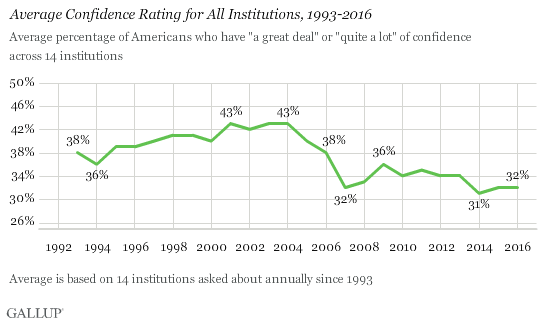
The most important finding is that Americans have less trust and confidence in our institutions than ever before, and have been in this state for three straight years. (See chart above.) The 32% average confidence level in all institutions measured was one point above 2016, which came in at a record low 31%, but that difference is not statistically significant. This is the third straight year that the number has been under 33%. That has never happened before.

I have written about this issue in the past (and discussed it with professional groups, like newly elected state legislators, in ethics seminars), with the same alarm. For a democracy to lack confidence and trust in its institutions portends disaster, and the danger cannot be understated. Of all forms of government, it is democracy that is most built on a foundation of public trust. This erosion in public trust—the average level of trust has fallen about 26% in just ten years—is collectively frightening. Look at the first line and the last in many of these charts: Continue reading

A Vermont State’s Attorney Prosecuted A College Student For An Overheard Phone Call. Why Is She Still Employed?

In October of last year, police charged Wesley Richter, a University of Vermont continuing education student, with disorderly conduct after university officials said he used “explicitly racist and threatening language” against black students and diversity initiatives on campus. Richter was overheard in a phone call with his mother, though exactly what Richter allegedly said has not been made public.unknown. Of course, what he said doesn’t matter, unless he was planning a crime, which he was not. He was talking to his mother, and a student who overheard the discussion took offense at what was said. Richter, through his lawyer, denied saying anything racist, but again, it doesn’t matter. Saying racist things in a phone conversation cannot be a crime. It’s bad manners. It’s disrespectful to those listening. A school may be able to justly find some kind of violation to a reasonable and neutral civility code involving words but not content. But an overheard phone conversation cannot be a crime. It is mere words.

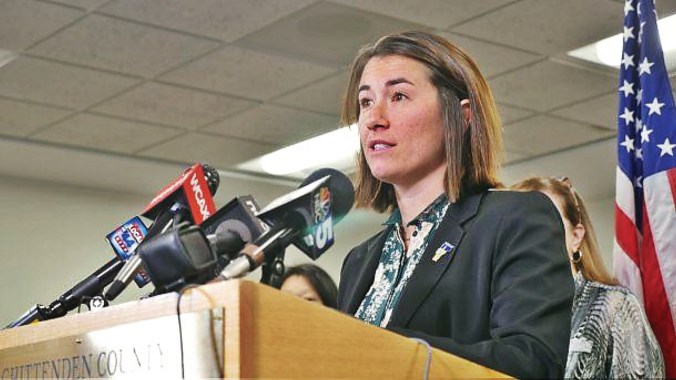
Nevertheless, the University of Vermont, the University of Vermont Police Department and the Chittenden (County) state’s attorney’s office in the person of Sarah George, the State’s Attorney, prosecuted the case against Richter. George is a graduate of the University of Vermont Law School, where presumably they taught constitutional law. There is no excuse for this.

Richter’s lawyer, Ben Luna, argued that George didn’t have probable cause to bring the misdemeanor charge, and Superior Court Judge David Fenster agreed. In a statement, Luna called the dismissal a victory for free speech and the First Amendment. “The court’s ruling reinforces my opinion that this matter should never have been brought,” he said.

The court’s ruling also reinforces my opinion that Sarah George should be disciplined by the bar and fired.

Right at the start, Vermont’s Rule 3.8, as in every other state, makes it clear that prosecutors must not charge anyone with a crime without probable cause:

Rule 3.8. SPECIAL RESPONSIBILITIES OF A PROSECUTOR

The prosecutor in a criminal case shall:

(a) refrain from prosecuting a charge that the prosecutor knows is not supported by probable cause;

The Comments to the rule say in part,

[1] A prosecutor has the responsibility of a minister of justice and not simply that of an advocate. This responsibility carries with it specific obligations to see that the defendant is accorded procedural justice and that guilt is decided upon the basis of sufficient evidence.

The First Amendment makes it beyond argument that the government may not punish or seek to punish citizens for the content of their speech. Since the only evidence that George had that a misdemeanor had been committed was a third party complaint about the content of Richter’s speech in a conversation over the phone with his mother, she did not have legal or sufficient evidence to charge or prosecute Richter. As a lawyer and a prosecutor she had to know that. If she knew it, she was knowingly abusing her power, and should be suspended from the practice of law.

If she didn’t know it, then she is incompetent and not fit to practice. She should be fired.

Incredibly, George said she thought the case was strong, but that it was also “a learning experience.” “It’s disappointing, but it’s also good for us to know. It’s a really great decision for us in terms of case law and reasoning, so we know now what this court expects of us,” George said.

Yeah, the court expects you to follow the Constitution. If you have to learn that at this late stage in your legal career, Sarah, you need to go back to the drawing board. Maybe you can sell maple syrup.

She wasn’t through. “What we allege he did, we still allege he did,” she continued.  “It just didn’t rise to the level of a hate crime.”

A phone conversation cannot be a “hate crime.” Speech cannot be a hate crime. “Hate speech” is not a legal designation.

Why is this woman a state prosecutor? Fire her.

If she is not fired, then this totalitarian, illegal, abusive and intimidating prosecution chills free speech, not just on the University of Vermont campus, but in the whole state. A citizen should not have to wait two months, as Richter did, for a judge to declare that the state cannot persecute him for what he is overheard saying, whatever it is.

Fire

Her. Continue reading

Museum Ethics: The Rape Of The La Salle University Art Museum

“This old thing alone will fetch enough to fund that Klingon language course!”

Among its other tenets, the Code of Ethics For Museums followed by The American Alliance of Museums requires that member organizations ensure that:

  • collections in its custody are lawfully held, protected, secure, unencumbered, cared for and preserved
  • acquisition, disposal, and loan activities conform to its mission and public trust responsibilities, and
  • disposal of collections through sale, trade or research activities is solely for the advancement of the museum’s mission. Proceeds from the sale of nonliving collections are to be used consistent with the established standards of the museum’s discipline, but in no event shall they be used for anything other than acquisition or direct care of collections.

In other words,  museums cannot ethically sell off  their collections to finance or benefit non-museum goals and objectives.

Never mind. La Salle University’s trustees announced that the university planned to sell 46 paintings, sculptures, and drawings selected by Christie’s auction house and use the expected profits of $4.8 -$7.3 million into teaching and courses. That means that the University will be using the art as investments and assets rather than art.

Unethical.

“I feel as though the place has been raped,” said Caroline P. Wistar, a longtime curator of the museum who retired about a decade ago. “They’re selling all of the very best things — a Degas drawing, a Vuillard. This is major. I feel like they’ve killed the museum.” Timothy Rub, head of the Philadelphia Museum of Art and past president of the Association of Art Museum Directors,  said, Continue reading

California’s Ethics Rot

This is the prevailing culture in the state Hillary Clinton won so overwhelmingly that she was able to claim that she really “won” the election. You don’t want to live in that culture. It opposes the Freedom of Speech.

Opposing free speech is unethical. It also is undemocratic. But Californians are increasingly incapable of seeing this. It is a case study in how a culture rots. Some recent examples of how the rot is proceeding.

I. Mean Facebook posts are crimes.

In 2016, Mark Feigin posted five insulting comments on the Islamic Center of Southern California’s Facebook page. Among them:

  • “THE MORE MUSLIMS WE ALLOW INTO AMERICA THE MORE TERROR WE WILL SEE.”
  • “PRACTICING ISLAM CAN SLOW OR EVEN REVERSE THE PROCESS OF HUMAN EVOLUTION.”
  • “Islam is dangerous – fact: the more muslim savages we allow into america – the more terror we will see -this is a fact which is undeniable.”
  • “Filthy muslim shit has no place in western civilization.”

As a result, California is prosecuting him for allegedly violating Cal. Penal Code § 653m(b):

Every person who, with intent to annoy or harass, makes repeated telephone calls or makes repeated contact by means of an electronic communication device … to another person is … guilty of a misdemeanor. Nothing in this subdivision shall apply to telephone calls or electronic contacts made in good faith or during the ordinary course and scope of business.

A First Year law student of reasonable mental acuity could tell you in a trice that this was unconstitutional—that is, she could if she hadn’t been marinated in the anti-democratic culture that is 21st Century California. It is also an unethical and intellectually dishonest effort to use an ill-fitting law to punish “hate speach.” Here, in part, is the analysis of Prof. Volokh, a constitutional law specialist:

This can’t possibly be consistent with the First Amendment; indeed, in U.S. v. Popa (D.C. Cir. 1999), the D.C. Circuit set aside a telephone harassment conviction of someone who left seven racist messages on the voicemail of then-U.S.-Attorney Eric Holder; and the court focused on the “political message” of the speech, and not on Holder’s status as a government official. Given that insults targeted to a particular person, related to a political message, are thus constitutionally protected, so are more general insults aimed at an ideology and all its adherents, whether that ideology is Islam, Scientology, conservatism, gun rights, or anything else. Laws aimed at preventing unwanted repeated messages to particular private citizens shouldn’t be applied to messages sent to ideological organizations (or to public officials). And this is especially so when it comes to annoying Facebook posts, which the organization can simply block.

…I hope the court indeed promptly throws them out as unjustified under the statute, forbidden by the First Amendment, or both. But if the courts accept such charges, expect to see many more people, left, right, and otherwise, prosecuted for posting insulting messages on many groups’ web pages.

II. No free speech on campus without permission!
Continue reading

Morning Ethics Warm-Up, 12/31/2017: The Too Many Year Ending Ethics Issues To Handle In One Day Edition

Happy New Year!

1 Arrgh! In an op-ed called “Higher Ed’s Low Moment, Farnk Bruni bemoans the fact that colleges “found themselves on the defensive.” Citing the Pew Center’s findings that I discussed here, he writes of declining opinions about the value of college,

“That’s not so surprising, given Americans’ intensifying resentment of anything that smacks of elitism and given Republicans’ attacks on science and intellectuals. As Ron Daniels, the president of Johns Hopkins University, recently told me, “Even if we were completely unblemished in the way in which we pursued our mission, it would be hard to imagine that in Trump’s America, we wouldn’t be targets for scorn.”

Incredible. (Or, as my late, schizophrenic cousin Trefon would say, “Umba!“, as in “Umbelieveable!” I always found that funny, and I would love to see his slang word enter the popular lexicon. Trefon was a great kid who had a short, empty life, and ended it by jumping off an overpass into an oncoming truck. It would be nice if he left some enduring contribution to the culture, even if it was a silly one.) No, the reason so many Americans no longer think college is a wonderful thing is that they can see and hear. Students aren’t being educated. Graduates have minimal knowledge of history, literature, government and culture. They can’t write, and they can’t argue. Their professors get on social media and issue things that would destroy trust in any institution that employed them.

The campuses are increasingly hostile to free speech, free thought, democracy, capitalism and the United States of America. None of these factors penetrate Bruni’s biases and conventional wisdom. He keeps repeating the mantra that caused me to resign from an education board many years ago: ” a college degree is one of the surest harbingers of higher earnings and better economic security.” That’s how college has been regarded as a reflex for a century now, and the policies that followed that starting point–a degree,  means jobs and money—have created the sick system in which students who are not qualified to attend college are accepted anyway, and tuition has soared to obscene level., all while the actual content of the curriculum and teaching have become an afterthought. It’s the diploma that matters!

No, it’s the education. Bruni says, ” [T]he continued competitiveness of the American economy depends on the skills of our work force, the intellectual nimbleness of our citizens, the boldness of our scientific research and the genius of our inventions. Our colleges and universities are central to that.”  If getting as many people diplomas as possible is the mission, however, seeking “intellectual nimbleness” is obviously an afterthought.

This emperor has no clothes, and hasn’t had for a long time. The disturbing development isn’t that so many conservatives have finally realized that the golden ideal of an American college education no longer comports with reality. It is that so many opinion makers and policy makers hold on to that ideal when it is so evidently false. If college degrees don’t prove that  graduates have core knowledge, writing and critical thinking skills, then they are  just high-priced tickets to be incompetent.

And they don’t. Continue reading

Ethics Observations On Pew’s “17 Striking Findings From 2017”

#1Partisan divides dwarf demographic differences on key political values. The average gap between the views of Republicans and Republican-leaning independents and Democrats and Democratic-leaning independents across 10 political values has increased from 15 percentage points in 1994 to 36 points today. Two decades ago, the average partisan differences on these items were only slightly wider than differences by religious attendance or educational attainment, and about as wide as differences across racial lines. Today, the partisan gaps far exceed differences across other key demographics.

I attribute this ominous development to both parties crossing previously observed lines of appropriate political tactics and rhetoric, picking at the seams that hold our society and democracy together. The GOP-advanced Whitewater investigation of the Clintons’ financial shenanigans began the criminalization of politics. President Clinton’s arrogance and recklessness as a sexual predator placed Democrats in the position of defending unethical conduct especially repugnant to conservatives, and the furious (and dishonest) efforts of both Clinton and Democrats to deny the legitimacy of his impeachment drove the parties further apart.

The essentially tied election of 2000 came at the worst possible time, but Democrats made its wounds to public comity worse that they had to be by using the false claim that the election was “stolen” to energize its base for years. The rise of hyper-partisan leaders in the House and Senate—Gingrich, Pelosi, McConnell, and worst of all, Harry Reid—continued to poison discourse.  The Iraq War fiasco, a Republican mistake, and the false Democratic mantra “Bush lied…” in response to it exacerbated the divide. Then the bi-partisan botches that led to the 2008 crash were widely attributed only to Republicans. Spurred by the prospect of a black President, the news media, always heavily tilted leftward, abandoned large portions of its ethical values to be an unapologetic cheerleader for the Democratic candidate, because having a black President elected would be so darn wonderful for everybody. Thus did the media fully embrace “the ends justifies the means” as an operating principle/

The inevitable racist response of a minority—but a vocal one—in conservative and Republican circles to the prospect of a black President caused further division, and Obama’s alliance with an openly racist Reverend Wright caused more racial polarization. Once elected, President Obama could have healed much of the damage since 1994 (as he promised to do) , but instead he chose to leverage divisions among races, genders, ages, classes, gays and straights, and legal and illegal immigrants for political advantage. His supporters, meanwhile, including those in the news media, began using accusations of racism to smother and inhibit legitimate criticism. Obama broke with Presidential tradition by repeatedly blaming his predecessor for problems he proved unable to solve, keeping partisan resentment hot.

Even with all of this, Obama could have healed much of the accumulated partisan antipathy if he had been an effective leader. He wasn’t. In contrast to his predecessor he was an effective (though over-praised) communicator,and in marked contrast to the current POTUS, he played the part beautifully, and that’s not inconsequential. The rest, however, was an ugly combination of misplaced priorities, incompetence, laziness, racial bias and posturing, with awful results. This hastened the divide, because Obama’s core base, the African American community, was inclined to view him uncritically no matter what he did. As other groups called out the President on his failings, that group’s loyalty and bias drove it, and allied groups, into defensive, knee-jerk ideological opposition, as the growing power of social media exacerbated hostility between the ideological polls.

Obama’s divisive administration, rhetoric and poor governing habits begat Donald Trump.

And here we are. Continue reading

Morning Ethics Warm-Up, 12/28/2017: Bad Lawyer, Bad Losers, Bad Lottery, Bad Policy


GOOD MORNING!

1 Gee, I wonder how this happened? I’m doing a year-end legal ethics seminar for D.C. Bar members this afternoon, and this story showed up in time for me to use. A federal jury has found Evan Greebel, the former lawyer for convicted fraudster Martin “Pharma Bro” Shkreli guilty of helping the fick pharmaceutical executive craft a scam to repay defrauded investors. You remember Shkreli—this guy, who entered the Hall of Infamy for his unapologetic price-gouging of the HIV drug Daraprim after he bought the rights to the drug and  then hiked its price from $13.50 to $750.

Prosecutors  claimed Greebel, Shkreli’s lawyer during  scheme, gave his client detailed advice on how to pay off investors in his  hedge funds, MSMB Capital and MSMB Healthcare, with his company’s  funds, as well as how to circumvent trading restrictions. He was also was accused of participating in fraudulent backdating of documents and helping draft phony settlement and consulting agreements. Greebel’s lawyers countered that Shkreli was an evil manipulator who dragged his own lawyers, unaware, into his crimes. his own lawyers. Greebel, they said, acted in good faith as the outside attorney for Shkreli’s company, and lacked criminal intent.

The news story ends with this:

“Greebel, a partner with Katten Muchin Rosenman, saw his annual salary triple from $355,000 in fiscal year 2013 to $900,000 in 2014, when he was advising Shkreli.”

The moral: Nothing freezes ethics alarms like a lot of money.

2. What do Roy Moore, Al Gore and Hillary Clinton have in common? They are lousy losers. Moore, the horrible GOP candidate for the empty Alabama Senate seat, has filed a lawsuit to try to stop Alabama from certifying Democrat Doug Jones as the winner of the U.S. Senate race. Moore lost by 20,000 votes, but insists that there were irregularities. He wants a fraud investigation and a new election. Once upon a time, even the losers in close elections where some funny things went on conceded gracefully and accepted the results. This was a traditional demonstration of respect for the system and democracy, and girded our elections from cynicism and distrust. Even Samuel J. Tilden, the Democrat who was cheated out of the Presidency despite winning both the popular and the electoral vote, acceded to the back room deal that gave Hayes the victory.

No longer. Al Gore permanently killed that tradition in 2000, and Hillary’s minions set the corpse on fire in 2016. Now losing candidates can be expected to exploit any excuse imaginable to try to reverse election results. This is a dangerous slippery slope the endless Florida recount put us on, and I fear that it will eventually slide into violence. Better that the occasional election be won illicitly than to have every election be a potential court case.

In other news, the determination of a tie-breaker to settle who won a decisive seat in Virginia’s House of Delegates has been delayed after lawyers representing Democratic candidate Shelly Simonds filed a motion asking a trio of circuit court judges to reconsider their decision to allow a controversial ballot to be counted as a vote cast for her Republican opponent.

Of course! Continue reading

Morning Ethics Warm-Up, 12/20/2017: Maybe It’s The Christmas Tree Lights That Are Putting Me In A Rotten Mood, But This Stuff Isn’t Helping…

(It only looks this way to me…)

Good morning, everyone!

Grrrrrrrr…!

1 Again I ask: how does democracy survive this? It is so discouraging to read about facts that “the public has a right to know,” that are”fit to print,” or that must be revealed if democracy is not to “die in darkness,” and know, know, that they will not be honestly or properly covered by the mainstream news media for purely partisan and ideological purposes. It is doubly discouraging to know that so many Americans are either so brainwashed or without integrity to begin with that they will defend this betrayal…and even attack those who try to let the truth out.

There was  a story published earlier this week by Politico, which is largely left-leaning but a major source of political news on the web. It was thoroughly sourced, and thoroughly shocking.

It described how Obama administration secretly quashed efforts to stop Hezbollah from funding its operations through criminal enterprises in the United States, deliberately sabotaging US law enforcement’s efforts to fight terrorist drug and money laundering operations, by  curtailing long-standing efforts to interdict cocaine shipments in the U.S. by Hezbollah, the terrorist organization closely allied with Iran.

The federal and international effort to root out Hezbollah’s crime network predated the Obama administration:

The campaign, dubbed Project Cassandra, was launched in 2008 after the Drug Enforcement Administration amassed evidence that Hezbollah had transformed itself from a Middle East-focused military and political organization into an international crime syndicate that some investigators believed was collecting $1 billion a year from drug and weapons trafficking, money laundering and other criminal activities.

But President Obama was determined to get his nuclear deal with Iran done in his second term, so this effort was suspended by executive directive. “This was a policy decision, it was a systematic decision,” said Politico’s on-the-record source David Asher, a Defense Department official charged with tracking Hezbollah’s worldwide criminal enterprise “They serially ripped apart this entire effort that was very well supported and resourced, and it was done from the top down.” Continue reading

Comment Of The Day: “Yes, Catherine Gregory Should Be Fired”

Well, this is depressing. Is it too pessimistic? I think so. I hope so.

I wish I knew so.

Here is Michael R.’s Comment of the Day, a trenchant and timely analysis of the underlying factors that culminated in the post, Yes, Catherine Gregory Should Be Fired:

The current Democratic college faculty, journalists, and politicians have shown how dangerous the political correctness of the 80’s and 90’s was. They are the product of that philosophy embraced by the Left and the Democratic Party. People disputed how bad it was at the time, but now we see the true effects of excusing it, ignoring it, and Democrats still voting for the Left. Let’s not pretend they all just became unhinged recently because of Trump’s election. They have been this way for a long time, it is just that people excused it or denied it. Even today, every single person I know who is a Democrat STILL denies the mainstream media has a liberal bias. Why wouldn’t they, it is the same media we had 10 years ago. All the news coverage of George W. Bush was just as unreliable as the current coverage of Trump, they just weren’t as blatant as they are now (remember Dan Rather, remember the NYT and CBS fake news story on election day about weapons of mass destruction?).

In 10 years, hate speech will be illegal and hate speech will be anything the Left doesn’t like. Roughly 60% of college students, in survey after survey, already think it is illegal to express opinions they don’t like. Since about half of college students are Democrats, it suggests that ~100% of the future Democratic voters, representatives, governors, Presidents, and judges, will view it as illegal. Continue reading