Ethics Dunces : Michigan State University Student Feminists

MSU womens_study_lounge

Higher education progressives, students, professors and administrators alike, are seriously confused about ethics, and some basic principles like fairness, respect, equity, and competence, not to mention common sense. How did they come to such a state?

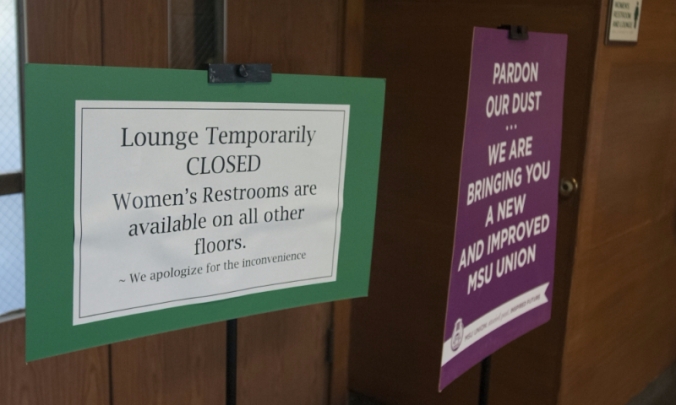
For various reasons, none of them reasonable, Michigan State University had maintained that gender segregation was appropriate in the student Union, and  a study lounge there was designated for women only. Perhaps we can forgive the school’s initial judgment in this case, since the Union’s Women’s Lounge, located on the main floor of the MSU Union, debuted in 1925, just five years after women gained the right to vote.Men vastly outnumbered women then, and were looked upon as oddities, or perhaps temptation.

It is 2016, however, and women are demanding equality where it may already exist, and declaring gender discrimination where it may not, so the continued existence of the male excluding lounge was more than a bit anachronistic. After all, Harvard College just declared war on any male student who dared to belong to off-campus all-male clubs, since even freedom of association away from school is deeply offensive to the progressive values of Ivy League educators.

Then a University of Michigan-Flint professor named Mark Perry, filed a complaint to the Michigan Department of Civil Rights towards MSU alleging that the lounge violated federal anti-discrimination law, which it obviously does. Continue reading
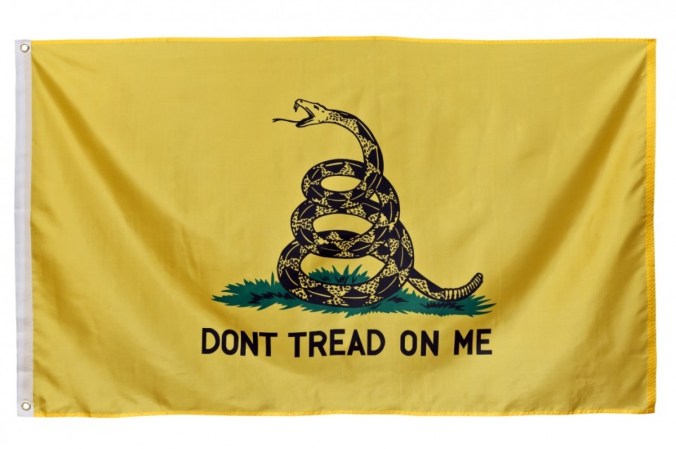
Observations On The Gadsden Flag Controversy

Gadsden Flag

On the Volokh Conspiracy, now featured on the Washington Post website, Prof. Volokh applies his First Amendment expertise to a recent EEOC decision which ruled that a complaint from an African-American that a fellow worker who repeatedly wore a cap with the famous “Don’t Tread On Me” insignia from the Gadsden flag may have created a hostile work environment at the federal agency both worked for. The Equal Employment Opportunity Commission called for further investigation, including an interview of the cap-owner’s intention in wearing the symbol, concluding,

“In light of the ambiguity in the current meaning of this symbol, we find that Complainant’s claim must be investigated to determine the specific context in which C1 displayed the symbol in the workplace. In so finding, we are not prejudging the merits of Complainant’s complaint. Instead, we are precluding a procedural dismissal that would deprive us of evidence that would illuminate the meaning conveyed by C1’s display of the symbol.”

Observations:

1. Now this is the slippery slope. Because murderous racist Dylan Roof posed with the Confederate flag, a tipping point was reached that resulted in the symbol and the flag being effectively and in some respects officially banned. The EEOC had already ruled the wearing a Confederate flag T-shirt constituted racial harassment,. Now the banning of historically significant symbols is threatening to spread to a flag that had no relationship to race whatsoever, in large part because of who has chosen to display it.

2. There is a whole website devoted to the Gadsden flag, from which we learn that…

  • It first appeared in October of 1775, as the British were occupying Boston and the desperate Continental Army was dug in in nearby Cambridge, lacking sufficient arms and ammunition.  In October, a merchant ship returning to Philadelphia from a voyage to England brought private letters to the Second Continental Congress informing it that  England was sending two cargo ships to America loaded with arms and gunpowder for the British troops.
  • Congress decided Washington’s troops’ plight required that those ships and their cargo be captured. It authorized the creation of a Continental Navy, then only four vessels, to take the ships. Congress also authorized the mustering of five companies of Marines. Some of the Marines enlisting that month in Philadelphia carried drums painted yellow, emblazoned with a  rattlesnake with thirteen rattles, coiled and ready to strike, accompanied by the motto “Don’t Tread on Me.”
  • That same December, a citizen calling himself  “An American Guesser,” anonymously wrote to the Pennsylvania Journal, saying in part:

“I observed on one of the drums belonging to the marines now raising, there was painted a Rattle-Snake, with this modest motto under it, ‘Don’t tread on me.’ As I know it is the custom to have some device on the arms of every country, I supposed this may have been intended for the arms of America…the Rattle-Snake is found in no other quarter of the world besides America….She never begins an attack, nor, when once engaged, ever surrenders: She is therefore an emblem of magnanimity and true courage. … she never wounds ’till she has generously given notice, even to her enemy, and cautioned him against the danger of treading on her..

I confess I was wholly at a loss what to make of the rattles, ’till I went back and counted them and found them just thirteen, exactly the number of the Colonies united in America; and I recollected too that this was the only part of the Snake which increased in numbers. …Tis curious and amazing to observe how distinct and independent of each other the rattles of this animal are, and yet how firmly they are united together, so as never to be separated but by breaking them to pieces. One of those rattles singly, is incapable of producing sound, but the ringing of thirteen together, is sufficient to alarm the boldest man living.”

It is generally agreed that the writer was really Benjamin Franklin. Ben had a hand in the design of the flag, since the first use of a rattlesnake to represent the colonies was his own “Join or die” cartoon,

800px-Benjamin_Franklin_-_Join_or_Die

…published years earlier. Continue reading

So It Has Come To This: Criminalizing Burps In Middle School

At  Cleveland Middle School in Albuquerque, a persistent class clown, age 13, kept burping in class, followed by the usual titters from his classmates.

I was in class with one of these characters in the 8th grade, and I must admit, his burp was something: loud, long, low, and seemingly inexhaustible. He was yanked out of class, he was sent to detention, his parents were called, he was suspended, and eventually, without too much conflict, he learned to cut it out. (They never caught the guy who shouted “HOG!” in a raucous voice during study hall.) Apparently this method was beyond the abilities of the  Cleveland Middle School staff to execute.

The teacher, Ms. Mines-Hornbeck, called the police, who arrested and eventually cuffed the boy. Principal Susan LaBarge and Assistant Principal Ann Holmes  not only suspended him for the rest of the school year, but allowed the criminal justice process to proceed, with the boy being processed for the charge of  violating a New Mexico statute, N.M. Stat. Ann. § 30-20-13(D), that reads…

No person shall willfully interfere with the educational process of any public or private school by committing, threatening to commit or inciting others to commit any act which would disrupt, impair, interfere with or obstruct the lawful mission, processes, procedures or functions of a public or private school.

That’s right: arrest and criminal prosecution for burping in class.

None of the staff at the school, apparently, had an ethics alarm go off that induced them to point out that the year long suspension was an unethically harsh punishment, and the criminal charge was tantamount to child abuse. I remember that in the fourth grade at Parmenter School in Arlington, Mass, my friend Timmy Russell was moved to leap to his feet during a math lesson and do a ten second imitation of Elvis singing “Hound Dog.” Everyone laughed, including the teacher. Then, that burst of childish energy over, she went on with the lesson, because she was a confident professional.

In New Mexico, 2016, Timmy would have broken the law. Continue reading

Two Critical Integrity Questions For African-Americans, University Administrators, Democrats, Civil Rights Advocates, Progressives And Social Justice Warriors

Seperate-but-Equal

First question: 

Are you prepared to rationalize this?

From the Wisconsin State Journal:

UW-Madison’s Multicultural Student Center separated attendees by race to discuss a violent week of news that stirred debates about racism and law enforcement, prompting criticism from conservative news outlets that the arrangement amounted to segregation.

Campus officials said the decision to hold separate meetings Monday for white and minority students, faculty and staff was made to ensure people of color had a place to discuss their concerns, and said the rules were not meant to exclude participants.

“No one was turned away from any session,” UW-Madison spokeswoman Meredith McGlone said in a statement.

A post that has since been deleted from the Multicultural Student Center’s Facebook page described the meetings as a place where students and UW employees could emotionally process the prior week, which included fatal police shootings of black men in Minnesota and Louisiana, followed by the targeted killing of five police officers in Dallas.

Two of the meetings were for white students and UW employees, according to the post, while two meetings were for people of color.

The Daily Caller, a national conservative news site, wrote about the meetings Monday night, posting a story that included a historic photo of a segregated waiting room sign. The site Right Wisconsin also wrote about the meetings.

McGlone said participants wanted “a space to express feelings without the fear of being judged.”

“Our students of color often find such spaces hard to come by,” McGlone said. “It is a best practice in student affairs to allow quiet and reflective space for those who request it.”

Still, McGlone said, the intent behind the different meetings “could have been communicated more clearly to avoid any impression of exclusion.”

McGlone did not respond to a followup question asking whether the Multicultural Student Center would use a similar structure for meetings in the future…

Here is a handy link to the Ethics Alarms Rationalizations List, so those of you choosing to try to justify this have all the necessary arguments in one convenient place..

The second question:

If you are not prepared to rationalize it, do you have the courage and integrity to condemn it?

Continue reading

The Black Lives Matters Effect, Part 2: Purdue’s Free Speech Chill

Perdue letter


So powerful is the desire to be seen as on the “right” side  in an era where race trumps everything that a major university is harassing a student because he dared to be critical of Black Lives Matter. This is another, more sinister aspect of the Black Lives Matter Effect. A racist hate group that claims to promote virtuous objectives as cover, Black Lives Matter causes well-intentioned progressives-in-denial to equate well-earned attacks on the group to rejection of racial justice.

This episode is especially troubling. Purdue University Northwest student Joshua Nash received an ominous letter summoning him to a “required Administrative Meeting” scheduled by a campus administrator to discuss Nash’s personal Facebook comments. This is as appropriate as a letter demanding a student’s appearance before authorities because there was a complaint about his off-color toast at a wedding reception.

Nash says he isn’t certain which Facebook post was deemed worthy of threatened discipline, but it was probably the one where he states “Black Lives Matter is trash because they do not really care about black lives. They simply care about making money and disrupting events for dead people.” According to Nash, that comment was reported to Facebook, with removed it and suspended his account for 30 days. Nash also claims that a campus official said his social media comments could result in his expulsion.

I assume that FIRE will soon be in Nash’s corner, and maybe, just maybe, the ACLU, depending on what its integrity level is these days. This is campus suppression of free speech. I think the threat of expulsion–for a Facebook post?—is too ridiculous to be taken seriously, but the letter is bad enough. All students need to know is that a politically incorrect Facebook post will get them hauled into a “meeting,” a.k.a. inquisition, and their speech, with the exceptions of a few wilful martyrs, civil libertarians, and rebels, will be effectively muzzled. Continue reading

The Quest For A Positive Argument For A Donald Trump Presidency Continues: The Pathetic Professor Kesler

Searching

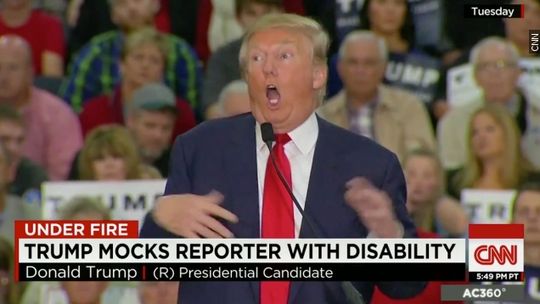
I am not a “Never Trump” advocate. I can conceive of a Presidential race that would force me to vote for Donald Trump, over, say, a Gorn, frightful Florida Congressman Alan Grayson, “Simple Jack” or Darth Vader. None of those, fortunately, are likely to be running in 2016, however, so the issue is moot. I have stated that there is no rational reason to vote for a candidate as undeniably unfit as Trump when the alternative is a candidate as undeniably as unfit as Hillary Clinton. Unlike Trump, Clinton does have positive features in her resume. As a Senator and former Secretary of State, she presumably has a passing comprehension of how the government works, and she comprehends the importance  of  public decorum and civility for a national leader, meaning that she knows that boasting about her penis or doing this…

Trump-Mocks-Disabled-Reporter-CNN-USA-Today

…is not remotely Presidential. Hillary’s positive features are, we all know, buried beneath the avalanche of her dishonesty, venality, incompetence and corruption,  but still, she has something. +1 beats – 1,606…even zero beats – 1,606.

Months ago, I challenged Trump supporters, Trump fans, Trump defenders and even Trump “oh come on, nobody is that bad”-ers to present a single, substantive, positive feature of Donald Trump that could justify voting for him as President. I have searched for and read alleged posts by professional pundits and others; I have listened to (until overcome with depression and nausea) Trump’s uniformly idiotic surrogates, and I have invited submissions. The results? Zilch. Nada. Bupkis.

“Hillary is evil!” is not a positive argument for Trump. Other submissions— “He’ll destroy the Republican Party, those collaborating traitors!”“I’m mad as hell, and I’m not going to take it any more!,” “He says what he thinks!,” “I hate political correctness!,” “He’ll stick it to the elites!” and the ever-popular incoherent grunt—are similarly non-responsive. I don’t think it is too much to ask, and the lack of any entry remotely meeting the modest requirements (the best so far is, “At least the news media might do their job with someone like him as President”) makes me more certain by the day that 1) I am correct to reject him and 2) that Gorn may not be so bad.

Clearly I am not the only one engaging in this quest. The Washington Post obviously searched under every rock to come up with an academic who would put his name on an op-ed last week titled “Why ‘Never Trump’ conservatives are wrong about Trump.”

He is Charles R. Kesler, a professor of government at Claremont McKenna College, and the editor of the Claremont Review of Books. My heart soared like a hawk when I saw the column:  Claremont McKenna is an excellent institution, and finally someone who does not communicate in howls, hocks and memes had written down a substantive argument to vote for Donald Trump!

But no.

Here, alas,  are his “substantive” points: Continue reading

KABOOM! The Tale Of The Third-Grader’s Racist Brownie Offense: No, I Don’t Understand This At All

brownies explosion

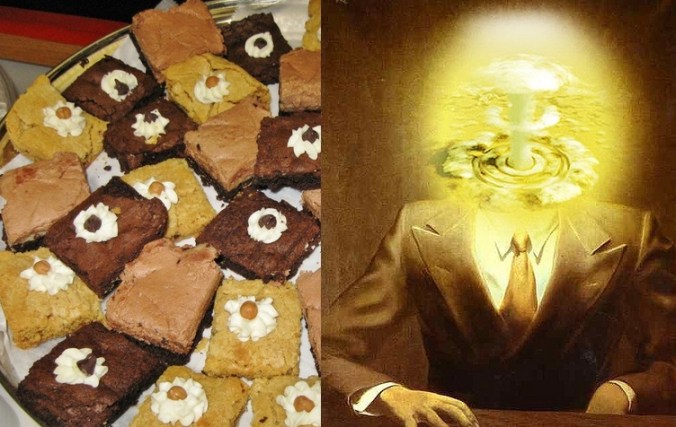
This story made my head explode, and thus it will be tagged “Kaboom!” Unlike most such Kaboom! posts, however, this one is likely to make my head explode every time I read it. Or think about it. Forever.

On June 16, a third grader made a comment about the brownies being served to his class during an end-of-the-year class party at the William P. Tatem Elementary School in Collingswood, New Jersey.  After another student opined that the remark was “racist,” the school called the Collingswood Police Department.

Okay, stop. I’m puzzled already, and my head exploded again just writing that:

  • How could a comment about brownies be racist? Did the child say, ” As with human beings, the blonde brownies are innately superior to the dark ones”? Somehow, I doubt it.
  • Another third grader pronounced the statement as racist. Not a teacher, now. An eight-year old. How can that trigger anything, in a sane world, but a discussion led by the teacher about what is and isn’t racist, and how people shouldn’t leap to such  inflammatory observations, because it makes human interaction difficult if not impossible?
  • The school called the police department? For what? A threatened brownie massacre? How is this conceivably a police matter? Why did the police come?

“What is the nature of your emergency?” “A third-grader in my class made an inappropriate remark about brownies!” “Calling 911 with prank calls is a crime, ma’am. Don’t do this again.” 

It is per se unethical and irresponsible for any police department to treat such trivia seriously.

All right,slogging on… Continue reading

Gene Autry Misinformation Update: Believe It Or Not, It Happened Again!

"Wild Bill" Donovan, who should have had nothing whatever to do with my ethics seminar today, but did anyway...

“Wild Bill” Donovan, who should have had nothing whatever to do with my ethics seminar today, but did anyway…

Yesterday I wrote about a lawyer in a legal ethics seminar interrupting me with a revelation about Gene Autry that was completely false.

Today I taught another legal ethics seminar, this time for a government agency. I was discussing was the various government ethics dilemmas in “Bridge of Spies,” the story of how lawyer Jim Donovan helped secure the release of downed U.S. flyer Francis Gary Powers in a famous incident during the Cold War. Many of the issues covered in my presentation were explored in this Ethics Alarms post.

As the film portrays it, Donovan, an insurance lawyer, does such a tenacious job defending an accused Soviet spy from U.S. government prosecution that the CIA recruits him to broker the trade of his now-former client, convicted and in prison, for Powers. In discussing the classic government lawyer dilemma of “who is the client?,”  I noted that the CIA agent who recruited Donovan told him that he would have no client. “Why did the CIA trust Donovan?” I asked socraticly. “Why did Donovan, an insurance lawyer, think he was qualified to engage in this kind of representation, it it was a representation?”

For the second time in nine days, an attendee piped up with an amazing piece of information.

“I suspect some of the answer to both questions is that James Donovan was the son of “Wild Bill” Donovan, who is considered the father of the Central Intelligence Agency,” he said. Continue reading

Four Supreme Court Decisions: Abortion, Guns, Affirmative Action, Corruption…And Ethics. Part I: Fisher v. University of Texas

Abigail Fisher: Not dark enough to get "an equal shot"

Abigail Fisher: Not dark enough to get “an equal shot”

The under-populated U.S. Supreme Court recently made four decisions on issues with ethical principles involved. This is the first of four posts reviewing the ethics implications of the decisions.

I. Affirmative Action: Fisher v. University of Texas

The University of Texas’ admissions program guarantees admission to top students in every high school in the state. It is dubbed the  Top 10 Percent program, though the percentage cutoff is flexible. A second part of the admissions program admits other students from Texas and elsewhere using standards that take into account academic achievement and other factors, including race and ethnicity. Many colleges and universities base all of their admissions decisions on such grounds. The case before the Court challenged that part of the program, and presented an opportunity for the Supremes to finally declare affirmative action unconstitutional, as previous opinions hinted they might do some day.

This was not the day, however. Justice Kennedy, writing for the majority, said courts must give universities significant but not total autonomy in designing their admissions programs, writing:

“A university is in large part defined by those intangible ‘qualities which are incapable of objective measurement but which make for greatness.’ Considerable deference is owed to a university in defining those intangible characteristics, like student body diversity, that are central to its identity and educational mission.But still, it remains an enduring challenge to our nation’s education system to reconcile the pursuit of diversity with the constitutional promise of equal treatment and dignity.”

This defines either an ethical dilemma, which the Court’s majority is punting, or an ethical conflict…which the Court majority is punting. Is diversity an ethical objective, or a practical one, that is, a powerful non-ethical consideration? It is hard to argue that diversity in a student body isn’t desirable—to enhance the educational experiences of students, to avoid having a permanent, under-credentialed underclass, to “look like America.” However, fairness and common sense argue that admitting one candidate over another who is better qualified simply because of ethnicity or race is per se wrong. I don’t blame the Court at all for not making a clean call.

As usual, President Obama described the result in simplistic terms. “I’m pleased that the Supreme Court upheld the basic notion that diversity is an important value in our society,” he told reporters at the White House. “We are not a country that guarantees equal outcomes, but we do strive to provide an equal shot to everybody.”

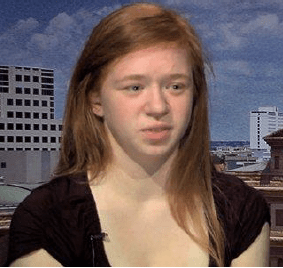
Thank you, President Obvious. The crux of the case, however, was what should be done when using race as a standard for admission to attain that diversity denies an “equal shot” to someone who has the misfortune to be white, like Abigail Fisher, or Asian-American. Continue reading

Why Does Colby College Think That It’s Ethical To Keep A “Bias Incident Log”?

Might be time for a new motto, Colby. On the other hand...

Might be time for a new motto, Colby. On the other hand…

Wait…you say that more than a hundred campuses have this or the equivalent?

Oh-oh.

I am scheduled to teach a legal ethics class in the avoidance of bias in the practice of law next year, and I’m already worried. Past engagements of mine on this topic have been popular with attendees, but not always appreciated by my clients. The bar associations that make such training mandatory usually want to get someone to drone on about how lawyers should love Big Politically Correct Brother and search their souls for any germ of an attitude that would make Chris Matthews say they are racist, or the President of NARAL say they are sexist, or a Black Lives Matter activist call them privileged.  In other words, these are often devised as political indoctrination courses, using “bias” as code for “non-conforming thoughts according to progressive orthodoxy.”

I can’t and won’t teach that, because it’s as wrong as it is boring. Bias includes all ideas wedged in our minds that overcome reason and prevent just, even-handed, logical and fair decision-making. Bias makes us stupid, and for lawyers, the kind of bias I’m talking about undermines justice. Ironically, what most proponents of anti-bias courses want to do is instill biases that they and their partisan allies approve of. Once that is done, the Orwellian process is complete. “Bias” then means “not accepting our biases, which aren’t biases because we believe them, and we are good.”  The rationalization involved is 14. Self-validating Virtue.

The news and ethics issues are reaching one of those crisis points for me where everything seems to be connected to everything else, and I am torn whether to write one huge, conceptual post (the ones most readers skip) or a series of single episode posts. Facebook, a topic on its own, is revealing most of my friends whom I would identify as Democrats or progressives as in the grip of a crippling cognitive bias-based malady. Why did they think it was just wonderful for so many elected officials to deliberately ignore the core Constitutional principle of due process? Why did they reflexively attack the British vote to leave the European Union as “racist” or “xenophobic” rather than recognize it as a principled reassertion of their nation’s autonomy and democratic principles? How did freedom of speech, freedom of thought, true civil rights, and democracy itself become so alien to so many supposedly intelligent and self-proclaimed liberal adults?

Don’t worry, I’m coming back to Colby. It really does come down to bad and anti-American education poisoning the culture. In an excellent though disturbing essay on the Ethics And Public Policy website, Stanley Kurtz persuasively argues that U.S. education itself has turned against liberty, resulting in an increasing majority of citizens who do not believe or accept the virtues of core American ideals.

The incident that brought my attention to the Colby Bias Incident Log, which, at Colby and elsewhere, sends a Bias Response Team into investigation mode, was one in which a student was reported for allegedly using the idiom “on the other hand.”

No, this is not a hoax. It is not a joke. And what the fact that I am writing this suggests is far from funny. It is tragic. Continue reading