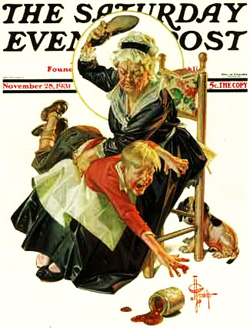
The Ethics of Corporal Punishment For Children

Spare the rod, and avoid a restraining order...

The societal approval pendulum has swung so far away from physically punishing children that a formal spanking risks an accusation of child abuse. The Hawaii Supreme Court, in the case of Hamilton ex rel. Lethem v. Lethem,  in which a retraining order was issued against a father accused of abusing his 15-year-old daughter, pronounced guidelines for determining what constitutes reasonable and moderate corporal punishment of a child by a parent, ruling that such punishment is reasonable (and a Constitutional right ) when..

  • “…the parent’s discipline is reasonably related to the purpose of safeguarding or promoting the welfare of the minor,”
  • The punishment properly takes into account the nature of the misbehavior,
  •  …the child’s age and size, and
  • …the nature and propriety of the force used. Continue reading →

Where Should The Alarms Sound For THIS?

I have little to add to the video above, which is nearly self-explanatory. A student took a video camera to the halls of his Washington State high school to quiz  class mates on basic U.S. history, geography and civics. I’m sure—I hope—that the answers shown on the video were atypical, but never mind: they are scary enough.

The blogger Kevin DuJan on Hillbuzz uses the video to attack teachers unions, writing,

As I watched the video above, two thoughts immediately popped into my head:

1. Why do teachers’ unions claim they deserve more pay and endless benefits when this is the result of their “hard work” in the classroom?

2. I honestly can’t remember anyone this dumb in my Catholic high school back in Ohio when I was going to school in the mid-90s. Continue reading →

Tales Of Ethics Dunces Past: Recalling the Self-Indulgent Suicide of Hunter Thompson

I can’t claim that I am surprised that my post about the suicide of Don Cornelius attracted comments that either showed a misunderstanding of what I wrote or a stubborn determination to change the subject. It was not a post about the virtues of suicide, but about how suicide’sethical calculations may be changing as a broken medical care system increasingly makes the final years and months of the elderly a burden that crushes families and constricts the quality of life  for the nation generally. In short, killing yourself for your country may have to become an accepted practice, an ethical and courageous act, if something doesn’t change. Killing yourself for yourself—to avoid pain, problems, or the consequences of your own actions, should always be considered wrong, for wrong it is.

Jeff Hibbert, one of my favorite contributors here and also one with a great memory, reminded me that I had written on this topic once before. I had forgotten, but that post may be a useful contrast to the Cornelius post. There is not a word of it that I don’t still believe. It concerned the 2005 suicide of Hunter S. Thompson, the cult “gonzo journalist” who lived like frat boy and  wrote like angel. Here it is:

Hunter Thompson’s values were admittedly always a little out of whack, but nothing diminished the self-styled “gonzo journalist” in this world so much as his manner of leaving it. He shot himself to death last February while talking on the phone to his wife, with both his son and grandson in his house with him. Nice. That should guarantee some lucky psychoanalyst or three a comfy income for the foreseeable future. Continue reading →

Don Cornelius, Suicide…and Ethics Hero?

“Soul Train” creator and pop culture icon Don Cornelius took his own life at 75 yesterday, using a gunshot to the head to do it. Suicide always conjures up feelings of special sadness for the deceased, sometimes mixed with anger. The act can be cruel and devastating to family members and friends; often it leaves behind crushing problems, financial and otherwise, that the living have to deal with. Suicide is stigmatized in our culture as a coward’s way out of earthly problems; many religions consider it a sin, and many legal systems consider suicide a crime. Yet it may be that American culture will have to undergo a major cultural transformation in the matter of taking one’s own life. While morality tends to ossify, ethics is fluid and adaptable. Changing conditions and new realities can, in rare circumstances, cause societies to conclude that what was once considered right is really wrong, and what was once condemned as wrong is in society’s best interests. I think we may reach that point with suicide. Continue reading →

Comment of the Day: “Let’s Have An Open Debate on Both Sides …”

Blameblakeart’s comment to my post about the school district that condemned a student’s high school newspaper anti-gay adoption column, part of a “pro vs. con” feature approved by the editors and faculty advisor, illustrates a point that was the subtext of my post but never explicitly stated.  It should have been, but blameblakeart shows how it’s done. The productive, educational, fair and persuasive way to rebut any argument is by using facts and logic, not to just condemn it as “offensive” or “bullying,” or to discourage future expressions of unpopular points of view. That is true in school and out of it.

Here is his Comment of the Day on the post, “Let’s Have An Open Debate on Both Sides of This Controversial Issue. Wait…Your Side Offends Me. Shut Up. You’re A Bully.”  I’ll have a comment at the end: Continue reading →

Republican Nomination Ethics Points, 1/18/2012

I’m sitting here watching the GOP Final Four debate. Here are some brief ethics observation on a lively day in the race:

  • At the opening gun, Newt Gingrich gave a bravura performance of indignation personified when moderator John King asked him about the looming ABC interview of his ex-wife, Marianne, in which she impugns Newt’s character and claims that he asked her to agree to an “open marriage.” He told King it was a despicable question and said that the issue was not worthy of mention. Good act, but of course the question of character is relevant, and of course Gingrich, who has none, wouldn’t think so. Continue reading →

Ethics Dunce: Greta Van Susteren

Newt: ” Honey, I’m divorcing you to marry the woman I’ve been cheating on you with for the last 6 years.” Marianne: “Fine. Just wait til you run for President. I’ll be ready.”

Newt Gingrich’s second (of three) wife, Marianne Gingrich, has said in the past that she had it within her power to  end her ex-husband’s career with a single interview. This is not as remarkable as it sounds; just consider how many political spouses past and present have or had that power regarding their own power partners. Let’s see: Eleanor Roosevelt…Jackie Kennedy…Coretta Scott King…Lady Bird Johnson….Pat Nixon…Hillery Clinton, of course…Bill Clinton…Laura Bush…Tipper Gore. That’s just for starters. I have no doubt that Marianne Gingrich might be able to tell tales that would make any of these women feel fortunate by comparison, but on the other hand, what could she say that would be a surprise? Anyone who doesn’t know by now that Newt is about as miserable an excuse for a human being as one can be and avoid being shot or imprisoned hasn’t been paying attention.

This is the problem, however. People don’t pay attention, and have the memories of Eric Holder under Congressional questioning about Fast and Furious. After Gingrich’s deft response to Juan Williams’ accusatory race-baiting question at the last South Carolina debate sparked a standing ovation, you would have thought that he was the new star on the scene to hear callers on conservative talk-radio rave.* Yes, yes, Gingrich is smart and articulate. So were Richard Nixon, Tom DeLay, Huey Long and Joe McCarthy. So were Professor Moriarty and Goldfinger. We know Newt is smart; we also should know other things about him by now, like the fact that he’s an untrustworthy narcissist and a cur.

Apparently Marianne Gingrich has decided to do America a favor and to remind amnesiac Republicans once and for all who they were cheering this week. She has taped a two-hour spill-the-dirt interview with ABC News. The Gingrich camp is in a panic, and supposedly there is an ethics debate at ABC about whether the interview should air before the critical South Carolina primary, possibly Newt’s last chance to stop the Mitt Romney juggernaut, or after. Fox host and legal analyst Greta Van Susteren comes down on the side of holding the interview in the can until Monday. On her blog, she writes: Continue reading →

The “I Have A Dream” Speech Ethics Train Wreck

Dr. King's familiy says this was a "performance" not a speech. Funny: I thought he was just speaking the truth. I guess I was dreaming.

Take Martin Luther King Day, turn right at the “Stopping Online Piracy Act” (SOPA/ PIPA) protests, and you get to the ridiculous fact that you are breaking the law anytime you circulate a recording or video of the Martin Luther King’s immortal “I Have A Dream” speech.

Through a baroque combination of expediency, legal maneuvers, luck and greed, this vital part of American thought, rhetoric, culture and history is restricted by the copyright laws, and will not be in the public domain until 2037, or more than 70 years after King’s words were spoken in front of the Lincoln Memorial. Now, under SOPA/PIPA, if it passes, any educational website that includes a video of the King Video could be taken down by the Feds, but that’s a side issue. I am no expert on the bill, but you can brief yourself on what all the fuss is about here, here, here, and here, the bill itself. Similarly, if I tried to explain the legal process by which courts agreed that a critical chapter in American history should be unavailable to Americans unless they pay a fee, it would 1) bore you stiff, 2) confuse you, and 3) probably be wrong. So I recommend this post by Alex Pasternak over at Motherboard, who does a great job laying out the whole, tortuous, tragic story.

I’ll concentrate on the ethics train wreck feature, of which the basic elements are these: Continue reading →

“Ask Amy” Tackles A Classic—And Misses

Advice columnist Amy (of the syndicated column “Ask Amy”), was just asked one of those questions that every advice maven has to have in their files, with the perfect answer ready to go. If Amy had her answer prepared, it was  the wrong one.

The question was the deathless classic, “I just found out my husband has been having an affair with a married co-worker. Should I tell the other spouse?”

Amy gets it half right: she tells the reader that the other spouse has a right to know; that this is not a case of meddling because the reader is directly involved in the betrayal; and that not to make sure the other spouse learns the truth would now be abetting the deception. All true. BUT…

…Amy forgets the Golden Rule as it applies to the reader’s husband’s adulterous lover (yes, the rule still applies to busted wrongdoers) and the whistleblowers obligation to minimize needless harm. She tells the victimized wife to spill the beans to the victimized husband.

Wrong.

The adulterous wife deserves the opportunity to tell her husband herself. That would allow her to reveal the affair to her spouse with the least damage to the marriage, and providing that opportunity to her is kind and fair. Amy should have told her reader to contact her husband’s paramour and say this: “I will be calling your husband and telling him about your relationship with my husband in three days. You should tell him the truth yourself, and then all he needs to say to me when I call is, ‘Yes, she told me.’ But if you haven’t told him, he’ll hear it all from me.”

File it away, Amy, and get it right the next time.

The Third Annual Ethics Alarms Awards: The Worst of Ethics 2011 (Part 1)

Yes, it was Joe Paterno's year, all right.

Welcome to the Third  Annual Ethics Alarms Awards, recognizing the Best and Worst of ethics in 2011!

This is the first installment of the Worst; Part 2 is here. And the Best is here. 

2011 prompted more than 1000 posts, and even then I barely scratched the surface of all the ethical dilemmas and unethical conduct swirling around us. If you have other choices for the various distinctions here and in the subsequent Awards posts, please make them known.

Here are my selections:

Unethical Community of the Year:  Huachuca City, Arizona. Leading the way among American communities that believe, in their hysteria, that former sex offenders who have served their sentences are nonetheless fair game for persecution and the denial of basic rights as citizens and human beings, Huachuca County passed an ordinance that bans registered sex offenders from the use of all public facilities, including parks, school and libraries.  Runner-up: Obion County, Tennessee. Last year, Ethics Alarms gave the county runner-up status as “Unethical Community of the Year” for sending its volunteer fire department to watch a man’s house burn down because he had failed to pay a $75.00 fee. In 2011, it did it again. I swear: if Obion County hasn’t come up with a better system and this happens again in 2012, Obion County will get the title no matter what some other unethical community does.

Most Warped Ethical Values: The Penn State students who protested the firing of football coach Joe Paterno, because, you know, he was such a great football coach that a little thing like allowing a predatory child molester to run amuck on campus shouldn’t be blown all out of proportion. Runner-up: Ron Paul supporters.

Unethical Website of the Year: Lovely-Faces, the anti-Facebook stunt pulled by Paolo Cirio, a media artist, and Alessandro Ludovico, media critic and editor-in- chief of Neural magazine, to show how inadequate Facebook’s privacy controls were. To do it, they stole 250,000 Facebook member profiles and organized them into a new dating site—without the members’ permission. The site embodied “the worst of ethical thinking: taking the identities of others for their own purposes (a Golden Rule breach), using other human beings to advance their own agenda (a Kantian no-no) and asserting that their ends justify abusing 250,000 Facebook users, which is irresponsible utilitarianism.” Continue reading →