And Today’s Worthless Study Is: “2020’s Most Patriotic States In America”

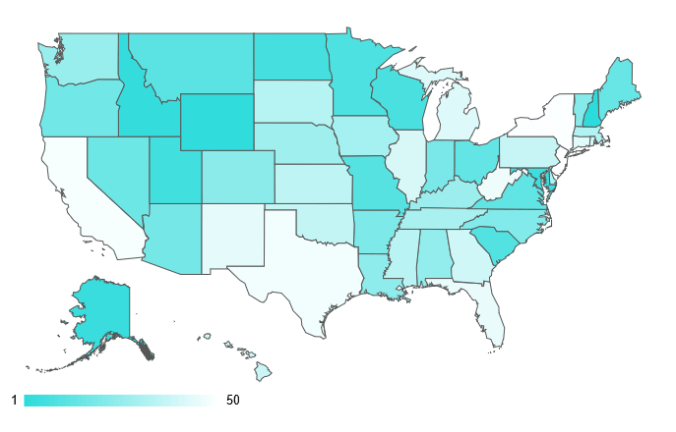
In plenty of time for the weird Fourth of July celebration coming up, a financial website called WalletHub spent a lot of time and money researching the a question nobody seriously would ask: How do the 50 states rank in strength of patriotism from best to worst?

The study came up with an answer, and the answer is being dutifully reported in newspapers and websites as if there is any reason in the universe to believe it. New Jersey ranked last in patriotism, the New York Post gloated. #1? New Hampshire!

The study report is here.

You can go to the link and check it out, or watch this:

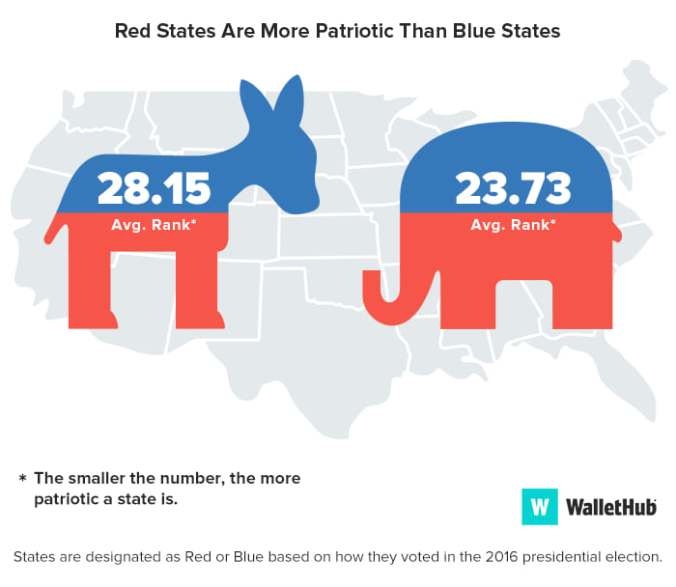
The significance of the study results is zero. Nothing. The study consists of misleading and arbitrary data assigning numbers according to subjective criteria to measure something that cannot be measured because it cannot be conclusively defined. Nonetheless, the study is willing to present findings like this:

What, exactly, does this tell us? What is the gravamen of a difference of 4.42 points in the average score of “red” vs. “blue” states? I have no idea. I don’t think the researchers do either. Continue reading →

Ethical Quote, Fair Quote, Unethical Quote, Share Quote…

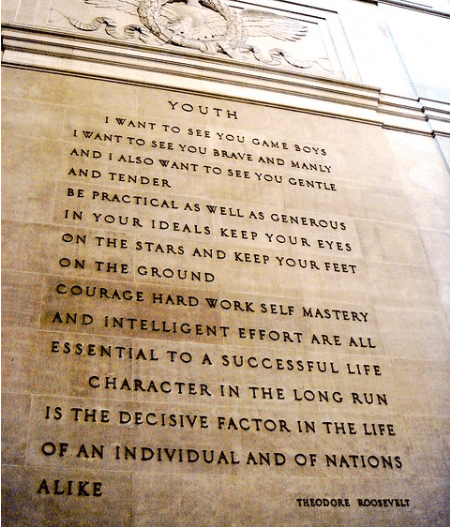
The ethical quote:

These words are on the outside wall of the Museum of Natural History near the Teddy Roosevelt statue that will be coming down, according to the museum.

The quote is a far better memorial to Roosevelt  and his character than the statue.

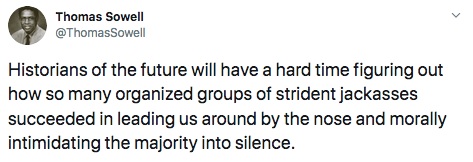
The fair quote:

The question is how soon this will dawn on the groveling, and how soon the intimidated will have the courage to speak the truth.

The unethical quote:

The Washington Post issued a justification for its widely (and correctly) criticized 3000 word story about a politically incorrect  costume that a woman wore at the Halloween party of Post editorial cartoonist Tom Toles two years ago. Because two vicious social justice Furies who were guests at the party decided that the current George Floyd Freakout presented  an opportunity to humiliate the woman and contacted the paper, it published 3000 words about an old, private incident, resulting in the woman losing her job, and Toles, who had refused to identify her when one of the vengeful and self-righteous women called him to re-open the episode, was embarrassed by his own employer.

The Post’s own readership found the paper’s news journalism ethics atrocious (as do I), prompting this response from a spokesperson to Fox News:

“Employees of The Washington Post, including a prominent host, were involved in this incident, which impelled us to tell the story ourselves thoroughly and accurately while allowing all involved to have their say. The piece conveys with nuance and sensitivity the complex, emotionally fraught circumstances that unfolded at the party attended by media figures only two years ago where an individual in blackface was not told promptly to leave. America’s grappling with racism has entered a phase in which people who once felt they should keep quiet are now raising their voices in public. The story is a microcosm of what the country is going through right now,”

A simple “We’re sorry, we screwed up, the story never should have been written and we don’t know what came over us and we pledge to be more responsible and to exercise better judgment in the future” might have salvaged a smidgen of the paper’s rotting reputation. Instead we have more evidence of just how unethical and untrustworthy this rag is: Continue reading →

Monday Ethics Warm-Up, 6/22/2020: Lenin, Oliver, And The Troublesome Name

It would be well to consider the fate of that ultimate Sixties folk-pop group the Mamas and Papas, as we watch today’s idealistic anarchists make fools of themselves. By mid-way through their four-year run (during which they sold 40 million recordings), the group was self-destructing with inter-and extra-group sexual affairs and stage appearances where one or more of the group was too drunk or stoned to perform. The group kept breaking up and re-assembling, and fell apart for good in 1969. Mama Cass died of heart failure at the age of 34, after battling heroin addiction and other substance abuse. John Phillips, the creative leader of the group, also was a heroin addict and had emotional and substance abuse problems that he managed to pass on to his daughter, actress Mackenzie Phillips. In her memoir, “High on Arrival,” she wrote that she had a long-term sexual relationship with her father. Papa John also died of heart failure, when he was 66. Tenor Denny Doherty’s solo career flopped after the group ended. He was an alcoholic, but stayed sober for the final decades of his life. An acting career also failed; he finally got a gig as the “Harbormaster,” hosting a kids TV show that was a flagrant rip-off of “Thomas the Tank Engine,” but starring a talking tugboat. Doherty was 67 when he died from an aneurysm.

Michelle Phillips is the lone survivor of the group. She avoided substance abuse problems and after divorcing Phillips, whom she wed at 18, went on to a moderately successful acting career.

As today, these people who aspired to inspire lacked the wisdom, common sense, self-discipline, character, values or perspective to be trusted with their chosen mission.

1. Speaking of...When asked how it was that a statue of Vladimir Lenin was still standing in Seattle when protesters had toppled those of Ulysses S. Grant and others, the Human Rights Campaign’s Charlotte Clymer said, among her reasons, that “Lenin was not a slave-owner, you Confederate apologist fucks.”

To which National Review writer David Harsanyi responded with the obligatory, “Lenin created tens of millions of slaves.”

In related news, a 2015 video  of an interview with Black Lives Matter founder Patrisse Cullors shows her saying, “We actually do have an ideological frame. Myself and Alicia in particular, we’re trained organizers. We are trained Marxists. We are super versed on ideological theories…”

Several of the tenets seen on the BLM website are redolent of Karl. Do all these companies and pandering celebrities giving lip service to the group, attaching #BlackLivesMatter to their tweets and proclaiming support, know what they are supporting? I think it’s pretty obvious that they don’t. They are signaling their virtue by ostentatiously endorsing the most simple-minded and deceptive interpretation of the slogan, as if there is anyone who believes black lives don’t matter. I bet the vast majority have never visited the BLM website and read its agitprop.

That, needless to say, is as dumb as it is irresponsible. Continue reading →

Nearing The Abyss: The Democrats, “The Resistance” And The Media Cheer On Campaign Sabotage

Brian looks pleased, doesn’t he?

What Ethics Alarms terms the Axis of Unethical Conduct or AUC—the alliance of the Democratic Party, “the resistance” and the mainstream news media—reached a new low in hostility to democracy and  new high in hypocrisy yesterday after it was confirmed that the turnout for President Trump’s campaign rally in Tulsa had been undermined by Nixon-style “dirty tricks.”

Yesterday morning, the front page of the Times was gloating over the surprisingly small audience for the President. Written by a team including staff Trump assassin Maggie Haberman,  the story, which yesterday had a headline stating that the rally “sputtered” and on line says it “fizzled,” said in part, “The weakness of Mr. Trump’s drawing power and political skills, in a state that voted for him overwhelmingly and in a format that he favors, raised new questions about his electoral prospects for a second term at a time when his poll numbers were already falling.” It quickly became clear that there were sinister factors at work, but the reporters allowed confirmation bias to suppress what should have been an automatic instinct: “Gee, what could have caused this?” Instead, they went with an analysis based on their desires and hostility to the President, and presented readers with fake news.

Nah, there’s no mainstream media bias.

It soon became clear that Tik-Tok and K-Pop users, mostly teenagers, reserved hundreds of tickets for the rally, without any intention of showing up. Brian Stelter, CNN’s risible “media watchdog,” happily reported Sunday morning,

“And it seems that one of the other reasons why there were so many empty seats is a no-show protest. A no-show protest. This all started with a video on TikTok created by Mary Jo Laupp, who is effectively being called a ‘TikTok grandma.’ So, she made a video more than a week ago urging viewers to go to Trump’s site, sign up to attend the rally, but pointedly not show up at the rally. And look, it did seem to work to some degree. We don’t know exactly how well but Trump’s campaign manager Brad Parscale was out there talking about how many people were signing up…..

In a tweet, Parscale had announced that there had been 800,000 requests for tickets.

Stelter then rewarded the organizer of this operation by bringing her on his show to interview. Her rationalization for the dirty trick was that black activists were angry because the President had scheduled his rally on the same week as “Juneteenth,” that revered annual holiday that virtually no one, including CNN, had ever talked about before the George Floyd Freakout. Continue reading →

Ethics Dunce: Nikole Hannah-Jones

Nikole Hannah-Jones, staff writer at The New York Times and lead essayist in The New York Times Magazine’s “1619 Project” tweeted that she finds the common rebuttal of presentism—the popular practice of condemning those of different times and cultures for not magically acquiring the evolved beliefs and values that those who have had the advantage of decades and even centuries of experience, observation and enlightenment—that those criticized were of their time “offensive.”

“I mean, Hitler was a man of his time. Bin Laden was a man of his time,” the Pulitzer Prize winner tweeted. “It’s a justification and unnecessary.”

This is the quality of analysis and thought we now receive from the best of American. journalists, one who has been deemed worthy of the occupation’s highest honor.

First, it is profoundly unrealistic and unfair to expect those raised in a culture with long-established values to determine on their own that such values are flawed or based on faulty assumptions and information. This should be intrinsically obvious to anyone capable of critical thought. Continue reading →

Sunday Ethics Warm-Up, Father’s Day Edition Though There’s Absolutely Nothing Here About Father’s Day

Happy Father’s Day.

On YouTube, the first comment on this video is from someone who writes, “It’s a grate song.” Yeah, THAT guy had one hell of a father…

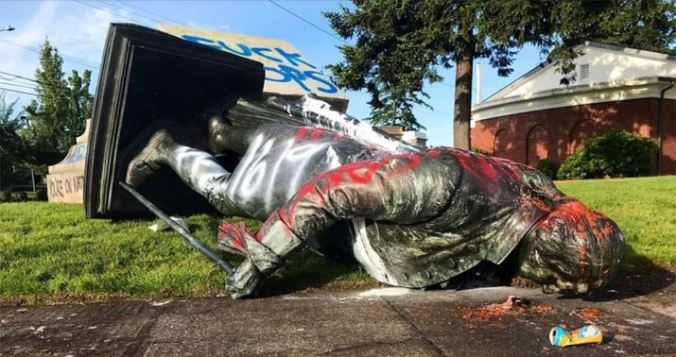
1. Bored with statue-toppling and honor stripping yet? Obviously the Hun and Vandals aren’t. Here in the D.C. universe, George Preston Marshall the original owner of the Washington Redskins who was the NFL’s version of Cal Griffith, lost his statue two days ago when the D.C. government pulled it down after protesters had vandalized it. Mayor Bowzer is one of the Democratic mayors who are actively enabling the protests. Of course, with statues being indiscriminately being toppled now, the gesture is increasingly less meaningful. Woodrow Wilson, the white-supremacist, racist President who spread the Spanish flu around the world by sending infected troops into Europe when he  sent the U.S. into The Great War for no discernible reason, and who then planted the seed for World War II by sitting by and allowing the victorious English, French and Italians inflict devastating punitive  term on Germany as long as he got his pet project, the League of Nations, into the Versailles Treaty, will have his name removed from buildings by Monmouth University and  Camden, New Jersey. A private college in West Virginia announced last week that it is removing the name of the late U.S. Sen. Robert C. Byrd from its health center. The Democratic Byrd may have been a reformed KKK member, but he also brought many millions of dollars into rural West Virginia, thus explaining the proliferation of his family’s name there. Surely you heard that protesters in Liverpool, England, want to rename Penny Lane of Beatles song fame, because a Liverpool man with the last name of Penny was a slave-trader. Was the street actually named after him? No, there’s no indication that it was, but hey, any association with the name Penny now has a “connection” to racism, so let’s see how far this goes. Penny candy! Penny arcades! Penny loafers!  Penny, Sky King’s niece on the old TV show!

Meanwhile, Dreyer’s Grand Ice Cream, the owned of Eskimo Pie, now says the name is “derogatory,” and that it will be changing the product’s name and marketing. The head of marketing  told CBS News. “We are committed to being a part of the solution on racial equality, and recognize the term is derogatory.”

This is yet another example of the Niggardly Principle. The term Eskimo, according to the Alaska Native Language Center at the University of Alaska Fairbanks, actually came from the French word esquimaux, meaning one who nets snowshoes, like what  Arctic peoples do. Never mind: the rumor started that the term was racist because racist Europeans used it. I highly doubt any native Inuit people are offended by the name of the ice cream bar. In fact, many Native Alaskans still refer to themselves as Eskimos, in part because the word Inuit isn’t part of the Yupik languages of Alaska and Siberia. Is it racist when they use it?

Losing its famous brand will almost certainly eliminate the product, costing business and jobs, but apparently it’s worth it for the company to signal it’s virtue with a move that can’t possibly have any salutary effect on racial equality whatsoever.

“Madness. Madness!” Continue reading →

Statue-Toppling, The Ethics Incompleteness Principle, And Calvin Griffith, Part Two

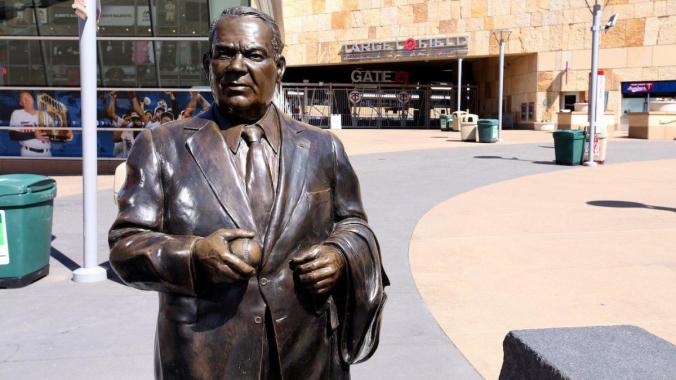
Where Cal Griffith’s statue once stood…

Here is what Calvin Griffith said in the 1978 remarks that led the Minnesota Twins to remove his statue in from of the team’s stadium, Target Field.

Griffith was invited to speak to the Lions Club in Waseca, a small city in southern Minnesota. Taking questions from the audience after his planned speech, someone asked Griffith  why he brought the Twins to Minnesota from Washington, D.C., in 1961. Griffith lowered his voice, asked if there were any blacks around, and  looked around the room. Apparently confirming that his audience was all white,  Griffith said,

“I’ll tell you why we came to Minnesota. It was when I found out you only had 15,000 blacks here. Black people don’t go to ball games, but they’ll fill up a ‘rassling ring and put up such a chant it’ll scare you to death. It’s unbelievable. We came here because you’ve got good, hardworking, white people here.”

It’s hard to get more racist than that, at least short of a Klan rally. I’ll poll this at the end of the post, but I believe that this is a case where the Ethics Incompleteness Principle applies, and the usually valid ethical objections to pulling down the statues of problematic, controversial or subsequently disgraced historical figures have to yield to other considerations, which are these: Continue reading →

Comment Of The Day: “Saturday Ethics Freakout, 6/20/2020: Fake News, Resignations, Topplings And Cancellations…But Also Hope,” Item #4

The toppling of a statue of our 18th President and the Civil War general who defeated Robert E. Lee, Ulysses S. Grant, in San Francisco should disabuse the historically literate of any misconception that all of the George Floyd demonstrators are concerned with “systemic racism.” Dishonoring Grant, as well as Francis Scott Key, whose statue also was pulled down, is signature significance for enmity toward the United States itself. 

Steve-O-in-NJ performed a service for all of us by taking the time to provide a concise and informative summary of this important American’s life of public service for Ethics Alarms readers. There are several references to Ulysses S. Grant on the blog; the most extensive was this segment of the President’s Day post in 2015:

My son is named after Grant, arguably the nicest and most sensitive of our Presidents. (How this sensitive man was able to sacrifice his soldiers in the thousands to win the horrible battles he did is an enigma.) As a cadet at West Point he drew pictures of horses obsessively; in the field, he refused to allow any of his men to see him unclothed. He loved his wife passionately, and wouldn’t allow her to get her badly crossed eyes fixed, because “God made her that way.” When his daughter was married, he retired to his bedroom and could be heard sobbing for over an hour.

As President, he was fatally handicapped by his nature, which caused him to trust people he shouldn’t and allowed others to exploit his good nature. The result was several scandals engineered by his appointees and associates, including Crédit Mobilier and the Whiskey Ring. Yet he had a natural aptitude for leadership, as his superb autobiography proved on every page. He could manage and lead; what he was bad at was manipulation, deceit, pretense, and retribution—in short, politics.

In one odd area, his customary sensitivity was completely lacking. He hated music of any kind.

Here is Steve-O-in-NJ’s Comment of the Day on Item #4 in the post, “Saturday Ethics Freakout, 6/20/2020: Fake News, Resignations, Topplings And Cancellations…But Also Hope”:

Apparently a lot of people don’t know their Presidents or their Civil War history. The man on the statue in Richmond is Robert E. Lee, commander of the Army of Northern Virginia, and General-in-Chief of all the Confederate Armies. The man in the San Francisco Park, although likewise bearded and in the uniform of the time, is his polar opposite. Born Hiram Ulysses Grant in Ohio, he adopted the name Ulysses Simpson Grant when he was admitted to West Point to avoid the embarrassing initials H.U.G. Graduating 21st of 39, he never planned to be a career officer.

During the Mexican-American War, where he was “an untidy young captain” as opposed to Lee being pronounced “the very finest soldier I ever saw in the field” by General Winfield Scott, and which he opposed as a land grab, he discovered he was actually a skilled officer, and began to change his mind about what he would do for a career. However, he left the army in 1854 after he was found drunk on duty and offered the choice of resigning or being court-martialed.

For the next seven years, Grant struggled between farming, real estate trading, and a few other things, none of which he was very good at. At one point he pawned his gold watch to buy his family Christmas gifts. He did not vote for the first Republican candidate for the presidency, John Fremont, because he could see this would probably lead to the country splitting in two. He did during this period acquire a slave named William Jones from his father-in-law. However, he found he didn’t have it in him to force him to work, and manumitted him before a year had passed. As the election of 1860 approached, he found himself becoming increasingly opposed to slavery.

Grant was a civilian when the Confederates fired on Fort Sumter, and initially Lincoln’s top military officer, George McClellan, turned down his request to be recommissioned. However, before the month was out, the governor of Illinois made him his military aide and a colonel, tasked with mustering in the Illinois militia. By August, old General Fremont, who he hadn’t voted for, made him a general himself and a district commander. That November he won the first major Union victory of the war at Fort Donelson. The following April his victory in the bloody Battle of Shiloh (for which he was roundly called a butcher and accused of drunkenness again) killed Confederate hopes of conquering the Mississippi Valley. That November he assumed command of the Army of the Tennessee, and ordered freed slaves to be incorporated into the ranks.

You probably know or should know the rest: the taking of Vicksburg, the brief reverse at Chickamauga, the taking of Chattanooga, his naming to supreme command (btw, before this, only Washington had held the three-star rank), and the slow, methodical advance into the South on five fronts. It took a year and was not without some reverses and mistakes, but ultimately he forced the Army of Northern Virginia under Robert E. Lee to withdraw from the Confederate capital at Richmond and flee west. On April 9, 1865, Lee tried to break through the Union cavalry screen, but was forced to abort the attack when he topped a ridge and saw two untouched full corps of Union infantry. He had no choice but to surrender.

Grant was actually heartbroken to receive the surrender of a man he had served with, even though he considered the Southern cause one of the worst ever fought for. He granted generous surrender terms, including letting the officers keep their personal sidearms and the soldiers keep their horses. He also stopped all celebration among his own men, reminding them that the rebels were now their countrymen again. He later personally opposed any attempts to try Lee and his officers for treason, since he had promised otherwise at the time of the surrender.

He actually became Secretary of War for a time during the presidency of Andrew Johnson, but issues with the appointment led to a complete break between the two men. He remained popular, though, and was elected the next president, in an attempt to unify the nation. During his presidency he actively fought the Ku Klux Klan and fought for civil rights for the freedmen, including the Fifteenth Amendment. His policy toward the Indians unfortunately fell apart in his second term. His reputation among historians was low until recently, due to scandals among his cabinet. It has enjoyed a revival recently, starting with a biography by Edward Jean Smith in 2001.

So, what do we take away from this long story (which could be a lot longer)? Ulysses S. Grant was, like all men, human, and like most humans, had feet of clay. Like most men, he passed through some difficult times, some of which were his own fault, and, like most men, he was probably given some opportunities that he might not have deserved. However, I can confidently say that he made more than the most of his second chance in the US Army, and was the right man at the right time to deal with the greatest crisis this nation has ever faced on the battlefield. He was as good a strategist and tactician as Lee, he just had the good fortune to have at least three lieutenants who were almost on the same level (Sherman, Thomas, Sheridan), while Lee had only the one (Jackson, whose loss he never recovered from). I can say with confidence that he was a man of his word, even when it might have been expedient not to be. I can also say with confidence that he did the best anyone could with the almost impossible task of putting a broken and embittered nation back together again.

He never betrayed the oath he swore twice, and he never once considered turning against his nation, although he did leave its service for a time. He never struck a blow against a fellow American, save one who was in open rebellion. He was not in sympathy with the Southern cause, and thought it was wrong, however, in the end he realized that continued hostility toward the defeated states would be counterproductive. He did not display any particularly racist attitudes or belief that one race was superior to another, in fact he incorporated freed slaves into his army. Continue reading →

Statue-Toppling, The Ethics Incompleteness Principle, And Calvin Griffith, Part One.

The Ethics Incompleteness Principle, a core concept on Ethics Alarms, holds that even the most convincing ethics rules, moral codes, laws and principles have exceptions. The inspiration for this observation was the work of Czech-born mathematician Kurt Gödel, whose two Incompleteness Theorems, which relate to mathematical proofs, are his most famous contribution to civilization and science. A linguist as well as a scientist,  Gödel unintentionally delivered an essential blow against the ethics absolutism of Kant and rigid morality when he proved that human language is not sufficiently precise to define rules that will work as designed in every instance. The logical extension of Gödel’s theorems, which he applied only to mathematics and, by extension, physics, tells us that there will always be anomalies on the periphery of every normative system, no matter how sound or well articulated it is. If one responds to an anomaly by trying to amend the rule or system to accommodate it, the integrity of the rule or system is disturbed, and perhaps ruined. Yet if one stubbornly applies the rule or system without amendment to the anomaly anyway, one may reach an absurd conclusion or an unjust result. [ Here is an online discussion of the application of Gödel to ethics, which appeared years after the Ethics Incompleteness Theorem was posited on Ethics Alarms.]

The Ethics Incompleteness Principle suggests that when a system or rule doesn’t seem to work well when applied to an unexpected or unusual situation, the wise response is to abandon the system or rule—in that one anomalous case only— and use  basic ethics principles and analysis to find the best solution. Then return to the system and rules as they were, without altering them to make the treatment of the anomalous situation “consistent.”

Much as we would like it to be otherwise, for life would be so much simpler if it were so, no system or rule is going to work equally well with every possible scenario. This is why is why committing to a single ethical system is folly, and why it is important to keep basic ethical values in mind in case a pre-determined formula for determining what is right breaks down.

When a reader and frequent commenter sent me this announcement from the Minnesota Twins a few days ago, my reflex reaction was as you would expect: Continue reading →

Saturday Ethics Freakout, 6/20/2020: Fake News, Resignations, Topplings And Cancellations…But Also Hope

I know just how you feel, Homer.

1. Mainstream media journalism, 2020. I thank Tim Levier for this classic, from NBC News:

Fake news. First, the Court did NOT rule that Trump cannot end DACA. The opinion by Chief Justice Roberts said explicitly that he can. Second, “Dreamers”  were not legal immigrants so they cannot magically become legal immigrants. At best, they will be illegal immigrants who have been given a pass for their violation.  The tweet is deceptive, misleading, and incompetent.

2. Cancellations, Resignations and Topplings Update! The current list of entertainment celebrities and politicians who have been documented as wearing blackface for one reason or another is long, and if one falls to the mob, the rest might start feeling awfully nervous.

The list includes Justin Trudeau, Ralph Northam, Howard Stern, Jimmy Kimmel, Jimmy Fallon, Joy Behar, Sarah Silverman, Ted Danson, Gigi Hadid, Julianne Hough and Billy Crystal.  Right now rumors are swirling around the irredeemable Jimmy Kimmel, who has suddenly announced a hiatus, with many speculating that he is holding on to his job by a thread…and if he goes, the innocuous Fallon may be next. Though Stern, Kimmel and Behar are blights on the culture whose professional demise I would cheer, long past blackface dabbling should not be used to punish any of these people now….except perhaps the Virginia Governor.  Northam is a special case, because his party is wildly hypocritical to allow him to escape accountability when it is cheering on the mobs. However, again, a law school costume has no relevance to the Governor today.

As for Trudeau–I don’t care.

3. Cancellations, Resignations and Topplings Update, Literary Division. At the Poetry Foundation earlier this month,  leadership was forced to resign because its official grovel to Black Lives Matter and the George Floyd mob was deemed not abject enough. The Foundation had issued a brief, four-sentence statement on June 3, expressing “solidarity with the Black community” and declaring faith in “the strength and power of poetry to uplift in times of despair.” This prompted a critical uproar from the progressive poets, with another letter from members calling the statement “worse than the bare minimum” and an insult to George Floyd, Breonna Taylor and other African-American victims of police violence. The foundation’s president and board chairman then quit, because, I suppose, poets are lovers, not fighters.

“As poets, we recognize a piece of writing that meets the urgency of its time with the appropriate fire when we see it — and this is not it,” the letter said. “Given the stakes, which equate to no less than genocide against Black people, the watery vagaries of this statement are, ultimately, a violence.”

Genocide! Talk about poetic license. Continue reading →