A Facebook Case Study In How People Cripple Their Ability, And Ours, To Make Ethical Distinctions

I inadvertently stumbled over a provocative Facebook post by a friend of a friend of a friend. My friend is a principled and intelligent liberal: apparently I stumbled on to a chain where each link was a little more detached from reality and reason.

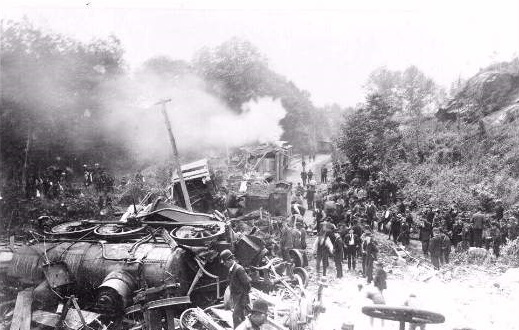
The stranger’s post involved the story from two weeks ago, in the aftermath of the collapse of a crucial  highway bridge in Atlanta. Investigators found the the collapse was caused by a fire.There were no deaths or injuries caused by the fire and the explosion it sparked , but i  severed the vital roadway that runs north-south through downtown Atlanta and carries 250,000 vehicles daily, City Fire Department investigators arrested three homeless people on suspicion of involvement in the fire. Eventually only one was charged:  Basil Eleby, a homeless man, was arraigned on charges of first-degree arson and criminal damage to property. He had many previous drug and assault arrests, according to Fulton County jail records.

To this my friend’s friend’s friend—his name doesn’t matter—responded,

Three people are now under arrest for the fire that led to the freeway collapse in Atlanta – 3 homeless people. I predicted this. But rather than seek out revenge on these 3 for the tremendous inconvenience they’ve caused, can we take a moment to realize that no person reading this has ever known the reality of sleeping under a bridge. None of us have been compelled to light a fire under that same bridge in order to keep our bodies warm.

And can we please have a conversation about funding mental health for the homeless? And can we please have a conversation, not based in shame, not based in revenge, about getting homeless people off the street?

Yes, these 3 folks have done something that has inconvenienced many people. Lighting that fire is something they have probably done countless times before. Can we take this as an opportunity to deal with the real problem? It gives me no satisfaction that the person charged with the worst of this situation will have his homelessness solved by a jail sentence.

Now, I’m sure this individual is a really kind, compassionate individual. I’m also sure he’s the kind of person who is always saying things like “Why is anyone going hungry in the richest country in the world?” to the vigorous head-nodding of his friends, and his friends’ friends. (I am willing to bet money that he was a passionate Bernie Sanders supporter; probably Occupy Wall Street too.) This kind of statement, however, is policy and ethics static. It literally makes people stupid, and leads them away from useful, objective, dispassionate analysis, not towards it.  It is an irresponsible Facebook post.

Of course, it is also flagrant virtue-signalling and grandstanding. Now everyone knows that this guy is oh so compassionate and such a good Christian, who rejects revenge, and wants us to apply the Golden Rule to the poor and the weak. Applause, please. Yes, you’re a wonderful human being. Unfortunately, thinking like this impedes policy solutions to problems, by simplifying them and dumbing them down into their most emotionally distracting components, while pretending that hard truths don’t exist. Continue reading

Remember That Old 1963 Song By The Angels, “My Boyfriend’s Dead And I Want To Have His Baby (Hey-la, Hey-la, My Boyfriend’s Dead)”?

Neither do I.

This goes in the “How in the world does someone get the idea that this is ethical?” file.

Coloradan Kate Criswell’s boyfriend Tom Alexander died over the weekend after having heart problems while the two of them were hiking. Then she had a great idea: why not have the hospital harvest his sperm, so she could be artificially inseminated and have his baby! Unfortunately, sperm viability only lasts 24-48 hours after death, the hospital didn’t have the equipment necessary to extract and preserve Alexander’s sperm, nor was there any legal documentation of his consent for such a procedure.

Criswell doesn’t understand why taking his sperm should be such a big deal. After all, she says, he’s an organ donor. Isn’t that the same thing as being a “give my sperm to any woman who asks for it” donor?

“Tom was amazing,” says his ex-girl friend. “He was always so generous and loved me so much and always made sure that I knew that. He took such good care of me.”

Yes, I would imagine that she needs a lot of taking care of, since she is an idiot. Criswell said she will take up the fight with state lawmakers, so this doesn’t happen to anyone else, “this” meaning ” a couple doesn’t get married, he dies, and the law stops her from unilaterally using his sperm to have his baby without his consent, thus gaining claim to his estate, and maybe even part of his family’s estate.” And what if he had more girl friends? What empowers her to be the only one to with a claim to his genetic material? How many of his babies can she have? Does she want the legislature to declare any dead man’s sperm to be a public resource? What constitutes being a “girl friend”? If he had wanted to have a baby with Kate, why didn’t Tom get her pregnant before he died? Since he didn’t, isn’t there a rebuttable presumption that he didn’t want to start a family with her? If you wanted a baby so much, Kate, why didn’t you two love birds get married? Or are you thinking of Tom’s baby as more of a souvenir?

Based on the fact that this woman thinks “organ donor” applies to sperm, there may also be a public policy argument against this pregnancy based on eugenics.

____________________

Pointer: Tim Levier

From The Ethics Alarms “Do The Ends Justify The Means?” Files: The Breast Cancer Survivor’s Inspiring Scam

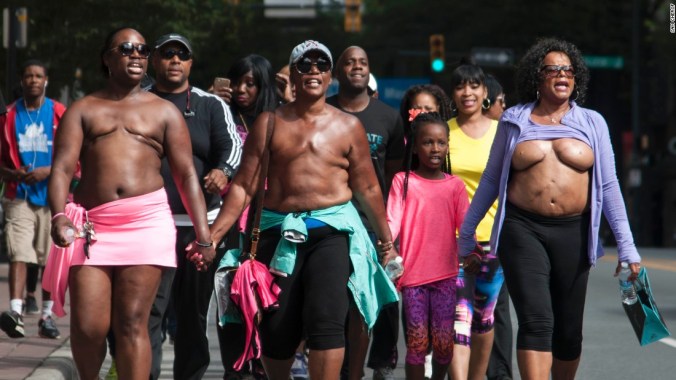
At one point, profiling the double-mastectomied Paulette Leaphart’s 1,000-mile walk from  Mississippi to Washington, D.C….topless…CNN reporter Jessica Ravitz writes,

“If even one woman’s life was saved thanks to a conversation Paulette started, wasn’t that enough? So what if our hero was flawed?”

Oh, no: the “just one child/just one life” rationalization again! (Which, I now notice, isn’t on the Rationalizations List, and it should be.)

Ravitz writes this to begin a long, detailed, infuriating narrative about the well-publicized and much-hyped crusade of Leaphart, whose journey, displaying her scarred chest,  was to ostensibly demand more funds for cancer research cure and  better and more affordable health care. She said she was a champion for women without breasts “to believe in their beauty and be proud of their strength.”

“By showcasing and embracing her scars, she hoped to inspire others to do the same,” Ravitz writes. “Her journey was bold, visual, moving. It offered a hero to admire and, given Paulette’s audacious decision to walk shirtless in the face of strangers, a rich spectacle to witness. It spoke to African-American women, who face the highest breast cancer mortality rate. It inspired legions of survivors. And it spoke to many who’d lost someone to the disease.”

Ravitz is conflicted, clearly, as she tells the complicated story of the woman whose official cause is admirable, but whose motives are murky, and whose credibility is non-existent. While explaining the mounds of evidence she uncovered that the woman has a record of deception, venality and financial flim-flam, that she sees the long walk as a ticket to fame and cash, and that she has lied and fabricated aspects of her ‘inspirational story” repeatedly while the efforts of journalists to pin her down. Yet Ravitz still ends up by  being wishy-washy and equivocal:

“There’s no way to measure how much of a difference Paulette Leaphart made in shaping the conversation about cancer in this country. She touched many minds and hearts, but whether she did so in the most honest and transparent way remains questionable.”

What? There is nothing questionable about whether Leaphart has been honest and transparent—she hasn’t. Ravitz documents her deceptions impressively. She lied about her cancer treatment. She lied about her eligibility for Medicaid and financial resources. She lied to a documentary team that had arranged to follow her, leading them to end the relationship. She lied on her Facebook page, representing her health travails by using the experiences of a friend. Her unguarded comments suggest that she began the walk as a way to make money for herself as well as research. She accepted contributions under false pretenses.  Yet the journalist still seems to want to say that all of this doesn’t matter,  if some good resulted from it: Continue reading

THREE Comments Of The Day (Really Useful Ones): “Tech Dirt’s Mike Masnick On The Internet Privacy Bill”

There were not one but three excellent, informative, detailed comments, one after the other,  in response to the post about the GOP’s elimination of the recent Obama FCC regulations of Big Data gathering by broadband providers. Technology competence is, I believe, the greatest looming ethics issue for the professions, and it is important for the general public as well. All three of these Comments of the Day are educational. If only the news media and elected officials were as well-informed as Alex, John Billingsley, and Slick Willy.

I am very proud of the level of the discourse on Ethics Alarms, and these three Comments of the Day on the post Ethics Quote Of The Month: Tech Dirt’s Mike Masnick On The Internet Privacy Bill are prime examples.

First, here’s slickwilly:

How to be safe with electronic data

First rule: anything online is vulnerable, no matter who secures it. It follows that any computer/device connected online is also vulnerable.

Second rule: Public WiFi is hack-able, and doing so is not that difficult. Someone just has to want to. Using it for playing games could make you vulnerable, and using it to access your financial information (banks, brokers, etc.) is stoopid

Third rule: Anything you do electronically is forever. Any tweet, snap chat, Facebook post, cell phone text or conversation, email, web post, browsing activity, and anything else may be saved by someone. Some of those are harder to get than others: browsing activity takes a snooper on the data line, or a court order to set a snooper up at your ISP. For instance, all cell phones activity is now all saved by the NSA, including where the phone was when. No, no one looks at it, not until they have a reason to research a person, perhaps years later. ‘Smart’ TVs can record you in your own home, without your knowledge, unless you take steps to stop it (electrical tape over cameras/microphones is a start, but still not enough)

Fourth rule: Any public activity can be recorded today. Besides CCD cameras everywhere and license plate readers on many roads, facial metrics can track you in most urban and many rural areas. Even going into the desert or mountains could be spotted via satellite, should the motivation be enough to look your way.

So don’t leave your computer connected to the Internet 24/7 (a power strip that stops electricity from reaching the computer helps cut connectivity when ‘off’), do nullify the ability of other devices to spy on you in your home, and never say anything electronically you do not want going public. Use complex passwords, and never the same for multiple sites. Password safes are better than written notes (and Apple Notes are silly to use for this.) How much you protect yourself depends on your level of paranoia.

Do you have something to hide? A secret you would rather not be made public? Do not document it electronically! Or use the method below.

Now, how to be safe with electronic information: Place it exclusively on an air-gapped (no network connection at all) computer. Place that computer in a heavy steel safe. Encase that safe in concrete, take it out to a deep ocean trench, and drop it overboard. Forget the coordinates where you dropped it.

The point is, nothing is fool-proof

You can take steps to lower the probability that your information gets out, but even using paper and quill pen was only so good as the physical security the document was placed under. Learn some simple steps and you will remove yourself from the radar of most predators. People are careless, apathetic, and just plain dumb, so anything you do helps keep you safer.

I keep such information in a secure, encrypted flash drive that is not stored in a computer USB slot. Could someone break the encryption, should they find the drive and wish to spend the effort? Sure. But if they want me that badly they will get me, one way or another. Why would they? I do not have any deep dark secrets or hidden crimes in my past. Even so, why should my business be available to anyone just to browse through?

Your mileage may vary, but doing nothing is unethical in my responsibilities to my family.

Now John Billingley’s contribution:

Continue reading

The False Lesson Of The GOP Failure To Replace Obamacare

They called off the Charge of the Light Brigade, the incompetent fools!”

Ethics Alarms feels obligated to state what should be obvious, but increasingly is not, as abuse is heaped on the Republican House and President Trump for failing to be able, for now at least, to agree on a replacement/repeal/fix for the Affordable Care Act, “Obamacare” its close friends….enemies too, come to think of it.

The headlines on stories all over the web describe the lack of a GOP bill are brutal:The failure of the Republican health care bill reveals a party unready to govern (Vox)…Republicans Land a Punch on Health Care, to Their Own Face (New York Times)…Inside the GOP’s Health Care Debacle (Politico). Those are the nicest ones. The conservative media’s headlines are even more contemptuous. This only reflects how much the prevailing delusion on the Left and by extension the Left’s lapdog media and punditry, has infected political common sense, leaving a Bizarro World* sensibility about what ethical governing is about.

It may be futile to point this out from this obscure corner of the web, but hell, I’m a fan of quixotic endeavors: the House health care bill was a bad bill. Virtually everyone who examined it thought so. If the thing had somehow been passed by the Senate (it wouldn’t have been, so this meltdown just got all the abuse and gloating out of the way early) and signed by the President (who admits that he has no idea what a “good” health care system would be), it would have thrown millions of lives and the economy into chaos. It isn’t responsible governance to pass bad laws. (Why is it necessary to even say this?) It’s irresponsible. The Republicans wouldn’t show they were “ready to govern” by passing an anti-Obamacare bill that made a bad mess messier; they would have shown that they were fools, reckless and incompetent.

You know: like the Democrats when they passed the Affordable Care Act. Continue reading

And The Obamacare Ethics Train Wreck Rolls On…

Barack Obama’s legacy is a series of ethics train wrecks of remarkable and depressing longevity. The oldest of them, the Obamacare Ethics Train Wreck. may never stop rolling, leaving destruction in its wake forever..

Observations:

1.   It is clear that the Republicans will not be able to repeal, undo, repair or reinvent Obamacare, aka The Affordable Care Act, consistently with their rhetoric and the wishes of the thoroughly messed-up law’s abundant critics. The many bills passed by the GOP-controlled House to that end during the Obama Administration were grandstanding only: they passed because there was 100% certainty they would be vetoed. Now that such bills actually risk becoming law, Republicans are, reasonably enough, not willing to take the leap into the void.

2. The President has told Congress that if they are not prepared to deal with the repeal and replacement of the ACA now, he will move on to other priorities.  This is entirely responsible, both politically and pragmatically. Passing a sweeping law in haste that will affect millions of Americans would be irresponsible.

3. This means, of course, that the President’s campaign pledge to repeal Obamacare and replace it with something “great” “on Day One” was nonsense. On one hand, it was reasonable for him, or anyone, to assume that after seven years of complaining the party’s legislators had a viable plan ready to replace the affordable Care Act. On the other, it was dishonest to make such a pledge without ascertaining with certainty that what Candidate Trump was promising was within the realm of possibility. “Day One” is obvious hyperbole, but anyone making such a statement must assume that it will  be widely interpreted as “before the next Ice Age,” and thus should not be uttered unless the pledge can be fulfilled eventually. Continue reading

A New Way To Be Unethical On An Airplane, Courtesy of “The Hamilton Effect”

I’m in O’Hare, with about 20 minutes to post something, and amazingly, I just witnessed something of ethics significance.

As my United flight from Sacramento was at the O’Hare  gate, with passengers waiting for the jetway to be set up, a young man stood up in the middle of the plane and launched into a loud sales pitch for his depression counseling services!

Let’s call this ‘The Hamilton Effect,” in which people assume that a captive audience is there to be inflicted with their particular rants, business promotions and other intrusions.

The flight attendants had no idea what to do.  He was behind me, and I didn’t feel like fighting my way to him, intervening, and telling him, “You’re depressing ME. Shut up. We’re not your infomercial audience, and we didn’t consent to being bombarded by propaganda or marketing blather.”

Now I’m ticked off that I didn’t. Next time, I’ll be ready. This has to be nipped in the bud.

Oh, this probably wasn’t really sparked by “Hamilton’s” ambush of Mike Pence, but I’m going to blame the production and cast anyway. And all the ethics-challenged theater professionals who applauded this breach of trust.

On another topic, David Cay Johnston,the journalist who revealed the President’s 2005 tax returns, offers a rebuttal to my recent post, here. What fun!

It’s Trenchant Original Reader Commentary And Plausible Conspiracy Theory Thursday!

I don’t have time to come up with a better name.

It’s 4:40 AM, I’m in Sacramento, and my cab is on the way. I’ll be on a plane for about the next 8 hours, and I can’t plan in in-flight internet, so you are on your own for the day. Ethics issues only, please. No political rants. Substance, and please, keep it civil.

Meanwhile, tell me what you think of this.

Particularly, I am interested in hearing from those who would discard it as conservative nonsense what they would call it IF it were true.

See you soon.

Comment Of The Day: “Catching Up On “Instersectionality,” And Finally Paying Attention”

These do not exist.

My heart sank when the I saw that the extremely lively debate following yesterday’s post about “intersectionality” had sparked a posting of “White Privilege: Unpacking the Invisible Knapsack” by Paula McIntosh, who either was time traveling  from 1947 or who was awakened from a coma in 1988 and set it to paper.  The list was out of date then, and it is 29 years old now: one of my favorite aspects of perpetual victim-mongers is that they always pretend that no progress has been made in ethics and human relations, because progress puts them out of business. 

I had to debunk this thing, but there were other priorities hanging over me. Fortunately, reader Isaac took up the challenge. This is often the case in Ethics Alarms, where the remarkable reader base either assists me in doing my job, or, as in this case, does it for me, often better than I could. Isaac chose humor to do the job here, and looking over the material, that might have been the kindest course.

Here is Isaac’s epic Comment of the Day on the post, “Catching Up On “Instersectionality And Finally Paying Attention.” (I’ll have a few comments at the end.)

I wish to thank Deery for sharing about the “Invisible Knapsack” of 26 White Privileges invented by someone named McIntosh. I had never heard of it and am eager to unpack all of unseen ways that the White-spiracy has gifted me with an implicit advantage over my colored people friends. By knowing what my white privilege affords me, I can now exploit it and achieve my highest potential! Let’s dive in.

—-“1. I can if I wish arrange to be in the company of people of my race most of the time.”—-

That can’t be right, and I don’t just mean the sentence structure. My neighborhood in Riverside County, California is about 65% Latino and 15% Black. And I can’t afford to move. I like it here. But if I did want to move to Orange County or Malibu or whatever and hang around fellow Whites all day, I can’t afford it. Maybe McIntosh can connect me to the secret White Privilege Office that will hook me up with a McMansion in Irvine.

—-“2. If I should need to move, I can be pretty sure of renting or purchasing housing in an area, which I can afford and in which I would want to live.”—–

Seriously, McIntosh? I just went over this. If it costs more than a one-bedroom apartment in Perris, I CAN’T afford it. Who is McIntosh and why does she believe that being White gets you real-estate discounts?

—-“3. I can be pretty sure that my neighbors in such a location will be neutral or pleasant to me.”—-

My neighbors have been pretty cool except for the three or four people who have robbed me or smashed some of my property. Is this the realization of my White privilege or do I still have untapped benefits?

—-“4. I can go shopping alone most of the time, pretty well assured that I will not be followed or harassed.”—-

I got kicked out of a gift store once as a teenager, but to be fair, I WAS shoplifting at the time.

I’ve only been unfairly followed or harassed while shopping a few times. But I checked with some of my Brown and Black friends, and they ALSO had only been followed or harassed while shopping a few times. That number should be WAY higher for them than for me. What kind of white privilege is this? Why are my benefits not notable?

—-5. “I can turn on the television or open to the front page of the paper and see people of my race widely represented.”—-

To check my privilege in this area I turned on the television and looked at a newspaper, and was surprised to find that yes, there were quite a few white people there. Sweet, privilege! But it gets better! I checked Wikipedia and found out that White people make up almost two thirds of the population of America! Wow! How can a group of people that make up 63% of a country’s population also be seen on the television and newspapers constantly? It’s gotta be a conspiracy, baby! A sweet, sweet, white conspiracy.

—-“6. When I am told about our national heritage or about “civilization,” I am shown that people of my color made it what it is.”—- Continue reading

KABOOM! Unethical Quote Of The Month, And Maybe Hypocrisy Of The Century: Nancy Pelosi

I’m stunned. I honestly did not think it was possible for  Nancy Pelosi to surprise me any more, as my expectations for her utterances are so low as to be subterranean. I certainly didn’t think she could make my head explode again. Pelosi accomplished the impossible, however, by including this astounding line in a letter to Paul Ryan regarding a GOP replacement for the Affordable Care Act. She actually wrote…

“The American people and Members have a right to know the full impact of this legislation before any vote in Committee or by the whole House.”

KABOOM!

1. This is the same woman whose most famous quote, regarding the ACA, is “We have to pass the  bill so that you can find out what’s in it….” 

2. The law the Republicans want to replace with something the “American people and Members have a right to know the full impact of … before any vote in Committee or by the whole House” was one that almost no Democrats read before voting for it, so even they didn’t understand its “full impact.”

3. The ACA passed in this manner included a mandate that Pelosi and her party swore was not a tax but a penalty, and then when the law was challenged argued to the Supreme Court that it wasn’t a penalty, but a tax.

4. The President of the United States who signed the ACA materially misrepresented the impact of the law repeatedly by stating that it allowed Americans who wanted to keep their current health plans to do so.

How dare Nancy Pelosi make that demand? How astoundingly hypocritical, overflowing with gall, and immune to self-awareness can any human being be? This is like Bill Clinton lecturing Donald Trump about avoiding intimate relations with subordinates, but worse.

Of course she’s right, but Pelosi is the last person on earth, literally the last person, entitled to demand transparency regarding health care bills. How can she say something like this? Is she senile? Is she trying to look ridiculous? Is she so completely devoid of integrity that she can advocate the exact opposite of her own conduct and that of her party without a twinge of irony or shame? Does she believe that her followers are so blind, stupid an unable to hold a memory in their heads that they won’t see how offensive this is, coming from her?

Are they that blind and stupid?