President McKinley’s Statue And Revisiting The Newlands Fountain Principles

The statue-toppling mania as a part of the Left’s cultural revolution and determination to remake history in its own image—a form of thought-control–hasn’t abated; it’s just been eclipsed in the news cycle. For the record, 28 cities have removed close to a hundred statues of Confederate figures alone. Meanwhile, the statue topplers, flushed with victory, are raiding their sights to include Founders like Washington, Jefferson and Madison, politically-incorrect Presidents like Andrew Jackson, Woodrow Wilson and Teddy Roosevelt, and others. You can read, if you have lots of time, most of the Ethics Alarms posts on this topic here and here.

It isn’t just statues, of course. It is honors of every kind: university dining halls and dorms, Democratic party annual dinners, and much more. The Boston Red Sox have petitioned the city to retract the honor of a having a street by Fenway Park named after the man who made the team the regional institution is is today, and who was primarily responsible for the team remaining in Boston.

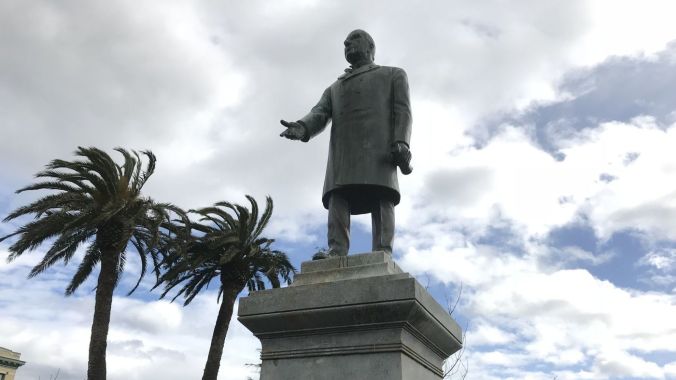
The latest mutation of the culturally-rotting virus has Native Americans demanding that memorials and honors to any figure whose legacy offends them must be eliminated. Five years after President William McKinley was assassinated,  George Zehnder presented the Northern California city of Arcata with an 8.5-foot-tall statue honoring him.  Arcata home to Humboldt State University, placed it in the city’s main square.

McKinley was no Confederate: he was a Union war hero at the Battle of Antietam. He was also a popular and effective President. He was elected in 1896 while the nation was in a serious depression, and was successful enough in getting the economy back on its feet that he was re-elected in 1900, the first Republican to get a second term since Grant.  He, not Teddy Roosevelt, led the U.S. into international significance, winning the Spanish-American War, and acquiring Puerto Rico, Guam and the Philippines. He also gave his life for national service, as have all our Presidents who died in office. Ah, but President McKinley also oversaw federal policies that continued the decline of Native American tribes in the U.S., and reservation lands were reduced by as much as 90 million acres. during his administration. Now the Tribal Council of the Wiyot Tribe in Northern California senses a chance at revenge.  It is demanding that the statue of McKinley be removed.

Almost four years ago, before the din of falling statues became a faint hum, like locusts, across the land, I wrote about a controversy in Chevy Chase, Maryland, where a fountain at the center of Chevy Chase Circle honored Francis Griffith Newlands,  a U.S. Senator who also founded the Chevy Chase Land Co., which in turn created neighborhoods on the Washington and Maryland sides of the circle. Senator Newlands also was a racist, and a proactive one. He was a white supremacist who even attempted to have  the 15th Amendment, which granted voting rights to African American men, repealed.

To assist in the analysis of when and whether any honor to a historical figure should be withdrawn, I offered a series of seven guiding principles: Continue reading

Morning Ethics Warm-Up, April 11, 2018: Caesar’s Wife At The EPA, Idiots On The Air, And Dreamers Demanding Discounts [UPDATED]

Good Morning!

1. Forgetting to heed the “Caesar’s wife” Principle. Whatever one may think about EPA head Scott Pruitt’s controversial policy directions as head of the environmental agency, all ought to be able to agree on this: he’s an idiot.

Here is a cultural literacy test: How many Americans under the age of—what, 45? 60? 104?—know what the term “like Caesar’s wife” means? When you have a target painted on your back because you are taking positions that are guaranteed to be anathema to powerful critics, like the news media, you are “like Caesar’s wife.” This should communicate something to you. In 63 BC, Julius Caesar, a man on the rise, was elected to the position of the Pontifex Maximus, the chief priest of the Roman state religion. The next year, his wife Pompeia hosted the festival of the Bona Dea (“Good Goddess”) in which no man was allowed to participate, at Caesar’s official residence. Publius Clodius Pulcher, a  rash young patrician, snuck into the celebration disguised as a woman, allegedly to seduce Pompeia. He was caught, prosecuted ( not for trying to shag Caesar’s wife but for the crime of sacrilege), and ultimately  acquitted. Nevertheless, Caesar divorced Pompeia, saying, “My wife ought not even to be under suspicion.”  Thus was born the saying, once well-known to educated individuals, that “Caesar’s wife must be above suspicion.”

Either Pruitt doesn’t know the reference, or doesn’t understand it. He has made himself vulnerable and a political liability to the Trump administration by the kind of grubby ethics violations so many of the administration’s recruits from the corporate world have engaged in. (And what does this tell us about that culture?)

David J. Apol, acting director of the Office of Government Ethics, sent  a letter this week to Kevin Minoli, the EPA’s  top ethics official,  asking the agency to take “appropriate actions to address any violations.”

Among the issues raised were Pruitt’s $50-a-night rental  of a Capitol Hill condominium from the wife of an energy lobbyist (This may not have been market value, the letter speculates, raising the question of whether it was a gift, aka “bribe.” Ya think? You can’t rent a decent garden tool shed for 50 bucks a night…), Pruitt taking an excessive number government-funded flights home to Oklahoma and back (He’s about the 78th Trump official to be caught doing this kind of thing—do these guys read the newspapers?), and worst of all, reports that agency staff members who raised concerns about these and other actions creating “the appearance of impropriety”  found themselves transferred or demoted.

“The success of our government depends on maintaining the trust of the people we serve,”wrote Apol. “The American public needs to have confidence that ethics violations, as well as the appearance of ethics violations, are investigated and appropriately addressed.”

Why yes! And anyone who holds high government office is supposed to know that. Anyone holding high government office in this administration, which is in the position of the thug sprung from police lock-up on a technicality to which an angry detective says before he strolls out the door, “If you so much as spit on the sidewalk, I’ll be there to pick you up,” should know that especially. When they are gunning for you, you have to be like Caesar’s wife.

The President should fire Pruitt for these flagrant abuses. He won’t, because he literally doesn’t think ethics matter. I wonder if he thinks stupidity and unrestrained arrogance matter… Continue reading

Comment Of The Day: “Ethics Quiz: Harvard And Evangelicals”

Here is another Comment of the Day emerging from the discussion of Harvard’s suspension of a student religious organization.

The topic is a bit tangential, but interesting nonetheless. One of EA’s readers from across the Atlantic—you can tell he’s British because he spell “theater” wrong— clarifies some history regarding England’s unpleasantness with the Colonies, and as you all know, correcting historical misconceptions is always welcome here.

This is P.M. Lawrence’s Comment of the Day on the post, “Ethics Quiz: Harvard And Evangelicals”:

“When we look at the Second Amendment, it was written at time when a rag-tag group of colonies resisted the greatest empire the world had seen to date.”

Though I mostly just lurk these days, I have seen that misconception so much that I want to rebut it here, as this is one of the few places where the search for truth might let it be taken seriously. Feel free to check what follows for yourselves.

Britain had only just acquired Canada and Bengal, along with hegemony over some (not all) of the rest of India. At that point, all of its gains were yet to be consolidated, and represented drains rather than sources of strength; the same applies to Gibraltar and Minorca too, of which more below. In military, geographical, and economic terms, Britain was weaker than the Chinese, Russian and Ottoman Empires – though all those fell back in one or more of those respects very soon afterwards, when Britain was surging ahead, which may give people the wrong idea from looking anachronistically at what came later. More to the point, Britain was then behind both France and Spain too in most of those respects, and those countries were allied with the revolting colonists.

Britain had just two advantages over France and Spain: it had a more resilient financial system than France and Spain (though not than Holland, a minor rebel ally), and it had denied France more territory even though it had not yet consolidated that for itself.

Britain was – at the time – equal in naval power to France, though not yet to France and Spain combined, which it only became after the Battle of Trafalgar in 1805. That was why Britain lost the.Battle of Chesapeake Bay, which in turn made Yorktown into a Dien Bien Phu rather than at worst a Corunna or a Dunkirk, or at best even a Torres Vedras. Continue reading

Comment Of The Day: “Ethics Quiz: Harvard And Evangelicals”


 The theological discussions that periodically break out on Ethics Alarms are always interesting. Naturally the question of whether seeking out a same-sex relationship justified expelling an officer in an evangelical Christian student group at Harvard sparked one. Here is Rich in Ct’s Comment of the Day on the post, “Ethics Quiz: Harvard And Evangelicals”:

“Given that someone other than Jesus Christ created the ideology then I cannot automatically believe that proscriptions against said choices are in fact Christ’s teachings. Much of those ideas are old testament ones. Christ’s teachings obliterated many of those old testament ideas.”

It is a fallacy to make these two unrelated but true statements (that Christ did not address homosexuality, and that Christ negated much of the Old Testament), and imply that the current ideology that homosexuals must abstain is inconsistent with Christ’s teachings. It is also a bit weaselly to say that you cannot “automatically believe” one way or the other, but not examine readily available arguments.

Stipulated: I am only arguing what Christianity historically teaches, not whether Christianity is correct or should be accommodated by Harvard or society at large; my goal is only to point out inconsistent theology and history. In the broader context here, understanding what Christ taught and teachings are inferred is important to understand the particular motivation for the student group.

At a minimum, the bible was not written in a vacuum, but within a living culture. The gospels and epistles were written for specific audiences, to address the particular concerns of those groups, not rotely restate what was already collectively understood. Luke, for instance, was addressed to Theophilos (his most excellency). That Jesus Christ was not recorded as addressing a particular topic just means that the gospel authors did not think it needed to be clarified. There is even a catch-all at the end of John stating as much:

“Now there are also many other things that Jesus did. Were every one of them to be written, I suppose that the world itself could not contain the books that would be written”.

This is not an esoteric concept. We live in our own collective culture. In constitutional law, for instance, justices routinely review contemporary sources to infer the framer’s intent. When we look at the Second Amendment, it was written at time when a rag-tag group of colonies resisted the greatest empire the world had seen to date. When interpreting “the right of the people to keep and bear arms shall not be infringed“, it very clearly echos the Declaration of Independence:

“That to secure these rights, Governments are instituted among Men, deriving their just powers from the consent of the governed, — That whenever any Form of Government becomes destructive of these ends, it is the Right of the People to alter or to abolish it,…”

The right of the people to resist their government as a last resort cannot reasonably be preserved if weapons are only guaranteed to a “militia” not elsewhere defined in the constitution. The Second Amendment can only be interpreted to mean something else if one ignores the culture and contemporary events that motivated it.

When we look at theology, we must interpret the topics discussed by Christ and the biblical authors in light of earlier theological works. To infer his teachings regarding homosexuality, we must look at his words regarding similar topics, and their relationship with Old Testaments view of homosexuality. Specifically, if we look at Christ’s teachings regarding sex, marriage, and lust, Christ act actually clamps down, rather than liberates. He abolishes Mosaic Divorce, binding married couples for life “what god has joined let no man put asunder”.

This must be interpreted within the Jewish culture; if men and woman are now bound for life, but if as stated in the Old Testament “If a man lies with a male as with a woman, both of them have committed an abomination;” it stands to reason that if the man laying with a woman portion of the law were tightened by Christ, then the man lying with a man part were not likely loosened.

However the second part of that line, “they shall surely be put to death; their blood is upon them….” must be equally reinterpreted in light of Christ’s mercy towards the adulterous, the violator of the vary portion of the law he tightened:

“(Let He Who is without Sin cast the First Stone) Woman, where are your accusers? Has no one condemned you?” – “No one, Lord,” she answered. – “Then neither do I condemn you,” Jesus declared. “Now go and sin no more.”

The theologically sound conclusion might be that Christ did not approve of homosexual behavior, but demanded that mercy be shown to them. Continue reading

Morning Ethics Warm-Up, 4/7/2018: “Ruggles Of Red Gap” And “Williamson No Longer Of The Atlantic'”


Good Morning…

(Do you remember when Saturday morning was fun? Stupid, but fun…)

1. Your cultural literacy note of the day. The Charles Laughton classic “Ruggles of Red Gap” was on Turner Movie Classics last night. The movie itself is wonderful—I recommended it in an Independence Day post here—but it is also a cultural literacy triumph.  In 1935, when the film was released, Lincoln’s Gettysburg address was in the process of falling out of the public’s consciousness. The film’s most famous scene, however, revived it. In a saloon, reference is made to “what Lincoln said at Gettysburg,” and all the cowboys in Red Gap ask each other, “What did Lincoln say at Gettysburg?” Then, quietly, unexpectedly, Ruggles the English butler (Laughton) and the only foreign-born man in the room, recites the speech. TCM host Ben Mankiewicz, in his post showing observations, revealed that when the film was first shown, audiences frequently stood and applauded Laughton’s rendition, and the Address itself became more widely known and quoted.

This is how popular culture works when it is in sync with national values, and not attempting to undermine them.

Here is the scene…for some reason YouTube doesn’t have it, but does have the entire film. The saloon scene begins at about the 56:09 mark:


2. The Atlantic-Kevin Williamson controversy. Unless you routinely plumb the depths of pundit wars and cultural bloodletting, you might well be completely unaware of this skirmish, but it is ultimately an ethics story. Continue reading

Morning Ethics Warm-Up, 4/6/2018: The Good, The Bad, And The Ugly

Gooooood Morning!

1. From the Moral Luck files:

What you just saw is a bald eagle landing on Seattle Mariners starter James Paxton’s shoulder during the National Anthem before yesterday’s Mariners-Twins game.  Here’s a closer look…

The eagle got confused: it is supposed to go to his trainer, in one of the more spectacular Anthem displays that has ever been devised: I’ve seen this performance several times.  After the game, Paxton was asked why he didn’t try to escape. His answer:

“I’m not gonna outrun an eagle, so just thought, we’ll see what happens.”

Heck, he had already endured the horror of Dessa’s incredibly off-key rendition of “The Star Spangled Banner,” what’s a mere bald eagle attack? Seriously, Paxton’s quote is an ethics guide: Don’t panic, don’t act on emotion, assess the situation, see what happens, and act accordingly. Of course, the fact that this strategy worked out well helps: if the eagle had ripped his eyes out, everyone would be saying Paxton was an idiot not to run.

How I would have loved to see this happen to Colin Kaepernick!

2. How the President gets himself into ethics trouble. I just watched a clip of Trump speaking yesterday about California’s sanctuary cities. “The thing is that these cities are protecting bad people,” he said, with emphasis. Naturally, this will be characterized as racism. It’s not racism, however. The statement is just overly simplistic, and exacerbated in its inflammatory elements by the President’s rudimentary vocabulary, in which the only operable adjectives appear to be great, bad, horrible, wonderful, terrible, sad, and a few more. It is impossible to communicate about complex issues competently and fairly with such meager tools. Illegal immigrants have broken our laws and willfully so. That is not good, but it does not make all of them bad people….though many are. Continue reading

Comment Of The Day, Rebuttal #1: “Morning Ethics Warm-Up, 4/4/2018:…A Presidential High Crime…”

Is Teddy looking down from Rough Rider Heaven and smiling at Trump’s Big Tweet?

Of course, I knew suggesting that President Trump’s deliberate attacks on Amazon via Twitter was an impeachable offense would set heads a-blowing. The resulting debate has been fascinating, with interesting historical parallels being proposed. This comment, by Chris Marschner, is the first of two erudite and well argued rebuttals.

Not to hold you in unnecessary suspense, I am not convinced or dissuaded. I do not see Teddy Roosevelt’s  policy-oriented attacks on the era’s monopolies, correctly leading a movement to reform an area of widespread capitalist abuses that eventually were agreed to be criminal, with Trump’s tweeting crudely phrased animus to the public. Nor do I find Obama’s general criticism of big money lobbying efforts by energy interests in general and the Kochs in particular at the same level of abuse of power as Trump taking aim at the owner of the Washington Post,

I am a lifetime fan of Teddy, but he crossed many lines, and could have been legitimately impeached himself. As I have stated before in multiple posts, the power of the Presidency is too great to be abused with casual wielding against individuals and named businesses. As always, there are exceptions.  I’ll concede that taking on the robber barons and the monopolists in the early 20th Century can be fairly designated as one.  Chris seems to feel that there is a close parallel in Amazon’s growing power, but that’s not the case the President chose to make, instead focusing on a deal Amazon forged with the Postal Service, as much to keep the latter in business as to benefit Amazon.

Basic lessons in POTUS leadership: if you are going to cross lines of appropriate uses of  power, 1) You better be right and 2) Be Presidential about it.

Other examples, like Obama designating Massey Energy as responsible for the Upper Big Branch mining disaster before the investigation was complete, can not be so easily excused, but can be fairly labelled a mistake. (Obama made many, too many, such mistakes.) Trump’s attack on Amazon is neither as limited as Obama’s mistake, not as carefully considered and justifiable as Roosevelt’s trust-busting. I would like to see future Presidents restrained from abusing power in this way, even if it takes a trail before the Senate to do it. If we don’t restrain it, we will be sorry.

But the other side has some good arguments: by all means, read them.

Here is Chris Marschner’s Comment of the Day on the #2 in “Morning Ethics Warm-Up, 4/4/2018: Baseball Lies, A Presidential High Crime, And A Judge Makes A Panty Raid”:

I would like to point you to this in 2015:

https://www.usatoday.com/story/news/politics/2015/08/26/war-words-obama-v-koch-brothers/32423959/

“When you start seeing massive lobbying efforts backed by fossil fuel interests, or conservative think tanks, or the Koch brothers pushing for new laws to roll back renewable energy standards or prevent new clean energy businesses from succeeding, that’s a problem,” Obama said at the summit. “That’s not the American way.”

“Josh Earnest said the exchange illustrates the kind of president Obama set out to be.”

“This is exactly why the president ran for office, it’s why he ran for this office, is that for too long, we saw the oil and gas industry exert significant pressure on politicians in Washington, D.C.,” he said. And when Obama fights that influence, “the special interests, including the millionaires and billionaires that have benefited from that paralysis, start to squeal. And I guess in this case, at least one billionaire special interest benefactor chose to squeal to a Politico reporter.”

This type of rhetoric does not include Obama officials publicly stating (incorrectly and improperly) that one of the Koch brothers paid no income taxes. (http://freebeacon.com/politics/hazy-memories/)

Is it only an abuse of power when referencing specific individuals? Does it matter if you say the 1% don’t pay their fair share or is it an abuse of power only if you identify them by name?

I will concur with the Koch brothers that it is beneath the dignity of the president to go after a specific individual, but to suggest that it amounts to even a misdemeanor abuse of power is a stretch. If calling out a specific firm is an impeachable offense then why was there no call to impeach Obama when he routinely criticized and mocked Koch Industries, Fox News and others that did not line up with full throated support of his agenda.

But , Obama was not the first to chastise “punch down” on a business person. Who can forget the trust buster himself Teddy Roosevelt. JP Morgan was singled out for bad behavior. Continue reading

No Wonder We Can’t Communicate With Each Other Or Have Coherent Debates: We’re Culturally Illiterate

“Who?”

Ugh.

 I was watching the MLB channel this morning, and the hosts were discussing the Milwaukee Brewers and their general manager’s statement that the team would “keep its powder dry” until the mid-season trading deadline. All three hosts professed to have no idea whatsoever what the phrase about keeping powder dry meant. In his 1988 book “Cultural Literacy,” E.D.Hirsch, Jr., argued that children in the United States are not learning the basic knowledge that they need to function competently in society. the background information about world, Western and U.S. culture that literate writers and speakers assume their audience already has. The three MLB hosts were all schooled since 1988, and clearly, the problem has only gotten worse.

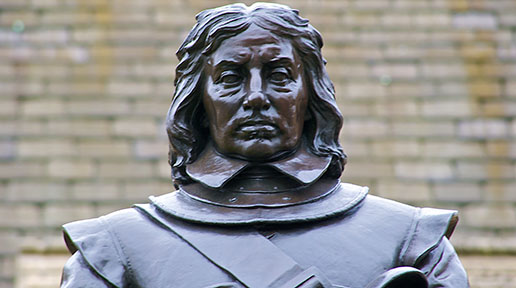
The phrase at issue is a useful and formerly famous one. It comes from a reported quote from Oliver Cromwell—Teddy Roosevelt wrote a biography of Oliver Cromwell. I bet fewer than one out of a thousand Americans could tell you who he was—during the Battle of Edgehill in 1642. Cromwell supposedly told his Roundhead troops in that opening fight of the English Civil War, ”Put your trust in God, my boys, but mind to keep your powder dry.” The last part of the quote is usually evoked to mean “keep cool,” but the entire quote is more profound. As the late language maven William Safire wrote in the New York Times, it means ”stay calm” but carries an implicit, most ominous threat: ”and be prepared to blow the enemy’s head off at the propitious moment.” Prayer is great, but the Lord helps those who help themselves. Or, as a World War II slogan had it, “Praise the Lord and pass the ammunition!” This was made into a popular wartime song by Frank Loesser, who wrote “Guys and Dolls.” I know: what’s “Guys and Dolls”? What’s “World War II?”

This morning’s depression reminded me of an essay by Patrick Deneen from 2016, titled “How a Generation Lost Its Common Culture.” He wrote in part, Continue reading

Morning Ethics Warm-Up, 4/4/2018: Baseball Lies, A Presidential High Crime, And A Judge Makes A Panty Raid


Wake Up!

1 Fake history, baseball style. Broadcasts of Red Sox games from Fenway Park in Boston refer to “the Pesky Pole,” the official name of the tall, yellow foul pole in right field. It is named in honer of the late Johnny Pesky, who also is honored in a statue outside the park—it featured him and his team mates and longtime friends, Ted Williams, Dom DiMaggio, and Bobby Doerr. Pesky, with a couple of brief interruptions,was a Red Sox lifer, beginning with his 1942 rookie season, and ending with his death several years ago as an honorary coach. In between, he was Sox minor league manager, the big team’s manager, a hitting coach and a broadcaster.

The Pesky Pole got its name because the notoriously power-free shortstop reputedly hit several of the few he managed to slug in his career by knocking a pitch  around the marker, which arose from  what is now the shortest foul line in baseball. The  low Fenway right field fence veers sharply out from there to over 400 feet, so such homers are considered, and indeed are, lucky flukes. During his brief and undistinguished tenure as a Red Sox radio color man, former Red Sox pitching ace Mel Parnell repeatedly told the story about how Johnny won a game for Mel in 1948 with a pole-shot. This tale led directly to the team officially naming the pole on September 27, 2006, on Pesky’s 87th birthday, with a commemorative plaque placed at its base and everything.

Afterwards, and not before, someone actually checked the game records. Pesky never hit the home run  described by Parnell. He only hit six home runs in Fenway at all, and nobody knows how many hit the pole, looped around the pole, or even went to right field. (Pop-ups hit by Punch-and-Judy hitting shortstops sometimes landed in the screen over the left field wall for home runs, as the cursed Bucky Dent can attest.) Nevertheless, the fake history is in place: the Pesky Pole is named that because Johnny Pesky hit a famous home run off of it, or was famous for looping cheap homers around it, or something.

Baseball excels at creating fake history, the most notable being represented by the locale of its Hall of Fame, in Cooperstown, New York. When the museum was envisioned, the accepted story about the game’s origin was the Union general Abner Doubleday invented the sport in 1839 and organized the first game in Cooperstown. After the construction was underway,  research suggested that everything about the Doubleday tale was rumor and myth, but baseball and the museum’s management, in one of the all-time classic examples of adopting the philosophy of the newspaper editor in “The Man Who Shot Liberty Valence,” went to great lengths to keep the original story before the public. Eventually some hard evidence surfaced suggesting that the game was invented by Alexander Cartwright, who was eventually inducted into the Hall as the game’s creator, while Doubleday is not. Nonetheless, the myth survives. Major League Baseball Commissioner Bud Selig, for example,  said in 2010 that “I really believe that Abner Doubleday is the ‘Father of Baseball.'” This is the equivalent of saying that one believes in the Easter Bunny.

Selig was later inducted into the Hall of Fame.

2.Believe it or Not! I would support impeaching  President Trump for his tweeting attacks against Amazon. This is such an abuse of Presidential power that it demands at least a Congressional reprimand or sanction. Amazon lost $53 billion in market value in the wake of the tweets, meaning that investors, retirees, and ordinary Americans lost wealth as well. It is unconscionable for a President of the United States to deliberately target a company, just as it is wrong for a President to punch down at a private citizen, but the consequences of doing what Trump has done to Amazon is far, far worse. The Wall Street Journal suggested in an editorial that if the attack on Amazon was politically motivated because Amazon mogul Jeff Bezos owns the Washington Post, impeachment would be justified. Yes, that would be even worse, but it is not an essential element of this “high crime.” The President of the United States must not abuse his power by intentionally harming lawful businesses.

The foolish resistance is so focused on trying to impeach Trump based on exotic laws and imaginary conspiracies that it doesn’t see the real thing when it’s right in front of its face, and the anti-Trump media has so destroyed its credibility by embracing ridiculous impeachment theories that a valid one will just look like more of the same. Continue reading

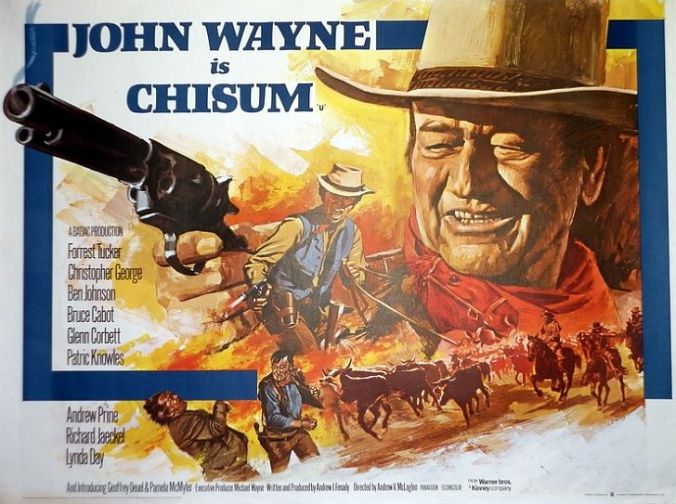
John Wayne Western Ethics: Just Thought I’d Mention This…

“Chisum” is a lesser effort by the Duke for sure; I saw the Western when it came out in 1970, and it made no impression on me at all, apparently. When I watched it again two days ago, almost nothing seemed familiar. There was one scene, however, that raised my eyebrows.

The story is very loosely based on John Chisum (of  Chisum Trail fame) and his involvement in the Lincoln County War of 1878 in the New Mexico Territory. At one point in the story, British rancher and Chisum’s neighbor Henry Tunstall rides to Santa Fe to seek help from Territorial Governor  Sam Axtell in the increasingly tense range war.  Henry does not know that he has been framed for cattle rustling, and when he  is intercepted by two deputies (they are in on the plot, but he doesn’t know that) who accuse him and tell him he is under arrest, he objects strenuously.  Saying he is late, Tunstall starts to reach into a pocket. One of the deputies shoots him dead. The two then plant a gun on Tunstall to back the story that the deputy fired in self defense.

But why did he have to do that? Continue reading