I Worry About Cary Grant [Updated]

…and James Cagney. And Kirk Douglas. And Bette Davis. And Rita Hayworth.

Seeing Kirk Douglas at the Golden Globes revived the concern that every Christmas season intensifies for me, when I realize that it is only Christmas that keeps such giants of entertainment past as Gene Autry, Bing Crosby and Dean Martin from fading into permanent obscurity.  The cultural figures who we remember are mostly the beneficiaries of moral luck, not a fair merit-based calculation. It is a random process, and culture, which is significantly defined by who and what we remember and who and what we forget, should not be shaped by coincidence, chance, and random amnesia.

It should not be, but it is. A classic example outside the realm of entertainment is the strange case of  Col. Joshua Lawrence Chamberlain, the hero of Little Round Top in the Battle of Gettysburg, and by some assessments the savior of the Union itself. When the story of Gettysburg was assembled by the battlefield commission, plaques erected and statues placed. Chamberlain’s desperate stand protecting the Union army’s flanks on Day Two of the battle didn’t make the cut. Despite as remarkable a career as anyone from Maine could have, and more than one shining moment of distinction during the Civil War, he was forgotten for more than a century. Then a brilliant, best-selling historical novel, “The Killer Angels,” recounted his heroics leading the 20th Maine so vividly that Chamberlain memory was re-animated, and began receiving the attention from historians that it deserved from the start.

In popular culture, whether a performer’s unique talents and contributions are remembered after more than a generation is now almost entirely dependent on whether there is a film featuring them that is regularly presented on television. Only a handful of performers who have permanently entered iconic status avoid that standard: I’d include Charlie Chaplin, Marilyn Monroe, Fred Astaire, Judy Garland, Shirley Temple and John Wayne in this category, with a few debatable others. (And even the Little Tramp, MM, Fred, Judy and The Duke aren’t necessarily  safe: once Rudolf Valentino, Laurel and Hardy, Lon Cheney, Greta Garbo, Boris Karloff and James Dean could be safely called icons. I doubt one Millennial in a hundred could identify any of them. Marlene Dietrich has a thumb-hold on her iconic status only because of  Madeline Kahn’s film-long send-up of her in “Blazing Saddles.”) Continue reading

Comment Of The Day: “Lies, Dunces, Fools, Villains, Hypocrites And Big Liars In The Resistance’s Plan E, “The President Is Disabled!” [Part 3]”

Here’s another one.

Regular readers here know I’m a sucker for Presidential history, even when I’m not the one expounding on it. I’m also a sucker for posts that I would otherwise have to write myself., and I was outlining a very similar post to this when Steve-O-in-NJ kindly produced this Comment of the Day. For of there is one thing my life-time love affair with the Presidency and the men who have had the audacity to try, always with mixed success, to fulfill its crushing challenges, has taught me, it is that these were all weird men, each in their own unique ways. You have to be weird to seek this job, or survive it.  The argument that Donald Trump’s undeniable weirdness is somehow deserving of less tolerance than any of the other Presidents is  bigotry mixed with ignorance. Leadership is itself abnormal, and has infinite guises.

Welcome to Steve-O-in-NJ’s Comment of the Day on the post, Lies, Dunces, Fools, Villains, Hypocrites And Big Liars In The Resistance’s Plan E, “The President Is Disabled!” [Part 3]

Washington was an inch away from leading an army personally to put down the Whiskey Rebellion. Andrew Jackson had a notorious temper (all his life), fought duels (though not while in office), and said he was going to hang the first South Carolinian who defied Federal law to the first tree he could find if bloodshed resulted from that defiance. LBJ gave interviews while on the toilet, more than once. Jimmy Carter talked about having consulted with his young daughter regarding policy matters and claimed to have seen a UFO. Calvin Coolidge brushed off a reporter who had made a bet that she could get more than two words out o him by saying “you lose.” Grover Cleveland had half his jaw cut out due to cancer and told the press he had two bad teeth extracted. He also married a woman who was young enough to be his daughter. Lincoln of course battled what we’d probably now recognize as clinical depression.

The two biggest offenders for presidential disability were Woodrow Wilson, who was actually completely disabled by a stroke and hid it, in effect making the nation an oligarchy ruled by his wife and closest advisors, and JFK, who hid the fact that he had Addison’s disease (why that didn’t keep him out of the Navy I don’t know), probably PTSD, and crippling back pain that sometimes left him unable to stand without drugs. I also wonder if it would be out of line to diagnose Clinton with satyriasis, given his behavior.

My main point is that some of the arguably best presidents like Washington and Jackson, others who were at least popular like Cleveland and Clinton, and some that official history is reluctant to examine too closely like JFK (although that is starting to change) all had issues of risky or extreme actions, bizarre behavior, or concealing disability from the public, and no one now calls any of them unfit for office, nor was that charge ever leveled to my knowledge at any of them with any level of seriousness. As far as I know no Republican leader has ever leveled the charge of mental or other unfitness at any Democratic president with any seriousness, although Clinton’s sexcapades, Carter’s incompetence and errors, LBJ’s open crudeness and weirdness, and JFK’s litany of problems presented the opportunity several times. Continue reading

Morning Ethics Warm-Up, 1/7/2018: Lies, Dunces, Fools, Villains, Hypocrites And Big Liars In The Resistance’s Plan E, “The President Is Disabled!” [Part I]

I won’t lie to you…

It’s not a good morning,

(until Americas and journalists condemn this for what it is.)

1 The Big Lie Let us begin by calling the pile of news stories spreading the slander, libel and fake news that President Donald J. Trump is mentally disabled what it really is. It is part of a Big Lie strategy by Democrats, “the resistance”, and the mainstream news media to bring down the Trump Administration without having to win an election.

Because the term”Big Lie”  itself was coined by  Adolf Hitler, in his 1925 book Mein Kampf, and because the Nazis were themselves so fond of the tactic, many hesitate to use the phrase when that is exactly what is being done for fear that to do so will be attacked as comparing the Big Lie wielder to Hitler, Goebbels, or fascists. People are free to make whatever comparisons they like. Using a technique the Nazis mastered doesn’t make a group Nazis, but using a sinister, powerful propaganda weapon that honest and fair people recognize as vile and dangerous is unforgivable.

The claim that President Trump is suffering from dementia or some other form of mental disability is a big lie” by definition. Hitler called it a lie so “colossal” that no one would believe that someone “could have the impudence to distort the truth so infamously.” The idea, of course, is to make it impossible for the victim of the attack to ignore the lie, and require the victim and others to deny it. The lie is given currency by the denials, and then the Big Lie propagandists can focus on the denials rather than the substance of the lie itself, of which there is none. Brilliant!

An essential element for a Big Lie to work is extreme bias and bigotry. The absence of these in sufficient measure is why other recent Big Lie attempts, such as the theory that the Bush administration bombed the Twin Towers and the Pentagon, and the Birther claims, failed. The past year has demonstrated that, thanks in part to the unAmerican efforts by Democratic leadership to undermine the legitimacy and acceptance of President Trump’s election, and a non-stop negative tone and attitude in the reporting of the news regarding his administration, a very large component of the electorate is steeped in irrational fear and hate of the President that is emotional rather than rational. That’s bigotry, and it is the fertile solid where big lies flourish.

2. Why Plan E now? Plan E is one of the rotating plans (reviewed in #5 here) embraced at various times in the past year by “the resistance” to justify overturning the 2016 election.I touched on this yesterday. Plan J, the effort to force Trump to resign in the midst of the Terror-like, Harvey Weinstein sparked witch hunt to drive from positions of power make any man who ever allegedly engaged in any sexual misconduct ranging from a gross proposition to an impulsive kiss to rape, never came close to working, even though Democrats sacrificed an iconic Congressman and a rising Senator in the effort. The death knell of Plan J was when it was revealed that Democratic supporters, including the shameless Media Matters, were paying women, through lawyers or otherwise, to make accusations and bring law suits. The decision to re-animate Plan E was the furor and media feeding frenzy surrounding Michael Wolff’s latest book of whispered gossip, pay-back, rumors and spin, “Fire and Fury.” Wolff is a muckraking entrepreneur whose past books and articles have been frequently criticized for including speculation and outright falsehoods. Never mind: the timing of a sensational best seller purporting to dish the real dirt about the chaotic early day of the Trump White House as it struggled to find its footing and the man at its center, Donald Trump was too good to pass up. Wolff is no Bob Woodward, but as they say, any port in a storm. The new narrative is that Trump is nuts, or senile, or something. He’s not right in the head. Lots of people who work with him say so (anonymously), and lots of people who would have said or done anything to stop him from being President have been saying so all along.

3. This Big Lie’s essential smaller lies.

  • Prime among them is that anything new has occurred, or that there is evidence of the President’s mental/emotional unfitness that the public was not fully aware of long before they elected him. There isn’t. The re-emergence of the Plan E narrative is nothing more than a re-litigation of the campaign.

Trump critics (like me, as I variously described him during the campaign—and before–as unstable, narcissistic, infantile, stupid, deranged and worse, based on specific statements and incidents) always believed that he did not have the appropriate intellect, instincts, emotional make-up or character to lead the country, but the electorate did not agree, and that’s all that matters. Conservatives, Republicans and those just sick of the arrogance and divisiveness of the Obama administration adopted  the long-accepted Democratic position, specially reinforced to get Bill Clinton (and, hopefully, his equally ethics-challenged wife) elected and keep him in office, that only results matter, not character. This coalition  elected Trump despite his obvious flaws, and to some extent, because of them.

  • The second attendant lie to Plan E—maybe it should be #1– is that the 25th Amendment’s Section 4 allows the Cabinet to remove any President who isn’t literally unable to function. Section 4 states,

“Whenever the Vice President and a majority of either the principal officers of the executive departments or of such other body as Congress may by law provide, transmit to the President pro tempore of the Senate and the Speaker of the House of Representatives their written declaration that the President is unable to discharge the powers and duties of his office, the Vice President shall immediately assume the powers and duties of the office as Acting President.”

Until the Democrats began pretending otherwise, no one, not legal scholars, not Constitutional experts, not people who can read English, ever interpreted “unable” to mean anything but completely disabled: a major stroke, a coma, debilitating illness. A disabled President can’t sign documents, can’t make decisions, can’t delegate, can’t hold meetings, can’t even tweet. If the definition of “unable” bleeds into “doesn’t make decisions or express himself in ways others think are wise or prudent,” then the 25th Amendment becomes an open-ended means to achieve a coup….which is the real purpose of distorting it now. Underestimating the seriousness of this effort, or its existential danger for the nation, would be mistake.

  • Even if Trump were handicapped by a new mental or emotional problem, and there is no evidence that he is, Presidents battling such problems are practically the natural state of the office.  Too many Presidents have suffered through various health issues, physical and mental, in the course of their terms in office to count. The 25th Amendment was not put in place to allow a coup any time a President was temporarily diminished or not in top form. Several Presidents, including Lincoln and Teddy Roosevelt, suffered from clinical depression. They dealt with it. Others dealt with alcoholism, drug addiction, serious illness, narcissism, old age, and often many of these at once. FDR was dying during his entire last term, until he did in fact die.

Most of our leaders have been mentally and emotionally abnormal in one way or the other, because normal people don’t become President.

  • Finally, contrary to what “the resistance” and the media are peddling, the evidence indicates that the President has been doing his job surprisingly well. Those who hate him and his policies can’t accept or admit that, but it is a matter of record. There is no legitimate, objective evidence to support Plan E. That is why this is, in reality, a Big Lie.

Exposing a Big Lie takes a Big Post. I’ll get into the fools, dunces, villains and liars next.


It’s A Comment Of The Day Weekend! First Up…Comment Of The Day (3): “An Ethics Alarms Holiday Challenge! Identify The Rationalizations, Logical Fallacies, Falsehoods And Outright Errors In This Essay…” AND, In Related News, Another Bakery Gets Slammed In Oregon

I’m not exaggerating: I have at least four Comments of the Day stacked up on the Ethics alarms runway after this one, and there are usually COTDs arriving on Saturdays. I can’t promise to get all of them up today, especially since I’m hacking away at the 2017 Ethics Alarms Awards, and this is a long working weekend at ProEthics. Still, I will get a lot of them to you, and it’s a provocative group, as you will soon see.

But first, a prelude and some context.

An Oregon appellate court this week upheld a ruling against the owners of the since-closed Sweetcakes by Melissa,  Aaron and Melissa Klein, forcing them to pay emotional-distress damages of $135,000 to Rachel and Laurel Bowman-Cryer, a lesbian couple for whom they refused to design and sell a wedding cake almost five years ago. The Klein’s argued that state Labor Commissioner Brad Avakian violated state and federal laws and their rights as artists to free speech, their rights to religious freedom and their rights as defendants to  due process.

The Oregon court ruled that the Kleins’ argument that their cakes entail an artistic expression is “entitled to be taken seriously,” but it’s not enough for the couple to assert their cakes are pieces of art:

“Although we accept that the Kleins imbue each wedding cake with their own aesthetic choices, they have made no showing that other people will necessarily experience any wedding cake that the Kleins create predominantly as ‘expression’ rather than as food.”

This mess commenced  when Rachel Bowman-Cryer went to the suburban Portland bakery with her mother in January of 2013. When Aaron Klein was told that the wedding did not involve a male partner,  he said that the bakery did not make cakes for same-sex weddings. They left, but soon the mother returned to argue with Klein as Rachel sat in the car, weeping. her mother went in to speak with Klein. The mother told Klein she had once thought like him, but having two gay children forced her to see the error of her ways.  Klein retorted with Leviticus: “You shall not lie with a male as one lies with a female; it is an abomination.”

The complaint and action by Oregon’s Bureau of Labor and Industries followed. You can read the opinion here.

Ugh.

This case is even worse than the one currently before the Supreme Court, discussed here. Continue reading

Ethics Quote Of The Week: Peggy Noonan

“Why does all this matter? Because we are losing history. It is not the fault of Hollywood, as they used to call it, but Hollywood is a contributor to it. When people care enough about history to study and read it, it’s a small sin to lie and mislead in dramas. But when people get their history through entertainment, when they absorb the story of their times only through screens, then the tendency to fabricate is more damaging. Those who make movies and television dramas should start caring about this. It is wrong in an age of lies to add to their sum total. It’s not right. It will do harm.”

—-Former Reagan speechwriter and current columnist Peggy Noonan, after citing the material historical misrepresentations in the Netflix series “The Crown” and the new Spielberg film, “The Post.”

I have written about the ethics of misrepresenting history in films many times, always facing the “Lighten up! It’s just a movie!” chorus. As Noonan explains deftly, the stakes are different now, in an age of rotten public education, mass media and internet indoctrination. The first time I wrote about this issue was 2010, in the post “Titanic” Ethics. It concluded in part,

I don’t blame Cameron for not basing his portrayal on evidence that only was clarified years after his film. I fault him for discounting the testimony of survivors, and misinforming the public by plastering a false version on a giant screen for millions to see, knowing that they would trust that a man who would insist that the doomed ship’s china pattern was accurate…Now the film is back, bigger than ever, and false representations of Officer Murdock, “Unsinkable” Molly Brown, the sinking itself, and other aspects of the iconic event will be embedded even deeper into our historical understanding. It didn’t have to be that way, and it is wrong that it is. History, the public, and the 1500 who died that night in 1912 deserve better.

I’ve seen “The Crown,” and like it a lot. The portrayals that Noonan complains about, however, especially the suggestion that Jack Kennedy abused Jackie, rang false immediately. As for “The Post,” which I haven’t seen, Noonan calls out a misrepresentation of a cultural villain whom the film-makers probably thought nobody would rise to defend: Continue reading

Ethics Observations On Pew’s “17 Striking Findings From 2017”

#1Partisan divides dwarf demographic differences on key political values. The average gap between the views of Republicans and Republican-leaning independents and Democrats and Democratic-leaning independents across 10 political values has increased from 15 percentage points in 1994 to 36 points today. Two decades ago, the average partisan differences on these items were only slightly wider than differences by religious attendance or educational attainment, and about as wide as differences across racial lines. Today, the partisan gaps far exceed differences across other key demographics.

I attribute this ominous development to both parties crossing previously observed lines of appropriate political tactics and rhetoric, picking at the seams that hold our society and democracy together. The GOP-advanced Whitewater investigation of the Clintons’ financial shenanigans began the criminalization of politics. President Clinton’s arrogance and recklessness as a sexual predator placed Democrats in the position of defending unethical conduct especially repugnant to conservatives, and the furious (and dishonest) efforts of both Clinton and Democrats to deny the legitimacy of his impeachment drove the parties further apart.

The essentially tied election of 2000 came at the worst possible time, but Democrats made its wounds to public comity worse that they had to be by using the false claim that the election was “stolen” to energize its base for years. The rise of hyper-partisan leaders in the House and Senate—Gingrich, Pelosi, McConnell, and worst of all, Harry Reid—continued to poison discourse.  The Iraq War fiasco, a Republican mistake, and the false Democratic mantra “Bush lied…” in response to it exacerbated the divide. Then the bi-partisan botches that led to the 2008 crash were widely attributed only to Republicans. Spurred by the prospect of a black President, the news media, always heavily tilted leftward, abandoned large portions of its ethical values to be an unapologetic cheerleader for the Democratic candidate, because having a black President elected would be so darn wonderful for everybody. Thus did the media fully embrace “the ends justifies the means” as an operating principle/

The inevitable racist response of a minority—but a vocal one—in conservative and Republican circles to the prospect of a black President caused further division, and Obama’s alliance with an openly racist Reverend Wright caused more racial polarization. Once elected, President Obama could have healed much of the damage since 1994 (as he promised to do) , but instead he chose to leverage divisions among races, genders, ages, classes, gays and straights, and legal and illegal immigrants for political advantage. His supporters, meanwhile, including those in the news media, began using accusations of racism to smother and inhibit legitimate criticism. Obama broke with Presidential tradition by repeatedly blaming his predecessor for problems he proved unable to solve, keeping partisan resentment hot.

Even with all of this, Obama could have healed much of the accumulated partisan antipathy if he had been an effective leader. He wasn’t. In contrast to his predecessor he was an effective (though over-praised) communicator,and in marked contrast to the current POTUS, he played the part beautifully, and that’s not inconsequential. The rest, however, was an ugly combination of misplaced priorities, incompetence, laziness, racial bias and posturing, with awful results. This hastened the divide, because Obama’s core base, the African American community, was inclined to view him uncritically no matter what he did. As other groups called out the President on his failings, that group’s loyalty and bias drove it, and allied groups, into defensive, knee-jerk ideological opposition, as the growing power of social media exacerbated hostility between the ideological polls.

Obama’s divisive administration, rhetoric and poor governing habits begat Donald Trump.

And here we are. Continue reading

A Trigger Warning About A Trigger Warning: Audiences Should Walk Out Of The Movie Theater When This Appears

This is not a joke. This is not The Onion. This is real. And frightening.

At the beginning of “Darkest Hour,” the new film about the wartime heroism and brilliance of  Winston Churchill, this warning appears on the screen:

“The depictions of tobacco smoking contained in this film are based solely on artistic consideration and are not intended to promote tobacco consumption. The surgeon general has determined that there are serious health risks associated with smoking and with secondhand smoke.”

Winston Churchill, you see, smoked cigars. Actually he chain-smoked them, and inhaled. They were among his trademarks. Any adult who doesn’t know that should not have graduated from high school. Interestingly, shooting and bombing people are also serious health risks, so I don’t know why it wasn’t noted that the depictions of warfare contained in this film are based solely on artistic consideration.”

Whatever “based solely on artistic consideration” is supposed to mean…

Of course, showing Churchill smoking cigars is not an “artistic consideration,” but one of historical accuracy and integrity. Does this mean that there was really a debate in the studio about whether or not Churchill should be shown smoking, so as not to trigger good little progressive totalitarians, who believe in changing the past for the greater good of the present? I wonder if they considered making Winston, who was fat, appear slim and ripped, since the surgeon general has determined that there are serious health risks associated with obesity and over-eating. I don’t see why they wouldn’t, if they felt that showing people smoking in the 1930s, when almost everyone smoked,  might be interpreted as promoting smoking today.  Churchill also drank like Bluto in “Animal House.” Why no warning about that? Uh-oh—does this mean that the film, for artistic considerations, only shows Winston sipping soda water and prune juice? Continue reading

Morning Ethics Warm-Up, 12/27/17: Height And Leadership, Among Other Things


Good Morning, all.

1  Fake news update. The news media’s daily efforts to poison public opinion against the President and everything connected to him is so—someone give me a new adjective,please, as I am sick of despicable, unconscionable,  outrageous, unforgivable, even unethical—reprehensible that I feel pulled into the position of having to defend Trump in order to defend basic ethical principles.

Newsweek featured this headline yesterday:

Melania Trump Orders Removal of Near-200-Year-Old Tree From White House

Those monsters! These crude Trumps, with no respect for history or tradition, trash everything they touch–even the famous magnolia Andrew Jackson planted in 1828, in honor of his late wife Rachel, who died before he took office. The Trump Hate Mob picked it up from there, with one tweeter sneering online,

“A rotten dying Iconic White House tree is representative not just of Trump’s brutal attack on Mother Earth & science, but it’s symbolic of everything that Trump has done to our sacred Democracy since taking office.”

The tree had to be removed, as even Newsweek explained if a reader got past the misleading headline, which many readers don’t…

CNN obtained documents from specialists at the United States National Arboretum, which determined the magnolia tree must be removed. The tree is “completely dependent on artificial support,” the document read.

The document said, “Without the extensive cabling system, the tree would have fallen years ago. Presently, and very concerning, the cabling system is failing on the east trunk, as a cable has pulled through the very thin layer of wood that remains. It is difficult to predict when and how many more will fail.”

Moreover, only part of the tree, and not “the tree,” is being removed. From CBS:

A “large portion” of the Jackson Magnolia, a tree that has been a South Lawn fixture since the 1800s, is being removed, the White House says. It had become a safety hazard after decades of decay…A substantial portion of the Jackson Magnolia will be removed …including one tree limb which will be conducted by the National Park Service, CBS News has confirmed.

(Look at the photo above. I bet you can guess which portion is being removed.)

Wait…one tree limb will be conducted? What’s that supposed to mean? And back to the Newsweek headline: what’s a tree doing in the White House anyway? It should have been removed centuries ago.

Fake news.

Also, news copy apparently written by monkeys at a keyboard… Continue reading

From “The Ethics Incompleteness Principle” Files: Memphis, Tennessee’s Confederate Statues

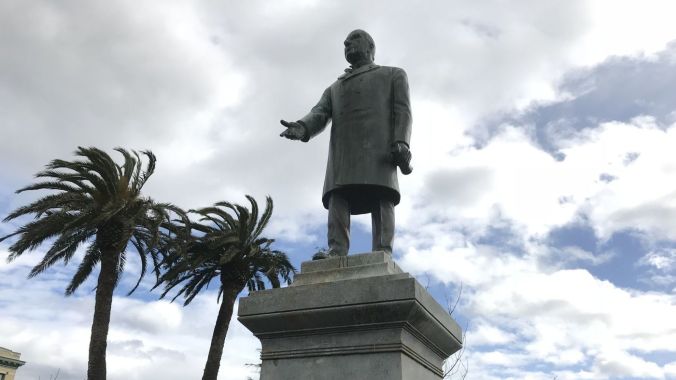
A better application of the Ethics Incompleteness Principle would be difficult to find than the decision by Memphis, Tennessee to remove a huge monument to Jefferson Davis, the president of the Confederacy, and an even larger heroic equestrian statue (above) of Nathan Bedford Forrest, swashbuckling Confederate general and (allegedly) the first Grand Wizard of the Ku Klux Klan,  from two public parks.

As we have discussed here in great detail, I am unalterably opposed to the current mania among our Left-leaning friends and neighbors  of tearing down statues, monuments and memorials honoring  past historical figures because their lives, beliefs and character do not comport with current day standards or political norms.  This primitive exercise in historical censorship has been especially focused on famous and notable figures from the Confederacy, although recent efforts have targeted George Washington, Thomas Jefferson, Andrew Jackson and even Theodore Roosevelt. Of the attacks on memorials to Confederate figures, I wrote,

[ Union veterans]  didn’t think of the former Confederates as traitors, or racists, or slavery advocates. They, like the Union veterans, were just men of their times, caught up in a great political and human rights conflict that came too fast and too furiously for any of them to manage. They were caught in the same, violent maelstrom, and knew it even 50 years earlier. Soldiers on both side wrote how they admired the courage of the enemy combatants they were killing, because they knew they were, in all the ways that mattered, just like them. It was the Golden Rule.  After the war, these soldiers who had faced death at the hands of these same generals, officers and troops, did not begrudge them the honor of their statues and memorials, nor their families pride in the bravery of their loved ones.

Yet now,  self-righteous social justice censors who never took up arms for any cause and in many cases never would, employ their pitifully inadequate knowledge of history to proclaim all the Civil War’s combatants on the losing side as racists and traitors, and decree that they should be hidden from future generations in shame. We have honored men and women for the good that they represent, not the mistakes, sins and misconduct that are usually the product of the times and values in which they lived. In doing so, we leave clues, memories, controversies, differing views, and stories for new generations to consider and better understand their own culture and society, and how it came to be what it is.

Those who want to tear down monuments to the imperfect, whether they know it or not, are impeding knowledge, perspective, wisdom, and understanding. They want only one view of history, because they will only tolerate one that advances their ideology and values—just as the Americans of the past believed in their values. Foolishly, I suppose, they trusted future generations to act on their own ethical enlightenment without corrupting the historical record.

I feel strongly about this, as the tone of that post, far from my first on the subject, shows.

But… Continue reading

Introducing Rationalizations #25B, and #25C: “I’m Just Doing My Job,” and “It’s Policy!”

Here are two  more rationalizations for the list, bringing the grand total to 89.

#25B  The Nuremberg Rationalization, or “I’m Just Doing My Job!”

Amazing: 87 previous rationalizations described, and the word “Nuremberg” did not appear once.

Rationalization # 25. The Coercion Myth, covers the excuse for unethical conduct that the actor “had no choice,” and # 25A. Frederick’s Compulsion or “It’s My Duty!” posits that duty excuses wrongdoing. #25 B follows the theme of denying free will by using the fact of employment to justify or excuse unethical conduct. It embodies the defense of the Nazi officers at the Nuremberg Trials that because they followed the orders of others, they were simply agents, and their horrible crimes against humanity should not bring them punishment…after all, they had no choice. It was their duty to follow orders, because that was their job.

We all need jobs, but we all have a choice whether to remain in a job or not. Sometimes it’s not a very attractive choice, and even a frightening one, in which choosing the ethical course requires personal sacrifice. Nonetheless, when a job requires one to commit unethical acts, the choice is this: quit the job and refuse to perform the unethical act, or commit the unethical act, following orders but accepting the responsibility, accountability and consequences of doing so.

For inspiration, we need look no further than the first admittee to the Ethics Alarms Heroes Hall of Honor, the amazing Henri Salmide.

From the Ethics Alarms post:

In 1944, Salmide was a German officer in the 159th Infantry Division of the German army occupying the French city of Bordeaux, the largest seaport on the west coast. It was August 19, and Allied Forces were spreading out from the beaches at Normandy and taking control of the war. An order came from Berlin calling on the Division to destroy the entire seven miles of port infrastructure before abandoning the city. The port’s destruction was scheduled to occur within a week.

“It fell to me,” Salmide recounted in an interview, because, as head of the bomb disposal unity, he had expertise with explosives. “I couldn’t do it. I knew the war was lost. What was the point of this, I asked myself. People would die and suffer, and the war would still be lost by Germany.”

On  August 22, he filled a bunker at the docks with detonators, plungers, timers and other hardware needed for the planned demolition. But instead of using them to destroy Bordeaux, Salmide blew them up with dynamite, in a terrifying explosion. “It was all I could do,” he said later.

French historians estimate he saved 3,500 lives by refusing to carry out his orders. About fifty Nazi soldiers died in the blast instead. “I could not accept that the port of Bordeaux be wantonly destroyed when the war was clearly lost,” he explained in an interview. “I acted according to my Christian conscience.”

Salmide deserted, and was hunted by both the Gestapo and the French authorities. He hid with the French Resistance for the remainder of the war. Then Salmide adopted a French name, married a local woman, became citizen of France, and raised his family in the very city his conscience had rescued. The Germans regarded him as a traitor, and even the French were reluctant to give him the recognition he deserved, according to his wife.

“No one wanted to admit that he had done it,” Mrs. Salmide told the New York Times. “If he had been French, it would have been easier for him.”  It was not until 2000 that the French government finally awarded him the French Legion of Honor,* and the Bordeaux City Hall said this week that it wants to erect a memorial to Salmide.

His best and most lasting memorial, however, would be for his story to be known around the world, and taught in every school, of every nation. For when any of us finds ourselves being required to act under authority to accomplish unjust and cruel ends—to blindly do our job, knowing that the results would harm others unjustly, and we wonder if it is fair for us to be accountable for our actions when, in reality, we seem to have no choice, we should recall Henri Salmide. His moment of courage should remind us that we are always accountable, and we always have a choice, provided we also have the ethics and courage to take it.

Continue reading