Saturday Ethics Warm-Up, 2/15/20: Dresden, Bloomberg, Snopes, Climate Change, And “The Chalkening”

Good Morning…

1. Dresden bombing ethics. February 13-15, 1945 witnessed the Allied firebombing of Dresden, Germany, with the resulting deaths of between 22,000 and 135,000 civilians. depending on whose propaganda you choose to believe. Regardless of the number, the destruction of the German cultural center and questionable military target so late in the war—after its loss in the Battle of the Bulge, Germany’s defeat was just a matter of time—was instantly controversial, and is still intensely debated today.

The attack, which dropped more than 3,900 tons of high-explosive bombs and incendiary devices on the city, destroyed more than 1,600 acres. By all accounts, the human toll was horrific. Lothar Metzger, a survivor, wrote,

We saw terrible things: cremated adults shrunk to the size of small children, pieces of arms and legs, dead people, whole families burnt to death, burning people ran to and fro, burnt coaches filled with civilian refugees, dead rescuers and soldiers, many were calling and looking for their children and families, and fire everywhere, everywhere fire, and all the time the hot wind of the firestorm threw people back into the burning houses they were trying to escape from.

Was the firebombing of Dresden a war crime?  If the Allies had lost the war, it would have become a war crime. As we have discussed here before, the concept of war crimes is confounding and hypocritical at best. If the attacks were deemed essential to ending the war as soon as possible, then they were ethically defensible.

Much of the debate over the years has focused on whether the bombing was terrorism. Of course it was, as were the atom bombs dropped on Hiroshima and Nagasaki, and General Sherman’s March to the Sea. Terror is a legitimate weapon in warfare, when the objective is to destroy the enemy’s will to fight. Attacks on civilians for revenge and to inflict gratuitous death and pain for no legitimate strategic purpose are unethical . The distinction is usually in the eye of the beholder.

Wikipedia has an unusually thorough article on the Dresden attack, and I found this paper interesting as well. Continue reading

Amy Gets A “Gotcha!”

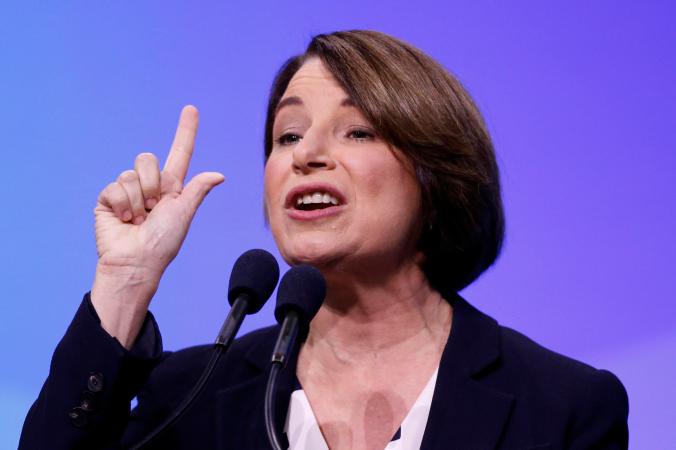
Senator Amy Klobuchar, the suddenly surging Democratic Presidential candidate, stumbled when she was quizzed by reporter Guadalupe Venegas of Telemundo on the name of the president of Mexico.

When asked “Can you tell me his name?” about the leader of the rather important U.S. neighbor to the south, Klobuchar answered “No.”

It is Andrés Manuel López Obrador,  known by his initials, AMLO ,  who took office in December 2018. (I had to look it up.) Continue reading

Oh, Great: Baseball Turned Bernie Sanders Into A Socialist

First the sign-stealing scandal, and now this.

It is, apparently not exactly a new revelation that having his juvenile heart broken by a baseball team set Bernie Sanders on the dark road that had stops in Moscow and the Workers’ Paradise, but it is a timely moment to expound on the tale, readying as the Vermont Senator is to tear the Democratic Party asunder.

Many distinguished Americans of a certain age, from historian Doris Kearns Goodwin to Old Blues Eyes himself have waxed nostalgic about Walter O’Malley’s great betrayal, when he yanked the beloved Brooklyn Dodgers away from their iconic Ebbets Field home to the corrupt embrace of La La Land.

As  baseball fans know *or should), the year was 1957. The Brooklyn Dodgers, affectionately called “Dem Bums” by  the locals, had finally rewarded their community with a World Series championship over the hated Bronx-dwelling Yankees in 1955. Then, on a day that lives in infamy, Dodgers owner O’Malley announced that the team was leaving. (So were their National League rivals, the New York Giants, heading to San Francisco.) The Dodgers were a massive part of the Brooklyn community’s self-image, and the degree of trauma  it suffered cannot be underestimated. Bernie suffered too, and the scars still ache. Sanders told the Times in a recent interview:

“It was like they would move the Brooklyn Bridge to California. How can you move the Brooklyn Bridge to California?… I don’t want to tell you that was the sole reason that I’ve developed the politics that I’ve developed. But as a kid, I did see in that case about the greed of one particular company. And that impacted me.”

And here we are. In one of the more dramatic examples of Chaos Theory in action and the Law Of Unexpected Consequences, an upheaval in the  national pastime started the dominoes tumbling that threaten the Democratic Party and the nation’s economic stability 63 years later. What fun! Continue reading

Morning Ethics Warm-Up, 2/13/2020: I’m So Sorry I Missed Your Birthday, Mr. Lincoln.

I am awash with shame.

Yesterday was Abe Lincoln’s birthday, and I didn’t remember until late last night. This is the inevitable result of Presidents Day, the lazy combination of Lincoln and Washington’s birthdays into one floating holiday that lumps all our Presidents together as if they were equally laudable. (They are all laudable, but not equally.) Thus Franklin Pierce gets as much love from our calendar as Abe and George, which is ridiculous. ( President Pierce’s birthday I remember, because it’s the same date as my wedding anniversary, November 23.) In the old days before the blight of Presidents Day, school children would spend both February 12 and 22  learning about and doing projects related Lincoln or Washington. Without either of these great leaders, we probably don’t have a nation today, or if we do, it would be a vastly diminished one. Our first and Sixteenth Presidents tower over the rest in leadership ability, vision, and impact on our history and culture. Both deserve their own holiday, because every American should take at least a day out of every year to remember these two icons and honor their essential contributions, at great sacrifice, to the existence of the United States of America as well as the welfare of all of its citizens, past, present and future.

Today, most Americans couldn’t describe what Lincoln said at Gettysburg, and that’s not a recent phenomenon. In the classic movie “Ruggles of Red Gap,” a barroom full of Americans in a Western frontier town are unable to recall Lincoln’s message, but the very British butler, recently immigrated, can. Charles Laughton, who played the butler, continued to deliver Lincoln’s masterpiece throughout his career after that scene became the highlight of the movie. You can watch it here—I’d embed it, but there is no YouTube version.

1. Self promotion dept. I’ll be participating in a live podcast later today, discussing the ethical implications of nepotism. Details to come.

2. Still more developments in the Houston Astros cheating scandal. Earlier this morning I watched a live press conference from the Astros Spring Training camp about the sign stealing scheme. From a public relations standpoint, the spectacle made the Astros problems worse.

Stars  Alex Bregman and Jose Altuve spoke for a grand total of 90 seconds, sounding for all the world  like American prisoners of war in North Korea. Owner Jim Crane did most of the talking, which was unfortunate for the Astros and baseball. He  took no responsibility at all for what went on in 2017, though he was at the top of the organization chart: this is called the “Ken Lay excuse.” Worse, Crane repeatedly refused to acknowledge that using a secret camera to relay to the Astros dugout the opposing catchers’ signs telling pitchers what to throw, which were then relayed to  Astros batters by players banging on trash cans, constituted cheating. All Crane would say was “We broke the rules. We can argue about what you want to call it.”

Worse still, Crane said that it was impossible to say whether the team’s full year of sign stealing, including the playoffs and the World Series (which the Astros won), gave his team a competitive advantage. “Maybe it did, maybe it didn’t” he said. “Our opinion is this didn’t impact the game. We had a good team. We won the World Series and we’ll leave it at that.”

In later interviews with the players after the press conference, it sounded like everyone had been prepped to keep saying “2017” over and over, because there are lingering suspicions that the Astros scam extended into 2018 and 2019. As commentator Matt Vasgersian mused afterward on the MLB cable channel, if the Astros had won a championship cheating all the way through 2017 and hadn’t been caught, why would they suddenly stop the next season? Continue reading

Comment Of The Day: “Titanic Ethics”

Michael West has written a remarkable Comment of the Day in several respects. For one thing, it is a comment on a post that is almost eight years old, a record for Ethics Alarms. For another, he becomes the first commenter to comment on the same post under two different screen names. Finally, there is the fact that his point is one with historic validity, yet seldom if ever mentioned by the many critics of James Cameron’s  epic yet intermittently ridiculous film, including me. Follow the tag: there are a lot of  references to “Titanic” here.

One note in prelude to Michael’s essay: the cruel misrepresentation he alludes to can be partially laid at the now dead feet of Walter Lord, who wrote the influential and popular account of the Titanic’s sinking, “A Night To Remember.” It is an excellent account, but he decided to use Charles John Joughin as comic relief, and the  movies, including the one based on his book, distorted his portrayal, which itself seems to have been unfair.

Here is Michael West’s Comment of the Day on the 2012 post, “Titanic Ethics”

How about every Titanic movie’s depiction of Charles John Joughin?

Verdict: Unethical.

Joughin was the lead baker on board the Titanic. Built big and stout as a bull according to most who met him.

When he first heard the Titanic was going to go down, on his own initiative, he rallied the baking crew to gather what bread they could to distribute ample loaves to every lifeboat anticipating they may be afloat for awhile before rescue — something like 40 pounds of bread per boat. Several witnesses and his own testimony recount that he took multiple trips to help guide passengers from below decks up to the boat deck. He proceeded to a lifeboat, which he had been earlier commanded to be a crewman for (either tilling it or rowing, I’m not sure), only to discover another crewman had taken his spot. He didn’t protest, though he could have, so he helped load that boat and then went back to find more passengers below decks. After realizing there’d not be enough life boats and that many people would have to swim for it, he began to throw as many deck chairs into the water as he could as flotation devices, later he mentioned he hoped he could possibly find one of them after the ship went under. When the ship made its final plunge, he found himself standing on the back of the Titanic riding it into the icy waves. In the water, which was so cold, most people died of hypothermia within fifteen minutes…most much sooner than that, Joughin treaded water and swam for a remarkable one and a half to two hours before finding the upside-down collapsible commanded by Lightoller. Naturally, given Joughin’s luck thus far, the collapsible had no more standing room, so he had to float to the side for a bit longer before another lifeboat came by and picked him up. Continue reading

Oscar Ethics Part II: The “In Memoriam” Snubs

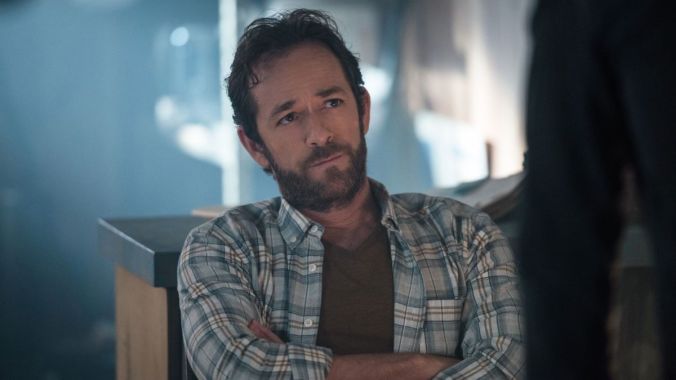
For some reason, Luke Perry’s snub (That’s Luke above) has attracted most of the outrage, though he is far from the worst of the omissions, as you will see.

Luke Perry

(October 11, 1966 – March 4, 2019

Perry became a teen idol at 23 after he was cast as the brooding son of a millionaireon Fox’s prime time soap opera,  “Beverly Hills, 90210.”  A riot broke out when 10,000 teen girls attended one of his  August 1991 autograph sessions  While starring in 90210,” Perry appeared in the original film version of Joss Whedon’s” Buffy The Vampire Slayer” (1992). That was pretty much the high point of his film career, though he had a small role in “Once Upon A Time In Hollywood.”  Mostly he was a TV actor whose career, after a spectacular launch,  settled into the typical orbit of supporting roles in various series and guest shots in everything from sitcoms like “Will and Grace” to “Law and Order: SVU.”  Between those jobs, voice-over work and regional theater paid the bills and kept him working.

He was, in short, a working professional actor who had one burst of superstardom, which is more than most. Perry was only 52 when he died of a massive stroke.

Michael J. Pollard

(May 30, 1939 – November 20, 2019)

Pollard rose to fame in 1967 as  Bonnie and Clyde’s dim-witted gang member, earning an Oscar nomination along with the other honors racked up by Arthur’s Penn’s ground-breaking, violent epic about the lover-killers. He went on to a long career as a Hollywood character actor, aided by one of the most memorable faces in screen history. That face had made him a familiar TV actor before “Bonnie and Clyde” made him famous: he played the cousin of Maynard G. Krebs (Bob Denver) on “The Many Loves of Dobie Gillis,” and Virgil, the cousin to  Barney Fife (Don Knotts), on “The Andy Griffith Show.” In the first season of the original “Star Trek,” he was  a creepy  teenage cult leader on a planet of children.

Pollard continued to make significant films after his Oscar nomination, such as  “Little Fauss and Big Halsy” (1970), a motorcycle racing buddy film in which he co-starred with Robert Redford. He was Billy the Kid in “Dirty Little Billy” (1972), an inept fireman in “Roxanne” (1987), the friend of a Utah gas station owner  who claimed to be Howard Hughes’s beneficiary in“Melvin and Howard” (1980), and  surveillance expert Bug Bailey in “Dick Tracy.”

Pollard was acting right up until his death: two of his films that yet to be released. Continue reading

Comment Of The Day: “Ethics Observations On The ABC Pre-New Hampshire Primary Democratic Candidates Debate”

Joel Mundt picks up his second Comment of the Day opining on the ever-green and always perplexing ethics controversy of slavery reparations, which was again broached in the recent Democratic candidates debate in New Hampshire.  The topic has had  a resurgence in recent years due to the advocacy of the current rock star of race-baiting , Ta Nihisi Coates, who regards the mass white to black wealth transfer as a the only way to solve America’s persistent economic gap among the races.

It has also had a long record of debate on Ethics Alarms, notably in the commentary on this 2019 post, where I admitted that I had momentarily lost my mind  in this one from 2016, in which I made…

“….no sense whatsoever. While again rejecting the concept of reparations (“the hell with that. [The idea is] to punish [whites] for the sins of slavery committed by their ancestors by arranging a massive transfer of wealth based on principles of tort law and damages. This has always been a pipe dream of civil rights extremists, couched in the language of revenge, as if the nation and the nation’s white citizens have made no efforts, sacrificed nothing, expended no resources or wealth, to try to undo the legacy of slavery and Jim Crow. Reparations are not going to happen, as the concept itself is unjust….”), I proposed a solution….that was indistinguishable from reparations…”

I concluded that mea culpa post by writing,

I’m better now. I am also, unfortunately, also back at Square One, my “Do something!” phase regarding race in America having accomplished nothing, as “Do something!’ arguments always do, and I still see no solution on the horizon.

I still don’t. Joel’s perspective can’t address that.

Here is Joel Mundt’s Comment of the Day on the post, Ethics Observations On The ABC Pre-New Hampshire Primary Democratic Candidates Debate:

The issue of reparations has tied numerous candidates up in knots. Now it’s Steyer’s turn, though I think he’s a knot-head regardless. I firmly believe that reparations have already been paid. If the practice of slavery had been cut off solely by Presidential decree or Executive Order, or because the South simply decided to halt it, one could make an argument, however painful and convoluted, that financial reparations had a place at the table of discussion.

But I believe that slavery was ended with bloodshed. Those who supported slavery and secession from the Union paid dearly for it. Hundreds of thousands of Confederate soldiers died for their cause, cities were razed and burned, and their newly-formed government was terminated. And the North paid, too, with the lives of hundreds of thousands of young men who fought to save the Union and ultimately, to end slavery.

And now, 160 years later, people like Steyer (and Buttigieg, and others) say that’s not enough. They are, in effect, telling those soldiers, “Thanks for the sacrifice, but this is more about money than you getting eviscerated by cannon shot and having your body eaten by gangrene.” I’m not sure spitting on their graves is worse.

But it does get worse. Continue reading

Was Rush Limbaugh A Worthy Recipient Of The Medal Of Freedom Award?…Epilogue

I am doing this for my own sanity. After I researched the post about Rush, I couldn’t stop thinking about the figures who have not received Medals of Freedom. If you think about it, it will drive you crazy too. The honor is now self-defining, like all such honors—the Mark Twain Award and the Kennedy Center Awards come to mind.

The sequence in the post that asked “Why Robert De Niro  and not, say, Al Pacino, Gene Hackman or Dustin Hoffman? Why Loretta Lynn and not Johnny Cash? Why Stephen Sondheim and not Jerry Herman? Why Chita Rivera and not Rita Moreno? Why Vin Scully and not Ernie Harwell?” did it to me. President Trump has entered the realm of post mortem MOF honors, for Elvis (if Elvis, why not Buddy Holly?)and Babe Ruth (If Babe, why not…well, there really isn’t anyone like Babe Ruth). I have no problem with either of them: they are clearly cultural icons who changed America. But once we open the doors to the past, there are thousands of important Americans who haven’t been honored.

Every President from Kennedy on has been awarded a medal (JFK,  LBJ and Bush I posthumously) except Nixon and Bush II.  If dead Presidents are eligible, then where’s Washington? Adams? Jefferson? Madison? Lincoln? FDR? Truman? Ike? Teddy? Trump can make progressives’ heads explode by giving the Medal to Andrew Jackson. He can have a ball with this. Continue reading

Was Rush Limbaugh A Worthy Recipient Of The Medal Of Freedom Award?

What an easy question.

Of course he was. Those who argue otherwise do not appreciate his remarkable influence on the culture, entertainment, and the political landscape. In many cases, they blame him for opening up public discourse and eroding the liberal domination of news commentary and political advocacy. They are the same people who find free speech “problematical,”

I am not a dittohead. Rush Limbaugh’s politics and causes are not mine; I admire his skills, but not always his employment of them.  In the Nineties I  sometimes listened to Rush in the car before I moved permanently to a home office. I have parallel life in theater, acting, comedy, skit writing and stage directing, and I was impressed with Limbaugh as a performer, which is what he is, and has always maintained that he is. His combination of politics, satire and  deft disc jockey patter was unique. It was obvious why he had become, by far, the biggest star in talk radio.

The end of the Fairness Doctrine, which required broadcasters to present all sides of opinion when discussing public issues—(riiiight)—was  repealed in 1987, and  Limbaugh invented a new format, a conservative talk radio show that was dominated by a quick-thinking , quick-tonged, generally jovial ideologue with a sonorous voice. Rush took phone calls from people on all sides of the political spectrum, and unlike so many talkmeisters that followed him, was never rude or abusive to those who challenged his positions.

Continue reading

Ten Ethics Observations On The President’s 2020 State Of The Union Message

The text of the speech is here.

1. As I mentioned at the end of the previous post, my professional assessment, as a speech coach and a stage director, is that Trump’s delivery–timing, pacing, energy, focus, expressiveness, emphasis, technique–was excellent. Like other politicians (and me, frankly) the President is best, most relaxed, most persuasive and likable, when he is speaking extemporaneously. This time, though the speech was obviously scripted, he delivered it like his more familiar riffs.

And he has improved over his term in office. So many POTUSes have not.

2. As for content, I saw the speech described as “Reaganesque.” That’s high praise, but not far off. There were no ringing catch phrases, but the most important feature was that the speech was positive, optimistic, and upbeat. This was especially remarkable because many expected the President to be combative and defiant, and to directly address his impeachment. Not doing so was wise, and indeed ethical. Living well is the best revenge, and the President’s recitation of his administration’s achievements, no matter how the factcheckers spin them—it’s Trump, so we assume hyperbole—was a virtuoso dismantling of Big Lie #5: “Everything is Terrible.”

It’s not terrible, of course, far from it, and the false narratives constantly repeated by the Democratic candidates about how the middle and lower classes weren’t benefiting  were belied by Trump’s statistics asNancy Pelosi stared.

3. The repeat stunt of having all the female members of Congress on the Democratic  side wear white  was juvenile, incoherent and dehumanizing. I was reminded of the sperms in Woody Allen’s “Everything You Wanted To Know About Sex But Were Afraid To Ask.” Whatever their chant was, it didn’t work. The President deserves ethics points for specifically condemning late term abortion in front of this group, and featuring a little girl born at 23 weeks was a powerful visual aid.

Most Americans do not approve of late term abortions, and the device of making Democrats explicitly show their disapproval of Trump’s vow to stop it exposes a gaping ethics black hole on the Left.

4. At times I wish Ronald Reagan had never introduced the manipulative technique of using guests in the audience for applause and heart-rending moments, but I have to admit President Trump used it like no one before him, shamelessly but effectively.  I just hope nobody tries to top it, because that was my limit, and perhaps a bit over.

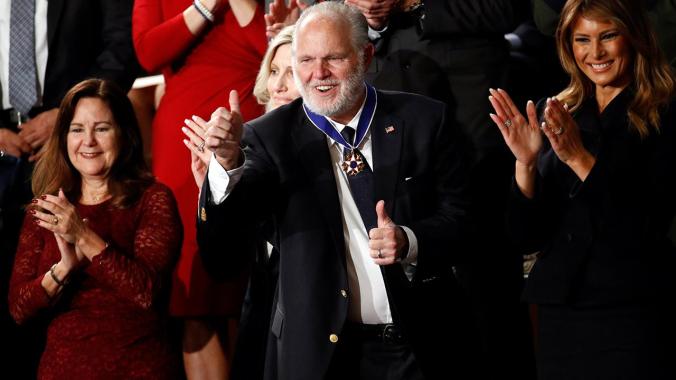
There was the African-American boy who wants to join the Space Force, and his 100 year-old Tuskegee airman great-grandfather, in uniform, having just been promoted to  general by Trump. There was the young African American girl who had been denied her application for a tax credit scholarship to attend a private school in Philadelphia because the state’s Democratic governor had vetoed a funding bill. The President told her she would get her scholarship after all, as she and her mother beamed. There was the new President of Venezuala, symbolizing a capitalist rescuer for a nation wrecked by socialism. Rush Limbaugh, recently diagnosed with Stage 4 lung cancer, appeared genuinely overcome when Mrs. Trump awarded him the Medal of Freedom on the spot. Also on the spot was a surprise reunion between a military wife and her soldier husband, back from deployment.

Great drama, great sentimentality, great showmanship. It was a combination of Oprah, Maury, and “Queen for a Day,” but schmaltz works, and the President proved himself a master of it.

5. Pelosi’s guests included Fred Guttenberg, the father of a high school freshman killed in the 2018 mass shooting at Parkland’s Marjory Stoneman Douglas High School. He got himself removed from the audience by shouting something about his daughter as the President pledged to preserve the Second Amendment. Using the victim of tragedies as political props is an objectionable stunt (Trump did this too, with Kelli Hake and her son;  Army Staff Sergeant Christopher Hake, was killed  in Iraq, a victim of the late Iranian terrorist leader Qasem Soleimani. Another guest was the brother of Rocky Jones, the victim of an illegal immigrant in Tulare County, California, and the parents of an ISIS victim, but Trump’s guests didn’t disrupt the event. They had also lost loved ones to bad people, just like Guttenberg, but do not advocate taking away law-abiding people’s rights in their grief. Continue reading