The Supreme Court Holds The U.S. To A Promise

“On the far end of the Trail of Tears was a promise. Forced to leave their ancestral lands in Georgia and Alabama, the Creek Nation received assurances that their new lands in the West would be secure forever…Because Congress has not said otherwise, we hold the government to its word.”

Thus did Justice Neil Gorsuch begin and end his historic 42-page majority opinion this month in McGirt v. Oklahoma, as the Supreme Court ruled  in a 5-4 decision that the Creek reservation in eastern Oklahoma had never been “disestablished” by Congress, and thus the promise made in a series of 18th Century treaties ensured that the territory remains an Indian reservation for the purposes of federal criminal law, and quite probably in other areas as well.

The decision was overshadowed by more politically debated decisions this month, but it may be the most overtly ethical of the Supreme Court’s recent holdings. Among other virtues, it rejects the false logic of Rationalization #52. The Underwood Maneuver, or “That’s in the past.” That one holds that time erases accountability, an attitude  useful to the habitually unethical, because “moving on” gives them  an opportunity to repeat their unethical and harmful conduct, or worse.

The Underwood Maneuver manipulates the victim of wrongful conduct into forgiving and forgetting without the essential contributions a truly reformed wrongdoer must make to the equation: admission of harm , acceptance of responsibility, remorse and regret, amends and compensation, and good reason to believe that the unethical conduct won’t be repeated.  By emphasizing that wrongdoing was in the past, this rationalization all but assures that it is also lurking in the near future.

Potentially half of Oklahoma will be affected by McGirt. The issue was whether the state of Oklahoma could prosecute Indians accused of major crimes in Indian Country, or if, under an 1885 federal statute known as the Major Crimes Act, such offenses were within federal jurisdiction. The case hinged upon whether the Creek Reservation had been withdrawn or disestablished, by Congress in the lead-up to Oklahoma’s admission to the Union in 1907, thus causing Hugh Jackman to sing.

This is 3 million acres in and around Tulsa we’re talking about here.

With the Court holding that the Creek reservation was never disestablished, four other tribes— the Seminole, Cherokee, Chickasaw and Choctaw Nations in eastern Oklahoma— may benefit from similar rulings. Those tribes’ total territory covers  19 million acres where 1.8 million Americans now live, relatively few of whom are Native Americans. Continue reading →
Tales Of The Niggardly Principals

Quite a bit of the censorship, word-banning and historical air-brushing we are seeing during the George Floyd Freakout, aka The Great Stupid, are fueled by ignorance, like that of the black D.C. employee in 1999 who forced  David Howard, an aide to Mayor Anthony A. Williams, to resign for using a “racial slur.”  (“Niggardly (noun: niggard) is an adjective meaning  stingy or miserly. It is derived from the Middle English word nigard, which is probably derived from Old Norse hnǫggr , meaning “stingy”) After Howard was reinstated, there was wide agreement that this was political correctness run amuck. Julian Bond, then chairman of the National Association for the Advancement of Colored People, said, You hate to think you have to censor your language to meet other people’s lack of understanding…Seems to me the mayor has been niggardly in his judgment on the issue” and noted that the US has a “hair-trigger sensibility” on race that can be tripped by both real and false grievances.”

Ah, those were the days! Imagine as statement like that coming from the NAACP today.

The core idea behind the three Niggardly Principles is that ignorance and stupidity should not be enabled, reward or encouraged, though it is unkind—unethical—to deliberately set out to offend someone even if the source of the offense is the individual’s knowledge or intellectual deficit. (That’s the Second Niggardly Principle.)

I do not think that one applies to this episode: Greg and Kjersten Offenecker, owners of The Nordic Pineapple in St. Johns, Michigan removed  the Norwegian flag and an American flag posted outside their Civil War-era mansion last week because morons had accused them of promoting racism in the largely conservative Michigan town.

The couple said they capitulated after receiving “at least a dozen hateful emails” and other complaints.  “I don’t see it because I grew up with the Norwegian flag.To me they are two distinct flags,” shrugged Kjersten.

They ARE two distinct flags, you cowardly, submissive enabler of race bullies.!You should have issued each sender of those emails an explanation. You should have put out a press release clarifying the difference between the flags. You should have extended a little time and commitment  to protect speech and expression from sinister efforts to intimidate and censor by the proto-totalitarian Left, which is getting less proto- by the hour. Too much trouble to do your duty to fight for American values and principles, is it? Then I pronounce you a lazy and irresponsible citizen.

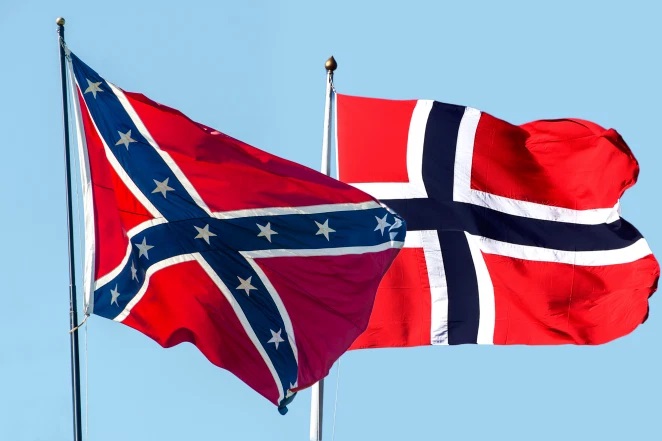
Here’s the Norwegian flag next to the Confederate flag:

They are not the same design. They do not have the same colors. Why are you allowing people this stupid to dictate your conduct? And if you remove the American flag because some vile mutation of citizen complains, you are as anti-American as it is. You are the kind of submissive coward who would raise a Nazi flag because your neighbors insisted on it.

The United States cannot survive if it is dominated by the ignorant and the meekly submissive.

Boy, Norway is so lovely this time of year. I don’t know how you can stay away… Continue reading →

The Murder Of Mary Phagan And The Forgotten Heroism Of John M. Slaton

I  just brought The Ethics Alarms Heroes’ Hall of Honor up to date. There are 44 men and women whose inspiring stories reside there, and I know who #45 will be: John Marshall “Jack” Slaton (December 25, 1866 – January 11, 1955),the 60th Governor of Georgia.

This won’t be the official entry for John Slaton; I want to do him justice, and the story of his moment of principle and sacrifice is not only complicated, but I am having a hard time settling the facts. The short version is this:

Mary Phagan, 13, an employee at Atlanta’s National Pencil Company where Leo Frank was the manager, died of strangulation on April 26, 1913. Her body was discovered in the factory’s cellar the next morning.  Over the course of their investigation, Atlanta police arrested several men, including the night watchman Newt Lee, Frank, and Jim Conley, a janitor at the factory. Lee and Conley were black; Frank was Jewish. Though this was the height of Jim Crow in the South, prejudice against Jews was as strong in Atlanta as racism.

On May 24, 1913, Frank was indicted on a charge of murder and the case was tried at Fulton County Superior Court beginning on July 28. The prosecution’s key witness was  Conley, who described himself as an accomplice, assisting Frank in disposing the girl’s body.  Frank’s defense lawyer argued that Conley was the real killer.

The jury pronounced Leo Frank guilty verdict on August 25, 1913. Then followed a series of unsuccessful appeals, the last being before the U.S. Supreme Court, which rejected it in April of 1915. Georgia Governor John M. Slaton was a popular figure about to leave office, and considered a rising political star whose ascension to the U.S. Senate was likely, if not a forgone conclusion. It was assumed that he would quickly reject Frank’s request for a pardon, given the extensive appeals and the overwhelming public outrage regarding Mary Phagan’s murder.

Those assumptions were wrong. A trial lawyer before entering politics, the Governor reviewed the evidence, acquired some evidence that had not been presented at trial , and interviewed some of the witnesses, including Conley. who had changed his story several times.  Slaton also heard arguments from both the prosecution and defense.

Although he knew, and had been warned, that taking any action favorable to Leo Frank would not only end his political career in Georgia but also place him and his wife in mortal peril, Slaton commuted Frank’s sentence from capital punishment to life imprisonment. In his official statement, he wrote,

I can endure misconstruction, abuse and condemnation, but I cannot stand the constant companionship of an accusing conscience, which would remind me in every thought that I, as a Governor of Georgia, failed to do what I thought to be right.

Continue reading →

Six Ethics Problems With This Picture….And You Should Be Able To Find More

“Scratch” is a New York Times cartoon feature  in the Sunday Business section. This was the most recent installment. I’ll save my (disgusted) comments for the end…

  • The breathtaking leap of logic in the introduction represents such flawed logic that the Times Business Section destroys its credibility, such as it is, by permitting such an illogical statement on its pages. ‘Since companies have been foolishly pandering to hyper-woke complaints about, for example, the picture on a box of rice and the artwork on a package of butter, and statues of important and influential historical figures who were honored in their times are being vandalized and toppled by people who barely know who they are, it’s a ‘perfect time’ time to consider dishonoring the Founders and others without whom we would have no nation at all.’

Continue reading →

A Banner Date In The History Of The Barn Door Fallacy: The Day The Concorde Died

s

The Barn Door Fallacy is one of the most striking example of persistent human and bureaucratic incompetence, as well as one of the most destructive.

It is just as illogical as the old saw it is named after, yet the reflex reaction to almost every accident, tragedy or chaotic event is to immediately adopt extreme measures that are deemed necessary to prevent what has already happened. This occurs despite the fact that most such events were in situations already operating with known risks and virtual certainty that the disaster that eventually prompts the Barn Door response would occur. Nevertheless, taking reasonable measures to prevent the catastrophe is somehow never recognized until after the bodies stack up, and then being reasonable  is no longer an option.

Examples of this phenomenon, a triumph of incompetence, emotion and fear of responsibility over responsibility and reason, abound: the aftermath to 9/11,  the over-reaction to the Oklahoma City bombing; the end of airship travel after the spectacular explosion of the Hindenburg, the death of nuclear power in the wake of Three Mile Island and Chernobyl.  The pandemic will undoubtedly lead to some manifestation of the Barn Door Fallacy. It even infects sports: all it took was a televised career-threatening injury to a franchise star catcher to make Major League Baseball drastically alter the rule regarding collisions at home  plate, and a freak accident breaking the leg of a player in a take-out slide at second base during post-season play-offs to prompt MLB to ban a routine aspect of the game—and an exciting one— practiced and accepted for over a hundred years. Continue reading →

Comment Of The Day: “Unethical Quote Of The Month: Joe Biden”

I bet Michael, when he submitted this Comment of the Day, had a feeling I’d groove on it. After all, it’s about a President, I’m a Presidents nut,  and he ends up agreeing with me, which is always welcome.

He also raises and interesting question that was not considered in the post. If we judged Presidents on a racism scale that weighted their attitudes according to how they compared to the culture and predominant beliefs of the day, which Presidents would come out looking best? That’s how baseball stat analysts judge players across eras, and it makes sense: players are compared to league averages while they were playing, and then the stats are adjusted accordingly.  For example, Carl Yastrzemski’s .301 average in 1968 was more impressive, and represented better hitting  in his offensive context, than Lou Gehrig’s .354 mark in 1936, when ten players hit at least .350.

Analyzed that way, Woodrow Wilson comes out as the most racist President, more than the slaveholders. Jefferson, despite being a slaveholder, looks relatively good in the context of his times. So, I think, does Teddy Roosevelt, unapologetic white supremacist that he undoubtedly was.

Here’s Michael’s Comment of the Day on the post, “Unethical Quote Of The Month: Joe Biden”: Continue reading →

Ethics Catch-Up, 7/23/2020: Waiting For Baseball Edition [Corrected]

This moment in “Field of Dreams” was how I started off my baseball and culture presentation this week. Ironically, the speech has always irritated me, because of its stagey blocking, and because it is a speech that sounds like a  speech, and is essentially right out of the book the film was based on. In the novel, “Shoeless Joe,”,the “Terrence Mann” character played by James Earl Jones was real life (and then, still living) recluse author J.D. Salinger. I dislike the speech, but the scene always moves me, for a personal reason.

As Terrance Mann stands, giving his speech, the ghostly players of the past silently assemble behind him in Ray Kinsella’s (Kevin Costner, of course) magic corn field. One of the players behind him has been identified in the film as Smokey Joe Wood, a 30 game winner with the World Champion 1912 Boston Red Sox. Just a few years before the film was made, I had been in the Fenway Park grandstands as  Smoky Joe, feeble, in his mid-nineties and in a wheel chair shortly before his death, barely threw out—more like dropped—the first pitch at a Red Sox Old Timer’s game, to a standing ovation.  And here he was, in that  corn field, but young and vital again.

Gets me every time….

1. Ethics query: is it ethical to perform “Piggies”? I just caught an old concert clip in which George Harrison and Eric Clapton performed the obnoxious pseudo-Marxist ditty “Piggies” (from the White Album) to thunderous applause.

[Notice of correction: I originally wrote that “Piggies” was a Lennon composition. All these years I assumed it was, heavy-handed and juvenile politics that it was. I am stunned that the song was George Harrison’s doing; I thought better of him.]

This was well after the Manson murders: I had never heard anyone perform the song in decades. Admittedly, it is just moral luck that a madman seized upon the White Album Beatles songs as his inspiration to mastermind the slaughters of  Sharon Tate, her unborn child, and her house guests, as well as supermarket executive Leno LaBianca and his wife Rosemary the following night. However, “Piggies” was the one song referenced directly in both murders. It is not inconceivable that if the White Album had omitted that song—no great loss, either–at least the LaBianca murders might not have taken place. I know I can’t hear the song without picturing carnage, and it seems to me singing the song is like a celebration of Manson’s work. I wouldn’t ban it; I don’t believe in banning anything.  I just think it’s bad taste to play it or perform it.

Is that inconsistent with my objection to “canceling”  “Dixie,” “My Mammy,” “Rockabye Your Baby with a Dixie Melody,” “When Johnny Comes Marching Home,” “Oh Susanna!” and other songs that are redolent of the Old South? I would argue that those songs have the virtue of being great tunes and important cultural touchpoints…in other words, works of musical art that justify themselves. “Piggies,” in contrast, is musical junk, like about 20% of the White Album filler. Continue reading →

Remembering Herb Stempel (1926-2020), Ethics Dunce Emeritus


I missed Herb Stempel’s death last month. If you aren’t 95 years old or didn’t see Robert Redford’s “Quiz Show,” that name probably doesn’t ring a bell, but Herb was a seminal figure in American popular culture ethics, and his story raises issues still unsettled today.

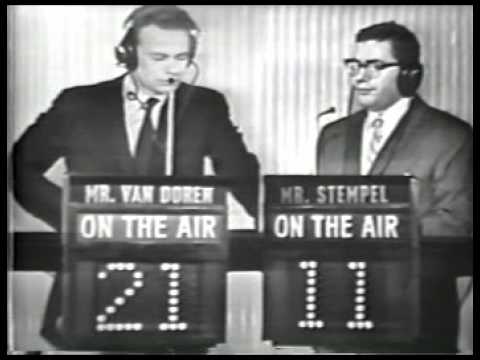
On the evening of December 5, 1956, Stempel, a City College student from Queens, was in his eighth week on the highly-rated NBC quiz show “Twenty-One.” He had won a total of $49,500, but the producers decided that his trivia-obsessed nerd persona (deliberately played up by the show, which instructed Stempel how to look especially dorky) was wearing thin. It was decided that his handsome, Columbia University professor challenger Charles Van Doren  should end Herb’s reign as champion, so Stempel was ordered to “take a dive.”  Despite Stempel’s protests, he was forced to whiff on the question,  “What movie won the Academy Award for best picture in 1955?,” an especially bitter pill because Stempel not only knew the answer, the winning film, “Marty,”was his favorite movie. Those who knew Stempel were shocked that he would answer, “On the Waterfront,.”

Van Doren went on to become the most celebrated  quiz-show contestant of all time—yes, even more so than Jeopardy’s Ken Jennings [Not “Jenkins” as I wrote here originally. Ken Jenkins is an actor, and he jumped into my head without being invited.] He was on the cover of Time magazine and received bags of fan mail and endorsement offers. Then Stempel, in part humiliated by the question he was forced to botch, in part out of jealousy, and maybe with a smidgen of public spiritedness, decided to become the prime witness as a federal investigation exposed the corrupt quiz show culture, telling the news media, prosecutors and congressional investigators that “Twenty One,” (and probably the other popular shows  like “The $64,000 Question,” “Tic Tac Dough’) was a fraud on the American public.

Van Doren was disgraced.  Stempel styled himself as a whistleblower and a hero. He assisted in the production of  Redford’s 1994 Oscar-nominated movie “Quiz Show,”  and also  in a 1992 documentary for the PBS series “American Experience.” After the film revived interest in the  quiz-show scandal, Stempel gave lectures and made radio and television appearances.

In other words, he cashed in. I see nothing admirable about Herb Stempel, though he is typical of many, perhaps most, whistle-blowers.

He testified that before his first appearance on “Twenty One,” the producer asked, “How would you like to win $25,000?” “Who wouldn’t?’” Stempel said he replied. Before each show, Stempel was given the questions and correct answers. He was coached to bite his lip, mop his brow, stammer, sigh, and act as if every question to which he had already been provided the answer might be the one to defeat him. He signed a false statement that he had not been coached and that he had lost to Van Doren, who was also provided answers, fairly. In exchange, Stempel was promised future paid television appearances. It was when the network reneged on those promises that Stempel blew his whistle and let the public and law enforcement know that the  quiz shows were fixed.

They didn’t recover until quite recently, with shows like “Deal or No Deal?” and “Who Wants to be a Millionaire?” having success on prime time. Before that, the format was mostly relegated to daytime television. It’s strange, though. The appeal of shows like “Twenty One” was the same as the appeal of today’s competition reality shows, like “Survivor” and “The Amazing Race”: the illusion that audiences were watching real people dealing with a genuine challenge. The ethical line between a contestant faking that he isn’t sure of an answer to a question in order to ratchet up the suspense, and a reality show contestant following a scripted plot is vanishingly thin. Various levels of fraud exist in most of these programs.

I even believed that Paul Lynde was so clever he came up with those hilarious answers on “The Hollywood Squares” spontaneously.

Unethical Quote Of The Month: Joe Biden

“We’ve had racists, and they’ve existed, they’ve tried to get elected president. He’s the first one that has.”

—-Joe Biden at a virtual town meeting yesterday, giving a novel version of American history.

Where to begin? I suppose it’s obligatory to point out, again, that the now routine assertion that President Trump is a racist is based on distortions, innuendo and outright lies. The Democratic Party/”resistance”/mainstream media axis doesn’t even bother to try to support the claim any more, because, I explained here, this is a  a Big Lie strategy, pure Hitler/Goebbels, from the same source, ironically, of the Big Lie (it’s #3 on the list) that the President is like Hitler. Joe’s Big Lie yesterday is #4. It probably should be #1, since it was formulated from the moment Trump, in announcing his candidacy, said, very clearly, that a lot of illegal immigrants from Mexico were dangerous criminals. That is undeniably true, but it was reported, and has come to be believed, that he said all Mexicans were dangerous criminals.

I’m not going to rehash why Big Lie #4 is  a lie; in you haven’t figured it out, please go to the link. However, it is amazing what happens when you ask anyone, even the most articulate and intelligent Trump basher, how they conclude Trump is a racist. They just can’t do it without resorting to misrepresentations and distortions, then bubble over with rage when you point them out.

Joe Biden, as we all know, isn’t articulate or intelligent, and never has been. Now, sadly, he is existing in the twilight world of some kind of mental deterioration. As an aside, I wonder how the news media and those who would vote against President Trump if whoever was running against him “shot somebody in the middle of Fifth Avenue” are going to rationalize Joe’s increasingly garbled pronouncements. “Be fair. That’s just Joe being Joe. You know, he’s senile!”? “OK, he’s lost it, but at least he’s not a racist”? Incidentally, Joe’s statement describing Barack Obama as “clean” back when Biden had all of his marbles, which were never abundant to begin with, was a more reliable marker of racism than anything Donald Trump has said in public in his long career. Continue reading →

Today’s Featured Media Anti-Trump Smear [Corrected]

During a violent storm here in Alexandra, with the internet going in and out, my wife and I gave up and watched “Spotlight” again, an ethics movie, and a genuinely heroic story about journalists doing their jobs, informing the public, exposing popular institutions. Those were the days. The ending speech, where the Boston Globe’s editor talks in high-minded terms about the reason journalism is worth the effort, made me physically nauseous. The profession he described is virtually unrecognizable from what I see on CNN, Fox News, NPR, the Washington Post and the New York Times.

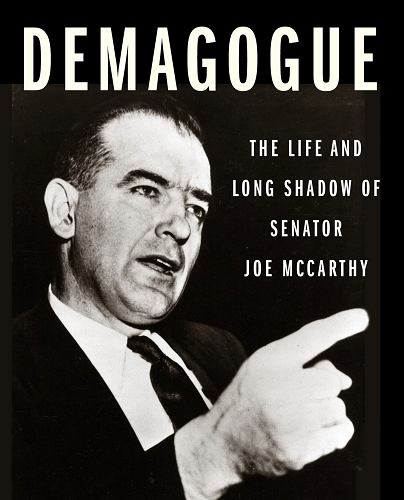
Almost immediately after, I read a column in the Times from two days ago, in the Arts section. It’s a periodic feature by John Williams where he interviews an author, “5 Things About Your Book.” This time he was talking to Larry Tye, whose biography of Joe McCarthy has just been published. The cut line read that Larry Tye “discusses his biography of that American bully, and an eerie echo.”

Having read the Times for the last four years and watched with admiration how it can toss gratuitous insults and sinister innuendoes about President Trump in any context no matter how remote, from book reviews to cooking columns to fashion essays.  I was certain what the “eerie echo” would be. Joe McCarthy was a bad guy, so the article would show how much Donald Trump is like Joe McCarthy.

For the nonce, I will ignore that salient fact that it is “the resistance,” the Democrats and the anti-Trump media, which is to say, the media, that have been using relentless McCarthyite tactics against the President from before he was elected.

So where was this eerie echo of Trump in the life of “Tail-gunner Joe”? Here’s Tye’s  shocking illumination of that question:

I knew there was a general link between Senator McCarthy and President Trump, but I didn’t realize how eerily echoing it was.

Huh? What “general connection”? The Senator died in 1957, when Trump was 10. How can you have a “general connection” with someone who isn’t in your family, you never met, and whom you didn’t know anything about at all until well after he died?

That’s smear #1. Here’s smear #2: Continue reading →