 The New York Times revealed this week that more than 300 district attorneys’ offices engage in a practice that is a clear violation of legal ethics and probably illegal as well. These prosecutors partner with debt collecting agencies, which sent thousands of threatening letters to people across the country who have bounced checks, threatening them with harsh penalties and imprisonment. The letters bear the seal and signature of the local district attorney’s office, which gives them extra persuasive power.The companies also try to sell the check-writers on budgeting and financial responsibility classes, and if they sign up, the district attorneys’ offices get a commission, in addition to a fee from the firms. It’s all in the interest of more efficient law enforcement, prosecutors argue; the partnerships free them to work on more serious crimes. Continue reading
Law & Law Enforcement
The Detainment Of Nakoula Basseley Nakoula Is A First Amendment Betrayal, Parole Violation Or Not
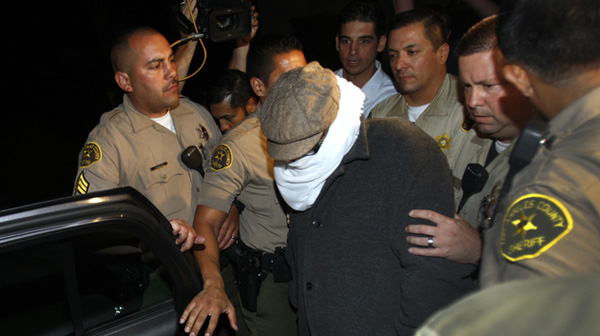
No, really, this has nothing to do with the President blaming this guy’s film on the attacks on US embassies; it’s just a parole violation thing. Unrelated. Really. Of course, if violent Muslims think we’re cracking down on him because he insulted their prophet, that’s a bonus, right?
Ken at Popehat applies his experience as federal prosecutor to make this observation (among others) in the Federal questioning—I regard it as political harassment that happens to have a convenient non-political justification—of the hack ” Innocence of Muslims” film-maker Nakoula Basseley Nakoula:
“I think the situation bears careful watching. Based on 6 years as a federal prosecutor and 12 as a federal defense lawyer, let me say this: minor use of a computer — like uploading a video to YouTube — is not something that I would usually expect to result in arrest and a revocation proceeding; I think a warning would be more likely unless the defendant had already had warnings or the probation officer was a hardass. But if I had a client with a serious fraud conviction, and his fraud involved aliases, and he had the standard term forbidding him from using aliases during supervised release, and his probation officer found out that he was running a business, producing a movie, soliciting money, and interacting with others using an alias, I would absolutely expect him to be arrested immediately, whatever the content of the movie. Seriously. Nakoula pled guilty to using alias to scam money. Now he’s apparently been producing a film under an alias, dealing with the finances of the film under the alias, and (if his “Sam Bacile” persona is to be believed) soliciting financing under an alias. I would expect him to run into a world of hurt for that even if he were producing a “Coexist” video involving kittens.”
Ken ends up where I do on other aspects of this incident, and I yield to his analysis here as far as it goes. But Nakoula Basseley Nakoula did not produce a “Coexist” video involving kittens. He produced a cheesy film that has provoked foreigners to violence, and also to demand that the creator of the film be punished by the U.S. government because of the film’s content; that voices on the left in this country are arguing should be censored (as well as that its maker be arrested); that the Obama Administration itself has tried to censor by persuading Google to ban it, and that Jay Carney is claiming, absurdly, is the sole target of all the Arab unrest. Continue reading
Integrity Check For Obama Supporters: Calling the Federal Harassmant of the Idiotic, Bigoted, Irresponsible, Anti-Muslim Film Maker What It Is
That is, intolerable.
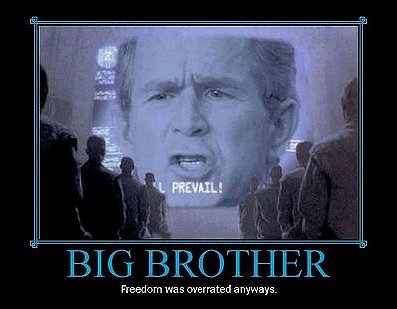
What’s wrong with this picture?
Nakoula Basseley Nakoula, a.k.a. “Sam Bacile,” was interviewed by Federal parole officials at the police station in Cerritos, California, where Nakoula lives. Supposedly they investigating whether Nakoula has violated the terms of his five-year probation for various financial crimes, which could cause a judge to send him back to prison.
- What has he done to justify such an investigation? Why, he made a film insulting to Islam, which is being cited by the White House as the provocation for the protests and attacks at American embassies in Islamic nations! Yes, he also may in fact be in violation of his parole, which included prohibitions on using computers and aliases. If anyone really believes this is the reason the Feds are swooping down on him now, in the wake of the Obama Administration explicitly using his film as its scapegoat for the embassy protests and attacks, I need to talk with them about this Nigerian prince I know.
- Is making a film insulting to Islam a violation of his parole by any stretch of the imagination? No. It is a protected act for any American citizen, and no matter what crimes he may have been convicted of in the past, completely irrelevant to them.
- So why is he being questioned now? Three reasons: 1) To indicate to Islamic nations that the U.S. government is “doing something” to the miscreant who dared to make an offensive film (trailer, actually) 2) To intimidate him and other citizens who intend to exercise their right of free speech that Big Brother is watching, and if you displease him, or cause embarrassment to his misguided foreign policy, you will be sorry and 3) To prove a genuine violation of his parole , so he can be jailed in close proximity to his supposedly protected exercise of free speech, which the foreign critics demanding punishment for the maker of the film will take as official sanction for insulting Islam, which, in truth, it will be.*
- And what is this conduct by the Federal government called? Continue reading
“Marion Berry’s Dirty Asian Summer Punch” and Attacks on Free Speech From The Left
 The United States’ has to be vigilant in protecting its unique Bill of Rights from dilution, degradation and manipulation. Once the threats came from the political right, as with the Red-baiting tactics of Sen. Joe McCarthy. Now it more typically comes from the kinder, gentler, more hypocritical political left, often in the form of threats to “hate speech,” a term that can mean pretty much whatever the kinder, gentler censor wants it to mean, and is especially handy to stifle dissent.
This First Amendment assault was on view yesterday on MSNBC, as PR loud mouth Donny Deutch, columnist Mike Barnicle and University of Pennsylvania professor Anthea Butler all agreed that the makers of the anti-Muslim video now being used as an excuse to attack embassies should be indicted. Uh, no. Making a movie cannot be a crime in the U.S.: this was what Citizens United was all about, and the principle is called “Freedom of Speech.” But bigger brains than Donny’s are trying to chip away at the right that makes America America, using the ever-popular “everybody does it” rationalization to argue that European nations prosecute those who “hurt religious feelings”, in the immortal words of our Cairo Embassy, so it must be the right thing to do.
Scared yet? If not read this post, and this, from the Volokh Conspiracy, on the arguments for limiting Free Speech being made by Prof. Peter Spiro and former Yale Dean Harold Koh, the latter now working in the Obama State Department.
Or just watch how much the bureaucrats in our nation’s capital respects the First Amendment. Or understand satire. Continue reading
Emmett Burns Emulates Rahn Emanuel, or, What Does It Tell Us That Yvette Clarke Is NOT This Month’s Most Incompetent Elected Official?
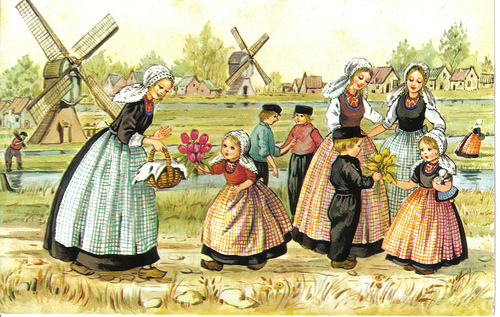
Brooklyn, NY, circa. 1898. If you look closely, you can see the slaves working in the windmills…
In case you missed it, Rep. Clarke, the Congresswoman from Brooklyn, NY, had thousands of American banging their heads against the wall (and, tragically, many more, like those who voted this dolt into office nodding their empty heads and saying, “She speaks the truth!”) when she told Comedy Central’s wag Stephen Colbert that Brooklyn still had slavery in 1898, a full 33 years after the Civil War and the passage of the 13th Amendment. When Colbert, in mock surprise, said, “It sounds like a horrible part of the United States kept slavery going until 1898! Who would be enslaving you in 1898 in New York?”, Rep. Clarke, eager to fill the gaps in Colbert’s knowledge of New York history, informed him that it was “the Dutch”…who lost control of New York when “New Netherland” was conquered by the British in 1664, 200 years before the end of the Civil War. Continue reading
Chris Darden: Failing The Accountability Test and Making the Unethical Quote of the Week, Too
I feel sorry for Chris Darden.
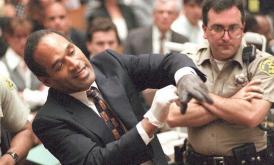
It’s all Johnny Cochran’s fault.
Like Monica Lewinsky and others, he was living a normal personal and professional life until events beyond his control thrust him to the center ring of a media circus, and the bright lights of celebrity and hyper-scrutiny derailed his life forever. As a young prosecutor, he could have made many worse errors than his infamous gamble of allowing O.J. Simpson to try on the murder gloves found at the scene of Nicole Simpson’s and Ron Goldman’s death, and been able to learn and move on. But his blunder was on live TV, during the most watched trial in history. Master defense attorney Johnny Cochran turned it into a ditty (“If the gloves don’t fit, you must acquit”) that found immortality in law school classes, history books and “Seinfeld,” and Chris Darden, working lawyer, became celebrity road-kill. (So did his colleague Marcia Clarke. Seeing today, bleached, botoxed and barely recognizable, desperately trying to eke out a living as a D-list celebrity pundit, it becomes vividly clear that Simpson ruined more lives than the two he snuffed out that bloody night.)
So I understand why Darden, taking part in a panel discussion about the trial at Pace Law School in New York City, shocked his fellow panel members and the audience by saying, “I think Johnnie tore the lining. There were some additional tears in the lining so that O.J.’s fingers couldn’t go all the way up into the glove.” Darden then asserted that the defense team had unsupervised custody of the glove before the infamous test, which is when he surmised that the tampering took place. I understand it, just as I understand a lot of terrible conduct that is still inexcusable. Continue reading
“Is We Getting Dummer?” Oh,Yes. Does We Care?

Why yes, it DOES remind me of “Idiocracy,” which is only funny if it isn’t true.
Today, just prior to convicting Drew Peterson of killing his wife, his jury sent a message to the judge asking what the word “unanimous” meant.
Think about the implications of this. First of all, it means that one man’s life and the U.S. justice system’s integrity is resting on the judgment of twelve people, not one of whom possesses a fifth grade vocabulary, or, if one of them does, he or she did not possess the skills of persuasion or credibility to convince a majority of his colleagues that yes, “unanimous” means that everybody is in agreement. It means that the voir dire system managed to carefully select the most ignorant and inarticulate jury of adults imaginable for a first degree murder trial.
That’s not all. It means that in Joliet, Illinois, a select group of twelve adults, in addition to possessing only a rudimentary English vocabulary, were completely uninformed about the jury system. To reach adulthood this stunningly ignorant about one of the basic features of our justice system and democracy, these individuals could not have regularly read newspapers or watched the news, and if they did, could not possibly have understood what they were reading or seeing. Continue reading
Bad Crime, Unethical Punishment, Ominous Sign
Here’s a pop quiz for you.
The topic: crime and punishment
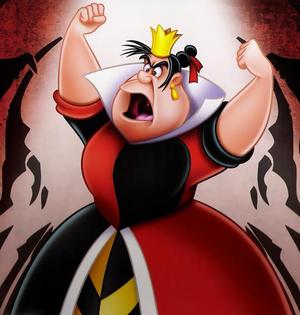
“Off with his head!” Uh, Queen? Isn’t that just a tiny bit severe?
An attractive woman falls asleep on an airplane, and the stranger sitting next to her, a card-carrying, pig-man creepazoid, takes that opportunity to “feel her up.” He is caught in the act, and arrested when the plane lands. What should be the maximum penalty imposed for such a violation of the poor woman’s privacy, dignity, and person?
If you said “life in prison,” go to the head of the class. The federal government has exclusive jurisdiction over sexual abuse cases that occur on American airplane flights, and sets the penalties. A New Jersey man is currently awaiting trial after allegedly engaging in such in-flight molestation. How can such an extreme sentence be justified or even contemplated? What is this, “Midnight Express”? Rumania under the wise rule of Vlad the Impaler? Continue reading
The Forgotten Meaning of Labor Day

Do you know who this is? You should! It’s Labor Day, dammit!
Labor Day commemorates one of the great ethical victories of American society, and not one in a hundred Americans know it. Labor Day marks the end of summer, and a time for retail store sales, and the last chance to get away to Disney World, but few of us think about the real meaning of the word “labor” in the name, and how it is meant to honor brave, dedicated men and women who fought, sometimes literally, the forces of greed, political influence, wealth and privilege in this country to ensure a measure of safety, consideration, fairness and justice for the hardest working among us.
Today labor unions are controversial, and with good reason. Many of them have been run as criminal enterprises, with deep connections to organized crime; many operate in a blatantly coercive and undemocratic fashion. Union demands and strong-arm tactics, while providing security and good wages to members, have crippled some American industries, and limited jobs as well. Today the unions get publicity when one of them tries to protect a member who should be punished, as when the baseball players’ union fights suspensions for player insubordination or even drug use, or when school districts are afraid to fire incompetent teachers because of union power, or when the members of public unions protest cutbacks in benefits that their private sector counterparts would be grateful for. It is true that today’s unions often embody longshoreman philosopher Eric Hoffer’s observation that “Every great cause begins as a movement, degenerates into a business and ends up as a racket.” *
That not what Labor Day honors, however. It is celebrating the original labor movement that began at the end of the 19th century, and that eventually rescued the United States from an industrial and manufacturing system that was cruel, exploitive, deadly and feudal. Why the elementary schools teach nothing about this inspiring and important movement, I do not know. I suspect that the story of the American labor movement was deemed politically dangerous to teach during the various Red Scares, and fell out of the curriculum, never to return. Whatever the reason, it is disgraceful, for the achievements of the labor movement are every bit as important and inspiring as those of the civil rights movement and the achievements of our armed forces in the protection of liberty abroad. Continue reading
He Must Not Have Liked The Tofu At The Reception: Worst Wedding Guest Ever

“I invited him? I thought YOU invited him!”
The Ethics Alarms week just completed week was notable for the bizarre and lengthy argument over proper conduct by wedding reception hosts, prompted by my criticism of advice columnist Carolyn Hax. It is with some trepidation that I now ask: Can we agree that this is the worst wedding reception guest ever?
The guest is Omar Santiago, a young lad invited to the reception by the brides’ niece, who probably needs to cultivate better taste in boyfriends. Omar was observed around midnight doing something suspicious in a closet at the West Sayville (New York) Country Club as the less larcenous guests were bunny-hopping. The maitre d’ asked bride Joanna Williamson if she had directed a young guest to handle her gift box. Why no, she hadn’t, Williamson replied—Holy cats!! Someone is stealing our wedding gifts????? Continue reading
 Ethics Alarms