Thirteen Ethics Observations On The GOP’s Letter To Iran

Letter to IranFrom the Washington Post:

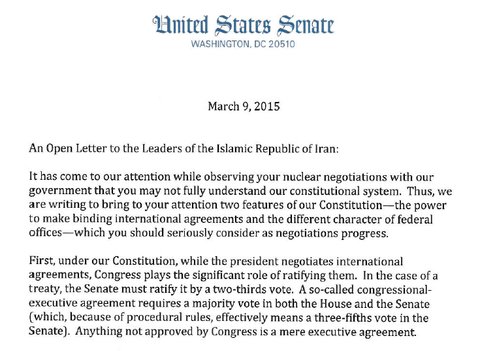
“An already heated battle between the White House and Republicans over negotiations to curtail Iran’s nuclear program grew more tense Monday when 47 Republican senators sent a letter to Iran designed to kill any potential deal.

The White House responded by accusing the Republicans of conspiring with Iranian hard-liners, who oppose the delicate negotiations, and suggesting that their goal was to push the United States into a military conflict.”

Observations:

1. The letter cannot be defended as anything other than an effort to sabotage sensitive international negotiations. As such, it is direct interference with the President’s ability to do his job. The fact that Republicans, like Israel, have abundant evidence that President Obama is likely to do that job, in this case, badly and even dangerously is no justification for this unethical, unconstitutional, arrogant and offensive act. The American people elected Obama president, and with that came the authority to conduct foreign affairs and oversee negotiations with foreign governments. The letter is wrong in every way.

2. It does not matter, and should not matter, to any American whether or not they believe that a breakdown in negotiations with Iran would be preferable and safer than the kind of deal this President is likely to produce. It does not matter. The letter is per se a breach of the separation of powers, and as precedent, endangers the nation’s entire governance structure.

3. Anyone who defends this atrocious, reckless and unprofessional conduct is fully embracing “the ends justifies the means” as a principle of democratic government.

4. If he was not aware of it and did not approve it, Republican Senate leader Mitch McConnell is obligated to condemn this action, and punish all signatories,  stripping them of committee assignments related to foreign affairs.

5. He won’t. Continue reading →

Ethics Observations On The Selma Celebration “Gotcha’s!”

Selma redux

1. The big controversy as of this morning involved the New York Times front page photo, which managed to be cropped exactly at the point where former President Bush could have been seen. Given the Times’ proclivities, conservative blogs and Fox News presumed the snub was intentional. If it had been intentional, that would have indeed been disrespectful and unethical photojournalism. The Times explanation, however, seems reasonable. It tells us something, though, that nobody at the Times saw this coming. I think it’s incompetence born of bias. “Where’s Bush?” “He was too far down the line, so the photo looks lousy if he’s included.” “Damn. Well, put a note in explaining that.” Bias makes us stupid, and the fact that no Times editor had this conversation is, in fact, stupid.

2. If the NAACP was setting the place cards, and I assume they were, then Bush should have been second row center, and not an MSNBC demagogue and race-hustler who owes the U.S. back taxes. Talk about biased and stupid. The NAACP claims it wants to be a unifying force in the country, but it doesn’t. It promotes divisiveness,and intentionally. It’s good for business.

3. A graceful, fair, respectful and competent President of the United States would have insisted that his immediate predecessor be in a position of prominence, as part of the message that this event was an important part of the history of America and all Americans. It would have been the right thing to do. Bush would have done the same for him. But we do not have a graceful, fair, respectful and competent President. We have an arrogant, petty, self-absorbed and divisive one.

4. …who can, on occasion, rise to give an excellent speech, which he did. Continue reading →

Why The Sweet Briar College Fight Matters

sweet-briar-collegeEthics Alarms has been besieged by interest in the threatened Sweet Briar College closing, with the recent post on the topic already the third most viewed essay in the history of the blog. I was surprised; I shouldn’t have been. From an ethics and societal perspective, what the controversy stands for is as important as any covered here. It is also central to the nation itself.

When a business fails, the casualties include ambitions, opportunities, dreams, financial resources, community assets, and jobs. That is serious and tragic. Non profit organizations, however, exist to turn ideas into reality, to strengthen them, bolster them, and prove that they deserve to survive and flourish. The death of Sweet Briar will also mean the loss of ambitions, opportunities, dreams, financial resources, community assets, and jobs. Far more important, however, is that it will mean the death of an idea, or at very least the serious wounding of one.

This is why non profit boards should not be, as they so frequently are, merely comfortable curriculum vitae-stuffers  and networking forums for prominent dilettantes. Non profit boards are stewards of ideas, and they must also be willing and able to be warriors in defense of those ideas, if an idea is imperiled. It is not a job for the faint of heart, and the consequences of failure, or, as in the case of Sweet Briar, fearful and premature capitulation, are catastrophic, not just for the organization, institution and its constituents, but the entire U.S. culture.

Sweet Briar exists to nurture a particularly vital idea, the mission of training young women… Continue reading →

How Listening To Democrats Spin Shamefully To Excuse Hillary Clinton Makes Me Think Of Sir Thomas More…

Today’s Sunday Morning spectacle of Democrat spin-meisters using deceitful rationalizations to make the untenable case that Hillary Clinton’s  violating her own agency’s policies to allow her the power to redact and hide her communications as needed prompts in me, in addition to disgust, a reflection on my favorite ethics drama and film. To paraphrase but slightly one of the more memorable lines from Robert Bolt’s play and screen play, “A Man For All Seasons,” delivered by the doomed martyr Sir Thomas Moore:

“It profits a man nothing to give his soul for the whole world… but for Hillary Clinton?”


The Sweet Briar Betrayal

white-flag-2

After 114 years, Sweet Briar College, the venerable women-only college in rural Virginia, announced Tuesday that this will be its final year despite strong alumnae support and more than $90 million left in its endowment, even after several years of running a deficit.

Paul G. Rice, board chair, said that he realized some would ask, “Why don’t you keep going until the lights go out?” but that doing so would be wrong. “We have moral and legal obligations to our students and faculties and to our staff and to our alumnae. If you take up this decision too late, you won’t be able to meet those obligations,” he said. “People will carve up what’s left — it will not be orderly, nor fair.”

Well, at least the board is taking this lying down.

Rice’s excuse is nonsense, and the board’s action  is an abdication of a difficult duty, not an acceptance of one. Non profits have missions, and their boards are obligated to keep pursuing that mission until it becomes hopeless, not until it becomes tough. Yes, small colleges face challenges, and single-sex education has been out of favor since the Sixties. On the other hand, feminists are making the case that co-ed universities are little better than hunting grounds where women are the helpless prey of serial rapists. Surely Sweet Briar’s niche might become an asset with some vision and leadership. Continue reading →

Hillary Clinton and the E-mails: A Case Study In Ethics Corruption

corrupted

I’ve been meaning to write this post for a couple of days now, but haven’t had the heart. Frankly, I am really sick of having to make the same point about the Clintons over and over again—they never learn, and will never change—knowing that so many people will just immediately turn off their brains and run for the rationalizations dispensary any time dishonesty, hypocrisy, deceit or misconduct by one of them is uncovered.

This happens, you see, because the Clinton are perhaps the most prominent among a particular harmful species of individual in our culture, the ethics corrupter. Ethics corrupters are popular, powerful, successful and famous people who, because they are popular, powerful, successful and famous, many citizens conclude that they must also be good and wise, and therefor trustworthy. Since they are (many believe) good and wise, what they choose to do must also be good, and when they are accused of doing wrong, even when the evidence is unavoidable that they have done wrong, there can be only two explanations to those vulnerable to correuption. The first is that the evidence, no matter how strong, cannot be believed, and those wielding it are in fact enemies of right, good, honesty and fairness. The second is that if these good and wise people did it, then what they did cannot be wrong, or can be justified, usually by “the ends justify the means.”

Thus by gaining the trust and admiration of good people, usually through clever use of dishonesty, deception and manipulation, ethics corrupters set their admirers and supporters up to have their own values weakened or destroyed. Richard Nixon caused honest people to defend the covering up of crimes. Charlie Rangel caused people with integrity to support accepting bribes. Bill Clinton made feminists excuse exactly the kind of sexual harassment they persuaded Clinton to sign a law prohibiting, and inspired lawyers to excuse perjury because “everybody lies about sex.” Lance Armstrong made parents who once taught their children not to cheat to defend cheating, because he had a foundation with a noble cause. Brian Williams and Bill O’Reilly made TV viewers excuse lying by journalists.

Ethics corrupters make their supporters worse parents, friends, employees, employers and human beings; in turn, those corrupted supporters make society less ethical and more cynical as well. These are genuine cultural polluters; indeed, they are cultural pollution.

Hillary Clinton is an ethics corrupter, and the response to the revelations of her use of exclusively personal e-mails proves it beyond the shadow of a doubt.

There is no benign interpretation of her conduct regarding her State Department e-mails. It was not a mistake; one cannot claim that it was accidental. Since it was intentional, there must have been a purpose, and the only conceivable purposes are unethical ones. According to the 2009 National Archives and Records Administration regulations in effect when Clinton took office, “Agencies that allow employees to send and receive official electronic mail messages using a system not operated by the agency must ensure that Federal records sent or received on such systems are preserved in the appropriate agency recordkeeping system.”  With a private e-mail account and only using that for official correspondence, Clinton did not have a system that ensured such preservation. She, not the system, determined what would be preserved. Anything not preserved or left on her private account would not be subject to the Freedom of Information Act. Is there any explanation for having a private account only, an justification that is simultaneously responsible, plausible and does not suggest that Clinton wanted to control which of her communications could come before the public and the press?

No.
Continue reading →

Ethics Tales: How Julia Sand Saved A President And Changed The Nation

open book on concrete background

In my recent overview of the U.S. presidency (the four parts are now combined on a single page under “Rule Book” above), I noted that our 21st President, Chester A. Arthur, was one of my personal favorites and an Ethics Hero. He confounded all predictions and his previous undistinguished background, not to mention a career marked  by political hackery and toadying to corrupt Republican power broker Roscoe Conkling, to rise to the challenge of the office and to effectively fight the corrupt practices that had elevated him to power. Most significantly, he established the Civil Service system, which crippled the spoils and patronage practices that made the Federal government both incompetent and a breeding ground for scandal.

I did not mention, because I did not then know, the unlikely catalyst for his conversion. Recently a good friend, knowing of my interest in Arthur, his tragic predecessor, James Garfield, and presidential assassinations sent me a copy of Destiny of the Republic, the acclaimed history of the Garfield assassination and its aftermath by Candace Millard. It’s a wonderful book, and while I knew much of the history already, I definitely did not know about Julia Sand. Her tale is amazing, and it gives me hope. If you do not know about Julia and Chester, and it is not a well-known episode, you should.

Allow me to tell it to you?

James Garfield, an Ohio Congressman, had been the dark horse nominee of the Republican Party in 1880, foiling the ambitions of many powerful politicians, the most powerful among them being Sen. Roscoe Conkling of New York. In order to cement New York’s electoral votes, the convention gave the Vice Presidential nomination to Conkling’s lackey, the dignified-looking but otherwise unimpressive Chester A. Arthur, who may have been the least qualified individual ever to run for that office. The highest position he had ever held was Collector of Customs of the Port of New York, which had been handed to him by Conkling, and he was later removed from that post for incompetence and corruption.  He’d never been elected to significant office or been any kind of executive. Arthur’s career before becoming Vice President makes Sarah Palin look like Winston Churchill.

After the election, Arthur got to work being a disloyal Vice-President, acting as Conklin’s agent in the White House. (Arthur, a widower, even lived as a guest in Conkling’s Washington mansion.) He actively undermined Garfield’s efforts at government reform, at one point going so far as signing a petition supporting Conkling when Garfield refused to appoint only Cabinet members with the Conkling stamp of approval. Then,  on July 2, 1881, less than six months after taking office, the impressive Garfield was shot in Washington D.C.’s Union Station by Charles Guiteau, easily the craziest of the various crazies who have taken a shot at our leaders. (He was also the only lawyer in that group.)

Everybody was horrified, initially at the crime, but also at the prospect of Arthur becoming President. Some even suspected him of being complicit in the act; Guiteau didn’t help by writing Arthur a letter prior to his attack telling him what he needed to do as President.  Most, however, were just aghast at the prospect of the brilliant, courageous, skilled and honorable Garfield being replaced by this utter non-entity under Conkling’s thumb.

None were more aghast than Chester A. Arthur. He may have been a hack, but he was no fool, and he knew he wasn’t up to the job. It was reported that when he learned of Garfield’s shooting, Arthur began weeping like a child. During the nearly three months it took the hardy Garfield to die—he was killed by sepsis induced by the unsanitary prodding of his doctors as they searched for Guiteau’s bullet: the wound itself was probably survivable—Arthur descended into panic, shock, and depression.  For nearly two months, he stayed at home with the blinds drawn, fearing his own assassination. So invisible was he that there were  rumors that Arthur had poisoned himself.

Then Arthur received a letter, dated August 27, 1881, from a woman he did not know, Julia Sands. It immediately got his attention, for she addressed him in a manner he had never been spoken or written to before. The remarkable letter said in part… Continue reading →
Hillary’s E-mail Ethics Breach: The Only Questions Are 1) “How Can Anyone Trust Her?” and 2) “Is there Nothing Her Supporters Won’t Excuse?”

hillary-clinton-pointing2The ethics issue here is very straightforward and uncontroversial. As the New York Times put it:

“Hillary Rodham Clinton exclusively used a personal email account to conduct government business as secretary of state, State Department officials said, and may have violated federal requirements that officials’ correspondence be retained as part of the agency’s record. Mrs. Clinton did not have a government email address during her four-year tenure at the State Department. Her aides took no actions to have her personal emails preserved on department servers at the time, as required by the Federal Records Act.”

I don’t know why the Times says “may have violated.” Her exclusive use of personal e-mail does violate the rules, and in fact the law, as the Times correctly states in the final sentence. Moreover:

1. This is a blatant example of Clinton again refusing to abide by rules and laws other officials are required to abide by. As the Washington Post notes, it was intentional: Clinton’s personal account was established on the same day that Clinton began her confirmation hearings to be Secretary of State., and the expiration on the domain is shortly after the 2016 election. Continue reading →

The Ethics Of Netanyahu’s Speech and the Consequences Of Lost Trust

netanyahu

One of my knee-jerk progressive Facebook friends is addicted to terrible analogies. Here is his recent attempt to frame the controversial appearance by Benjamin Netanyahu before Congress today:

“At the invitation of Speaker Yuli Edelstein, President Barak Obama will appear before the Israeli Knesset on Thursday to give a major speech on the Netanyahu adminstration’s bungling of the Palestinian conflict, territorial abuse to build settlements, and allocation of US foreign aide…”

What’s wrong with that? You have three seconds.

Time’s up. That is a lousy analogy, because the positions of the U.S. and Israel are not accurately reversed as a good analogy would demand. If Netanyahu was appearing before Congress to lecture it on U.S. policies regarding illegal immigration over the Mexican border, that would justify my friend’s hypothetical. What Netanyahu is here to talk about, however, is the future of his people and his nation, not ours.

As I wrote here about a month ago, there is no question that this is a breach of diplomatic protocol, nor is there any doubt that Congress is defying tradition, separation of powers and probably the Constitution to invite the Israel Prime Minister to, in essence, lobby the public regarding the President’s conduct of foreign policy. Congress’s actions are objectively unethical, a calculated tit for the President’s equally unethical tat of using executive orders to circumvent the lawmaking process. This episode is ethically more complicated than that, however, and when the criticism is doled out, other ethical considerations and principles are relevant.

Here is the chief one: Netanyahu does not trust the judgment, motives, negotiating skill and competence of the Obama Administration. Continue reading →

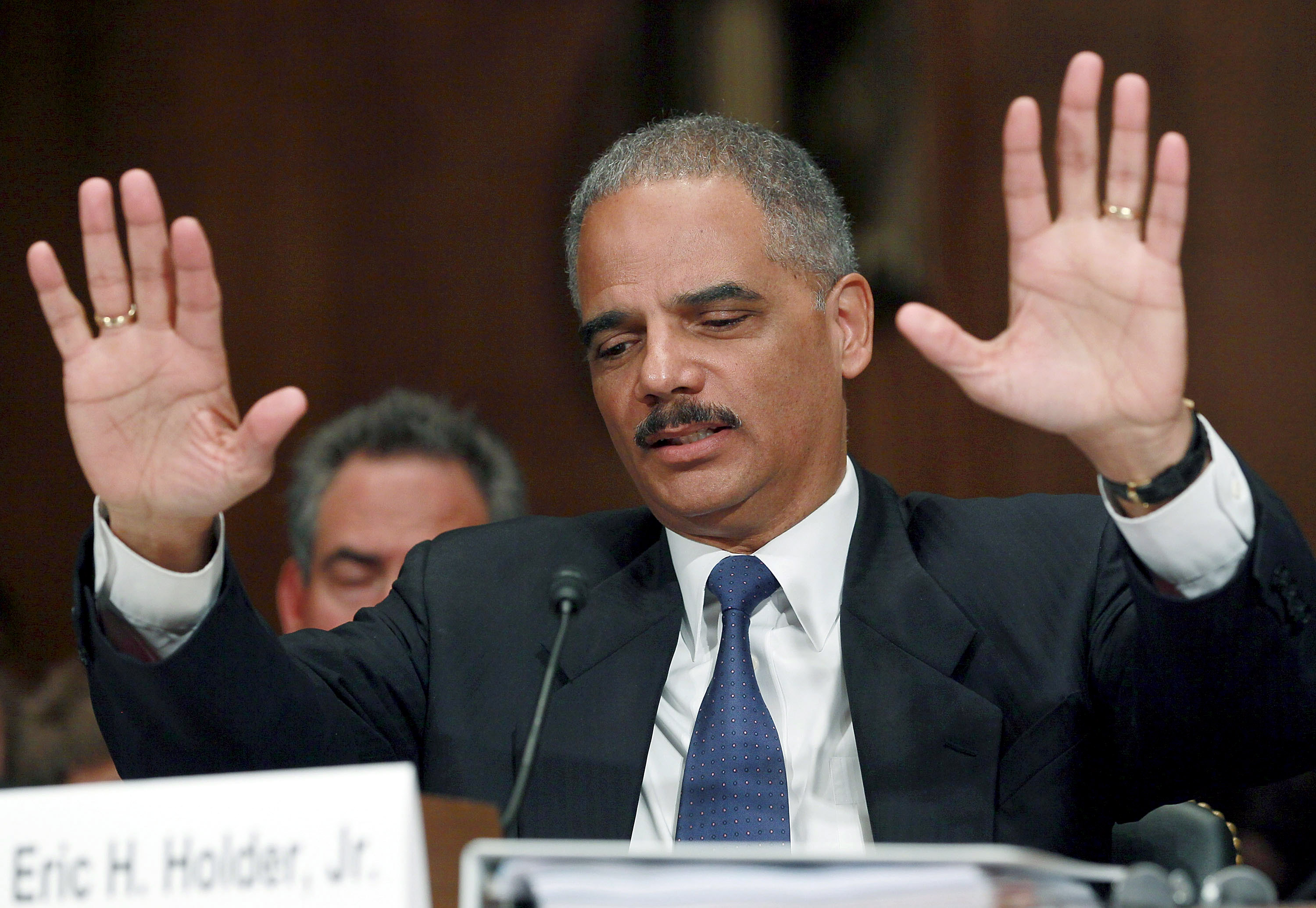
Unspoken Ethical Quote Of The Month: Outgoing U.S. Attorney General Eric Holder

Attn. General Holder Testifies At Senate Judiciary Hearing On Justice Dept Oversight

“No, I respect the motives and intentions of my critics. Those who have opposed me genuinely disagree with my philosophy and approach to the job, and I would never denigrate them by attributing their opposition to race, bias, or anything but the same passion and belief in their goals for the nation that I have in mine.”

—What Attorney General Eric Holder could have and should have answered in his “exit interview” with Politico’s Mike Allen, in answer to the question, “Now, there clearly have been times …when you have felt disrespected on Capitol Hill. How much of that do you think relates to race?”

Holder didn’t answer this way, however.

Holder is black, and consistent with the message that has been trumpeted from the White House, Democrats, the Congressional Black Caucus, and Presidential advisor and Holder consort Al Sharpton for more than six years, any and all problems, criticism, misfortune or failure affecting African Americans can plausibly, reasonably, credibly, and advantageously be attributed to racial bias or outright racism.

Thus Holder’s actual answer to Allen was…

“Yeah, there have been times when I thought that’s at least a piece of it.”

Continue reading →