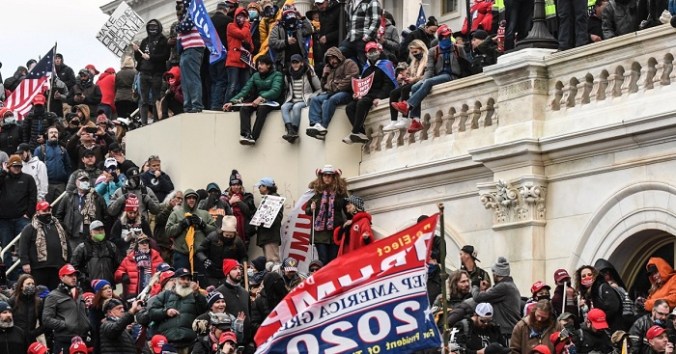
It is certainly appropriate to analyze and carefully consider the context and causes of the January 6 riot. Doing so, however, does not require the extended hyping, spin and deceit that we have been subjected to by Democrats, Trump-o-phobics and the news media for a full year, culminating in a contrived “anniversary” today. Over the past year, we have heard absurd comparisons of the one day riot to the bombings of September 11, 2001, Pearl Harbor, and maybe Darth Vader’s destruction of Alderaan—I don’t know, I didn’t read every hysterical screed on the topic.
Today’s retrospective overkill in the New York Times, for example, occupies four full pages in the A Section, with seven of the 24 containing at least one riot-related article. Pearl Harbor brought the U.S. into World War II, crippled the Pacific fleet and cost almost 3000 lives. 9/11 ushered in a new era of struggles against Muslim terrorists, also took 3000 lives, and profoundly affected the economy, privacy, civil liberties and politics. And January 6? It provided Democrats with a useful narrative to use to try to neutralize Donald Trump, and opened a new door to criminalizing the Right. The riot never threatened to overturn the election results at any point. It never even delayed the Congressional certification of those results, nor could it.
The motivation behind this orgy of narrative framing is clear: Democrats, progressives and the media are terrified that they are headed for an epic (and oh-so-richly deserved) wipe-out in the 2022 mid-term elections, and the only weapons they appear to have in their arsenal are fear-centered: fear of the end of “democracy” (meaning Democratic Party rule), fear of Trump, and fear of “the deplorables,” with fear of climate change thrown in for variety. It is a massive, shameless, relentless, desperate propaganda effort, divisive, dishonest, thoroughly despicable, and, of course, unethical.
Nonetheless, it would be helpful to examine the reasons the January 6 riot occurred, and I find it incredible that I haven’t seen a single balanced and ethically objective analysis anywhere. Typical of what I have seen is yesterday’s op-ed by The New republic’s contributing editor Osita Nwanvetu. The Times headlined it using a rare form of dishonesty, advancing a lie by denying the lie: “Trump Isn’t The Only One To Blame.” Trump certainly shares a large portion of responsibility for the riot, but since he neither led the mob to the Capitol nor participated in the riot himself, he obviously wasn’t the “only one to blame.” But the politicians and “journalists” who are terrified of him have worked tirelessly to embed that false impression.
Who and what are “to blame” for the ugly events of a year ago? Who isn’t at fault? Here is the Ethics Alarms list. If you know of another equally non-partisan and unbiased analysis, please let me know. I haven’t seen it.
Continue reading →





Matthew B. scored a Comment of the Day by raising an issue I had never thought about before: how the misapplication of PowerPoint leads to inadequate training and information dissemination within organizations and bureaucracies. He also references the reluctance of managers to know when to hand over decision-making to subordinates. That is something I have thought about, a great deal.
Two of my favorite movies illustrate how competent leaders and managers know when to delegate a crucial decision down. “Topsy-Turvy,” the superb 1999 film depicting the creation of “The Mikado” by Gilbert and Sullivan, accurately depicts the real incident when, after the final rehearsal, W.S. Gilbert told the “Mikado” cast that he was cutting “My Object All Sublime,” also known as “The Mikado’s Song.” Gilbert was a tyrannical director, and the cast was terrified of incurring his wrath. This time, however, they stood up to him. The cast as one told him that he was making a mistake. The soloist, Richard Temple, they told their shocked and steaming director who also had conceived of the song, should have the chance to perform it in front of an audience. His fellow cast members were certain it would be a hit. Gilbert, recognizing the certitude the cast must have had to risk his fury at being contradicted, decided that his performers might have a clearer understanding of the show even that he had, and relented. Temple would sing about letting “the punishment fit the crime” on opening night.
The song was an instant sensation, like “The Mikado” itself, and is still one of the most quoted of all G&S songs.
The other example is at the climax of “Hoosiers,” the great basketball film based on the true story of the miraculous Indiana state championship won by a tiny school from Milan, Ind. in 1954. During the last time-out before the team’s last chance to score, which would, if successful, give the team a one-point victory over their greatly favored competition in the championship game, the coach (Gene Hackman), who has led the ragtag group this far by emphasizing teamwork over individual achievement, lays out a play in which the team’s superstar, Jimmy Chitwood will be a decoy. He plans for another player to take the final shot, but the team doesn’t move. “What’s the matter with you?” he shouts as his players just stare, looking hesitant. “If I get the shot, I’ll make it,” Jimmy says, after a long pause. So the coach, who has insisted all season that his word was law, makes the same decision Gilbert did. When your subordinates are that sure, trust them. They know better than you.
Jimmy shoots and scores the winning basket as time runs out.
Here is Matthew B.’s Comment of the Day on “Comment Of The Day: ‘Catching Up: Professional Ethics And The Challenger Disaster’”:
Continue reading →