I wonder how the Board of George Washington University felt as it watched its newly hired President make a complete ass of himself. This is what is technically known as “a bad sign.” His botched and ominous response to his first test also may well be signature significance for a political correctness addled boob. We shall see.
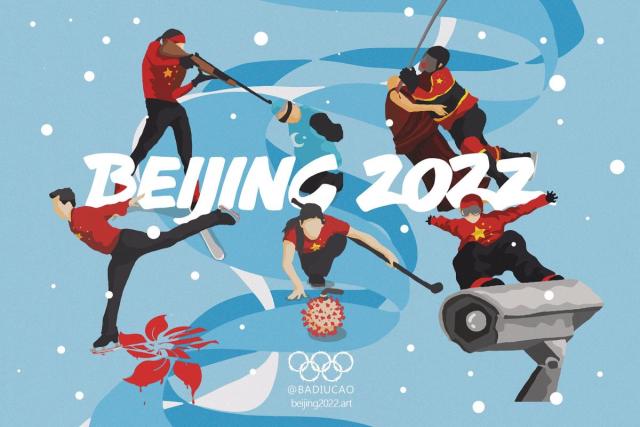
Last week, well-conceived satiric posters, appearing to promote the 2022 Olympic Winter Games in Beijing until one looks closely, began going up on dorm doors and elsewhere around the Washington, D.C. university campus. The artwork pointedly depicts Chinese athletes in “events” representing human rights abuses perpetrated by the Chinese government. In one poster, a biathlon competitor points her rifle at someone who is blindfolded and wearing the Uyghur flag. Another shows a snowboarder atop a surveillance camera. The posters were created by a Chinese dissident artist based in Australia.
The George Washington University Chinese Students and Scholars Association, a local chapter of a Chinese student group overseen by the Chinese Communist Party, reacted true to their corrupt culture while adopting one of the worst habits of ours. It attempted to censor the posters, calling them “seriously racist”—they learned that trick from Democrats here— and said the art “insulted China” in an email to students last week and a letter to university officials, including GW President Mark Wrighton.
“Racist” and “insulted China”—you know, like calling a pandemic virus that China unleashed on the world a Chinese virus was racist and insulted China. Indeed, The student group was most upset by the poster that shows a Chinese curler pushing a Wuhan virus instead of a curling stone. Good.





 Ethics Alarms
Matthew B. scored a Comment of the Day by raising an issue I had never thought about before: how the misapplication of PowerPoint leads to inadequate training and information dissemination within organizations and bureaucracies. He also references the reluctance of managers to know when to hand over decision-making to subordinates. That is something I have thought about, a great deal.
Two of my favorite movies illustrate how competent leaders and managers know when to delegate a crucial decision down. “Topsy-Turvy,” the superb 1999 film depicting the creation of “The Mikado” by Gilbert and Sullivan, accurately depicts the real incident when, after the final rehearsal, W.S. Gilbert told the “Mikado” cast that he was cutting “My Object All Sublime,” also known as “The Mikado’s Song.” Gilbert was a tyrannical director, and the cast was terrified of incurring his wrath. This time, however, they stood up to him. The cast as one told him that he was making a mistake. The soloist, Richard Temple, they told their shocked and steaming director who also had conceived of the song, should have the chance to perform it in front of an audience. His fellow cast members were certain it would be a hit. Gilbert, recognizing the certitude the cast must have had to risk his fury at being contradicted, decided that his performers might have a clearer understanding of the show even that he had, and relented. Temple would sing about letting “the punishment fit the crime” on opening night.
The song was an instant sensation, like “The Mikado” itself, and is still one of the most quoted of all G&S songs.
The other example is at the climax of “Hoosiers,” the great basketball film based on the true story of the miraculous Indiana state championship won by a tiny school from Milan, Ind. in 1954. During the last time-out before the team’s last chance to score, which would, if successful, give the team a one-point victory over their greatly favored competition in the championship game, the coach (Gene Hackman), who has led the ragtag group this far by emphasizing teamwork over individual achievement, lays out a play in which the team’s superstar, Jimmy Chitwood will be a decoy. He plans for another player to take the final shot, but the team doesn’t move. “What’s the matter with you?” he shouts as his players just stare, looking hesitant. “If I get the shot, I’ll make it,” Jimmy says, after a long pause. So the coach, who has insisted all season that his word was law, makes the same decision Gilbert did. When your subordinates are that sure, trust them. They know better than you.
Jimmy shoots and scores the winning basket as time runs out.
Here is Matthew B.’s Comment of the Day on “Comment Of The Day: ‘Catching Up: Professional Ethics And The Challenger Disaster’”:
Continue reading →