The Cowardly Courage of Tulsi Gabbard

Rep. Tulsi Gabbard, the Hawaii Congresswoman who is engaged in a quixotic effort to win the Democratic nomination for President from the relative center, became the fourth House Democrat not to vote for both articles of impeachment, instead voting “present.” Here is her statement explaining the non- vote:

Throughout my life, whether through serving in the military or in Congress, I’ve always worked to do what is in the best interests of our country. Not what’s best for me politically or what’s best for my political party. I have always put our country first. One may not always agree with my decision, but everyone should know that I will always do what I believe to be right for the country that I love. After doing my due diligence in reviewing the 658-page impeachment report, I came to the conclusion that I could not in good conscience vote either yes or no.

I am standing in the center and have decided to vote Present. I could not in good conscience vote against impeachment because I believe President Trump is guilty of wrongdoing.

I also could not in good conscience vote for impeachment because removal of a sitting President must not be the culmination of a partisan process, fueled by tribal animosities that have so gravely divided our country. When I cast my vote in support of the impeachment inquiry nearly three months ago, I said that in order to maintain the integrity of this solemn undertaking, it must not be a partisan endeavor. Tragically, that’s what it has been.

On the one side — The president’s defenders insist that he has done nothing wrong. They agree with the absurd proclamation that his conduct was “perfect.” They have abdicated their responsibility to exercise legitimate oversight, and instead blindly do the bidding of their party’s leader.

On the other side — The president’s opponents insist that if we do not impeach, our country will collapse into dictatorship. All but explicitly, they accuse him of treason. Such extreme rhetoric was never conducive to an impartial fact-finding process.

The Founders of our country made clear their concerns about impeachment being a purely partisan exercise. In the Federalist Papers, Alexander Hamilton warned against any impeachment that would merely “connect itself with the pre-existing factions,” and “enlist all their animosities, partialities, influence, and interest on one side or on the other.” In such cases, he said, “there will always be the greatest danger that the decision will be regulated more by the comparative strength of parties, than by the real demonstrations of innocence or guilt.”

Donald Trump has violated public trust. Congress must be unequivocal in denouncing the president’s misconduct and stand up for the American people and our democracy. To this end, I have introduced a censure resolution that will send a strong message to this president and future presidents that their abuses of power will not go unchecked, while leaving the question of removing Trump from office to the voters to decide.

I am confident that the American people will decide to deliver a resounding rebuke of President Trump’s innumerable improprieties and abuses. And they will express that judgment at the ballot box. That is the way real and lasting change has always occurred in this great country: through the forcefully expressed will of the people.

A house divided cannot stand. And today we are divided. Fragmentation and polarity are ripping our country apart. This breaks my heart, and breaks the hearts of all patriotic Americans, whether we are Democrats, Republicans, or Independents.

So today, I come before you to make a stand for the center, to appeal to all of you to bridge our differences and stand up for the American people.

My vote today is a vote for much needed reconciliation and hope that together we can heal our country. Let’s work side-by-side, seeking common ground, to usher in a bright future for the American people and our nation.

If you expect Ethics Alarms to award Gabbard an Ethics Hero designation for such equivocation, you don’t know me very well yet. Continue reading
Impeachment Ethics Update, Holiday Edition, Part Two: The President’s Letter

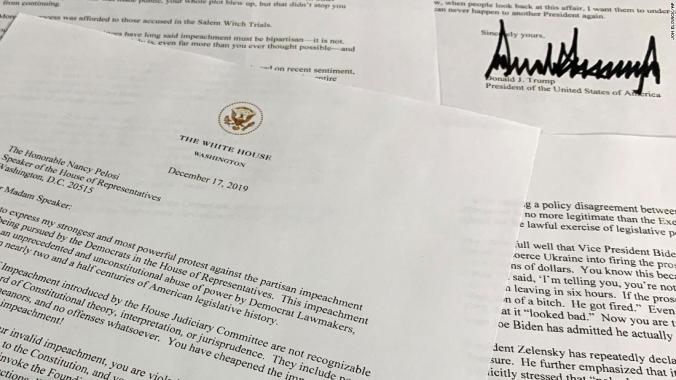
The President’s epic and historic letter to Speaker Pelosi on the eve of the vote to impeach him is nothing if not audacious and to someone who has been making many of the same points the President’s letter does, satisfying. I bet Bill Clinton wishes he had thought of it, except that he had a problem Trump does not: Clinton had in fact committed felonies by lying under oath, something a President must not do. (As I said at the time, without ever hearing a satisfactory rebuttal, if a lawyer would be disbarred for such conduct, as Clinton essentially was—he was forced to quit the Arkansas bar before he was fired from it—how can a President be held to a lower standard?).As President Trump’s letter correctly states, “The Articles of Impeachment introduced by the House Judiciary Committee are not recognizable under any standard of Constitutional theory, interpretation, or jurisprudence. They include no crimes, no misdemeanors, and no offenses whatsoever.”

Well, they are recognizable under some bad and dangerous Constitutional theories, many of which have advocates in the House and among the “resistance” punditry. For example, even now, prominent Democratic House leader Maxine  Waters admits that she has no facts to back up her conviction that the President had a deal with Putin, she’s just sure he did. Waters said she was “ready to talk about” impeachment in February 2017, three weeks after Trump was sworn into office.Her theory later became that an opposing party House majority could impeach a President at will, and didn’t need any reasons other than as assertion that he was “unfit.”

That appears to be what Nancy Pelosi allowed her team to settle on, lacking anything better.

Naturally, the letter has prompted the Democratic Party/”resistance”/mainstream media coup team (what Ethics Alarms calls “The Axis of Unethical Conduct,” or AUC) to have a collective head-explosion orgy. The mainstream print media would not even report on the letter  fairly, in most cases not giving readers the chance to make their own assessment and publishing it with “factchecks” attached, many if not most of which were just partisan spin as rebuttals. For example, in the New York Times version, the section I quoted above was linked to this: “The articles charge Mr. Trump with abuse of power and obstruction of Congress. But an impeachable offense does not have to be a specific crime.” Well…

  • That’s an opinion, not fact. Every previous impeachment has involved a specific crime.
  • As Prof. Dershowitz pointed out, the “obstruction of Congress” referred to in the Articles of Impeachment  cannot be called misconduct, since the Supreme Court has deemed the President’s power in this regard an open question until they rule on it—next June.
  • As Jonathan Turley (and Trump) pointed out, “abuse of power” is too subjective a standard to use as an excuse for impeachment.

Characteristically, as we have seen the past three years, the attacks on the letter have focused on style at least as much as substance. (On substance, however, the letter is difficult to rebut.)

On yesterday’s CNN Newsroom,  the spectacularly hypocritical John Avlon (who once pretended to lead a “no labels” movement as a neutral non-partisan) claimed  that the President’s letter  would cause Republican Senators to raise questions about his “mental state.”  This is rich: Impeachment Plan S is blowing up in Democrats’ faces, so Avlon pivots to good old, evergreen, Plan E : ”Trump is mentally ill so this should trigger the 25th Amendment.”

Yeah, boy, putting out that letter laying out exactly what the impeachment is in language anyone can understand was crazy.

Avlon’s foolishness does raise a question: did the President really write the letter himself? I doubt it. I think someone–Steven Miller has been mentioned as a prime suspect—did an excellent job channeling the President’s unique style and tone, but the letter is too well constructed to be Trump’s alone. Hey, John: if someone else authors a letter for the President that he signs, and you think it’s an “unhinged rant”  and “the definition of not presidential,” does that mean he’s crazy? Can you delegate crazy?

As with so much that has gone before, the President has triggered his foes into broadcasting their own derangement.

A typical, measured, lawyer-checked, restrained Presidential letter would be far less effective. Ann Althouse figured this out, writing, Continue reading

Final ‘Week Before Christmas’ Ethics Shopping, 12/16/2019: Joy, Obama, And JPMorgan

Inspiring Christmas lyrics of the week:

Oh, the world is your snowball, see how it grows
That’s how it goes, whenever it snows
The world is your snowball just for a song
Get out and roll it along

1. That this kind of thing could happen at a major bank in 2019 is inexplicable and disgusting. Jimmy Kennedy, a nine-year NFL veteran,  earned $13 million during his nine-year career and had been told that he would be accepted as a “private client” at JPMorgan Chase, an elite designation with perks like travel discounts, exclusive event invitations and better deals on loans. When he went to  his local JPMorgan branch in Arizona to determine why he had not been accepted into the cataegory, he was told by his representative, who is black, “You’re bigger than the average person, period. And you’re also an African-American. We’re in Arizona. I don’t have to tell you about what the demographics are in Arizona. They don’t see people like you a lot.”

Kennedy recorded the conversation, and after pulling most of his money out of JPMorgan,  complained to the bank as well as an industry watchdog agency. The bank sent him a letter saying, “You stated that Mr. Belton informed you that our firm was prejudiced against you and intimidated by you because of your race. We found no evidence to substantiate your allegations.”

He also sent the recording to the New York Times, which wrote about Kennedy’s experience. A few days later, Jamie Dimon, the chairman and chief executive of JPMorgan Chase, sent a memo telling employees that such behavior “does not reflect who we are as a company and how we serve our clients and communities every day.”

That’s the Pazuzu Excuse: “It wasn’t me!” Sorry, chief, but if you have employees treating African Americans like Kennedy was treated, that is who you are as a company, and as CEO, you’re responsible. Continue reading

The Democratic Party’s Unethical And Irrational Obsession With Diversity

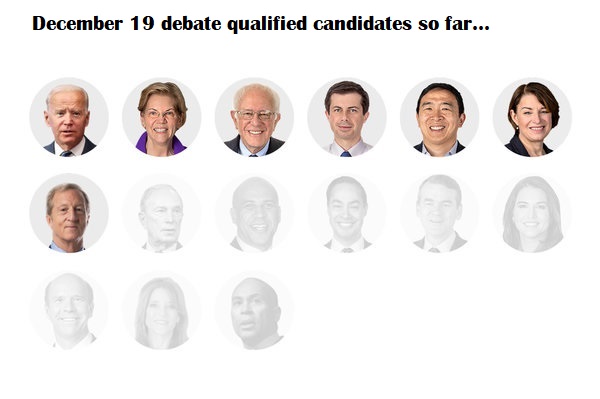
There is mass outrage in the Democratic Party, we are told,  over the fact that Cory Booker and Deval Patrick won’t be on the debate stage in December’s candidate’s debate, and neither will former housing secretary Julián Castro, or Representative Tulsi Gabbard of Hawaii. True, Andrew Yang has qualified, but Asians don’t count as minorities to progressives, because they are so successful and don’t commit many crimes, heaven knows why.  That’s why Harvard can discriminate against them and get away with it. But I digress…

There’s just one reason Yang will be the only non-white candidate on the stage: the other minority candidates couldn’t justify their candidacy, even among the frightening weak competition of Joe Biden, Bernie Sanders, Elizabeth Warren, Tom Steyer, Pete Buttigieg, and Amy Klobuchar. Naturally, Democrats being Democrats and primed to blame any result they don’t like on racism, sexism or bias, this obvious example of democracy working the way it’s supposed to is being condemned.  Well, I should clarify that: It’s working the way I think it’s supposed to, the way the Founders thought it was supposed to, and pretty much the way everyone thought it was supposed to until progressives came up with the moonbat idea that results were only fair if they distributed benefits in strict accordance with demographic percentages, and were even better if they gave an edge to “historically disadvantaged minorities.”

Thus, even though the process of deciding the winners in the slow motion musical chairs of the Democratic nomination game seems to rely on who the voters think is best qualified, that process is, according to moonbattism, bad, as in racist and unfair, if the process doesn’t yield sufficient numbers of contenders with the  right skin shades. The party really thinks like this, or at least significant numbers of the party to render the entire party untrustworthy.

I don’t understand how anyone can responsibly put a party in power that has adopted such an obviously destructive and non-democratic position.

“What message is that sending that we heralded the most diverse field in our history and now we’re seeing people like her dropping out of this campaign?” Senator Booker asked a crowd in Iowa. He darkly suggested that Kamala Harris left the race “not because Iowa voters had the voice. Voters did not determine her destiny,” but because bigotry was afoot.

The message being sent , Senator, was that lousy candidates like Kamala Harris (and you), who bungled every debate and who appear to have no leadership qualities at all, don’t appeal to voters seriously looking for a President rather than a symbol, like Bracak Obama. It is deeply self-serving for Booker to attribute Harris’s failure to racism, since he appeals to even fewer voters than she did, and is also, like her, wearing skin in the darker range.

The New York Times gasps, “The Democratic primary is facing a reckoning. In two weeks, Democrats will gather in Los Angeles for a debate that is likely to feature an entirely white roster. That is not, several candidates and prominent party members say, how the party that emphasizes diversity and fairness should want to represent itself.”

How about the fact that none of the candidates on that stage appear to be competent, trustworthy or responsible? Shouldn’t that be more of a concern than the skin-tones of the various socialists and panderers debating each other?

Not in Democrat Quota Land, I guess. Here’s a howler from the Times that only a thoroughly brain-washed progressive zombie could read without laughing:

“Some blame the rules for qualifying for the debates. The polling requirements give an advantage to candidates who can invest in extensive television advertising to get their name out. Others note, however, that the candidates of color in the 2020 field have not drawn significant support from black and Latino voters.”

Continue reading

Written Statement of Prof. Jonathan Turley: “The Impeachment Inquiry Into President Donald J. Trump: The Constitutional Basis For Presidential Impeachment” [PART III]

(Part I is here; Part II, here.)

In this section of his testimony, Turley deals with the Ukraine phone call that is supposedly impeachable. Here is the key paragraph:

“Again, the issue is not whether these comments are correct, but whether they are corrupt. In my view, there is no case law that would support a claim of corrupt intent in such comments to support a bribery charge. There is no question that an investigation of the Bidens would help President Trump politically. However, if President Trump honestly believed that there was a corrupt arrangement with Hunter Biden that was not fully investigated by the Obama Administration, the request for an investigation is not corrupt, notwithstanding its inappropriateness. The Hunter Biden contract has been widely criticized as raw influence peddling. I have joined in that criticism. For many years, I have written about the common practice of companies and lobbyists attempting to curry favor with executive branch officials and members of Congress by giving windfall contracts or jobs to their children. This is a classic example of that corrupt practice.”

IV.   THE CURRENT THEORIES OF IMPEACHABLE CONDUCT AGAINST PRESIDENT DONALD J. TRUMP

 While all three acts in the impeachment standard refer to criminal acts in modern parlance, it is clear that “high crimes and misdemeanors” can encompass non-criminal conduct. It is also true that Congress has always looked to the criminal code in the fashioning of articles of impeachment. The reason is obvious. Criminal allegations not only represent the most serious forms of conduct under our laws, but they also offer an objective source for measuring and proving such conduct. We have never had a presidential impeachment proceed solely or primarily on an abuse of power allegation, though such allegations have been raised in the context of violations of federal or criminal law. Perhaps for that reason, there has been a recent shift away from a pure abuse of power allegation toward direct allegations of criminal conduct. That shift, however, has taken the impeachment process far outside of the relevant definitions and case law on these crimes. It is to those allegations that I would now like to turn.

At the outset, however, two threshold issues are worth noting. First, this hearing is being held before any specific articles have been proposed. During the Clinton impeachment hearing, we were given a clear idea of the expected articles of impeachment and far greater time to prepare analysis of those allegations. The House leadership has repeatedly indicated that they are proceeding on the Ukrainian controversy and not the various alleged violations or crimes alleged during the Russian investigation. Recently, however, Chairman Schiff indicated that there might be additional allegations raised while continuing to reference the end of December as the working date for an impeachment vote. Thus, we are being asked to offer a sincere analysis on the grounds for impeachment while being left in the dark. My testimony is based on the public statements regarding the Ukrainian matter, which contain references to four alleged crimes and, most recently, a possible compromise proposal for censure.

Second, the crimes discussed below were recently raised as part of the House Intelligence Committee hearings as alternatives to the initial framework as an abuse of power. There may be a desire to refashion these facts into crimes with higher resonance with voters, such as bribery. In any case, Chairman Schiff and committee members began to specifically ask witnesses about elements that were pulled from criminal cases. When some of us noted that courts have rejected these broader interpretations or that there are missing elements for these crimes, advocates immediately shifted to a position that it really does not matter because “this is an impeachment.” This allows members to claim criminal acts while dismissing the need to actually support such allegations. If that were the case, members could simply claim any crime from treason to genocide. While impeachment does encompass non-crimes, including abuse of power, past impeachments have largely been structured around criminal definitions. The reason is simple and obvious. The impeachment standard was designed to be a high bar and felonies often were treated as inherently grave and serious. Legal definitions and case law also offer an objective and reliable point of reference for judging the conduct of judicial and executive officers. It is unfair to claim there is a clear case of a crime like bribery and simultaneously dismiss any need to substantiate such a claim under the controlling definitions and meaning of that crime. After all, the common mantra that “no one is above the law” is a reference to the law applied to all citizens, even presidents. If the House does not have the evidence to support a claim of a criminal act, it should either develop such evidence or abandon the claim. As noted below, abandoning such claims would still leave abuse of power as a viable ground for impeachment. It just must be proven.

A.  Bribery

Continue reading

Comment Of The Day: “Comment Of The Day: “Pre-Thanksgiving Day Ethics Wrap-Up, 11/27/2019””


Alizia Tyler’s Comment of the Day predictably set off another round of debates relating to the Civil War. There are few episodes in our history that are so rich with ethics and leadership controversies, so it is not surprising that Lincoln, secession, slavery, the Confederacy, Lee and other objects of contention keep finding their way here, most recently in connection with the relentless Confederate Statutory Ethics Train Wreck.

Red Pill Ethics has made an impressive entry in this fascinating and ever-green category. Here is his Comment of the Day on the post,”Comment Of The Day: “Pre-Thanksgiving Day Ethics Wrap-Up, 11/27/2019””….I’ll be back at the end.

I sat and argued Lincoln a bit to my significant other. Or at least all the things history kind of brushes aside.

1) Laws determine what we can’t do, not what we can do. If there is no law saying that an act is illegal then it is by definition legal. This is the foundation of American law. The government just can’t make up rules and arrest you for things that aren’t illegal.

By this universally true standard, the South’s secession was legal. There is no law prohibiting it and, historically, none of the early states entered the union with the understanding that it was an unbreakable agreement. Indeed the federal government was deliberately made to be a weak structure to preserve the autonomy of the states. To this day there is no law saying that the states can’t leave the union – in any case such a law would be deeply hypocritically and ethically bankrupt given America’s rebellious origin. Some Supreme Court cases have touched the issue but their constitutional basis is literally non existent – “Texas had become part of ‘an indestructible Union, composed of indestructible states’ ” uhhhhh where does the constitution say that?

2) At the time of the Civil War, secession was widely if not universally viewed as a legal option. So a few Southern States peacefully succeeded and ordered all Northern troops out of their sovereign territory. The feds did not comply. They sat in Fort Sumter and did not leave. The Confederacy then blockaded the Fort to prevent it’s resupply that the unlawful occupiers of that land might be forced to leave. Again the Feds did not comply. Instead they ran the blockade and sent more men and material to the Fort. Sorry fam, but when one nation sends troops into another nation to occupy their land… that’s an invasion no matter how bloodless it may be. The modern equivalent of a bloodless invasion like this would the Russian annexation of Crimea. Bloodless but inarguably illegal and an act of war. If Ukraine had gotten its shit together and actually had a functioning military or military alliances it very likely would have been the start of a big ol’ war. As it stands though, Ukraine lacks the power to fight back and so it took the invasion on the chin.

The South did not. They opened fire on the Fort and eventually took it back – and they managed to do it without actually killing anyone. A bloodless invasion was met with a bloodless defeat and sovereign land was returned to its sovereign owner. In any case, the North’s soft invasion and the previously unheard of authority that it implied so alarmed the other states that four more states who had initially opposed secession then decided to secede. The North then blockaded the South’s ports and invaded Virginia. Even Maryland and Delaware, Northern states, considered withdrawing from the Union but were prevented from doing so by federal intervention…which brings us to the next evil that Lincoln’s administration perpetrated. Continue reading

Comment Of The Day: “Pre-Thanksgiving Day Ethics Wrap-Up, 11/27/2019”

Presidential Thanksgiving Addresses, which used to be a big deal but which have fallen by the wayside. Winston Churchill had a memorable one too, on November 23, 1944:

We have come here tonight to add our celebration to those which are going forward all over the world, wherever allied troops are fighting in bivouacs and dugouts, on battlefields, on the high seas, and the highest air. Always this annual festival has been dear to the hearts of the American people. Always there has been that desire for thanksgiving, and never, I think, has there been more justification, more compulsive need than now.

It is your Day of Thanksgiving, and when we feel the truth of the facts which are before us, that in three or four years the peaceful, peace-loving people of the United States, with all the variety and freedom of their life in such contrast to the iron discipline which has governed many other communities – when we see that in three or four years the United Sates has in sober fact become the greatest military, naval, and air power in the world – that, I say to you in this time of war, is itself a subject for profound thanksgiving.

We are moving forward in this struggle which spreads over all the lands and all the oceans; we are moving forward surely steadily, irresistibly, and perhaps with God’s aid, swiftly towards victorious peace.

There again is a fitting reason for thanksgiving, but I have spoken of American thanksgiving. Tonight here, representatives of vaster audiences and greater forces moving outside this hall, it is British and American thanksgiving that we may celebrate today. And why is that? It is because under the compulsion of mysterious and all-powerful destiny we are together.

We are joined together, shedding our blood side by side, struggling for the same ideals, and joined together until the triumph of the great causes which we serve has been made manifest.

In her Comment of the Day, on “Pre-Thanksgiving Day Ethics Wrap-Up, 11/27/2019,”Alizia points us to one of Abe Lincoln’s Thanksgiving speeches:

The Proto-Fascist Lincoln wrote:

“Now therefore I do recommend and assign Thursday the 26th day of November next to be devoted by the People of these States to the service of that great and glorious Being, who is the beneficent Author of all the good that was, that is, or that will be—That we may then all unite in rendering unto him our sincere and humble thanks—for his kind care and protection of the People of this Country previous to their becoming a Nation—for the signal and manifold mercies, and the favorable interpositions of his Providence which we experienced in the course and conclusion of the late war—for the great degree of tranquillity, union, and plenty, which we have since enjoyed—for the peaceable and rational manner, in which we have been enabled to establish constitutions of government for our safety and happiness, and particularly the national One now lately instituted—for the civil and religious liberty with which we are blessed; and the means we have of acquiring and diffusing useful knowledge; and in general for all the great and various favors which he hath been pleased to confer upon us.”

The first assertion I would make is that we now live in outcomes of the Civil conflict of the mid-1800s. Some historian, I forget who, said that the Civil War or War Between the States was the ‘defining event’ that frames everything. When I heard it, I didn’t understand. Now I think I understand better.

There are many aspects to this, of course, but the one that most strongly comes to my mind is this imperious (that is how I see it) declaration made by President Lincoln which is a rhetorical marvel but, in fact, a group of powerful lies. Did the ‘glorious being’ desire that a civil war divide a people? Did the glorious being ‘give thanks’ that 700,000 men were killed as a result of an internal war that fractured the Republic? Was the ‘glorious creator’ standing behind the North in its imperious claim to define a ‘nation’ whose identity it would control? The questions could go on & on & on… Continue reading

Observations On The Charleston, W.V., “Christmas War” (And The Way The Mainstream Media Reported It)

There are many lessons, ethical and otherwise, to be learned from Charleston, West Virginia’s short-lived “Winter Parade.” I originally missed the story, which apparently took place over three days in October. Fox News, which has led the “War on Christmas” narratives since the days of Bill O’Reilly, covered it.

Even before Halloween, Charleston’s  new mayor (and its first female occupant of the office) Amy Goodwin sent out a Facebook announcement that “The Charleston Winter Parade will begin at the corner of the Kanawha Boulevard and Capitol Street.” For years, the city has had an old-fashioned “Christmas Parade” (you know, like they show in “A Christmas Story” ?) with Christmas-themed floats, marching bands, fire trucks, Shriners in their tiny cars and Santa Claus. Suddenly it was officially a Druid-sounding “Winter Parade” because Mayor Goodwin wanted to signal that her city embraced all faiths and cultures. “I wanted to show that Charleston is a welcoming and inclusive city,” she said.

A large number of Charleston residents didn’t welcome her unilateral decision at all. “The new mayor needs to be voted out if she does away with the Christmas parade,” read an early comment on ther Facebook post. “Christmas is all about Christ, not some winter parade.” Columnists and radio shows weighed in, almost unanimously condemning her decision. The largely white and  Christian city of 48,000 hadn’t exactly been racked with controversy over the Christmas parade, but now renaming the parade felt to many like a rejection of Christianity and tradition.

The New York Times quoted the president of the West Virginia Chamber of Commerce in Charleston, Steve Roberts: “The community reaction was a collective groan, It’s a cute little parade with cute little kids and can’t we just have a Christmas parade?”

The change threatened to start a chain reaction. The Times story says that Brandon Willard, a junior high band teacher, began to worry about his musical selection for his student band scheduled to march in the parade: Leroy Anderson’s “Sleigh Ride.”It’s a secular Christmas tune of long-standing (they always played it at my High School Christmas assembly), but Willard became worried that he would be accused of having the band take side. Maybe parents would pull their children from the parade in protest, maybe even preventing the band from having enough musicians to march. It would be a big disappointment to the students, who march every year in Santa hats and with decorated instruments, and this year, with new  light-up necklaces he had ordered. The parade also counted toward their grade. Continue reading

Headed Straight Into The Ethics Alarms Massive “Nah, There’s No Mainstream Media Bias!” File: Bloomberg News Provides A Smoking Cannon

Let’s give credit to Bloomberg News for this at least: it isn’t trying to hide its capitulation to a conflict of interest and its abandonment of journalism ethics.

2,700 journalists working at Bloomberg L.P., the financial data company primarily owned by newly minted Democratic Presidential candidate Michael Bloomberg, were thus instructed  in a memo sent by John Micklethwait, Bloomberg Editorial and Research’s editor in chief:

“We will write about virtually all aspects of this presidential contest in much the same way as we have done so far. We will describe who is winning and who is losing,. We will look at policies and their consequences. We will carry polls, we will interview candidates and we will track their campaigns, including [Michael Bloomberg’s] We have already assigned a reporter to follow his campaign (just as we did when Mike was in City Hall). And in the stories we write on the presidential contest, we will make clear that our owner is now a candidate.”

However, the memo went on to say, Bloomberg’s outlets, including Bloomberg Businessweek and several industry-specific sites, will not perform in-depth investigations of  Bloomberg or any of his Democratic rivals.

Let’s be clear about what this policy means by looking at it from another angle. Bloomberg media outlets will only be seeking damaging news and creating critical “in-depth” analysis on one party’s candidate, that being the Republican party and its candidate, President Trump.. They will operate during the next year like Charles Foster Kane’s newspaper, the New York Daily Inquirer operated when the corrupt Orson Welles character was running for governor in “Citizen Kane.” Continue reading

Post Road Trip Ethics De-Brief, 11/20/2019, AND Morning Warm-Up, 11/21/2019

Bvuh.

Thinking is a chore right now, never mind typing.

We returned from a triumphant two-Darrow ethics program New Jersey tour, highlighted by the intense Darrow oratory performed by actor/legal instructor Paul Morella. This does a cynical ethics CLE presenter’s heart good: finding myself short of time, I asked the assembled NJ Bar members to vote on whether Paul should omit Darrow’s famous Leopold and Loeb closing argument, or Darrow’s own desperate plea for an acquittal when he faced a jury considering his own guilt of jury tampering in the 1911 MacNamara case. The group almost unanimously voted that we complete both closings, with my ethics commentary as well, bringing the program to an end almost a half hour later than scheduled. Nobody left, and believe me, in most CLE seminars, the lawyers seldom stay one second longer than they have to.

Brought a tear to my eye…

No rest in sight, though: tomorrow, I take an early flight to team up with rock guitar whiz and singer Mike Messer in Las Vegas for Ethics Rock Extreme. And I’m punchy now...

1. Well, maybe the NFL is learning…News item: The Miami Dolphins released already suspended running back Mark Walton on Tuesday, hours after he was arrested on charges of punching his pregnant girlfriend multiple times in the head. Walton had been serving a four-game suspension because of  three arrests before the season started. He was sentenced in August to six months’ probation after pleading no contest to a misdemeanor weapons charge.

Now let’s see if the Patriots sign him…

2. Just a quick impeachment hearings note: It is astounding to me that witnesses are being called by the Democrats to testify regarding their opinions on a President’s phone call to a foreign leader. Big black headlines shout that witnesses called a phone call “inappropriate.” Who cares? The President has the authority to decide what is “appropriate,” and there are no impeachment articles in the Constitution designating “acting inappropriately” according to someone else’s opinion as a “high crime and misdemeanor.”  Leaders become leaders because they do thinks that others think are “inappropriate.”

Don’t get get me  started on presidential actions through the centuries that experts, government veterans and other critics at the time thought were “inappropriate,” or worse.

I started compiling a list of what I would consider genuinely impeachable actions by past Presidents The list makes the current impeachment push look even more contrived than it already is.

3. I see that the group that surreptitiously filmed Planned Parenthood staff discussing abortions was hit with over 2 million dollars in damages. Good. Continue reading