Once again, I am re-posting the first Ethics Alarms Christmas post from way back in 2010, its first full year. (The last time I revived this post was in 2016.) I’m not inclined to change it, though I did fix some typos.
In the 2016 introduction, I wrote, “The ascendant attitude toward Christmas is both anti-religious and non-ethical.” That is still true. In my extended neighborhood, there are giant penguins, snowmen, Santas, dragons, unicorns, the Grinch and Christmas Storm Troopers on lawns, and exactly one manger or reference to Jesus. There is no mention of peace, good will or love. My wishes of “Merry Christmas!” are returned, I’d estimate, about 20% of the time. Often I get glares, because saying “Merry Christmas!” must mean that I have a MAGA cap in my closet.
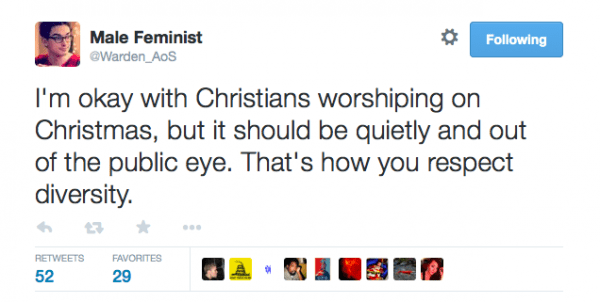
Those who might be otherwise tempted to show some signs of faith may be intimidated by the Diversity Fascists, like this guy:
Yes, many people–they call themselves “progressives”— believe that a healthy national culture embracing love, charity, generosity and kindness is disrespectful. The culture seems to be capitulating to the bullying without a fight. The two most prominent Christmas movies on cable this year are the mildly cynical “A Christmas Story” and the wretched “Christmas Vacation,” which isn’t even a good Griswald movie, much less a decent Christmas movie. I have been searching for the original “Miracle on 34th Street”—yes, I know I haven’t finished the ethics review–and keep finding arguably the worst version, the one with Richard Attenborough playing Kris Kringle. “Four Christmases,” another bitter comedy, has appeared many times. “A Christmas Carol” is now rare fare, but we get many showings of “Scrooged,” with Tiny Tim played by MaryLou Retton.
Some of the Hallmark Christmas stations have been playing a Whitney Houston version of “A Christmas Song” that interjects “Happy Kwanza” in the lyrics. Thanks to John Legend, we now have a Christmastime ditty that endorses abortion.
Think about that a minute.
I don’t know how to reverse the damage already inflicted on our society, but I do know that we have to try.
The Ethics Alarms Ethics Guide to Frank Capra’s 1946 masterpiece “It’s A Wonderful Life,”perhaps the greatest ethics movies of all time, has become this blog’s official welcome to the holiday season. Once again, I have reviewed the post after another viewing of the film. It is a mark of the movie’s vitality that I always find something else of interest from an ethics perspective.
The movie is an important shared cultural touch-point,and exemplifies the reasons why I harp on cultural literacy as so vital to maintaining our nation’s connective tissue. The film teaches about values, family, sacrifice and human failings unlike any other. I hope its power and uniqueness disproves the assertion, made in one online debate here this year, that new cultural creations inevitably and effectively supersede older ones, which, like copies of copies, eventually the cultural values conveyed get fainter and less influential.
Last year I wrote with confidence, “No, they really don’t,” but now I am not so sure. In , I learned that my druggist, about 35, married and with children, had never seen the movie. I gave him a DVD over the summer, and suggested that he watch it with his whole family, which he said he would: he moved on to another CVS branch, so I have no idea if he did or will. I used to be amazed at how many people haven’t seen the movie; now I am not. Last year I wrote that my son’s girlfriend admitted that she hadn’t; this year he has a new girlfriend, and she hasn’t either.
The movie is in black and white, and many Gen Xers and Millennials disdain uncolored films the way I once avoided silent movies. Will anyone be watching “It’s A Wonderful Life” 20 years from now? I wonder. The movie begins in heaven, and has a strong religious undercurrent. Religion is increasingly mocked and marginalized today, and I see no signs that the trend is reversing. Aside from the nauseating Hallmark Christmas movies, most of this century’s holiday fair is openly cynical about Christmas and everything connected to it.
Here’s an example of how rapidly cultural touchpoints vanish: I’m going to poll how many readers remember this:
Deck us all with Boston Charlie, Walla Walla, Wash., an’ Kalamazoo!
Nora’s freezin’ on the trolley, Swaller dollar cauliflower alley-garoo!
Don’t we know archaic barrel Lullaby Lilla Boy, Louisville Lou?
Trolley Molly don’t love Harold, Boola boola Pensacoola hullabaloo!
Bark us all bow-wows of folly, Polly wolly cracker ‘n’ too-da-loo!
Donkey Bonny brays a carol, Antelope Cantaloupe, ‘lope with you!
Hunky Dory’s pop is lolly, Gaggin’ on the wagon, Willy, folly go through!
Chollie’s collie barks at Barrow, Harum scarum five alarm bung-a-loo!
Dunk us all in bowls of barley, Hinky dinky dink an’ polly voo!
Chilly Filly’s name is Chollie, Chollie Filly’s jolly chilly view halloo!
Bark us all bow-wows of folly, Double-bubble, toyland trouble! Woof, woof, woof!
Tizzy seas on melon collie! Dibble-dabble, scribble-scrabble! Goof, goof, goof!
Now just answer the poll, don’t go giving away the answer. Nobody knows all the lyrics that I just posted, nobody but the author ever did. The first verse, however, was once familiar.
Maybe there is hope: it was recently announced that a new musical adaptation of the movie may be coming to Broadway as early as next year. The songs will be written by Sir Paul McCartney, and interest in The Beatles is surging.
“It’s A Wonderful Life” would be an excellent basis for a middle school ethics course. I haven’t seen a better, richer film for that purpose come along since, and I’ve been looking. Despite the many ethics complexities and nuances that the film glosses over or distorts, its basic, core message is crucial to all human beings, and needs to be hammered into our skulls at regular intervals, far more often than once a year.
What is this message? In an earlier posting of The Guide I described it like this:
Everyone’s life does touch many others, and everyone has played a part in the chaotic ordering of random occurrences for good. Think about the children who have been born because you somehow were involved in the chain of events that linked their parents. And if you can’t think of something in your life that has a positive impact on someone–although there has to have been one, and probably many—then do something now. It doesn’t take much; sometimes a smile and a kind word is enough. Remembering the lessons of “It’s a Wonderful Life” really can make life more wonderful, and not just for you
Finally, I hope you all have a terrific Thanksgiving, and that the holiday season is joyous for all.
There are at least two more Comment of the Day candidates in the comment threads following the Bazelon post, which makes five out of 25 total comments, highest percentage ever. Here is #3, by doctormoreau, perhaps my favorite Comment of the Day on “Ethics Dunce: Professor Lara Bazelon”:
My dad was a truck driver and an alcoholic. He was gone for weeks at time and when he was around you wish he wasn’t. I decided early on to be a different parent.
According to the Federal government my family lives in poverty. There are 8 of us, and I make less than $43,000. Yet our quality of life is excellent. Both of my vehicles are paid for. Yes, my “newer” auto is 8 years old, but it runs well and has never given us any issues. My old truck, purchased to make fixing our house easier, is ugly and rusty but paid for and also reliable.
My wife and I both have cell phones-we replaced our land line years ago. Once upon a time food was our biggest expense, but the growing monstrosity that is health care has passed that. We still get by just fine, though. Beans and rice can be made many ways. Continue reading →
The Ethics Dunce post highlighting prominent lawyer and legal commentator Lara Bazelon’s op-ed celebrating her decision to place her career and the welfare of clients over the best interests of her own children didn’t attract a lot of commentary, but the comments that arrived were excellent and often moving, and readers related her dilemma to their own lives. There have been three Comments of the Day so far. I’m going to post them in the order in which they arrived.
About 8 ½ years ago, I became a father. As I looked down at my newborn son, I couldn’t help but note was how small he was. How beautiful he looked. How unprepared I was to be in this situation. It’s funny the way life teaches us lessons. For example, did you know an 18-month-old could lock you out of your house? Or that a 2-year-old could operate an elevator? How about a 3-year-old using deception to win a game of hide and seek? Maybe that a 4-year-old could teach himself to swim?
It hasn’t been easy taking care of my oldest. From the beginning of his life, he has always been too interested in what was going on to care about being held or even staying in one place. His confidence has given him a unique perspective on the world where everything is a new adventure. It seems that he always must be in the thick of things. But here I am, trying to keep up, increasingly more aware that I am falling further behind and time is running out. Continue reading →
For the first time since my son was about to turn 9 almost 16 years ago, our home is without the extraordinary sweetness and aggressive unconditional love of Rugby, my son’s (but really the whole neighborhood’s) extraordinary Jack Russell Terrier.
He peacefully expired after an injection, as he was held tightly by my son Grant, whom he loved beyond explaining, wrapped in the tattered baby blanket that a toddling Grant himself once held for comfort, and that had lined Rugby’s dog bed in my son’s apartment.
In the end, these decisions always come down to ethical values. We received from our vet the not entirely unexpected news that our dog’s sudden lack of energy and stability as well as labored breathing was almost certainly caused by progressive heart failure. Dickens, his more flamboyant and occasionally diabolical predecessor of the same breed, had perished of the identical malady just short of 15 years of mischief. The first question— Is there anything you can do?— was met by an answer we have heard before in earlier animal companion tragedies: “Maybe, but even under the best circumstances, the time will be short.” Continue reading →
No way around it: today we are taking down the Christmas tree. It took over eight hours to decorate it, but that’s not why I always hate this annual task. Taking down the tree has always seemed to me like a symbolic rejection of all the ethical instincts and interactions of the season that the tree symbolizes. It is easier, somehow, to keep those ethics alarms tuned when this big, garish, lighted thing is dominating the living room, and shining out through the window into the street. One year, I managed to delay the Great Un-Christmasing until mid-February. There is something especially wrong and disrespectful about leaving this symbol of love, family, peace, generosity, continuity, community, kindness and more lying on its side, by the outgoing trash. This years Frasier Fir was a good tree that did it’s job well, and deserves better. Another year, I hated the idea of leaving our tree by the curb so much that I threw it down the bamboo-covered hill behind our home.
I wish I had the courage and resolve of the woman profiled in the Charlotte Observer on December 26, 1999. I adapted it in 2008 for the original script of “An American Century Christmas,” a musical revue recalling old-style TV Christmas specials as well as songs Christmas literature and movies. Continue reading →
Many, many excellent comments followed this post. The issue, covered here before but long ago, was when a transgender individual is ethically obligated to reveal that fact to a romantic target, or partner. The Ethics Alarms poll on the question reached these results:
I voted “before having sex” and/or “when the relationship becomes serious”; as these were the earliest stages on the list. I also included “when marriage becomes a possibility” as the latest possible time to reveal. (I did not include “first kiss”, as this is too vague a time period)
My take would be as soon as practical (including at soon as the overt risk of a violent reaction is ruled out). The current consensus is that gender and orientation are spectrums, not binary absolutes. Within this logic, we have a duty to understand and respect our romantic partner’s place on the spectrum. One (of ant orientation) might be exclusively attracted to the extreme end of the female gender spectrum, for instance. This might preclude attraction someone with a surgically transitioned body. Since gender and orientation are considered persistent traits, it is not necessarily bias alone that dictates this exclusive attraction.
One must also consider cultural values of a partner. Any relationship I’ve been in, I’ve made known early on that kids (naturally conceived) are a long term goal of mine. On this basis alone, I might decline to pursue any women with known infertility. Were such detail withheld, I would feel extremely hurt and betrayed. Continue reading →
I recently wrote here that I have been pleasantly surprised when looking back on old posts to find that I am almost always in agreement with them. Naturally, I have immmediately been confronted with an issue where I now question Past Jack’s verdict.
Ebony has a “confession’ article—it may be fake, but the issue isn’t—by a trans woman who writes in part regarding her husband,
We were months into dating and contemplating sex before it ever occurred to me that Carlos might need to know… It was wrong, but I chose to keep the secret rather than risk losing him. Now, four years later, Carlos and I are happy and madly in love! It has been a roller coaster, but we couldn’t be happier. But it’s this happiness that is causing me such pain because Carlos feels that it is time to add to our happy family. He is excited to be a father and his face lights up at the very thought. So how do I break his heart? How do I tell him that all of our trying has been in vain because, despite my best efforts to be the person I always felt I was, I’m still not who he thinks I am?
My answer: Suck it up and tell him the truth. Maybe have him watch “The Crying Game” a few times. The relationship has already been built on a material lie, and now adding to the dishonesty by concocting a reason why children are not an option just damages the relationship further.
I do think that transgendered individuals have a difficult choice regarding the timing of this revelation as they enter a relationship, but that’s a different issue (There’s a poll on that one coming up.)
In 2012, however, I did post following an Emily Yoffe advice column (“Dear Prudence”) , and came to the opposite conclusion, in contrast to Yoffe. Then I wrote,Continue reading →
1. Jurassic World II. I can’t honestly call this ethics, but as I posted about the film’s bad reviews earlier, I feel obligated to close the loop. I saw the movie last night, and as I knew I would, enjoyed it thoroughly, beginning to end. To those who did, I feel a bit the way I do about people who don’t like baseball, Westerns, Gilbert & Sullivan, and the United States of America: I’m sorry for you. This one even has a moment that seems to be written for those who don’t to help explain those who do, when Bryce Dallas Howard talks about her sense of wonder the first time she saw a dinosaur. Of course, the original movie better expressed the same sense of wonder in the iconic scene where Sam Neill is struck dumb by his first sight of the brachiosaurus (and the lawyer’s only reaction is “We’re going to make a fortune with this place!”), but the Howard’s speech is no less an accurate description of how we dinosaur-lovers feel when we see these creatures on-screen.
No, it’s not the equal of the first “Jurassic World,” but it is excellent for the sequel, and better, I think, than either sequel to “Jurassic Park.” A vicious mutant raptor chasing a child through Victorian mansion is the stuff of nightmares, and a new concept; the dinosaur auction to a bunch of international bad-guys was a weird cross between “Goldfinger” and “Taken,” and several scenes, including the dinosaur stampede away from the erupting volcano, were worth seeing the film all by themselves. There were also more “Awww!” scenes than in all of the previous films combined: Chris Pratt’s home movies of bonding with the raptor babies; a mother triceratops and her adorable little one, and a haunting evocation of on of Charles Addams. best, but least funny, cartoons. I’ll leave it at that.
My biggest complaints would be that there was not enough of a role for the T-Rex, some of the deliberate homages to the earlier films were ham-handed and predictable, and that there was a fatal decision by one of the villains that made no sense to me at all. These flaws were more than compensated for by the star turn of the Pachycephalosaurus, a species that had only cameos in “The Lost World” and “Jurassic World,” a terrific fight between a new species in the series, a Carnotaurus, and a Styracosaurus, (one of my mother’s best ceramic models in my collection) and several laugh-out loud moments authored by the dinosaurs. The film’s ending also sets up a final installment that should conclude the series, unless a “Jurassic Planet” is in the cards.
There are some ethics issues in the film, as in all of the films: respect for life, cloning, betrayal, and accountability for unforeseeable consequences. Michael Crichton had no qualms in his original novel with solving the problem of living dinosaurs by nuking the whole park, but Spielberg’s ending was better.
2. An Ethics Quiz That Is Too Minor To Justify A Whole Post. Do you find anything wrong with Donald Trump Jr. parading his new girlfriend in front of cameras at the White House before he is even divorced from his current wife? Writes Ann Althouse, “He and his wife have 5 children. He should be more discreet. Which, I know, obviously doesn’t sound like a Trump concept.” Let’s have a poll!
1 The Inspector General’s Report and Tales of Moral Luck: Stop me if you’ve heard this one: FBI staffer Peter Strzok, working on both the Hillary Clinton email investigation and the Russian collusion investigation, received a text from Lisa Page, Strzok’s co-worker and adulterous lover, that read, “[Trump’s] not ever going to become president, right? Right?!” Strzok replied, “No. No he won’t. We’ll stop it.”
September of 2016, the FBI discovered that Clinton’s illicit emails had somehow ended up on the laptop of disgraced former Congressman. Anthony Weiner, who is married to Hillary’s top aide and confidante, Huma Abedin. Strzok, we learn in Michael Horowitz’s report, was instrumental in the decision not to pursue the lead, arguing that the Russia investigation was a “higher priority” at the time.”We found this explanation unpersuasive and concerning,” the report concluded. The laptop was available from September 29 until October 27, when “people outside the FBI” finally forced the FBI to act on the evidence. “The FBI had all the information it needed on September 29 to obtain the search warrant that it did not seek until more than a month later,” the IG report stated. “The FBI’s neglect had potentially far-reaching consequences.”
“Comey told the OIG that, had he known about the laptop in the beginning of October and thought the email review could have been completed before the election, it may have affected his decision to notify Congress,” the IG report says, and also states,
“Under these circumstances, we did not have confidence that Strzok’s decision to prioritize the Russia investigation over follow up on the [Clinton] investigative lead discovered on the Weiner laptop was free from bias.”
Got that? The IG believes that anti-Trump, pro-Hillary bias led Strzok to delay the Weiner laptop investigation, and it may have backfired, helping Trump and hurting Clinton rather than the reverse. But the fact that moral luck took a hand and foiled his intent doesn’t change the fact that this is strong evidence that partisan bias DID infect the Clinton investigation, and probably the Russian inquiry as well. This makes the media’s spin that the IG report dispels accusations of bias even more unconscionable.
That Strzok’s biased and unethical tactics to help Hillary intimately failed spectacularly doesn’t change or mitigate the fact that a prime FBI staff member was intentionally trying yo manipulate the investigation for partisan reasons.
2. The Web thinks you’re an awful person. A tease from a “sponsored site” in the margins of my NBC Sports baseball feed says, “Jan Smithers starred in hit sitcom “WKRP in Cincinnati.” Try not to smile when you see what she looks like now!” Wait…what’s that’s supposed to mean? Is she a circus clown? No, these and similar come-ons apparently assume that normal people love mocking formerly beautiful young stars when they no longer look young. “Heh, heh..well, Jan Smithers, I guess you’re not so hot now, are you? What kind of person takes pleasure in the physical decay of others just because they were once gorgeous?
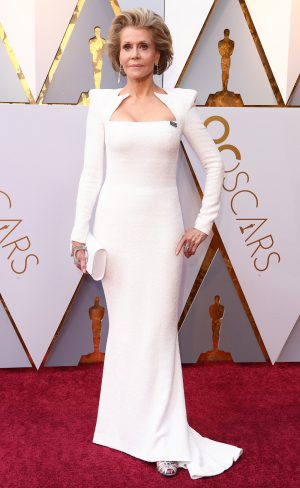
Actually, the photo of Jan Smithers did make me smile, because unlike, say, Jane Fonda,
…who at 80 has allowed plastic surgeons to make her look like one of the fragile immortal female ghouls who shatter into pieces at the end of “Death Becomes Her,” Smithers (who is younger than me and a decade and a half younger than Hanoi Jane) has allowed herself to age naturally, and by my admittedly biased lights, is lovely still: Continue reading →