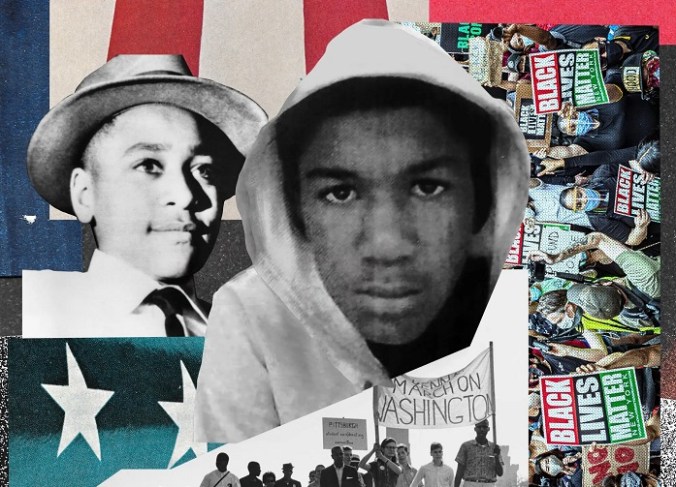
It is not exactly an upset that this column, as dishonest and irresponsible as any I have seen in the New York Times, which is saying a lot, came from the poisoned, bitter and unscrupulous mind of Charles M. Blow. Blow, the most consistently unethical of the Times huge reserve of unethical pundits, never lets fairness and facts get in the way of an anti-white, anti-cop, anti-Republican diatribe when he isn’t writing weekly Trump-hate pieces as he did for four years, nearly without pause. But this week’s column, outrageously coupling a photo of Trayvon Martin with Emmet Till, is special.
Let’s start with the headline: “Trayvon Martin Is Still Making
America Confront Its Original Sin.” That’s a lot of misinformation for a headline. The “original sin,” of course, is slavery, this being the New York Times, where Nicole Hannah-Jones contrived the fake history-based “1619 Project” that claimed the United States was created to protect slavery. Slavery was neither original with the American colonies nor did American history begin with the practice, and Blow’s analogy (which was also endorsed by Barack Obama) with “original sin” is a core part of the anti-American theme of Critical Race Theory. That anti-white, anti-American tool holds that nothing the nation has done or can do will erase or compensate for slavery and its long-lasting side-effects, though perpetual white guilt and a special set of standards making African-Americans permanent beneficiaries of legal and society favoritism is absolutely required.




 No, I’m not kidding, and this is not a hoax.

“The First Amendment, and whatever the Canadian equivalent is (however weakly codified) does not protect actions that interfere with lawful commerce or disturb the peace to the point of mischief.”
Well I’m glad you asked!
Canada also has a constitution, although ours wasn’t predicated on the same base narrative as America’s. As an outsider looking in, America’s constitution is almost paranoid in nature, usually you don’t draft the founding documents to a nation’s governments under the auspices of governments being tyrannical and specifically with an emphasis on protection from that tyranny. I make no negative values judgement there…they work, in a stiffly rugged way. To highlight the differences between Canadian and American constitutional theory: Where the founders wrote “life, liberty and pursuit of happiness” in America’s declaration of independence, Canada’s founders instead wrote in “peace, order, and good governance”.
Our Canadian constitution is more malleable, and over the years, it’s been broadly re-imagined. Instead of enumerated amendments to the constitution, in 1982, Canada codified our rights in a portion of our constitution called “The Charter of Rights and Freedoms”.
Continue reading →