Sorry, Steve Bartman, But It’s Impossible To Leave You Alone

As the Chicago Cubs plowed their way to the World Series and a possible end to their 108 year failure to win a World Series, numerous sports writers, including some I thought were smart enough to know better, set out to prove their compassion, sensitivity and gooey caramel centers by arguing that the news media and fans should “leave Steve Bartman alone.” Bartman, for those of you who have lived in a bank vault since 2003, was the hapless young Chicago Cubs fan who unintentionally interfered with a foul ball that might have been catchable by Cubs outfielder Moises Alou in the decisive game of 2003 National League Championship Series. In a perfect display of the dangers of moral luck, Bartman’s mistake—it didn’t help that he was wearing earphones and watching the ball rather than the action on the field—began a chain of random events  that constituted a complete collapse by Chicago in that very same half-inning, sending the Miami Marlins and not the Cubs, who had seemed comfortably ahead, to the Series. Bartman, who issued a sincere and pitiful apology, was widely vilified and literally run out of town. He then became part of Cubs and baseball lore, one more chapter in the sad saga has been called “the Billy Goat Curse,” the uncanny inability of this team to win it all.

Over time, even Bartman’s tormenters came to see that holding him responsible for the team’s failure was cruel consequentialism at its worst. Alou, who had sicced the Furies on Bartman by angrily pointing at him after the incident from the field and later told everyone that with the interference, he would have caught the ball, even came out ten years later–five years!—to say that he wouldn’t have caught the ball, and Bartman wasn’t to blame. (I wrote about that epic example of barn-door locking here.) Now, NBC’s Craig Calcattera and many others are beating a new drum: nobody should write about or talk about Stave any more, because it’s so unfair. Continue reading

Ethics Dunces: Fox Sports And Major League Baseball

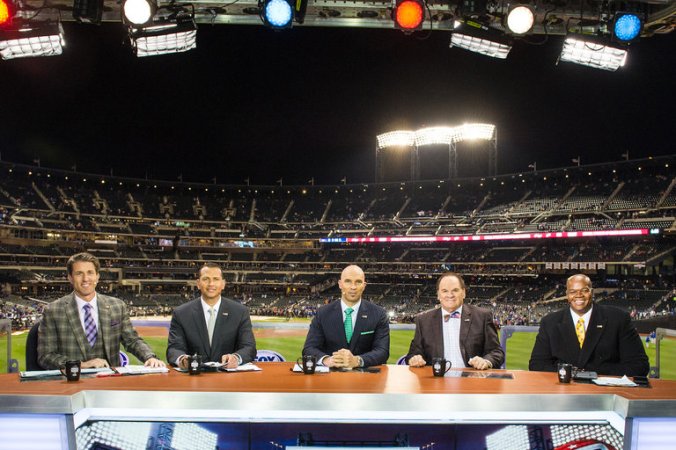
The ex players are (R to L), Hall of Famer Frank Thomas, banned Pete Rose, rapidly being forgotten Raul Ibanez, and the nearly universally detested Alex Rodriguez.

The ex players are (R to L), Hall of Famer Frank Thomas, banned Pete Rose, rapidly fading from memory Raul Ibanez, and the nearly universally detested Alex Rodriguez.

Among the commentators at the desk in the pre- and post game show for FS1 (that’s Fox Sports One) as it carries the National League Championship Series between the Cubs and the Dodgers, are Pete Rose, and Alex Rodriquez.

Pete Rose, baseball’s all-time hits leader, is banned from baseball for gambling on the game while a manager. This has been taboo since the 1919 World Series was fixed by gamblers. (Donald Trump has never accepted that the Cincinnati Reds won). Rose lied about whether he bet on baseball for over a decade, then he lied about whether he bet on his own team a little longer. In the meantime, he served prison time for tax evasion.

Alex Rodriquez eventually was suspended from baseball for more than a season for using banned performance enhancing drugs, years after he tested positive for steroid use and told the public sincerely that it was “one mistake” and he’d never do it again. He is also a serial liar. Eventually the increasingly cynical and ethically-addled younger sportswriters may vote him into the Hall of Fame, but he is second only to Barry Bonds as the worst of the worst. Currently, he is regarded as flunking the Hall’s character and sportsmanship requirement. Duh. Continue reading

Ethics Quiz Of The Day: Backing Into A Batting Championship

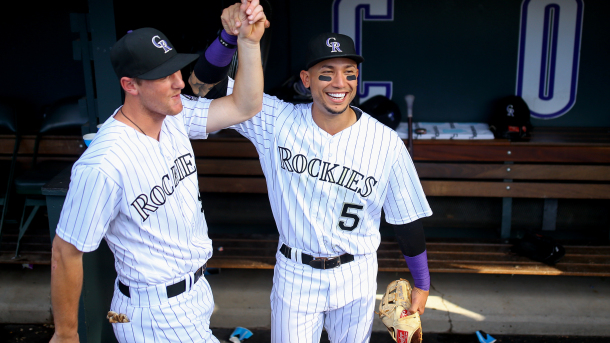
Milwaukee Brewers v Colorado Rockies

On the final day of the 2016 regular season yesterday, Rockies second baseman D.J. LeMahieu had a one point lead on Washington Nationals second baseman Daniel Murphy for the National League batting championship, .348 to.347. Murphy was nursing a pulled muscle, and hadn’t played for several games as the NL East winning Nationals rested him so he could be healthy for the play-offs. Murphy wasn’t going to be in the final game either, which meant that the only way LeMahieu could lose his lead was by making outs. Thus, with the consent of his manager, Walt Weiss, the player sat out the last game to protect his average. Realizing that the Rocky player was attempting to “back in” to the batting title, regarded in baseball ethics as dishonorable, or, in technical terms, “the conduct of a weenie,”  Nats  manager Dusty Baker sent Murphy limping up to the plate to pinch-hit for Jose Lobaton in the fifth inning. A hit by Murphy would have given him the lead, and required LeMahieu to bat in the Rockies game to pass him. Murphy, however, flied out.

Your End of Baseball’s Regular Season Ethics Alarms Ethics Quiz of the Day:

Was it fair, sportsmanlike and ethical for LeMahieu to win the batting title by not playing?

Continue reading

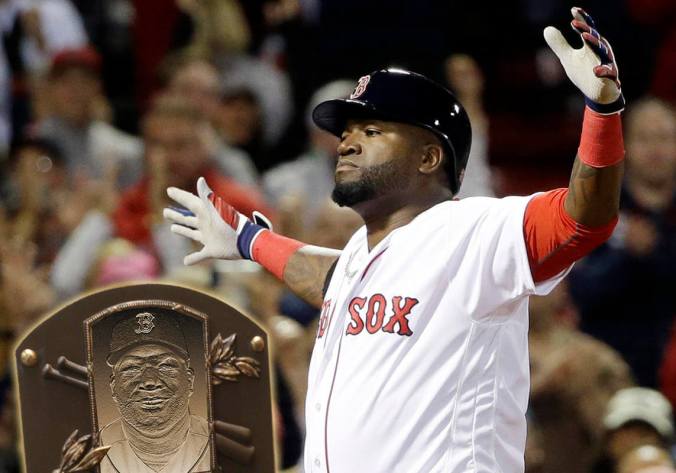
The Wrenching Problem Of David Ortiz, The Human Slippery Slope

papi_fame

Ethics conflicts force us to choose when multiple ethical principles and values point to diametrically opposed resolutions.  Often, a solution can be found where the unethical aspects of the resolution can be mitigated, but not this one. It is a tale of an ethics conflict without a satisfactory resolution.

I didn’t want to write this post. I considered waiting five years to write it, when the issue will be unavoidable and a decision mandatory. Today, however, is the day on which all of Boston, New England, and most of baseball will be honoring Red Sox designated hitter David Ortiz, who will be playing his finale regular season game after a 20 years career.  His 2016 season is quite possibly the best year any professional baseball player has had as his final one; it is definitely the best season any batter has had at the age of 40 or more. Ortiz is an icon and a hero in Boston, for good reason. Ortiz was instrumental in breaking his team’s infamous 86-year long “curse” that saw it come close to winning the World Series again and again, only to fail in various dramatic or humiliating ways. He was a leader and an offensive centerpiece of three World Champion teams in 2004, 2007, and 2013. Most notably, his record as a clutch hitter, both in the regular season and the post season is unmatched. You can bring yourself up to speed on Ortiz’s career and his importance to the Red Sox, which means his importance to the city and its culture, for nowhere in America takes baseball as seriously as Beantown, here.

That’s only half the story for Ortiz. Much of his impact on the team, the town and the game has come from his remarkable personality, a unique mixture of intensity, charm, intelligence, generosity, pride and charisma. After the 2013 terrorist bombing of the Boston Marathon, which shook the city as much as any event since the Boston Massacre, Ortiz made himself the symbol of Boston’s anger and defiance with an emotional speech at Fenway Park. Then he put an exclamation point on his defiance by leading the Red Sox, a last place team the year before, to another World Series title.

Performance-based arguments against electing Ortiz to baseball’s Hall of Fame are, at this point, untenable. Entering his final game, Ortiz had 541 home runs, (17th all-time), 1,768 RBI, (22nd), and 632 doubles, (10th).  He is only the third player in history to have more than 500 home runs and 600 doubles.  He ranks among the greatest post season hitters in baseball history with 17 home runs, 60 RBI and 21 doubles. His postseason average is .295 with an on base percentage of .409, a slugging percentage of .553 and a .962 OPS (the sum of the two.) Most great players did worse in the post season than during the regular season, for the obvious reason: the competition was better. Ortiz was better, which informs regarding his character and dedication.

The one lingering argument against admitting Ortiz to the ranks of Ruth, Williams, Aaron, Mays, Cobb, Hornsby, Griffey and the rest is that he has spent most of his career as a designated hitter, the American League’s 1973 invention, much reviled by National League fans and baseball traditionalists, designed to allow real batters relive fans from watching pitchers make fools of themselves at the plate. This makes him “half a player,” the argument goes. No designated hitter has ever been elected to the Hall, so that argument has prevailed so far. It was always a weak one—how did being lousy fielders like so many Hall of Fame sluggers make them greater players than one who never hurt his team at all with his glove? Now that a designated hitter has shown himself to be in the elite ranks of all the greatest batters, the argument sounds more like hysterical anti-DH bias than ever.

I should also note, before getting to the main point of this post, that I love Ortiz. I am a lifetime Red Sox fan, Boston born, bred and marinated, and Big Papi is special. He is one of the most interesting and admirable sports figures of my lifetime, and what he has meant to my city and my favorite sport is beyond quantifying. Few great athletes demonstrate persuasively that they are also great and admirable human beings. Ortiz is one of them.

Nonetheless, it is crucial that David Ortiz not be elected to the Hall of Fame when he becomes eligible five years from now, and that he never be admitted. On the matter of assessing the fitness for baseball honors of those who defiled the game by inflating their statistics, changing the outcome of games and harming players who abided by the rules, David Ortiz is a human slippery slope. Ortiz deserves to be in the Hall based on all admission criteria, including character and sportsmanship, but his admission will open the doors wide for players who are unfit, polluting the Hall of Fame and baseball’s values forever.

It’s not worth the trade off. This is the ethics conflict: one cannot be fair and just to “Big Papi” without doing widespread harm to the sport, and I would argue, the entire culture. Continue reading

Random Ethics Thoughts On The Death Of Jose Fernandez

marlins-tribute

Miami Marlins pitcher Jose Fernandez, at 24 one of the rising stars in baseball and a remarkable, charismatic young man as well, died when his boat hit a jetty at high speeds in the early morning hours last Sunday. He had escaped to the U.S. from Cuba at 15 after failing twice and being imprisoned by the Castro regime as punishment. How good a pitcher was he? At this point in his career, as good as any pitcher in the history of the game. What might he have accomplished? The possibilities were limitless.

Two of his friends were also killed in the accident, and he left a pregnant girlfriend behind. Baseball stars have died tragically mid-career before—Roberto Clemente, Thurman Munson, Harry Agganis, Ken Hubbs, Lymon Bostock…Lou Gehrig, of course…but seldom has a death in the sport caused such an widespread outpouring of grief.

Some random thoughts:

  • I have a gut reaction to such deaths, when a young man or women of infinite promise and special talent dies due to his or her own recklessness and foolishness. This was the case with Fernandez; there is no denying it. His boat was speeding, going much too fast for the conditions. It was dark, and he may have been drinking: he had just left a bar. My reaction is anger. I can’t help it; I know he’s dead, and that he didn’t want that. Still, part of ethics is the belief that all human beings have an obligation to do what they can to be a productive part of society and join in the effort to make existence better for everyone. To those who have special abilities and talents, more should be expected, and they have a duty to recognize that their life is more than just their own, but part of the collective wealth that everyone shares as long as they live. Amazing people who throw their young lives away, and with it all they might have given to the rest of us–joy, thrills, inspiration, memories—make me especially furious. (I am merely routinely furious with ordinary people who throw their lives away.)

Continue reading

Jacoby Ellsbury, Catcher’s Interference, And The Perplexing Ethics Problem Of “Using A Shield As A Sword”

interference

I led two legal ethics seminars for the Oregon State Bar yesterday. For some reason the issue of “using a shield as a sword ” kept coming up.

“Using a shield as a sword” is when lawyers game the ethics rules. Many local bar associations include a pledge within their creeds promising not to intentionally use the ethics rules as a tactical weapon; still, it’s not an enforceable promise. Examples are limited only by a lawyer’s devious ingenuity, but they usual involve one side creating a conflict of interest for the opposing firm or lawyer that will force the lawyer to withdraw from the case. One ploy: a lawyer recruits a key expert witness specifically because she was once a client of the the lawyer on the other side, making it impossible for her to be impeached on the witness stand by that lawyer because he would have confidential information about her that he would be bound to keep secret, even while being required to represent his current client by ripping her credibility to shreds.

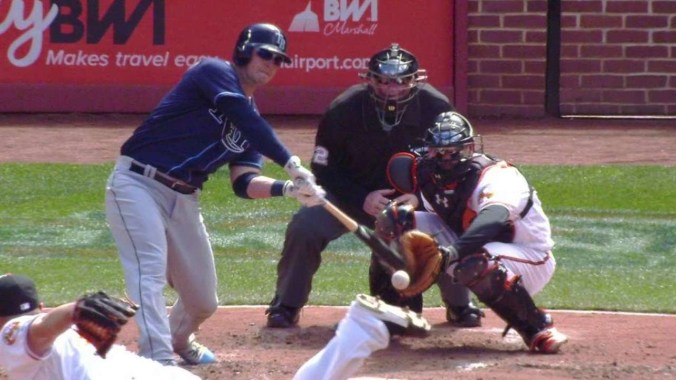
What does this have to do with Yankee centerfielder Jacoby Ellsbury? Well, Ellsbury is in the process of shattering an obscure baseball record: number of times reached base on catcher’s interference during a season. Catcher’s interference refers to instances in which a catcher makes any contact with a batter or his bat during a pitch. Usually, this involves the batter’s bat hitting the catcher’s glove, as in the photo above. When that happens, a player is awarded first base. The rule is based on fairness and  designed to protect the batter, but apparently Ellsbury has perfected the weird practice of using it as an offensive weapon.

Jacoby Ellsbury became the single-season record holder in catcher’s interference calls  in July with his ninth instance  getting rewarded for it. The record was formerly held by Roberto Kelly, who did this eight times in 1992.  Since breaking the record, Ellsbury has gotten catcher’s interference called three more times, for a current total of 11 with almost a month  left to the season. He is also second all-time in catcher’s interference with 23. The career record belongs to Pete Rose with 29; since Rose is baseball’s all-time leader in games played and career at bats, we would expect him to hold this record. No one else in baseball history has more than 18. Ellsbury is only five catcher’s interferences shy of Rose’s mark, and has done it in less than a third of the at bats. Continue reading

Major League Baseball Cares About Integrity And I Wish This Proved It…But It Doesn’t

I know this will be a shock, Henry, but there's forest here, not just trees...

I know this will be a shock, Henry, but there’s forest here, not just trees…

On Baseball Prospectus, one of the scholarly baseball sites, Henry Druschel has a provocative, inspiring and ultimately silly post pointing out that if baseball teams were only concerned with winning, they would forfeit games for strategic purposes, yet they literally never do. He writes…

“Teams are almost certainly harming their long-term win rates in a meaningful way by playing until every out of every game has been recorded. For example, the Red Sox encountered a grueling quirk of the schedule on Wednesday night, when they were scheduled to play the Orioles at 7:05 p.m. before traveling to Detroit and playing the Tigers at 1:10 p.m. the next day. When it began to pour in Baltimore at roughly 9:00 p.m., the Red Sox were leading 8-1 after six innings, but imagine if the situation was reversed, and Boston was instead trailing 8-1 with three innings to go. Their odds of coming back to win such a game would be something like 0.5 percent. In such a scenario, they could either wait in the clubhouse until the game was either resumed or officially cancelled, or they could forfeit as soon as the rain began, and head for the airport and Detroit right away. In the non-hypothetical game, the rain delay lasted about 80 minutes before the game was officially called; it seems obvious that an extra hour and a half of rest before the next game would add more to a trailing Boston’s total expected wins than remaining in Baltimore and hoping for a miracle would. That might seem like a corner case, and truthfully, it is; I bring it up to note that no one would even consider a forfeit in such a scenario, despite the strategic logic of the move. This isn’t limited to corner cases, however; every time a position player enters a baseball game as a pitcher in a blowout, teams are harming their long-term expected win totals by not forfeiting instead….”

The writer concludes:

Given that forfeitures would be win-maximizing in certain cases, and given that teams choose never to strategically forfeit regardless, there are two possible conclusions. One: Teams are behaving irrationally. Given the immense value even a single win can have to a franchise, I feel confident stating that this is not the case. That leaves the second conclusion: There is something the team values more than winning as much as possible. There is a societal norm that places something—a competitive ideal, maybe, or just completion—over winning, a norm that would be violated by a strategic forfeit, and a norm that teams invariably follow.

As someone who values other things over winning, this excites me…

Don’t get too excited, Henry.

Yes, I believe that baseball teams take considered actions sometimes that do not maximize their chances of winning. I was roundly pilloried in baseball circles for an article I wrote in 2008 (for another scholarly baseball site)  which argued that Barry Bonds, the shameless steroid cheat and home run champion who was suddenly a free agent and who could, based on his recent exploits, still hit though well past 40, would not be signed by any team—not even the Yankees!—because doing so would signal to that team’s fans, city, players and organization that the team endorsed flagrant dishonesty as well as a willingness to disregard fairness, integrity and sportsmanship for a few extra wins. I was on a MLB radio show where the host laughed at me. “Of course he’ll be signed! You’re crazy!” were his words. “Just wait,” I said. “If he isn’t signed, it will mean that baseball colluded against him!” he said. “Just wait,” I said.

Bonds, who said he was dying to play, that he was healthy, that he’d play for the Major League minimum, that he’d sue MLB if someone didn’t sign him, never swung a bat in anger again. There was no collusion, either. It was pure cognitive dissonance, you see. Remember the scale? Continue reading

KABOOM! The Wrigley Field DJ Really Thought This Would Be OK! (And The Cubs Get A Jumbo…)

exploding-head5

Talk about malfunctioning ethics alarms! This story made my head explode, once I confirmed that it was not a hoax, as I desperately hoped. It apparently made the heads of a lot of Cubs fans and Cubs executive blow craniums too.

If you don’t follow baseball closely, and by the way, what’s the matter with you?, you probably don’t know two crucial facts about the Chicago Cubs closer (that’s the pitcher who comes in to pitch the ninth when his team is ahead in a close game) Aroldis Chapman:

1. He throws the baseball over 100 mph. on almost every pitch, and has hit 105 mph. on the radar gun this season. Traditionally 90 mph on a pitcher;s fastball is considered good. 95 mph is considered very good. 100 mph is outrageous. Last year, Chapman threw more pitches over 100 mph than the rest of his league’s pitchers combined.

2. Chapman was suspended for much of this season for domestic abuse, under baseball’s new policies.

The Cubs recently acquired Chapman (from the Yankees) to be the team’s closer, in this, a season that bids fair to be the one that finally ends the team’s epic string of seasons without a World Series title. The Cubs last won the Series in 1908, over a century ago. The team hasn’t even made it to the Series since 1945.

Now here’s the punch-line.

Hold on to your head. Continue reading

Well, THAT Question’s Answered: No Parting Gifts For A-Rod

No-GiftI wrote in an earlier Ethics Quiz that the retirement of Yankee Cheat and Head Creep Alex Rodriguez tomorrow would put the Boston Red Sox in a difficult position tonight. Should they honor him, as the Yankees will honor Red Sox star David Ortiz in his final appearance in Yankees Stadium? Or should they  eschew any recognition, since the Boston fans hate Alex’s guts?

Apparently, as often is the case, the problem was not as difficult as my ethical alarms were telling me. The Sox won’t even give A-Rod a cupcake. There will be no recognition of his career, other than the symphony of boos that will rain down on him from the Fenway Faithful every single time he comes to bat.

Good.

Ethics Quiz: Boston’s A-Rod Dilemma

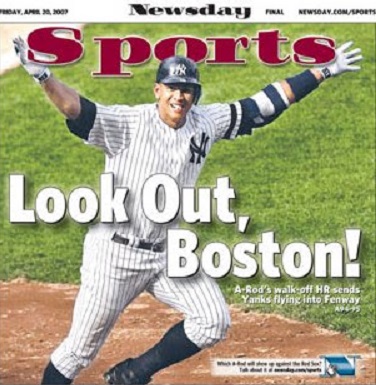
newsday-AROD

This is a really, really hard one.

Over the weekend, as reported here, Yankee superstar/pariah/cheating jerk for the ages Alex Rodriguez announced that he would “retire” after next Friday night’s game. He’s not really retiring, of course. Like almost everything involving A-Rod, lies and cover-ups reign. Since the Yankees were going to have to pay the rest of his contract to the tune of 27 million bucks either way, they told Alex that they could release him, thus ending his career on a sour note, or allow him to pretend to make the decision to leave the game himself, which would be better PR for all concerned.

However, the announcement presents a problem for the Boston Red Sox. A-Rod’s next-to-last game is Thursday night in Fenway Park, and a player with Rodriguez’s astounding career on-field achievements would typically warrant an on-field salute, like the Sox gave Yankee icon Derek Jeter when he retired. The problem is that Red Sox fans don’t like or respect A-Rod, and they shouldn’t. No baseball fan should. He disgraced the game with his drug use and lies; was an unsportsmanlike presence for most of his career, and will not reach the Hall of Fame despite one of the best careers ever unless the Hall junks all of its character requirements.

Yet reciprocity raises its ethical head. David Ortiz, the beloved Red Sox slugger, is also retiring after this season, and the Yankees have planned to give him a big send-off when Big Papi plays his last game in Yankee stadium. How can the Red Sox snub A-Rod, and expect the Yankees to honor their hero? If the Red Sox do hold a ceremony for Rodriquez, will Sox fans use it as an opportunity to heap well-deserved abuse on Alex one last time? If Sox fans fill Fenway with boos, will Yankee fans reciprocate by ruining Ortiz’s moment in New York? (I would give my guess on this, but it might expose a long-held bias against Yankee fans.)

Your Ethics Alarms Ethics Quiz of the Day:

What is the most ethical way to handle this awful situation?

Continue reading