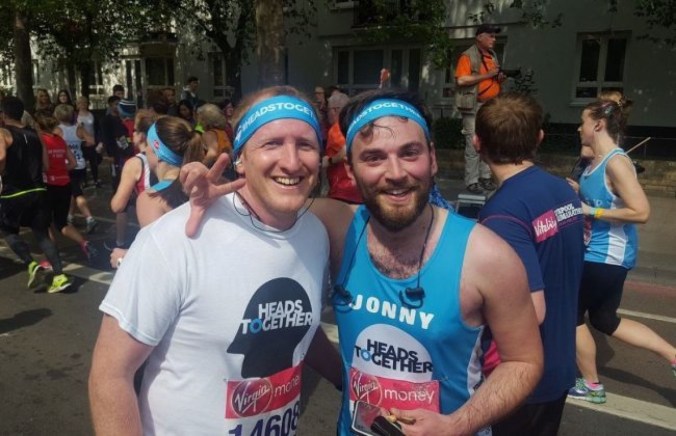
That’s Neil on the left, Jonny on the right.
Read this.
There is hope.
The post about the opposite response to a potential suicide is here,
Driving his route in Dayton, Ohio, bus driver Damone Hudson saw a woman standing on the other side of the rail on the Main Street Bridge that spans the Great Miami River. He could have continued on. He could have ignored her. Instead, he made an unscheduled stop, and as his passengers waited and watched, spoke to the woman, then left the bus to get closer to her.
He said, gently, in an exchange that was partially captured on video,
“Why don’t we come back over on the side of the rail? … Hey miss, why don’t we come back on this side of the rail for me?…Ma’am, you look like you’re having a bad day, you know. Can I give you a hug?”
Someone called 911 as Hudson kept talking until a Dayton Police Department crisis intervention specialist arrived. The potential suicide stepped back over the railing, and was taken to safety and a medical evaluation. The driver got back in his bus and continued the route.
“He did a great job,” Dayton police detective Patty Tackett told reporters.

As the Chicago Cubs plowed their way to the World Series and a possible end to their 108 year failure to win a World Series, numerous sports writers, including some I thought were smart enough to know better, set out to prove their compassion, sensitivity and gooey caramel centers by arguing that the news media and fans should “leave Steve Bartman alone.” Bartman, for those of you who have lived in a bank vault since 2003, was the hapless young Chicago Cubs fan who unintentionally interfered with a foul ball that might have been catchable by Cubs outfielder Moises Alou in the decisive game of 2003 National League Championship Series. In a perfect display of the dangers of moral luck, Bartman’s mistake—it didn’t help that he was wearing earphones and watching the ball rather than the action on the field—began a chain of random events that constituted a complete collapse by Chicago in that very same half-inning, sending the Miami Marlins and not the Cubs, who had seemed comfortably ahead, to the Series. Bartman, who issued a sincere and pitiful apology, was widely vilified and literally run out of town. He then became part of Cubs and baseball lore, one more chapter in the sad saga has been called “the Billy Goat Curse,” the uncanny inability of this team to win it all.
Over time, even Bartman’s tormenters came to see that holding him responsible for the team’s failure was cruel consequentialism at its worst. Alou, who had sicced the Furies on Bartman by angrily pointing at him after the incident from the field and later told everyone that with the interference, he would have caught the ball, even came out ten years later–five years!—to say that he wouldn’t have caught the ball, and Bartman wasn’t to blame. (I wrote about that epic example of barn-door locking here.) Now, NBC’s Craig Calcattera and many others are beating a new drum: nobody should write about or talk about Stave any more, because it’s so unfair. Continue reading
Remember Raymond Zack? In 2011, 50-year-old Raymond Zack waded into the surf at an Alameda, California beach and stood calmly in the 54-degree water, apparently waiting to die. His suicide took nearly an hour, but eventually he drowned, with no rescue attempts from any of the 75 San Franciscans, including firefighters, who gathered on the shore to watch the entire tragedy. I am so used to reading about bystanders allowing desperate people, sick, wounded or otherwise in peril, to perish because they “didn’t want to get involved” that a story like this one, the opposite of the Raymond Zack tragedy from St. Paul, Minnesota, comes as a shock.
How sad is that?
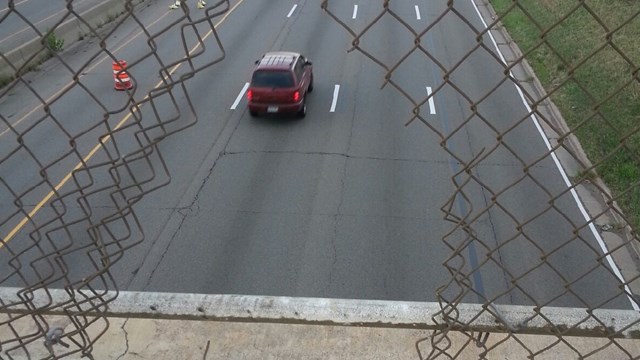
Motorist Angela Martin saw a woman climb onto a concrete wall and scale a chain-link fence above Interstate 94 in St. Paul, Minnesota. Martin could have continued driving, but she acted immediately, parking her car and calling 911. But she sensed there was no time to lose. Martin ran over to the woman, who having climbed over chain-link fence was now clinging to it with her fingers above heavy highway traffic.
“ No, honey. Don’t do this,” she shouted. Martin told reporters that the distraught young woman kept repeating, “My mom don’t love me. My mom don’t care for me.’”
“No, we love you, ” Martin told her. Martin reached through the links and grabbed the woman’s shirt and belt, just as the would-be suicide released her grip so she could fall to her death. Other motorists on the overpass saw the unfolding scene and came to Martin’s aid, and joined her in reaching through the fence to keep the woman from falling. Continue reading
I encountered this video on CNN this morning:
Observations:
1. No police officers should have to work under these conditions. This requires courage and tolerance above what any professional should have to muster on a regular basis.
2. Every urban mayor, district attorney, police chief, civil rights advocate and journalist should be asked to comment on the video regarding the principles of respect, civic responsibility, and citizenship.
3. If the question is asked why crime rates are rising in several cities due to a cessation of proactive law-enforcement, this video is a nearly complete answer.
4. What prominent U.S. African American officials, leaders and celebrities are condemning this conduct by the friends of the individual being arrested, and conduct like it all over the nation? I haven’t seen or heard a single one.
5. Allowing this phenomenon to continue without addressing it directly is community malpractice, irresponsible, destructive, and almost certain to be deadly.
6. When such a situation escalates to violence, as this one easily could, who will be responsible, and who should be held responsible?
Discuss.
 When I posted with disgust on the Tahera Ahmad story (a Muslim-American woman who reported on Facebook that she was discriminated against by a stewardess and subjected to verbal abuse by a passenger on a United Airlines flight, and that no passengers came to her aid of defense), I noted that the facts seemed hard to believe, and that my commentary was based on a presumption that the account was true without knowing whether they were.
Now there have been two developments that provide additional perspective on the incident, and no enlightenment whatsoever.
First, United announced that it has investigated the incident, and fired the flight attendant. This would suggest that Ahmed’s account had at least some validity…or that the flight attendant got a fat settlement as United fired her to avoid a public relations battle with Muslim groups.
Second, this was posted on FlyerTalk Forums: Continue reading

Feared soda can hijacker Tahera Ahmad
I don’t understand how this episode could happen as it has been described. I am assuming for the purpose of the post that it did, and thus have almost nothing to add to the story other than to ask “What the hell is the matter with these people?”
Tahera Ahmad, an associate chaplain and director of interfaith engagement at Northwestern, described the alleged incident on Facebook while she was on the United flight from Chicago to Washington, D.C. Friday night.She wrote that she was in tears following an ugly episode that began with her request for a Diet Coke when the beverage service reached her row. The flight attendant had given her an opened can of Diet Coke. When Ahmad requested an unopened can, the flight attendant told her, “Well, I’m sorry. I just can’t give you an unopened can, so no Diet Coke for you.”
Then the same flight attendant gave another passenger an unopened can of beer. Ahmad said she asked why the man was given an unopened beverage can, but she was forbidden from having one. The flight attendant, according to Ahmad, replied, “We are unauthorized to give unopened cans to people, because they may use it as a weapon on the plane.”
Ahmad told the flight attendant she felt she was being discriminated against, and the flight attendant quickly grabbed the man’s beer can, opened it and said, “It’s so you don’t use it as a weapon.” When Ahmad asked for support from other passengers, a man sitting in an aisle across from her said, “You Muslim, you need to shut the fuck up,” Ahmad said.
“What?” a shocked Ahmad said. The passenger looked her in the face and said, “Yes you know you would use it as a weapon, so shut the fuck up.” “Some people just shook their heads in dismay,” Ahmad wrote on Facebook. But nobody rose to her defense.
After the flight, the attendant and the pilot apologized to her, and United issued a lame mea culpa. It doesn’t matter. Everybody on the plane except for Tahera Ahmad should hang their heads in shame.
What the hell is United (or whoever made the “unopened can” policy, if there really is such a deranged policy) thinking? A can of soda is a weapon? There must be hundreds of things in carry-on luggage that would make a more plausible weapon than a soda can. Like pens. Like laptops. Like powercords. Like dop kits. Like electric razors.
Like fists and feet. Ridiculous.
Gee, I always thought they opened those cans to be nice…
What the hell was the flight attendant thinking? Making that excuse to Ahmad, and then handing a male passenger an unopened can right in front of her? What an obvious insult! Continue reading
 The free-range kids debate already raised this issue, and now my colleague and friend Michael Messer, the talented and versatile musician/singer/ actor who teams with me in the ProEthics musical legal ethics programs Ethics Rock, Ethics Rock Extreme, and Ethics Jamboree, just posted about his traumatic experience on Facebook, writing,
“I’m standing in Central Park and witnessed a tourist father grab his (approx 5 year old) child by the arm and shake him… The. open palm smack his child in the head. Hard. Twice. I screamed to him, from about 50 feet, where I witnessed it: “HEY!!! YOU DON’T HIT HIM” he looked up, startled to be called out, and waved me off to mind my business. “YOU DO NOT HIT A CHILD IN THE HEAD”, I repeated, at the top of my lungs, hoping to attract attention. The kid cried and then got himself together and went off to play. No one else in Sheeps Meadow saw or took notice. For about 5 minutes after I kept my eyes on him so he knew he was now being watched. What is the role of a bystander in this situation?”
Your Ethics Alarms Ethics Quiz for the day is…
The answer is simple, really—its that oft-repeated Ethics Alarms mantra, “FIX THE PROBLEM,” at least as much as you can. Do something. Mike did the right thing, from a distance: show the abuser he’s being observed, protest, shame him. If one can, if one has the ability, the skill and the timely reaction and the child looks to be in genuine danger, intervene physically.
The latter course, however, carries risks, and also may be precluded by the natural reflex most humans have when they observe something unexpected and shocking. I discussed this issue when Penn State assistant coach Mike McQueary was being pilloried in some publications for not immediately charging into the Penn State showers and stopping sexual predator Jerry Sandusky from sexually abusing a boy: Continue reading
Just months after suburban Maryland parents Danielle and Alexander Meitiv were cited by Montgomery County’s Child Protective Services for “unsubstantiated neglect” for allowing their children Rafi, 10, and Dvora, 6, to walk home from a park close to home, the defiant parents let their kids to do it again. Again, someone called 911 (anonymously), and again the children were picked up by police.
This time, the police took the Meitiv children to Child Protective Services headquarters and for some reason didn’t tell the parents, who, naturally enough, freaked out. Five and a half hours later the agitated children and frantic parents were reunited. You can read about the initial incident from the mother’s perspective here; and obviously Lenore Skanazy is in full battle array on her “Free Range Kids Blog.” Columnists everywhere are rushing to their keyboards to write columns like this one, by the Washington Post’s Petula Devorak, titled “Why Are We Criminalizing Childhood Independence?”
The ethics of this issue are more complicated than simplistic “We used to walk around freely all the time when we were kids and it was more dangerous then than now” reminiscences are equipped to explore.
Analyzing this ethics conflict (“when two or more ethical principles are in opposition”) screams out for the useful starting point for ethics analysis:
What’s going on here?
Before I answer, let’s get a couple of ethics verdicts out of the way: Continue reading

 Ethics Alarms