Ingratitude, Racism And Statue Toppling At The Asian Art Museum

I’ll begin with the ethics conclusion, and show how we get there.

If your organization, institution, or nation owes its existence to an individual that hindsight-wielding critics want to erase, your choice is to tell them to get lost while continuing to officially recognize the debt such organization, institution, or nation  owes to that individual, or to dissolve the entity. Recognizing in some form the fact that a founder has blemishes on his or her past may be justified and practical. Continuing to benefit from that founder’s actions while metaphorically kicking him or her in the teeth, however, is unethical and, in fact, despicable.

Thus we arrive at the current controversy at the Asian Art Museum  in San Francisco. The focus of the mess is the bust of Adrian Brundage you see above. Brundage is most remembered as the long-time (twenty years) President of the International Olympic Committee (IOC), and most reviled for his decision not to cancel the Munich Games in 1972 after the terrorist attack on the Israeli team in 1972. (I agreed with him then, incidentally, and still believe that he was correct, and courageous, in his decision.) Brundage also, however, created the Asian Art Museum, which is the centerpiece of San Francisco’s Civic Center Plaza, and which Brundage gave to the city in 1966 to house his fabulous personal collection of approximately 8,000 art pieces.

The New York Times story about the emerging controversy at the museum begins, “For 48 years, visitors to this city’s Asian Art Museum have had to pass the bust of Avery Brundage.” That’s right, they “had” to pass that bust because what they were coming to see belonged to Avery Brundage, the museum’s collection was his gift, and it was and is appropriate for that to be respected and acknowledged.

Given an opportunity by the zeitgeist of the George Floyd Freakout, however, the museum’s director and chief executive, Jay Xu, announced to a meeting of the board and commissioners in June that he was having Brundage’s bust  removed. There are two reasons given in the article. One is that Brundage was accused of being a Nazi sympathizer and anti-Semitic (with the decision not to stop the 1972 Olympics being cited as a prime piece of evidence for the latter), and that the museum he created “presents Asian art from a mostly white perspective.”

As for the last complaint, I will characterize it this way: it’s racism, pure and straight.

The George Floyd Freakout is being used to justify a national effort to “Get whitey,” and this disgusting outbreak of anti-white hatred (that so many white Americans are accepting with the meek submission and hollowed out character of post rats-in-his-face Winston Smith) will not end until sufficient numbers of the rational label it what it is: opportunistic hate and racism.

The museum presents Asian art from a “mostly white perspective”  because the museum’s collection was originally created by a  collector of Asian Art who was white. That does not justify an indictment of the collection, and if an Asian-American wants to establish a museum that reflects Asian art from a mostly Asian-American  perspective—not an Asian perspective now, be consistent, you racists!—then that Asian-American is welcome to spend millions on his or her own collection,  give it to the city, and see if anybody wants to see it. Continue reading
Unethical Quote Of The Year: House Speaker Nancy Pelosi

“People will do what they do.”

—-Speaker of the House Nancy Pelosi  yesterday, following being  asked at a press conference about her reaction to the statue of Christopher Columbus being torn down and dumped in the Bay by the usual gang of vandals and anarchists who are symbolically tearing down the United States and Western civilization, as well as its values.

I am serious about this being the Unethical Quote of the Year. I can’t imagine a worse one, once Pelosi’s status as the third ranking official in the United States Government and the leader of the Democratic Party is taken into consideration. This would be a morally, legally and ethically bankrupt statement if it came from a sociopathic teenager. Coming from a leader who people follow and trust, it is infinitely worse. Such an attitude strikes at the soul of civilized society. “They just do what they do” is a line from  “Jurassic Park,” as the paleontologist, Dr. Grant (Sam Neill) explains to the children that dinosaurs aren’t good or bad, they are just animals that “do what they do.”

But they were animals. Continue reading

Comment Of The Day: “Independence Day With Ethics Alarms 1… Ethics Quote Of The Month: President Donald Trump”

Adding international and historical perspective  to yesterday’s post regarding President Trump’s “dark and divisive” speech at Mt. Rushmore ( the mainstream media narrative has been so remarkably consistent that it has been credibly suggested that a memo went out. I could believe it…), E2 gives us this Comment of the Day on “Independence Day With Ethics Alarms 1… Ethics Quote Of The Month: President Donald Trump”:

Re the media’s race/Trump racism false commentary:

Doesn’t anyone know any history? As an amateur historian of British history, Churchill, the Holocaust, and WWII, I understand the horrors of British imperialism in the 18th-19th century (Africa, the Near and Far East, and on and on), but…

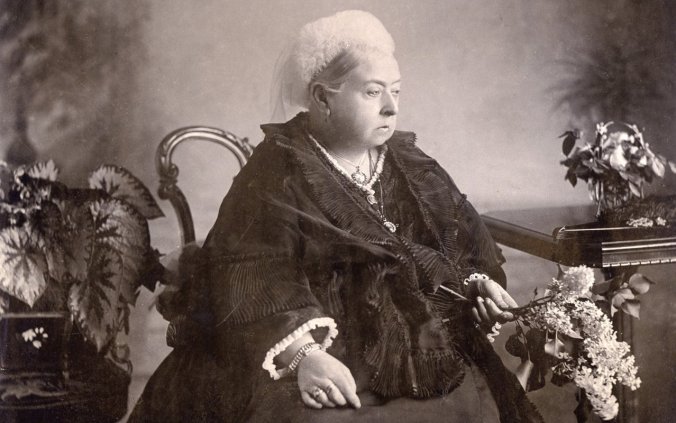
Queen Victoria (against the South’s fond hopes) refused to support the Confederacy for one reason: slavery. Despite England’s need for cotton, she wouldn’t put her stamp of approval on slavery in the interest of their economy. Of course one could argue that British imperialism was almost as bad as slavery, but it really was not, and unlike the French, who conquered African nations, hunted with chieftains, slept with their women, stole their resources, then left when it seemed appropriate or necessary, the British, in their unique fashion, created whole government structures (e.g. India) that survived as useful bureaucracies after WWII and the end of British imperialism. Smart they were, though, creating the British Commonwealth, which their conquered countries could join if they chose. An amazing number did.

But slavery of a particular race was not in the British ethic. (Or the Romans either, who enslaved everyone they conquered, regardless of race/origin/culture…) The result — especially after WWII — is that Britain became populated by traditional Englishmen, Indians, African blacks, Asians — all with the hope and most always the realization of good, safe, respected, lives. (The European Union, Brexit, etc., is changing that, I’m sure. It’s been a decade since I’ve been to England.) But to the point: Continue reading

My Ethics Conflict: Woodrow Wilson’s Name Should Have Been Removed At Princeton Long Ago, But Erasing It Now Opens The Floodgates, Part II: The Case For Expunging Wilson [Corrected]

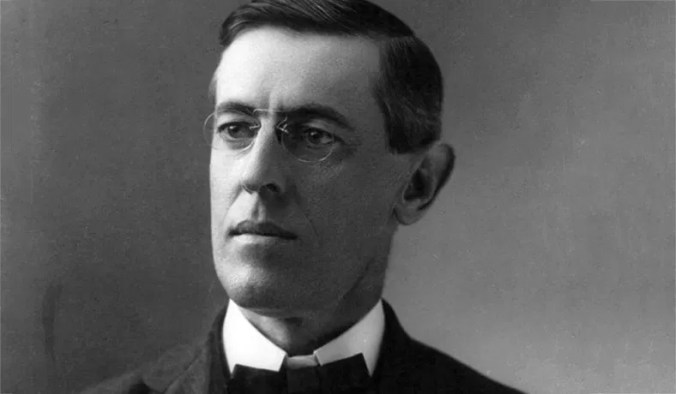
Woodrow Wilson’s name should have never been put on

Yet President Wilson ended up being honored by having his name plastered on buildings, schools and bridges (like here in Washington, D.C) more than most Presidents, in part because influential Democratic historians, notably Kennedy family flack Arthur Schlesinger Jr., pushed the false narrative that he was a great idealist and a great leader. This required burying Wilson’s well-documented record as a racist, though the rest of his record wasn’t great either.

In Part I, I gave the official Ethics Alarms argument for not tearing down honors to Wilson now that Black Lives Matters and its allies are in full Soviet/Maoist cultural bulldozing mode. When Wilson is gone, I see little stopping the mob from tearing down Franklin D. Roosevelt memorials next, to name just one example of where this slippery slope leads.

Despite leading our nation through an existential depression and World War II, FDR had his own black marks regarding racism and discrimination, arguably as many as Wilson. In  1916, a document was discovered  showing that  Roosevelt, as Wilson’s Deputy Secretary of the Navy, personally signed an order segregating bathrooms in the Navy Department. As President, FDR wouldn’t allow his black and white White House servants to eat together.  Everyone knows (or should) that he imprisoned about 70,000 American citizens because they were Japanese, and just last year, “The Jews Should Keep Quiet: Franklin D. Roosevelt, Rabbi Stephen S. Wise and the Holocaust” revealed  archival evidence of FDR’s callous and bigoted treatment of European Jews prior to and during the Holocaust.  Franklin Roosevelt was a racist and an anti-Semite. When we get into retroactively dishonoring Presidents virtually all of them are at risk.

However, there are persuasive arguments that Wilson is a special case. Continue reading

Today’s George Floyd Freakout Disgrace: The Metropolitan Museum of Art

 The triggering event:

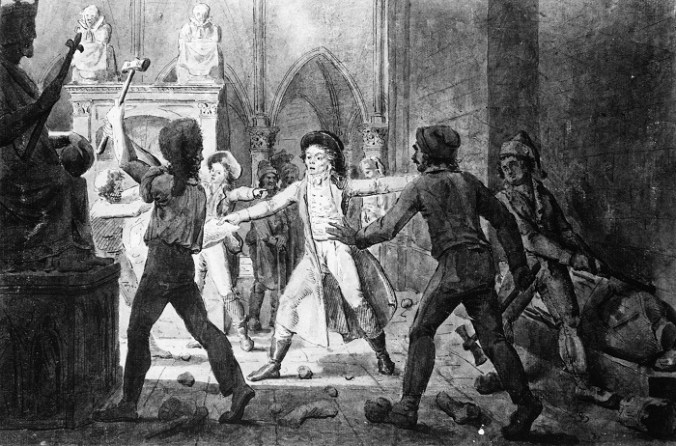
The museum’s powerful chairman of European paintings, Keith Christiansen, who has worked at the Met for 53 years, posted this image on Instagram. It depicts .

Christiansen also wrote,

“Alexandre Lenoir battling the revolutionary zealots bent on destroying the royal tombs in Saint Denis. How many great works of art have been lost to the desire to rid ourselves of a past of which we don’t approve. And how grateful we are to people like Lenoir, who realized that their value — both artistic and historical — extended beyond a defining moment of social and political upheaval and change.”

The statement was entirely appropriate and true.

But as we know, Facts Don’t Matter.

The response:

The post was quickly attacked  in a tweet by the advocacy group of arts workers, Art + Museum Transparency: “Dear @metmuseum, one of your most powerful curators suggested that it’s a shame we’re trying to ‘rid ourselves of a past of which we don’t approve’ by removing monuments — and, worse, making a dog whistle of an equation of #BLM activists with ‘revolutionary zealots.’ This is not OK.”

Responses to the tweet were similarly critical.

The reality:

  • Removing monuments is cultural suicide, and paves the road to historical ignorance.
  • BLM activists are “revolutionary zealots,” and denying it, or trying to punish those with the honesty and integrity to say so, won’t alter that fact.

Here is how Hawk Newsome, the president of Greater New York Black Lives Matter, described the movement in an interview with Martha MacCallum on Fox News, as reported by the NY Post:

“If this country doesn’t give us what we want, then we will burn down this system and replace it. All right? And I could be speaking figuratively. I could be speaking literally. It’s a matter of interpretation… Let’s be very real…. What is this country rewarding? What behavior is it listening to? Obviously not marching. But when people get aggressive and they escalate their protests, cops get fired, Republican politicians talking about police reform… Wow, it’s interesting that you would [ask what Black Lives Matter hoped to achieve through violence] because this country is built upon violence. What was the American Revolution? What’s our diplomacy across the globe? We go in and we blow up countries and we replace their leaders with leaders who we like. So for any American to accuse us of being violent is extremely hypocritical….. I think you should be applauding me, seeing how you guys are huge supporters of the Second Amendment….. But it seems to be the hypocrisy of America that when black people start talking about arming themselves and defending themselves, [that] talk is ‘violent.’ But when white people grab assault rifles and go to our nation’s, their state capitals, it’s all good… I just want black liberation, and black sovereignty. By any means necessary.”

Funny, that sure sounds like revolutionary zealotry to me. Continue reading

Monday Ethics Warm-Up, 6/22/2020: Lenin, Oliver, And The Troublesome Name

It would be well to consider the fate of that ultimate Sixties folk-pop group the Mamas and Papas, as we watch today’s idealistic anarchists make fools of themselves. By mid-way through their four-year run (during which they sold 40 million recordings), the group was self-destructing with inter-and extra-group sexual affairs and stage appearances where one or more of the group was too drunk or stoned to perform. The group kept breaking up and re-assembling, and fell apart for good in 1969. Mama Cass died of heart failure at the age of 34, after battling heroin addiction and other substance abuse. John Phillips, the creative leader of the group, also was a heroin addict and had emotional and substance abuse problems that he managed to pass on to his daughter, actress Mackenzie Phillips. In her memoir, “High on Arrival,” she wrote that she had a long-term sexual relationship with her father. Papa John also died of heart failure, when he was 66. Tenor Denny Doherty’s solo career flopped after the group ended. He was an alcoholic, but stayed sober for the final decades of his life. An acting career also failed; he finally got a gig as the “Harbormaster,” hosting a kids TV show that was a flagrant rip-off of “Thomas the Tank Engine,” but starring a talking tugboat. Doherty was 67 when he died from an aneurysm.

Michelle Phillips is the lone survivor of the group. She avoided substance abuse problems and after divorcing Phillips, whom she wed at 18, went on to a moderately successful acting career.

As today, these people who aspired to inspire lacked the wisdom, common sense, self-discipline, character, values or perspective to be trusted with their chosen mission.

1. Speaking of...When asked how it was that a statue of Vladimir Lenin was still standing in Seattle when protesters had toppled those of Ulysses S. Grant and others, the Human Rights Campaign’s Charlotte Clymer said, among her reasons, that “Lenin was not a slave-owner, you Confederate apologist fucks.”

To which National Review writer David Harsanyi responded with the obligatory, “Lenin created tens of millions of slaves.”

In related news, a 2015 video  of an interview with Black Lives Matter founder Patrisse Cullors shows her saying, “We actually do have an ideological frame. Myself and Alicia in particular, we’re trained organizers. We are trained Marxists. We are super versed on ideological theories…”

Several of the tenets seen on the BLM website are redolent of Karl. Do all these companies and pandering celebrities giving lip service to the group, attaching #BlackLivesMatter to their tweets and proclaiming support, know what they are supporting? I think it’s pretty obvious that they don’t. They are signaling their virtue by ostentatiously endorsing the most simple-minded and deceptive interpretation of the slogan, as if there is anyone who believes black lives don’t matter. I bet the vast majority have never visited the BLM website and read its agitprop.

That, needless to say, is as dumb as it is irresponsible. Continue reading

Ethics Dunce: Nikole Hannah-Jones

Nikole Hannah-Jones, staff writer at The New York Times and lead essayist in The New York Times Magazine’s “1619 Project” tweeted that she finds the common rebuttal of presentism—the popular practice of condemning those of different times and cultures for not magically acquiring the evolved beliefs and values that those who have had the advantage of decades and even centuries of experience, observation and enlightenment—that those criticized were of their time “offensive.”

“I mean, Hitler was a man of his time. Bin Laden was a man of his time,” the Pulitzer Prize winner tweeted. “It’s a justification and unnecessary.”

This is the quality of analysis and thought we now receive from the best of American. journalists, one who has been deemed worthy of the occupation’s highest honor.

First, it is profoundly unrealistic and unfair to expect those raised in a culture with long-established values to determine on their own that such values are flawed or based on faulty assumptions and information. This should be intrinsically obvious to anyone capable of critical thought. Continue reading

Comment Of The Day: “Saturday Ethics Freakout, 6/20/2020: Fake News, Resignations, Topplings And Cancellations…But Also Hope,” Item #4

The toppling of a statue of our 18th President and the Civil War general who defeated Robert E. Lee, Ulysses S. Grant, in San Francisco should disabuse the historically literate of any misconception that all of the George Floyd demonstrators are concerned with “systemic racism.” Dishonoring Grant, as well as Francis Scott Key, whose statue also was pulled down, is signature significance for enmity toward the United States itself. 

Steve-O-in-NJ performed a service for all of us by taking the time to provide a concise and informative summary of this important American’s life of public service for Ethics Alarms readers. There are several references to Ulysses S. Grant on the blog; the most extensive was this segment of the President’s Day post in 2015:

My son is named after Grant, arguably the nicest and most sensitive of our Presidents. (How this sensitive man was able to sacrifice his soldiers in the thousands to win the horrible battles he did is an enigma.) As a cadet at West Point he drew pictures of horses obsessively; in the field, he refused to allow any of his men to see him unclothed. He loved his wife passionately, and wouldn’t allow her to get her badly crossed eyes fixed, because “God made her that way.” When his daughter was married, he retired to his bedroom and could be heard sobbing for over an hour.

As President, he was fatally handicapped by his nature, which caused him to trust people he shouldn’t and allowed others to exploit his good nature. The result was several scandals engineered by his appointees and associates, including Crédit Mobilier and the Whiskey Ring. Yet he had a natural aptitude for leadership, as his superb autobiography proved on every page. He could manage and lead; what he was bad at was manipulation, deceit, pretense, and retribution—in short, politics.

In one odd area, his customary sensitivity was completely lacking. He hated music of any kind.

Here is Steve-O-in-NJ’s Comment of the Day on Item #4 in the post, “Saturday Ethics Freakout, 6/20/2020: Fake News, Resignations, Topplings And Cancellations…But Also Hope”:

Apparently a lot of people don’t know their Presidents or their Civil War history. The man on the statue in Richmond is Robert E. Lee, commander of the Army of Northern Virginia, and General-in-Chief of all the Confederate Armies. The man in the San Francisco Park, although likewise bearded and in the uniform of the time, is his polar opposite. Born Hiram Ulysses Grant in Ohio, he adopted the name Ulysses Simpson Grant when he was admitted to West Point to avoid the embarrassing initials H.U.G. Graduating 21st of 39, he never planned to be a career officer.

During the Mexican-American War, where he was “an untidy young captain” as opposed to Lee being pronounced “the very finest soldier I ever saw in the field” by General Winfield Scott, and which he opposed as a land grab, he discovered he was actually a skilled officer, and began to change his mind about what he would do for a career. However, he left the army in 1854 after he was found drunk on duty and offered the choice of resigning or being court-martialed.

For the next seven years, Grant struggled between farming, real estate trading, and a few other things, none of which he was very good at. At one point he pawned his gold watch to buy his family Christmas gifts. He did not vote for the first Republican candidate for the presidency, John Fremont, because he could see this would probably lead to the country splitting in two. He did during this period acquire a slave named William Jones from his father-in-law. However, he found he didn’t have it in him to force him to work, and manumitted him before a year had passed. As the election of 1860 approached, he found himself becoming increasingly opposed to slavery.

Grant was a civilian when the Confederates fired on Fort Sumter, and initially Lincoln’s top military officer, George McClellan, turned down his request to be recommissioned. However, before the month was out, the governor of Illinois made him his military aide and a colonel, tasked with mustering in the Illinois militia. By August, old General Fremont, who he hadn’t voted for, made him a general himself and a district commander. That November he won the first major Union victory of the war at Fort Donelson. The following April his victory in the bloody Battle of Shiloh (for which he was roundly called a butcher and accused of drunkenness again) killed Confederate hopes of conquering the Mississippi Valley. That November he assumed command of the Army of the Tennessee, and ordered freed slaves to be incorporated into the ranks.

You probably know or should know the rest: the taking of Vicksburg, the brief reverse at Chickamauga, the taking of Chattanooga, his naming to supreme command (btw, before this, only Washington had held the three-star rank), and the slow, methodical advance into the South on five fronts. It took a year and was not without some reverses and mistakes, but ultimately he forced the Army of Northern Virginia under Robert E. Lee to withdraw from the Confederate capital at Richmond and flee west. On April 9, 1865, Lee tried to break through the Union cavalry screen, but was forced to abort the attack when he topped a ridge and saw two untouched full corps of Union infantry. He had no choice but to surrender.

Grant was actually heartbroken to receive the surrender of a man he had served with, even though he considered the Southern cause one of the worst ever fought for. He granted generous surrender terms, including letting the officers keep their personal sidearms and the soldiers keep their horses. He also stopped all celebration among his own men, reminding them that the rebels were now their countrymen again. He later personally opposed any attempts to try Lee and his officers for treason, since he had promised otherwise at the time of the surrender.

He actually became Secretary of War for a time during the presidency of Andrew Johnson, but issues with the appointment led to a complete break between the two men. He remained popular, though, and was elected the next president, in an attempt to unify the nation. During his presidency he actively fought the Ku Klux Klan and fought for civil rights for the freedmen, including the Fifteenth Amendment. His policy toward the Indians unfortunately fell apart in his second term. His reputation among historians was low until recently, due to scandals among his cabinet. It has enjoyed a revival recently, starting with a biography by Edward Jean Smith in 2001.

So, what do we take away from this long story (which could be a lot longer)? Ulysses S. Grant was, like all men, human, and like most humans, had feet of clay. Like most men, he passed through some difficult times, some of which were his own fault, and, like most men, he was probably given some opportunities that he might not have deserved. However, I can confidently say that he made more than the most of his second chance in the US Army, and was the right man at the right time to deal with the greatest crisis this nation has ever faced on the battlefield. He was as good a strategist and tactician as Lee, he just had the good fortune to have at least three lieutenants who were almost on the same level (Sherman, Thomas, Sheridan), while Lee had only the one (Jackson, whose loss he never recovered from). I can say with confidence that he was a man of his word, even when it might have been expedient not to be. I can also say with confidence that he did the best anyone could with the almost impossible task of putting a broken and embittered nation back together again.

He never betrayed the oath he swore twice, and he never once considered turning against his nation, although he did leave its service for a time. He never struck a blow against a fellow American, save one who was in open rebellion. He was not in sympathy with the Southern cause, and thought it was wrong, however, in the end he realized that continued hostility toward the defeated states would be counterproductive. He did not display any particularly racist attitudes or belief that one race was superior to another, in fact he incorporated freed slaves into his army. Continue reading

What Destruction Of Public Art? What Slippery Slope?

I woke up today wondering  whether those who blindly applaud the carnage of the George Floyd Freakout are lying, frightened or ignorant. The late post last night on Commentary Magazine’s manifesto quickly attracted a comment from Rationalization #64 Land, where John Yoo’s Rationalization, “It isn’t what it is,” holds sway. Implicitly denying the editors’ substantive list of the mob’s acts, “Adam” wrote in part,  “Art must be propagandist or be chopped away? (What art? Where? Who? Propagandist? How?)”

The growing movement to “chop away” at the memorials and statues to men, women and events whose interaction with history and culture no longer conform to what most or many Americans consider admirable (or politically correct) has been growing for years, with the clash of protesters in Charlottesville over a Robert E. Lee statue being only the most publicized of incidents around the country. “What art?” If a citizen is so ignorant of current events,  he shouldn’t be registering an opinion until he educates himself.

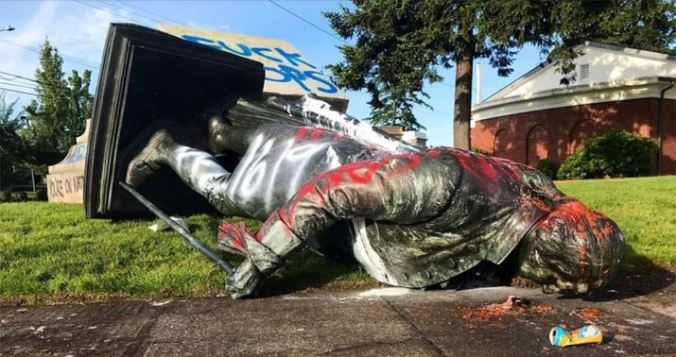
Almost on cue (protesters have been very accommodating of late in confirming past Ethics Alarms analysis), a George Floyd mob in D.C. pulled down a perplexing piece of public art, the statue of Albert Pike (above), an obscure Confederate diplomat and general who wrote alternate, bellicose, lyrics to “Dixie.” Writing this morning about why the D.C. police stood by and permitted the vandalism, Althouse wrote,

[W]hy isn’t mainstream media delving into the details of why the police are not acting to protect city artworks and to restore order? Where’s the journalism?! My hypothesis is that the media want to help Joe Biden get elected, so they’re presenting a rosy picture of the protests and refraining from any negativity about the Democratic politicians who control the cities where the disorder rages. I’m sure the journalists realize that at some point the majority of Americans will prioritize their interest in law and order, but — I imagine — they hope to hold us back from that tipping point.

The second question I am musing on is when and whether there will be that tipping point, or if, in the alternative, a critical mass of oblivious or dishonest “Adams”  will keep the public somnolent until it’s too late to tip, with disastrous consequences. Continue reading

Comment Of The Day: “Ethics Grab Bag: 6/18/20: Absolutism, DACA, Cancel Culture And Pancakes” [Item #4]

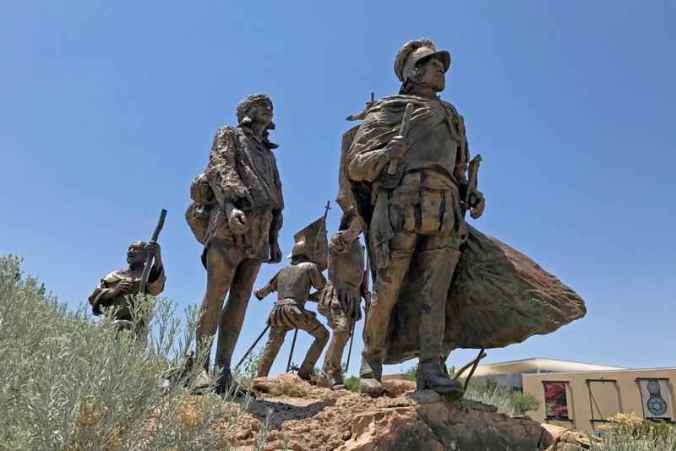
The poll on #4 among yesterday’s “ethics grab bag” is running strongly in favor of leaving up statues of Juan de Oñate, a particularly nasty Spanish conquistador who established the colony of New Mexico for Spain. [Aside: I was going to link to the article on the Britannica site, but as soon as I whitelisted it, I was bombarded with pop-up ads, drop-in ads, slide-over ads and more that shifted the text and  made it nearly impossible to read. They are morons, and screw them, to be blunt. I’ll allow a site’s ads if the site is smart and considerate enough to format them so that they don’t make using the site  infuriating. I will not be visiting again.]  Only 11% of voters so far think that there needs to be some limit on how horrible a historical figure can be to have a community decide that they don’t want to be reminded of him and her every day. Voting is still open:

Here is johnburger2013’s Comment of the Day on Item 4 in the post, “Ethics Grab Bag: 6/18/20: Absolutism, DACA, Cancel Culture And Pancakes”:

In general, I am not one calling for removing art from the public square. That smacks too much of Soviet Russia, Chairman Mao, and the Taliban. Perhaps a more complete history can be shown on the monument discussing the controversies.

The Oñate statue is one of those monuments that maybe should not have been dedicated, even if he founded or claimed the region for the Spanish crown over 400 years ago. Apparently, the statue’s foot amputation was in response to Juan de Oñate’s brutal repression of the Acoma Puebla after the Acoma rebelled in October, 1598, because the Acoma refused to pay a food tax to the Spanish crown, which had been implemented by Oñate. Oñate had claimed the region for Spain in March 1598, and instituted a food tax, which hacked the Acoma off – why wouldn’t it? – so they rebelled. The Acoma killing 11 Spaniards/Mexicans, including Oñate’s nephew, In response, Oñate ordered the burning of the town and the slaughter of almost the entirety of the 2,000 Acoma, leaving some 200 alive, including children. Oñate had his troops amputate a foot of each of the surviving males of fighting age and sent the children to “missions” in Mexico. The revolt has been referred to as the Acoma Massacre. Not sure that is something Spain is proud of. Continue reading