Confederate Statuary Ethics Train Wreck
What Destruction Of Public Art? What Slippery Slope?

I woke up today wondering whether those who blindly applaud the carnage of the George Floyd Freakout are lying, frightened or ignorant. The late post last night on Commentary Magazine’s manifesto quickly attracted a comment from Rationalization #64 Land, where John Yoo’s Rationalization, “It isn’t what it is,” holds sway. Implicitly denying the editors’ substantive list of the mob’s acts, “Adam” wrote in part, “Art must be propagandist or be chopped away? (What art? Where? Who? Propagandist? How?)”
The growing movement to “chop away” at the memorials and statues to men, women and events whose interaction with history and culture no longer conform to what most or many Americans consider admirable (or politically correct) has been growing for years, with the clash of protesters in Charlottesville over a Robert E. Lee statue being only the most publicized of incidents around the country. “What art?” If a citizen is so ignorant of current events, he shouldn’t be registering an opinion until he educates himself.
Almost on cue (protesters have been very accommodating of late in confirming past Ethics Alarms analysis), a George Floyd mob in D.C. pulled down a perplexing piece of public art, the statue of Albert Pike (above), an obscure Confederate diplomat and general who wrote alternate, bellicose, lyrics to “Dixie.” Writing this morning about why the D.C. police stood by and permitted the vandalism, Althouse wrote,
[W]hy isn’t mainstream media delving into the details of why the police are not acting to protect city artworks and to restore order? Where’s the journalism?! My hypothesis is that the media want to help Joe Biden get elected, so they’re presenting a rosy picture of the protests and refraining from any negativity about the Democratic politicians who control the cities where the disorder rages. I’m sure the journalists realize that at some point the majority of Americans will prioritize their interest in law and order, but — I imagine — they hope to hold us back from that tipping point.
The second question I am musing on is when and whether there will be that tipping point, or if, in the alternative, a critical mass of oblivious or dishonest “Adams” will keep the public somnolent until it’s too late to tip, with disastrous consequences. Continue reading
Comment Of The Day: “Ethics Grab Bag: 6/18/20: Absolutism, DACA, Cancel Culture And Pancakes” [Item #4]

The poll on #4 among yesterday’s “ethics grab bag” is running strongly in favor of leaving up statues of Juan de Oñate, a particularly nasty Spanish conquistador who established the colony of New Mexico for Spain. [Aside: I was going to link to the article on the Britannica site, but as soon as I whitelisted it, I was bombarded with pop-up ads, drop-in ads, slide-over ads and more that shifted the text and made it nearly impossible to read. They are morons, and screw them, to be blunt. I’ll allow a site’s ads if the site is smart and considerate enough to format them so that they don’t make using the site infuriating. I will not be visiting again.] Only 11% of voters so far think that there needs to be some limit on how horrible a historical figure can be to have a community decide that they don’t want to be reminded of him and her every day. Voting is still open:
Here is johnburger2013’s Comment of the Day on Item 4 in the post, “Ethics Grab Bag: 6/18/20: Absolutism, DACA, Cancel Culture And Pancakes”:
In general, I am not one calling for removing art from the public square. That smacks too much of Soviet Russia, Chairman Mao, and the Taliban. Perhaps a more complete history can be shown on the monument discussing the controversies.
The Oñate statue is one of those monuments that maybe should not have been dedicated, even if he founded or claimed the region for the Spanish crown over 400 years ago. Apparently, the statue’s foot amputation was in response to Juan de Oñate’s brutal repression of the Acoma Puebla after the Acoma rebelled in October, 1598, because the Acoma refused to pay a food tax to the Spanish crown, which had been implemented by Oñate. Oñate had claimed the region for Spain in March 1598, and instituted a food tax, which hacked the Acoma off – why wouldn’t it? – so they rebelled. The Acoma killing 11 Spaniards/Mexicans, including Oñate’s nephew, In response, Oñate ordered the burning of the town and the slaughter of almost the entirety of the 2,000 Acoma, leaving some 200 alive, including children. Oñate had his troops amputate a foot of each of the surviving males of fighting age and sent the children to “missions” in Mexico. The revolt has been referred to as the Acoma Massacre. Not sure that is something Spain is proud of. Continue reading
Ethics Grab Bag: 6/18/20: Absolutism, DACA, Cancel Culture And Pancakes
1. Oh, I’m sure that will help a lot. Quaker announced yesterday that the Aunt Jemima brand would be rebranded and renamed “to make progress toward racial equality.” Yeah, I’m sure the pancake box design and hearing that demon name “Jemima” has retarded the progress of racial justice for decades. I couldn’t care less what pancake mix is called and I doubt that anyone else does, but if any portion of the market claims to find the logo offensive, that’s a good reason to ditch it, which I assume means that Uncle Ben’s Rice will be called “U.B.R.” soon. Nonetheless, Quaker’s move isn’t substantive. It’s virtue signaling, and at this point, more historical airbrushing. Getting rid of Aunt Jemima will cost Quaker millions of dollars, and probably raise the price of the product. It won’t affect racial equality one iota.
Meanwhile, cultural context and history is lost. The R. T. Davis Milling Company hired former slave Nancy Green as a spokesperson for the Aunt Jemima pancake mix in 1890, and she continued in that role until her death in 1923. Green appeared as Jemima beside the “world’s largest flour barrel” while operating a pancake-cooking display at Chicago’s 1893 World’s Columbian Exposition. After the Expo, Green was given a lifetime contract to promote the pancake mix. Aunt Jemima was Nancy Green’s one link to immortality.
2. Today’s SCOTUS decision on DACA. Here’s how NPR put it: “A narrowly divided U.S. Supreme Court extended a life-support line to some 650,000 so-called DREAMers on Thursday, allowing them to remain safe from deportation for now, while the Trump administration jumps through the administrative hoops that the court said are required before ending the program.”
The President called this a political decision in his inimitable, meat-axe way:
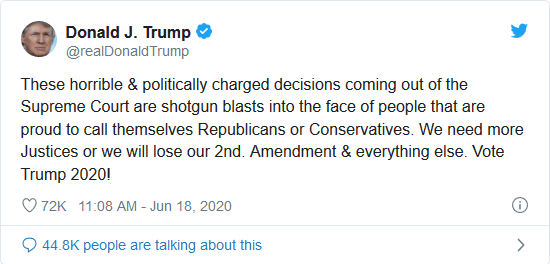
This is an especially stupid tweet. Every time SCOTUS doesn’t back the administration isn’t a political decision, and lumping apples and kumquats together, which is what generalizing about decisions as diverse as the gay discrimination decision and this one is, just shows that the President doesn’t read the opinions he’s complaining about, and only cares about the results. (Of course, in this he is like most Americans, sad to say.)
After wading through as much of the assorted opinions in the case as I can stand (Great thanks, once again, to valkygrrl for sending me the link), I think that’s unfair.
Chief Justice Roberts, again the swing man, joined with the four liberal Justices and authored the majority opinion. This sentence says it all: “The dispute before the Court is not whether DHS may rescind DACA. All parties agree that it may. The dispute is instead primarily about the procedure the agency followed in doing so.” That means that the decision isn’t about substance or policy, but rather process. Process decisions are not, or shouldn’t be, political. This note also undermines the idea that the Justices were just acting in partisan lockstep:
ROBERTS, C. J., delivered the opinion of the Court, except as to Part IV. GINSBURG, BREYER, and KAGAN, JJ., joined that opinion in full, and SOTOMAYOR, J., joined as to all but Part IV. SOTOMAYOR, J., filed an opinion concurring in part, concurring in the judgment in part, and dissenting in part. THOMAS, J., filed an opinion concurring in the judgment in part anddissenting in part, in which ALITO and GORSUCH, JJ., joined. ALITO, J., and KAVANAUGH, J., filed opinions concurring in the judgment in part and dissenting in part.
If the President paid attention, he would see that a majority of the Court found that his actions regarding DACA were not motivated by “animus,” thus denying Big Lie #4.
I am unalterably opposed to DACA, for reasons stated frequently here. The short version: it is incompetent and irresponsible law-making to provide an incentive for people to break the law. DACA is fueled by emotion and sentimentality (“Think if the children!”) and is an incremental step toward open borders. However, other than some dicta among the concurrences and dissents, there is no reason to see the decision as either favoring or disfavoring the law. Continue reading
Mid-Friday Ethics, 6/12/2020: The Fame Edition
Good afternoon!
1. On Fame. One of my pet peeves is the pursuit of fame as a life objective. It is inherently unethical, because fame itself is unrelated to good or evil; it is a neutral value, and its pursuit is pure self-interest mixed with ignorance.
First, as too many celebrities to count have informed us, fame is at least as much of a burden as a boon, and second, there is no such thing as “immortality” through fame. As Shelley wrote,
I met a traveller from an antique land,
Who said—“Two vast and trunkless legs of stone
Stand in the desert. . . . Near them, on the sand,
Half sunk a shattered visage lies, whose frown,
And wrinkled lip, and sneer of cold command,
Tell that its sculptor well those passions read
Which yet survive, stamped on these lifeless things,
The hand that mocked them, and the heart that fed;
And on the pedestal, these words appear:
My name is Ozymandias, King of Kings;
Look on my Works, ye Mighty, and despair!
Nothing beside remains. Round the decay
Of that colossal Wreck, boundless and bare
The lone and level sands stretch far away.”
The lyrics of the theme song from the movie and TV series “Fame” so annoyed me that I refused to view either:
Remember my name, fame
I’m gonna live forever
I’m gonna learn how to fly, high
I feel it comin’ together
People will see me and cry, fame
I’m gonna make it to heaven
Light up the sky like a flame, fame
I’m gonna live forever
Baby, remember my name!
Yeah, good luck with that life plan. Who remembers Irene Cara, the star of the film who sang the song? If you enter the field of performing, or any field, to become famous rather than to contribute something of value to society, you’re an asshole.
Chasing it is a fool’s pursuit, but sometimes fame finds you. I just read that former MLB baseball player Claudell Washington died. I remember him, but few do: he arrived heralded as a future superstar, but never reached that status. He is famous, however, because a foul ball he hit in a game of no importance is “immortalized” in “Ferris Bueller’s Day Off,” a cult classic, as the ball Ferris (Matthew Broderick) catches in the stands while playing hookie.
It’s more immortality than most of us get. Continue reading
Your Morning Ethics Update On The George Floyd Freakout

I was musing early yesterday about whether calling the current reaction/over-reaction/ exploitation/ “Hey great now we can do all kinds of stuff because nobody will dare say no to us!” to the George Floyd video a “freakout” was excessively denigrating it, trivializing or misrepresenting it. I decided it was all three. By the end of yesterday, I realized I was wrong.
I’ll still use the “George Floyd Ethics Train Wreck” tag on posts emanating from this madness, but ethics train wrecks, situations where virtually anyone who gets involved instantly engages in unethical conduct, are more rational than ethics freakouts, which are almost entirely fueled by emotion, hysteria, hate, present time perspective, and mob mentality.
I haven’t used the description often here, but looking back through the lens of history, I’d list among past freakouts the Salem witch trials, the French Revolution and “The Terror,” World War I, the Holocaust, and the U.S.’s ” Red Scare.” There are others; I’m not looking to compile the definitive list. The definition of a freakout, as opposed to a an ethics train wreck, is partially that once the fever has passed, virtually everyone looks back on the event and thinks, “What the hell? How did that happen? What was wrong with those people?” The other distinguishing factor is that while wise members of a society will contend with each other during an ethics train wreck and try to stop the runaway train, the tendency of the un-freaked during a freakout is to try to keep their heads down, avoid making eye contact, and if confronted with one of the raving, just nod and mutter, “Sure. Whatever you say.”
THAT, as the partial list above demonstrates, is a dire mistake. Ethics freakouts get people killed, and do damage to lives and society that can take decades to repair. Continue reading
TGIF Ethics Warm-Up, 6/5/2020, Although Now That I Think About It, There’s No Reason To Think Saturday Will Be An Improvement….
…Since everything is seemingly spinning out of control!
1. The party of Soviet-style historical airbrushing…Virginia Governor Northam, who you would think would now have to airbrush away himself, being a veteran black-face performer, has decreed that he will remove Richmond’s famous statue of Robert E. Lee from its pedestal and place it in storage, reports the Associated Press.
The monument was erected in 1890. Northam is expected to follow this cultural censorship with the virtual toppling of all Confederate monuments along Monument Avenue, including those of J.E.B. Stuart, Stonewall Jackson; Confederate naval commander Matthew Fontaine Maury, and Confederate President Jefferson Davis.
I’ve written a lot about the ethical folly of Americans adopting this Soviet habit; most of the essays are collected here. The American Civil War was probably the most important and complex event in our history with continuing influence and impact today, yet progressives think the wisest approach is to make it as invisible as possible to future generations. This is as good a symbolic signal regarding what’s dangerously wrong with 21st Century progressivism as one could find. The ethics values being missed are competence, responsibility, respect, perspective, humility and citizenship.
Lee, especially, deserves to be remembered and studied. I am not a Lee admirer in most respects, but it is indisputable that he was an important historical figure, and that all of his significant moments in the spotlight were not negative ones. In particular, Lee probably deserves credit for ending the Civil War and stopping the Confederacy from becoming a long-term guerilla insurrection. That alone earns him a statue.
What Northam and the statue-topplers are doing is lobotomizing America. Continue reading
Cemetery Ethics: The German POW Gravestones.
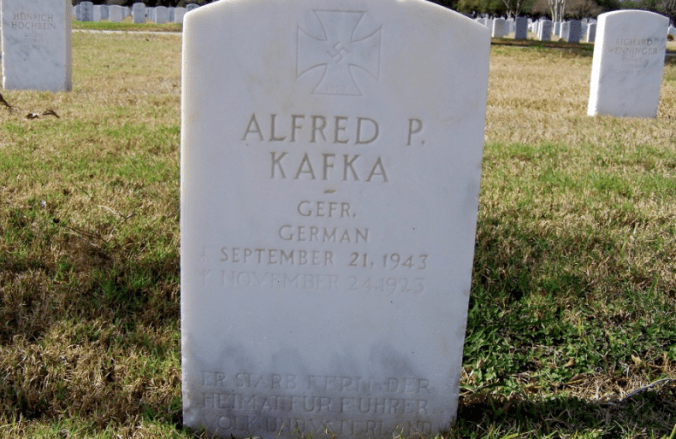
If you encountered that gravestone in a cemetery, would it move you to file a protest? Or to start an advocacy group dedicated to having the marker removed or taken down?
There are two such gravestones marking the resting places of German prisoners of war in Fort Sam Houston National Cemetery in San Antonio, and another one is in Fort Douglas Post Cemetery in Salt Lake City. They are located among the graves of American veterans, some of whom fought against Germany in World War II. A retired colonel visiting his Jewish grandfather’s grave at the Texas cemetery saw one of the markers with the swastika symbol, and his complaint moved the Military Religious Freedom Foundation, which obviously does not have enough on its plate, to demand that the Veterans Administration “do something.”
Apparently in the throes of a strong attack of common sense and possessing functioning ethics alarms, the VA’s National Cemetery Administration has responded to the protest by stating that it “will continue to preserve these headstones, like every past administration has. All of the headstones date back to the 1940s, when the Army approved the inscriptions in question.”
Mike Weinstein, the founder of the MRFF and a former Air Force officer, deeply feels the pain of having to allow buried soldiers have the emblems of the nations they fought for on their headstones, and is apoplectic about the decision. “It’s intolerable,” he said. “This should not require explaining why this is wrong.”
Baseball writer Bill James once wrote that when someone says that that their proposition shouldn’t require explaining, it usually means that they have no valid arguments.
“But..but…” Wienstein sputters, if you translate the German phrase on the the headstones, they read, “HE DIED FAR FROM HOME FOR FUHRER, PEOPLE AND FATHERLAND”! I know I always enjoy translating the foreign languages on headstones over the graves of strangers just in case I can find them offensive. Continue reading
Saturday Ethics Warm-Up, 4/4/2020: Letting The Perfect Be The Enemy Of The Good, And Other Blunders

Why is today unlike any other day?
1. What’s wrong with this picture? This, courtesy of ABC News, was the scene on a New York City subway yesterday:

My question is this: how can everyone be cheering Governor Cuomo’s leadership during the pandemic crisis when this is still going on? I heard Cuomo say, in one of his briefings, “You can’t stop public transportation. You just can’t.” Yet if you are going to allow the above scene all day, every day in your state’s largest city, why bother with the rest of the measures? Just wall off the Big Apple and let everyone get sick.
2. And speaking of New York…and while we’re justly bashing China for all the lies and disinformation, this blogger finds the charts , models and projections showing how the health care system will be overwhelmed by April 15 puzzling, and asks, Continue reading
Great. Now We’re Cancelling Bells…

BAD bell! BAD BELL. Nobody likes you, Bell. You’ve been bad!
Apparently Louisiana’s Tulane University believes in curses, or maybe it is the irredeemability of inanimate objects. What ever you want to call it, its theory is bats.
In a letter emailed to the Tulane community, President Mike Fitts and Board Chairman Doug Hertz said they were informed last week that the “Victory Bell” was originally used to direct the movements of enslaved people on a plantation. This means, apparently, that the bell itself is no longer fit to be seen or heard by decent people.
“It is terribly disheartening to learn that it is, in fact, a vestige of a horrific part of our nation’s past,” Fitts and Hertz wrote. “Now that we understand its history as an instrument of slavery, continuing to use this bell in a celebratory manner would run counter to our values.”
What values are those, exactly? No wonder substantial numbers among recent generations of Americans think that we are obligated to eradicate all images, symbols, memorials and references to the Confederacy, slavery, Jim Crow or other aspects of racial discrimination, if a piece of metal has to be banished because of what it was rung for over a 150 years ago.
The Victory Bell was cast in 1825 and donated to the school by a former Louisiana governor and Tulane law school graduate. Beginning in 1960, the bell stood in front of Fogelman Arena and was rung after Tulane basketball victories for decades. In 2011, the bell was refurbished and moved to the front of the university’s McAlister Auditorium, where, at least as far as anyone can tell, it has not been proselytizing students about the joys of slavery, ringing out “Dixie” all by itself, or attacking unwary students with its clapper. Nonetheless, I’m certain students would tell you that they won’t feel “safe” with a plantation bell around.
It’s a bell. Continue reading


The toppling of a statue of our 18th President and the Civil War general who defeated Robert E. Lee, Ulysses S. Grant, in San Francisco should disabuse the historically literate of any misconception that all of the George Floyd demonstrators are concerned with “systemic racism.” Dishonoring Grant, as well as Francis Scott Key, whose statue also was pulled down, is signature significance for enmity toward the United States itself.
Steve-O-in-NJ performed a service for all of us by taking the time to provide a concise and informative summary of this important American’s life of public service for Ethics Alarms readers. There are several references to Ulysses S. Grant on the blog; the most extensive was this segment of the President’s Day post in 2015:
Here is Steve-O-in-NJ’s Comment of the Day on Item #4 in the post, “Saturday Ethics Freakout, 6/20/2020: Fake News, Resignations, Topplings And Cancellations…But Also Hope”: