“It’s A Wonderful Life” Ethics, Part 2 (of 3)

When we last saw George Bailey, he was defending his father’s dubious loan practices. In this, Part 2 of the three installments of  “It’s A Wonderful Life” Ethics, we take the saga up the fateful Christmas Eve when George Bailey meets his guardian angel.

6. George’s Fork in the Road

George Bailey’s decision to give up his plans to go to college to save the Savings and Loan is clearly not motivated by his personal dedication to the institution; he doesn’t like the place. He says so over and over again. He admires his father’s motivations for starting it. Had Potter not sparked his resentment with his nasty comments about George’s late father, George would have been out the door. But his passionate speech in rebuttal of Potter’s words put him on the spot: after those sentiments, turning down the Board’s appointment of him to be the new operating manager of the S&L would have made George a hypocrite in his own eyes, and rendered his passion  laughable. If George had integrity, then he had to accept the appointment.

It is one of the most interesting ethical moments in the film, because it represents a realistically complex ethical decision. George does what he does for selfish reasons as well as altruistic ones, and irrational reasons as well as considered ones. He wants to respect himself; he fears what might happen to his family and the community if Potter becomes the only financial power in town, and knows he will feel guilty if the consequences are bad. He feels like not staying will be taking Potter’s side over his father’s—completely irrational, since his father had given his blessing to George’s college plans, and wasn’t alive to be harmed by whatever he chose to do anyway. A large proportion of George’s decision seems to be motivated by non-ethical considerations, for he doesn’t like Potter—even hates him, perhaps—and wants to stick it to the old tycoon by foiling his victory. There are few ethical decisions in real life that are made purely on the basis of ethics, and Capra makes George’s decision wonderfully impure. Continue reading


“It’s A Wonderful Life” Ethics, Part I (of 3)

“It’s A Wonderful Life” made its now traditional holiday season appearance on network television, and naturally, I watched it. The movie is one of the great ethics movies of all time, as well as being one of the great American movies of all time, perhaps director Frank Capra’s masterpiece. One of the markers of a classic film is how one can find new things in it upon every viewing, and that is certainly true of “It’s A Wonderful Life.” I was struck this time around by how many ethics issues are raised in the screenplay, some, no doubt, unintentionally.

1. “If It’s About Ethics, God Must Be Involved”

The movie begins in heaven, represented by twinkling stars. There is no way around this, as divine intervention isat the core of the fantasy; heaven and angels were big in Hollywood in the Forties. Nevertheless, the framing of the tale advances the anti-ethical idea, central to many religions, that good behavior on earth will be rewarded in the hereafter, bolstering the theory that without God and eternal rewards, doing good is pointless.

We are introduced to George Bailey, who, we are told, is in trouble and has prayed for help. He’s going to get it, too, or at least the heavenly authorities will make the effort. They are assigning an Angel 2nd Class, Clarence Oddbody, to the job. He is, we learn later, something of a second rate angel as well as a 2nd Class one, so it is interesting that whether or not George is in fact saved will be entrusted to less than heaven’s best. Some lack of commitment, there—then again, George says he’s “not a praying man.” This will teach him—sub-par service! Continue reading

Unethical Website of the Month: “Occupy Black Friday” Facebook Page

The  intellectual, logical and ethical deficiencies of the tiresome “Occupy” movement are on full outrageous display on “Occupy Black Friday,” a Facebook page that is part of the effort to harm large retailers by interfering with holiday shopping. Naturally, as with segments of the “Occupy” groups that have advocated or engaged in violence, used anti-Semitic rhetoric, broken laws and made ridiculous statements, defenders of the movement will dismiss this as an aberration, not representative of the principles of the “Occupiers” as a whole. This is the group’s genius, or something: by being infuriatingly vague, it avoids accountability.

But an organization is accountable for the events it sets in motion, and the harm that its pretensions wreak. The idea promoted by the group’s Facebook page is for mobs of Occupiers to swarm stores during their deep discount sales today, interfering with shoppers and bringing commerce to a halt:

“The idea is simple, hit the corporations that corrupt and control American politics where it hurts, their profits. Black Friday is the one day where the mega-corporations blatantly dictate our actions, they say “shop” and we shop! Pushing their ledgers from red to black. This Black Friday, we will boycott all of the corporations that corrupt our government, and put profits before people.”

The idea is simple minded. Continue reading

Ethics Quiz: “Ethics Dunce: An Unknown Diner”…. Just Desserts?

What would Jesus do if he got a crappy card like this instead of a fair tip?

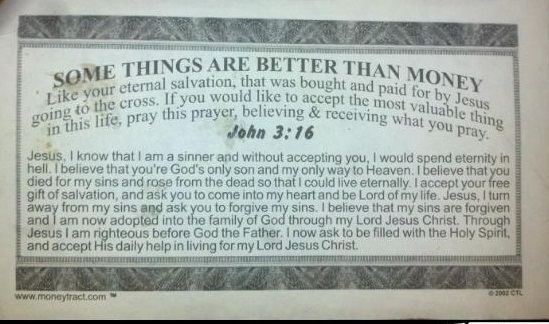
The tale of the diner who left a pre-printed proselytizing card, disguised to look like a $10 bill, in lieu of a tip has attracted a surprising amount of interest on other sites. (The card began, “Some things are better than money…like your eternal salvation,” and went on to extol the benefits of religion.) Some of the comments raise ethical issues of their own. On Reddit, this interesting exchange occurred:

First Commenter: “I had a table of four leave me one of these and sixteen cents on their $40+ bill. The next time that they came in, which was the next Sunday after their church service they were completely ignored by all staff including managers. Forty minutes for their drinks, an hour and a half for their food, and a swift walk-by to throw the bill on their table was their service from then on.”

Second Commenter: What you SHOULD have done is this: Made their order, brought it to them, then, just as they were about to start eating, you should’ve taken the food away and replaced it with a piece of paper that said SOME THINGS ARE BETTER THAN FOOD…

Third Commenter: And did that make you feel good? Why not just refuse them service?

 First Commenter: Couldn’t actually refuse service for corporate bullshit reasons. This was a chain restaurant. Trust me we all wanted to tell them to GTFO and take their proselytizing bullshit with them. And yes it made every employee feel good to treat them like shit. Servers work for less than half of minimum wage, and a religious pamphlet does not help pay the bills.

Your Ethics Quiz to begin Thanksgiving week is a multiple choice: Which of the responses to the card is the ethical one?

Possible Answers:

1. Giving the group lousy and rude service.

2. Leaving the ironic message after taking awy their food.

3. Refusing them service.

4. None of them. Continue reading

“Walking Dead” Ethics

American Movie Classics’ excellent, if harrowing, zombie apocalypse drama “the Walking Dead” finally raised the ethical issue looming like a zombie Woolly Mammoth over all zombie films: Is it ethical to kill zombies? Are they still human beings?

Nobody seriously disputes that killing a zombie who is about to eat you or your compatriots is self-defense, justifying deadly force. But what about the common practice in every George Romero-inspired zombie epic: shooting the shambling things (or the sprinting variety, as featured in the re-make of “Dawn of the Dead”) on sight—in the head, naturally? Is it murder? Euthanasia?

The issue was raised in this Sunday’s episode of “The Walking Dead,” as it was revealed that the prickly doctor who presides over the remote farm where our zombie-fleeing heroes are currently taking refuge keeps a batch of captive “walkers,” including his rotting wife, locked in a barn. He feeds them chickens, which are presumably finger-lickin’ good. The doctor regards zombie killing as an atrocity, the equivalent of killing a sick person. “They are humans,” he says. Continue reading

Bad Jack’s New Gig

Would you trust this man?

My NPR segment was live, and predictably shorter than the star of the day, disgraced lobbyist Jack Abramoff, who was there, also predictably, to talk about ethics. Isn’t it interesting that when businessmen, lawyers, investment gurus and politicians get caught and go to jail, they always manage to have very profitable epiphanies that make them ethics experts just in time to give them a book or speaking tour deal, since their original lines of work are no longer an option?

Do I believe these changes of heart and values are real? Not for a second. Continue reading

Ethics Dunce: An Unknown Diner

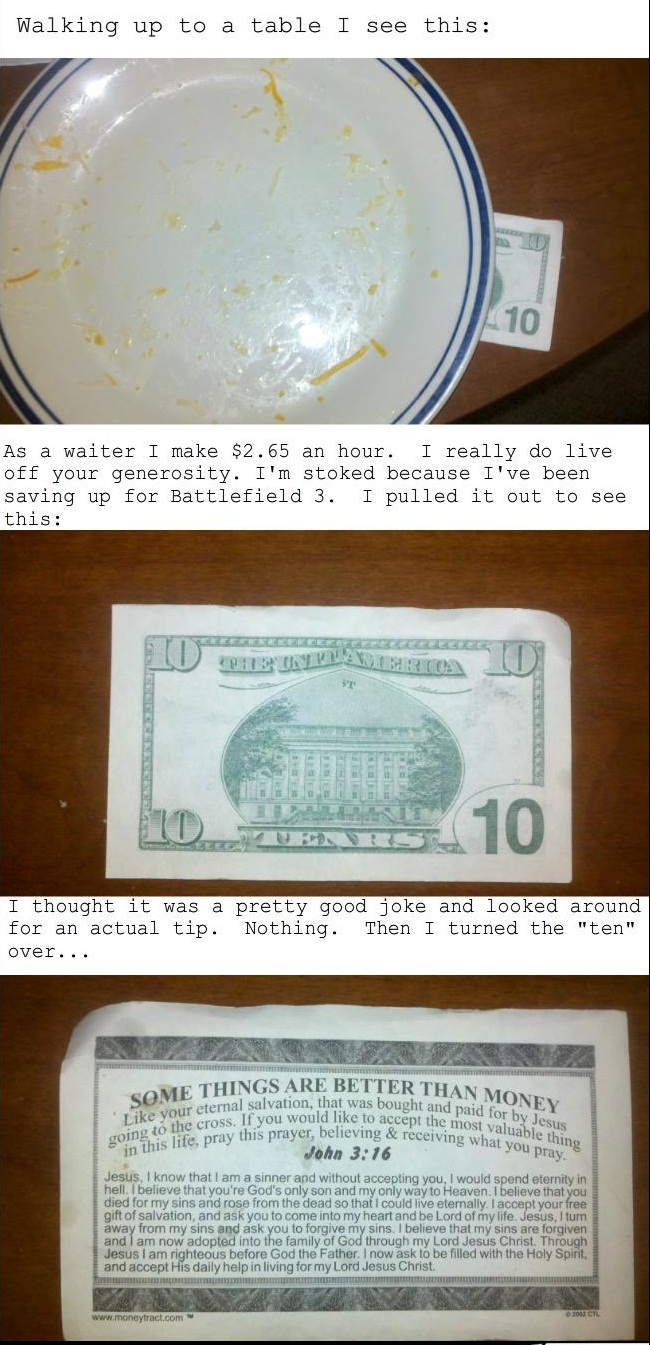
A waiter’s tale from a website called An Orange Box:

The waiter vows vengeance.

Here’s tip to the Faithful: this isn’t the way to convert anybody.

A Commercial Break

The new Hardball Times Baseball Annual 2012 is out today. As usual, publisher Dave Studenmund and his staff have done a terrific job gathering provocative commentary on the baseball season just ended, and have stuffed the book with the fascinating and useful statistics and analysis that makes the Hardball Times website such an enjoyable hang-out for baseball fans.

Dave consented to allowing this year’s Annual to include an essay on some of the important ethics issues that surfaced during the season, and it bears my name as author. I’m proud to be part of such an excellent publication.

If you are a baseball fan, I recommend The Hardball Times Baseball Annual 2012 heartily. You can order it, and many other nifty baseball books,  here.

Now back to our regularly scheduled ethics alarms…

This Story Leaves Me Speechless

All I can do is scream...

From The Daily Mail Online:

“A Catholic Church child safety co-ordinator who was in charge of investigating sexual abuse allegations was jailed for 12 months today for internet peadophile offences.

“Christopher Jarvis, 49, a married father-of-four, investigated historic claims of child abuse, interviewing the victims when they were adults. He was responsible for child protection at 120 churches and parish community groups for nine years. He also, as a member of the Devon and Cornwall Multi-Agency Safeguarding Team, had access to police and social services information about victims of child abuse.

“As a result of the conviction and sentencing, the Roman Catholic Church has ordered a review of child protection across the South West of England.”

I…I..this shows…it’s…when a….oh, to hell with it.

I have no idea how to react to this, besides screaming or jumping out the window.

Anyone?

My 15 Hollywood Cures For A Paterno-Penn State-Sandusky Hangover, Part 2

Part 1 listed the first seven of my 15 cinematic remedies for Penn State-inspired ethics ennui. Part 2 includes the final eight. Please don’t take the order too seriously; I could have shuffled the whole batch. I also tried to include as many genres as possible. When it comes to ethics, good lists can be compiled using all Westerns, all sports movies, all war movies, courtroom drama or science fiction. Here we go…

8Spartacus (196o)

The raw history is inspiring enough: an escaped gladiator led an army of slaves to multiple victories over the Roman legions in one of the greatest underdog triumphs ever recorded. Stanley Kubrick’s sword-and-sandal classic has many inspiring sequences, none more so than the moment when Spartacus’s defeated army chooses death rather than to allow him to identify himself to their Roman captors (“I am Spartacus!”)

Ethical issues highlighted: Liberty, slavery, sacrifice, trust, politics, courage, determination, the duty to resist abusive power, revolution, love, loyalty.

Favorite quote: “When a free man dies, he loses the pleasure of life. A slave loses his pain. Death is the only freedom a slave knows. That’s why he’s not afraid of it. That’s why we’ll win.” [Spartacus (Kirk Douglas)] Continue reading