Sunday Before Christmas Ethics Ornaments, 12/22/19: Googling Ethics, “Cats,” Goldman Sachs, De Niro, Trump Derangement

Here’s hoping that the the next three days rescue the Spirit of Christmas…

…because the last few weeks have been a downer, man.

1. Googling ethics:  Phillip Galanes, at Social Q’s was consulted by a woman who had bad vibes about her girlfriend’s new love, so she googled him, and found out, as she suspected, that he had some serious red flags in his past. She told her friend, who had discovered the bad news herself, but who was hurt and angry that the inquirer did a background check on her boyfriend. “Was I wrong?” she asked. In his answer, Gallanes implies that she was, although “everybody does it.” I’d like a nice, succinct, substantive explanation of by what ethical theory it can ever be wrong to access publicly available information about anyone. This isn’t an issue of privacy, because the information isn’t private. There was nothing wrong with the inquirer’s motives, because she was concerned about her friend.

I’d call this the Ick Factor at work. It seems unethical because the fact that anyone can check our lives out online is creepy. The research itself, however, is ethically neutral. The ethics comes in with how the information is used.

2. I guess I have to mention “Cats”…since it is getting the most spectacular negative and cruel reviews since “Showgirls,” and maybe before that. “Exorcist II, The Heretic” perhaps. Oddly, the usually hyper-critical New York Times is not one of the worst defilers, but here was what the reviewer really found objectionable :

“It’s too bad that no one seems to have thought through the semiotics of Victoria’s chalky white cat face, given that Hayward is of mixed race and that the heavy is Idris Elba’s predatory Macavity. Elba seems to be having a fine time, but come on!”

Ah! The old “mixed-race actress in whiteface being menaced by a black actor playing a cat” racist imagery!

I can’t wait for them to write down these rules. Continue reading

Comment Of The Day: “From ‘The Ethicist’: Revealing The Real Bigots Among Us”

A.M. Golden asks, in his Comment of the Day, “When did Americans start thinking that destroying someone and/or that person’s livelihood is acceptable behavior when it comes to a difference in opinion?” It is an issue also raised in the previous COTD, considering the mall Santa fired after someone complained about his Facebook post showing him as the Jolly Old Elf, but wearing a red MAGA cap. A.M. understands that this is not an idle question, but an important one that raises vital concerns about the erosion of core American values, the public’s belief in our founding documents, and the acceptance of the ethical standard of reciprocity.

Here is A.M.’s Comment of the Day on the post, “From The Ethicist: Revealing The Real Bigots Among Us.”

When did Americans start thinking that destroying someone and/or that person’s livelihood is acceptable behavior when it comes to a difference in opinion?

This goes far beyond boycotts to allow blacks to sit at the front of the bus or at lunch counters. This goes well beyond punishing companies for dangerous or illegal practices that have harmed customers. It goes against the heart of what it means to be an American. Too often, we are told that opinions have consequences. Sure, they do. They always have. Doesn’t it seem, though, that the consequences have become far more ominous than they used to be?

I have never understood ideological boycotts. I remember the Disney boycotts of the ’90s when people with too much time on their hands began seeing obscene Easter Eggs in the new animated films. When gays started congregating at Disney parks on certain days, the company was castigated for not warning people ahead of time that it was Gay Day, despite its protests that Disney had no sponsored days for any groups at its parks.

I thought the whole thing was silly then and it’s still silly.

While in college, I worked at a McDonald’s restaurant. One day, sitting in church, a woman pressed a news article into my hands that reported on health benefits being extended to same-sex partners at McDonald’s corporate offices (I didn’t have health benefits myself at the store where I worked).

I gave her a funny look as if to say, “What am I supposed to do with this?”. She whispered, “Well, you WORK there!” Continue reading

Cancel Culture Ethics: Two Gaffes, Two Polls

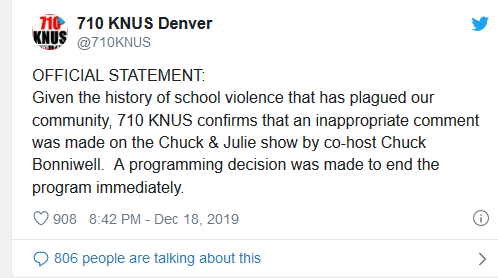
Chuck Bonniwell and Julie Hayden, a husband and wife team, co-hosted the “Chuck and Julie “show  on KNUS AM TalkRadio in Denver. Riffing about the impeachment this week, Bonniwell said,  “All right, here, a little after 1:30, talking about the never-ending impeachment of Donald Trump. Then he added, chuckling, ” You know, you wish for a nice school shooting to interrupt the impeachment news….”  Julie quickly jumped in, saying, “No! No! Don’t even — don’t even say tha!. No, don’t even say that! Don’t call us. Chuck didn’t say that!”Still laughing,  Bonniwell tried a save, finishing his handing sentence with “in which no one would be hurt.”

Jason Salzman of the Colorado Times Recorder, who said that after hearing Hayden’s plea for listeners not to call their complaints about her husband’s joke, he “called anyway.” Sandy Phillips, who lost her daughter in the Aurora theater shooting, posted on Twitter: “This guy should be fired. Total ignorance. Shootings hurt us all … just ask witnesses and first responders. You don’t have to be shot to be wounded.”

Bonniwell isued an apology the next evening after 24 hours of criticism on the “Chuck & Julie” Twitter feed, saying,  “I made an inappropriate comment meant as a joke. I’m sorry it was not received that way.”  Too late. KNUS fired Chuck and Julie later that evening:

Was this a fair decision?

I’m not sure it was. As I have held here on other occasions, those who take extemporaneously for a living, especially when they are expected to be amusing, are constantly walking a high wire. Occasional gaffes, including moments when certain metaphorical landmines are tread-upon or lines are crossed, are inevitable, and the more creative and bold the talent, the more likely such events are. A no-tolerance policy is unreasonable, and it is virtually always the ethical approach to treat the first such error with a warning or punishment short of dismissal. Virtually, because there may always be single gaffes that are so terrible and potentially destructive to the talent’s employer that firing is the only response.

Thus the question here is whether Chuck Bonniwell’s comment falls in the latter category. My view si that it does not: Continue reading

Movie Flop Ethics, Part I: “Richard Jewell” And The Alleged ‘Female Reporter Trading Sex For Scoops’ Smear

The two big flops among movies that opened last weekend were director Clint Eastwood’s “Richard Jewell” and “Black Christmas,” the second attempt to re-boot the 1976 slasher cult film. Both disasters have ethics lessons to teach, or not teach. Let’s look at Clint’s movie first.

“Richard Jewell” made lass that $4.5 million in its first weekend, and has also been snubbed by the various year-end awards. It is based on the now mostly forgotten  story of how Jewell, initially hailed as a hero for his part in foiling the 1996 Atlanta Olympics bombing plot,  was falsely accused  of complicity by local law enforcement, the FBI, and the news media. Conservative outlets loved the film, but the other side of the divide focused on a subplot, as the film’s screenplay  suggested that a named Atlanta Journal Constitution reporter, now deceased,  used sex to persuade a source to break the story.  The Journal Constitution has been attacking the film, denying that Kathy Scruggs would ever used he body to get a scoop. Her colleagues, friends and  family all insist that she would not have slept with a source, and reporters around the country circled the metaphorical wagons to proclaim they were shocked–shocked!—that anyone would even suggest such a thing. Jeffrey Young, senior reporter for HuffPost tweeted,  “The lazy, offensive, shitty way screenwriters so often treat female journalists infuriates me. Depicting women using sex to get stories is disgusting and disrespectful. It’s also hacky as hell. I was planning to see this movie but not anymore.’ Melissa Gomez of the Los Angeles Times wrote,  “Hollywood has, for a long time, portrayed female journalists as sleeping with sources to do their job. It’s so deeply wrong, yet they continue to do it. Disappointing that they would apply this tired and sexist trope about Kathy Scruggs, a real reporter.’ Susan Fowler, an opinion editor at the New York Times tweeted “The whole “female journalist sleeps with a source for a scoop” trope doesn’t even make any sense…”

This would be damning, except that while it may not be standard practice, there are plenty of examples of female journalists doing exactly what Eastwood’s film suggests.  Last year the Times—yes, Susan Fowler’s paper—reported on the three-year affair between  Times reporter Ali Watkins and James Wolfe, senior aide to the Senate Intelligence Committee, and a regular source for her stories. In October,  an employee of the United States Defense Intelligence Agency was arrested for leaking classified material to two reporters, and he was involved in a romantic relationship with one of them. Both reporters are still employed by their respective news organizations, the  Times and CNBC, so its hard to argue that sex-for-scoops is being strongly discouraged.

Continue reading

From The Ethics Alarms Archives: “Integrity Surrender For The U.S. Marines”

Frequent commenter Steve (not to be confused with Steve-O-in-NJ or Steve Withspoon, also veteran combatants here) asked my opinion about an article titled “Marines’ Obsession with Pull-Ups May Be Hurting the Corps, Study Finds.”

To begin with, it’s a  misleading headline. The real subject of the piece, in Military.com, is the alleged hostility being fostered toward female recruits because of their disparate and less demanding physical requirements, including pull-ups. I was sure that I had written about the Marine pull-up controversy before, and sure enough I had, in 2013, (My, how time flies.) Re-reading it now, I felt that the Ethics Alarms post was relevant background to evaluating the article, which includes this…

The idea that female Marines can do fewer pull-ups than their male counterparts and get an equal score “did not sit well” with men, researchers wrote. “Are [women] required to meet equal physical standards? No, it doesn’t take a scientist to study that,” one gunnery sergeant said. “They need to do this many pull-ups, and I need to do this many. Is that equal? No. Four and four is equal. 20 and 20 is equal. That’s equal. So either we’re equal, or we’re not.”

Somehow, the author spins the findings into a rationalization for allowing the unequal standards to continue, writing at the beginning of the article,

Marines are putting an “extreme emphasis” on the number of pull-ups leathernecks can do, a recently published internal study found. And that, some fear, could result in other important qualities that are vital to the Corps’ mission being overlooked. Participants in a study on Marine Corps culture were often focused on pull-ups as a best measure of a person’s value and worth, researchers found. Marines’ ability to lift their own body weight on a pull-up bar was “routinely what Marines referenced when discussing physical standards, a Marine’s value, and physical readiness,” the report’s authors wrote.

I hadn’t checked the name of the author until after I read the article and was struck by how the title and first paragraphs attempted to ignore the ethics issue involved. Guess the writer’s gender. Yup, you’re right.

Here was my article in 2013, (and I wouldn’t change a word); I’ll have some final comments at the end: Continue reading

Sackler, Tufts, Cancel Culture And The 100th Rationalization: The Reverse Ruddigore

I have been waiting to find the ideal 100th Rationalization, officially #70 (there are 30 sub-rationalizations on the EA Rationalizations list. It’s “The Reverse Ruddigore,” the equally valid opposite of Rationalization #21. Ethics Accounting, or “I’ve earned this”/ “I made up for that”:

 You cannot earn the right to act unethically by depositing a lot of ethical deeds in the imaginary ethics bank, nor can unethical conduct be erased by doing good for someone else. The illusion that one can balance the ethics books this way is referred to on the Ethics Alarms blog as “the Ruddigore Fallacy.”  Nobody earns the right to be unethical, not even once, no matter how exemplary their conduct. An unethical act is just as unethical, whether it is performed by a saint, a hero, or a villain.

“Ruddigore,” for those of you sadly unaware of the joys of Gilbert and Sullivan, is the unjustly under-rated work by the Victorian geniuses that involved an ancient curse on a family that required a Baronet of Ruddigore to perform a crime a day or die in agony, courtesy of his re-animated ancestors, who otherwise hang around, literally, as portraits in a haunted gallery. One member of the family who has inherited the curse, Sir Despard, believes that he has found a loophole:

“I get my crime over the first thing in the morning, and then, ha! ha! for the rest of the day I do good – I do good – I do good! Two days since, I stole a child and built an orphan asylum. Yesterday I robbed a bank and endowed a bishopric. To-day I carry off Rose Maybud and atone with a cathedral! This is what it is to be the sport and toy of a Picture Gallery!”

Looking back on past posts, I laid the groundwork for #70 when I condemned the decision of Walt Disney World to remove Bill Cosby’s bust from the its Academy of Television Arts and Sciences Hall of Fame of Fame:

[L]ast I heard Bill Cosby was still recognized as a major trailblazer in stand-up, TV comedy, and television integration (remember “I Spy”?), an important positive cultural force for race relations and black community self esteem, and a spectacularly talented comedian with a unique voice and presence. None of that has changed. Those were the achievements that prompted Cosby’s bust’s inclusion in Disney’s Academy of Television Arts and Sciences Hall of Fame Plaza, along with celebrities such as Lucille Ball and Oprah Winfrey who, like the Cos, have been inducted into the Television Academy Hall of Fame. O.J. Simpson is still honored in the College Football Hall of Fame, because he was one of the greatest college stars ever. His post-career hobby as a murderer, like Bill’s extra-curricular activities as a serial rapist, have nothing to do with the honor, just as Cosby earned and still deserves, his honor for what he achieved on stage and screen.

Subsequent bad acts no more cancel out past good ones than Sir Despard’s cathedral would make up for kidnapping sweet Rose Maybud. The current “Cancel Culture,” however, holds otherwise. In the latest episode, Tufts University announced today that it will strip the Sackler name from the buildings and programs on its medical campus, after a report censured the school for its relationship with the family whose drug company made OxyContin, the opioid blamed for hundreds of thousands of deaths nationwide. Continue reading

Another Cancel Culture Episode In Canada

A retired pro hockey player accused the NHL’s Calgary Flames coach Bill Peters of calling him a “nigger” a decade ago when Peters was coaching him on a minor league team, the Rockford Ice Hogs, an affiliate of the Chicago Blackhawks. Peters apologized in a letter to the Flames management after the allegations, and two days later was  forced to resign.

The Nigeria-born  player, Akim Aliu, wrote on Twitter  that when he was playing for a minor league team a decade ago, Peters, who is white, “dropped the N bomb several times toward me in the dressing room in my rookie year because he didn’t like my choice of music.” Aliu further said that he “rebelled” against the coach as a result of the episode,, and that Peters retaliated by advising executives to demote Aliu to a lower-level league. The National Hockey League reacted with a statement saying that Peters’s alleged behavior was “repugnant and unacceptable.” The Flames immediately opened an investigation into Aliu’s allegations.

In a letter of apology, Peters wrote in part, “I was rightfully challenged about my use of language, and I immediately returned to the dressing room to apologize to the team. I have regretted the incident since it happened, and I now also apologize to anyone negatively affected by my words.”

Aliu, who played briefly with  the Flames, in  2012 and 2013, refused to accept the letter as sincere. There are, by my count, about 28 black or bi-racial players in the NHL, or a bit fewer than one a team on average.

There is so much I don’t understand about this story, it’s hard to know where to begin.

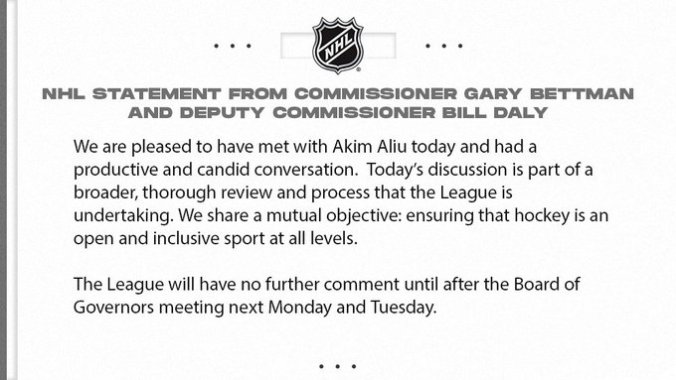
  • Yesterday Aliu met with NHL brass yesterday. Afterward, he told the press, “They couldn’t have been kinder and receptive to the message that we’re trying to bring. I think there’s just some big change coming and it’s long overdue, and I’m excited to see it come to fruition.” Wait, who is “they”? The NHL released a statement too:

  • Akim Aliu is being called a whistleblower.  If so, that was one slow whistle.

How does reporting an incident that took place ten years ago, in a different league, qualify as whistle-blowing in the NHL?

  • Were there other allegation against the Flames coach in his current job? Did he have a long record of bigotry and mistreating players? If this one late hit by Aliu about what happened with the <cough> Ice Hogs is really the whole thing, why did Aliu act now?

His Wikipedia entry describes him as something of a trouble-maker. Was this just vengeance for a his mistreatment for a decade ago?

  • Does it really make sense to fire someone for what he said, with a different employer, that long ago, no matter what it was? Does this mean that Peters can never work again, and will have to wander the world, starving, begging, without friends or shelter? If a statement—not a crime, mind you, but just words, ugly as they may have been— made ten years ago is sufficient to make a man unemployable and a permanent pariah, then why not 20 years ago? Is our enlightened society now concluding that no one can change, or improve, or learn, and a single moment of anger or bad judgment justifying shunning him or her for life?

If I write that this seems cruel and excessive and indeed unethical to me, does that make me racist too?

My usual question as I enter ethical conundrums is “What’s going on here?” In this case, I have no idea, but I doubt that it’s good.

Comment Of The Day: The Betrayal And Ultimate Triumph Of Dorothy Seymour Wills”

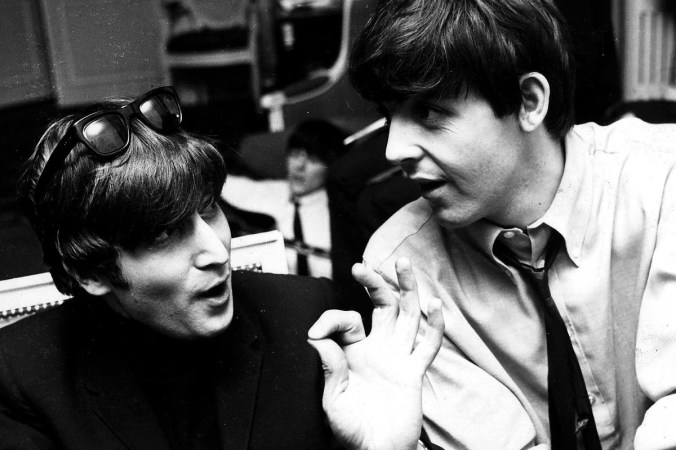
The smartest –and most ethical—thing John and Paul ever did: agreeing to share credit for every song, no matter who wrote it.

On the topic of authors being reluctant or resistant to sharing authorship credits,I wrote in a replay in a comment to the post,

I have shared the authorship credits of several stage shows where I was the initiator and the creator of 75-95% or more. There are two shows, a drama and a musical, that have made substantial money without my sharing in any of it—one because I added co-authors out of respect for their non-authorship contributions, the other for which I got no credit at all despite making the alterations that made the difference between the show being a hit and a flop. My wife thinks I’m a sap and a patsy. No, I think sharing credit liberally is the right thing to do, and that generosity should be the rule, not the exception. And I will continue to do unto others what they should have done unto me, even if the others usually don’t.

Here is a different personal perspective on the issue, in mermaidmary99’s Comment of the Day on the post, “The Betrayal And Ultimate Triumph Of Dorothy Seymour Wills”:

I was a record producer in the early 1980’s. (Still am.)

In ones early 20’s it was unheard of to be a producer unless one was in the group. To be a woman in their early 20’s was shocking to most every man who would arrive to the studio to see me in charge. They often assumed my boss was coming.

The men were always respectful and helpful as I cut my teeth in those early days.

How did I get a job like that?

The label owner, who was a studio musician and had played with The Righteous Brothers and other acts, had heard 3 songs I wrote on an album (my boss chose them and was the producer) and loved them. He asked my boss who wrote them, and he said I had. (And that I assisted on production on those too) so the owner said. “have her write and produced the next record, this stuff is amazing!”

So along with my then boyfriend, I did.

Yes, later I was a mom and asked to produce for another label. (Women producers were still unheard of) and I accepted. I asked my husband to help.

I’ll never forget his reply.

He kindly declined saying. If he did, I’d not get the credit, They’d think, “Oh, she helped her husband and probably nagged for credit.”

I was hurt because I wanted him to share in it. He explained nicely again how it wouldn’t support my Dream. And he LOVED producing too .

I’ve often felt lucky he was so supportive, and reading this I realize how very fortunate I am to have had him by my side.

I’m glad this story is being told. This woman deserves credit and I can see why men would both want her to, and not. Continue reading

The Betrayal And Ultimate Triumph Of Dorothy Seymour Wills

There was an upsetting ethics story in the obituaries last week. It told the tale of the rank injustice perpetrated by a famous and much-honored researcher, historian and author on his collaborator, from whom he withheld  credit and recognition—because she was his wife.

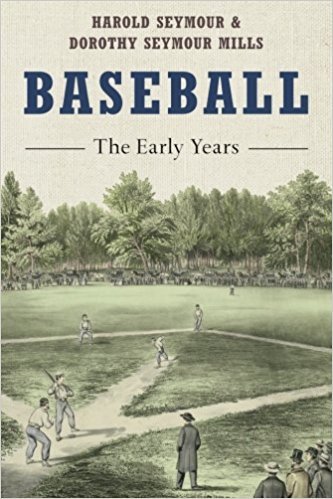
Dorothy Seymour Mills collaborated for more than 30 years on a landmark three-volume history of baseball with her first husband, Harold Seymour. Their work, originally attributed only to him,  is regarded as the first significant scholarly account of baseball’s past.  (“No one may call himself a student of baseball history without having read these indispensable works.” John Thorn in 2010, then Major League Baseball’s official historian.)

“Baseball: The Early Years” (1960), “Baseball: The Golden Age” (1971) and “Baseball: The People’s Game” (1990) all were completed with substantial and indispensable contributions by Dorothy, who, unlike her husband, was not a baseball fan. (“You write a lot more objectively about a subject you’re not in love with,” she once observed.) She was the primary researcher, organized the projects, typed the manuscripts, prepared the indexes (ugh) and edited each book before it went to the publisher. Because of her husband’s failing health, she wrote a substantial portion of “Baseball: The People’s Game.” Yet her husband adamantly refused to give her an author’s credit. Each book bore only Harold Seymour’s name, and hers was relegated to the acknowledgments.  The first book in the trilogy, “Baseball: The Early Years,” received rave reviews.  Sports Illustrated compared Seymour to Edward Gibbon, the iconic historian who wrote “The History of the Decline and Fall of the Roman Empire.” Dorothy was invisible, and her husband wanted it that way. Continue reading

It Is With Great Reluctance That Ethics Alarms Concludes That As Generally Repugnant And Vulgar The Term “Asshole” Is, Mayor Pete Buttigieg Is One.

If this was just disgraceful pandering, grandstanding, and shameless virtue-signaling, he would only  have proven himself to be a jerk—a big jerk, to be sure,  but still just a jerk. But it is far more.

The new fad contender for the Democratic Presidential nomination is returning thousands of dollars in donations because they came from two lawyers who had the audacity to represent Supreme Court nominee Brett Kavanaugh as he attempted to defend himself against the contrived  ambush accusation of a sex crime, made in a Congressional hearing  on national television, a ploy designed to destroy his reputation. Buttigieg’s campaign said that it will not accept funds from people who helped secure the justice’s seat on the Supreme Court. You know. Dirty money.

Buttigieg’s campaign had received $7,200 from Alexandra Walsh, and $2,800 from Beth Wilkinson, Walsh’s law partner. Both represented Kavanaugh during his Senate confirmation ordeal. As I have vowed to point out every time some ignoramus asserts that lawyesr must be punished for the character, conduct or beliefs of the clients they represent and are responsible or culpable in any way for what those clients have said or done (or NOT done), it is a core and essential principle of our legal system that such an assumption is not only wrong but dangerous. It threatens the right of every citizen to receive competent legal representation and access to our laws and other rights.

Here, once again, is my favorite ethics rule, from the ABA Model Rules of Professional Conduct:

(b) A lawyer’s representation of a client, including representation by appointment, does not constitute an endorsement of the client’s political, economic, social or moral views or activities.

Whether the target is Hillary Clinton, Ted Cruz, Elizabeth Warren, Harvey Weinstein’s defense attorneys (also here), Larry Tribe, Gitmo defense lawyers, or Clarence Darrow, Johnny Cochran, Leslie Abramson and other defense lawyers who defend murderers and worse, the false claim that lawyers who take on unpopular, repulsive or guilty clients have done anything less than protected  the Bill of Rights and the rule of law is either rank ignorance or a deliberate effort to reduce the civic literacy of the public.

Buttigieg isn’t a lawyer, but he is very well educated and has a reasonable claim to brilliance.  Thus he knows and understands what lawyers do, but is acting as if he does not, intentionally making the public stupid (or keeping it conveniently as stupid as it already is ) for his own benefit.

Despicable.

But that’s not all. Continue reading