Business Ethics: Searching For An Effective Way To Show Contempt, And Failing Miserably

"You got a complaint?"

“You got a complaint?”

After yesterday’s excursion, I am adding Gold’s Gym to the long list of companies I will no longer patronize come Hell or high water. As my Dad used to say (he died exactly four years ago today, on my birthday, which I suspect may have been just another in a long line of his black humor pranks), “That and twenty cents will get you a ride on the MTA.”

Gold’s Gym screwed me in one of those little ways that doesn’t matter much in any one case, but that multiplied by thousands probably pays for some nice bonuses. I don’t appreciate this, and there should be a some way to make it stop, or at least hurt the company a little.  As with so many other unethical business practices, however, by other companies large and small, there isn’t, which is why those practices persist. And the fact that they are just scrimey, petty, unfair and wrong apparently isn’t that enough to make cause an executive somewhere in the chain of command who was raised right to just say, “Wait—this makes our company look like a used car lot.  Where’s our integrity?”  I suspect it’s because when such an executive does this, his boss says, “Integrity is nice, Bill, but that little trick pays for your raise.” To which Bill answers, “Oh. Never mind.” Continue reading

The Golden Rule Distortions

golden-rule distortedA recent unpleasant visitor here sought to defend unethical conduct—or perhaps it is more accurate to say that she argued that no one was qualified to assess the conduct as unethical—by citing the hoary theory that only someone who has “walked in the shoes” of the wrongdoer in question may judge the ethical nature of his actions. This is a dodge, of course, and one which I need to add to the list of rationalizations. It is an appeal to purely subjective ethics, and ultimately no ethical standards at all, since if every individual is the only one who can judge his own or her own conduct (since each individual’s experiences are unique), then everyone is free to construct their own ethics rules that seem right from their self-centered perspective. The argument is also a convenient way to shut off dissenting voices: only the poor have standing to criticize the poor, only blacks can find fault with the acts of African-Americans, and since men can’t get pregnant, how dare they have any opinion at all on abortion?

But before I added this irritating trick to the Rationalizations List—I think it will be called “The Foreign Shoes Defense”—I realized that it is also another one of The Golden Rule distortions: flawed ethical arguments that seem logical to some because they are based on a warped version of the principle of reciprocity.

The Golden Rule, usually stated as “Do unto others as you would have them do unto you,” is frequently attributed to Jesus, but in fact it is much, much older, and is a basic ethical tenet, reciprocity, of most religions and many philosophies. Here are some examples; there are many, many more: Continue reading

Ethics Dunce: NBA Coach Jason Kidd

"Clean up on Court One!"

“Clean up on Court One!”

Needing a time out with his team trailing in a close NBA game with the L.A. Lakers, Brooklyn Nets coach Jason Kidd used a trick he had apparently learned as a player at the knee of another cheating coach. Kidd “accidentally on purpose” spilled his cup of Coke on the basketball court. Naturally, play had to be halted so the mess could be mopped up, giving Kidd that time-out he needed to set up the next play. (His Nets lost anyway. Good.)

Later, Kidd insisted that his spill was accidental.  “Cup slipped out of my hand I was getting Ty,” Kidd told reporters. “Sweaty palms. I was never good with the ball. In the heat of the battle, you’re trying to get guys in and out of the game, and the cup fell out of my hand.” Then video showed Kidd telling a player, “Hit me!” to force the spill. That sparked a $50,000 fine from the NBA, but no acknowledgment of wrongdoing by the coach. Later he admitted that he “probably” shouldn’t have done it, “it” being “cheating,” but that he was just trying to win the game. “It’s about trying to win and those guys in that locker room, and I tried to put those guys in a position to get a basket, a good look and we did,” he said. Continue reading

Tip Shaming Fraud On The Web: NOW Do You See Why Applebee’s Was Right To Fire Its Vigilante Waitress?

bad-tip-fraud

At the beginning of the year, we had a real donnybrook on Ethics Alarms over my contention that Applebee’s correctly fired a waitress for web- shaming a customer who refused to tip another server on the grounds, as the customer wrote on her credit card receipt, that the automatic tip of 18% was excessive since she (a pastor as well as a jerk) gave God only 10%. The indignant waitress posted the receipt on Reddit, which led to locals recognizing the pastor’s handwriting and appropriate antipathy being directed her way. Since the waitress’s conduct was a clear violation of Applebee’s employment terms and because publicly shaming customers who exercise their right not to leave tips is a poor customer relations strategy, she was sacked. Subsequently the unapologetic waitress received a lot of sympathy, while equally misguided observers vowed to punish Applebee’s for not wanting to be known for having  waitresses on the payroll who are prone to misappropriate customer receipts and post them online to bring opprobrium down on the niggardly diners’ heads.

I think Applebee’s is looking prescient and wise right now. Ask Red Lobster, which did not fire Christina Jenkins, a 19-year-old African-American server at the Red Lobster restaurant in Franklin, Tennessee. Jenkins served a $44.53 order to Devin Barnes and his wife. Barnes wrote the word “none” by “tip, ” and, Jenkins claimed, wrote “Nigger” on the receipt as well.  Jenkins then posted a photo of the racist receipt on her Facebook page, writing, “This is what I got as a tip last night…so happy to live in the proud southern states. God Bless America, land of the free and home of the low class racists of Tennessee.” Going the Applebee’s vigilante one better, Jenkins allowed Barnes’ signature to be visible on the receipt.

The photo, and story, went viral on the web and the news media gobbled it up. Mr. and Mrs. Barnes denied that they would write such a thing (they didn’t tip because the order was a carry out), but nobody believed them. After all, everyone knows that white customers in southern states are likely to write “nigger” on receipts, just as everyone knows that sort-of white neighborhood watch members racially profile black kids in hoodies for carrying bags of Skittles. Jenkins, in contrast, was besieged with sympathy and cash contributions: the latest tally was $10,749. A handwriting expert hired by Barnes, however, proved that “nigger” was not written by the customers, but by the waitress herself. Now Jenkins and Red Lobster are being sued by the Barneses, who have been subjected to harassment and threats.

And that’s not all… Continue reading

Comment of the Day: “Ethics Quiz: The Kidneys of Orlac”

But first, a last act of altruism...

But first, a last act of altruism?

The presumptive winner of the annual Ethics Alarms award for “Commenter of the Year” in 2013, texagg04has delivered a Comment of the Day expanding the topic of the post regarding a condemned prisoner in Ohio who wrangled a postponement of his execution so he could donate his organs to relatives. Here is  texagg04’s  take on “Ethics Quiz: The Kidneys of Orlac.” I’ll have some comments at the end.

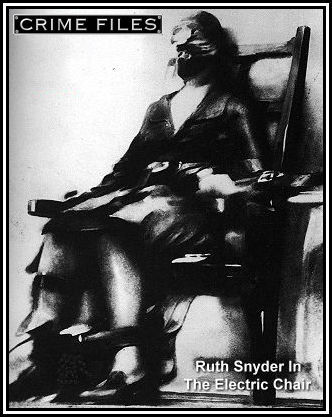
“First, a murderer or other capital criminal being held responsible for his or her conduct seems to be in conflict with the same individual being allowed to display charity when you say they  forfeited their freedom, all of it, with their commission of a  capital crime. I’m not so sure it should be viewed from that angle.

Punishment serves a variety of purposes. Some petty crimes receive punishment designed to compensate, as best as can be, the victim – the victim being dead, capital punishment does not serve this purpose. Some crimes are of an anti-social nature, and the apt punishment seeks to rehabilitate or reconcile the perpetrator to the community. Capital crimes are so heinous that we have determined that the perpetrator must be completely cut off from society, through their death. In this case, the punishment does nothing for the victim OR for the criminal; the punishment is designed solely for the benefit of society.

If the criminal wishes to donate his/her organs to (what we must assume is to salve their own conscience – even though we can, probably, cynically assume is just a delaying tactic), we should not care one bit. They are gaining no material benefit from the community, nor are they engaging in any direct interaction with the community – so the act of cutting them off from the community as part of the punishment is still complete. Continue reading

Ethics Poll: The Amityville Kidney

"Wait---you're going to put THAT  inside me???"

“Wait—you’re going to put THAT inside me???”

In the comments to the post The Kidneys of Orlac, Texagg04 raises a fascinating angle that I had not considered. I have previously written, regarding state regulations that do not require realtors or sellers to disclose that a grisly murder or six occurred on a property, that a purchaser has the right to know about such conditions that may bother him personally, and that regardless of the laws involved, there is an ethical duty inform  a potential purchaser know that he is buying the site of the Amityville Horror (for example). Texagg04 suggests..

“Much like real estate agents ought to reveal that a house had a grisly murder in it, I’d submit that recipients of organ donations of this kind should get to be informed of the donor’s convictions.”

Hmmm. I’m not so sure. One of the reasons for my views about the death houses is that they may be difficult for the uninformed buyer to sell later if the home’s history is known or becomes well known. Also, there are always alternatives to buying a particular house—given a choice between the site of a murder and a similar house with no such history, I might opt for the latter—I’ve seen too many of the “Paranormal Experiences”  and “The Grudge” movies, I guess. But with donated organs, the options are more limited. Maybe not telling the recipient that he has the heart of the Green River Killer is the fair and kind thing to do.

Let’s vote!

Being Fair To Harry Reid: This Began With A Borking

Blame the first domino, not the last one..

Blame the first domino, not the last one..

I generally revile Senate Majority Leader Harry Reid for his hyper-partisan leadership of the Senate, his unethical statements and his manner of conducting himself.  Still, I am bound to take this rare opportunity to defend Sen. Reid, who is taking the brunt of  criticism from both Democrats and Republicans for weakening the filibuster last week. True: he didn’t have to take this course, and I think it will probably, as the talking head shows Sunday seemed to agree, make the toxic and dysfunctional politics in Washington worse, not better. Reid, however, is not the primary one at fault. He was doing his job as he saw it, dealing with circumstances that are now beyond his control.

What led to the so-called “nuclear option” becoming reality was an unplanned convergence of Machiavellian politics, breaches of professional duty, dishonesty, irresponsible legislating, lack of statesmanship, unfairness, disrespect, bad luck, incompetent leadership, and most of all, a cycle of revenge that is now only likely to continue. Most of this was out of Harry Reid’s hands.

History shows that U.S. Presidents were once virtually always given the benefit of the doubt regarding judicial appointments to the federal courts, except in the rare cases of serious ethical questions or dubious qualifications. It was a good system, and the right system, and both parties followed it, realizing that the ideological mix in the courts was fluid and cyclical, and that today’s new conservative judge would eventually be offset by the appointee of the next liberal President, and vice versa. Democrats destroyed that tradition and accord on judicial appointments when in 1987, the Senate Democrats blocked President Reagan’s nomination of Robert Bork, who had been selected by President Reagan to fill a vacancy on the U.S. Supreme Court. Continue reading

Funny! But Unethical: The “Fuck You!” Spite Statue

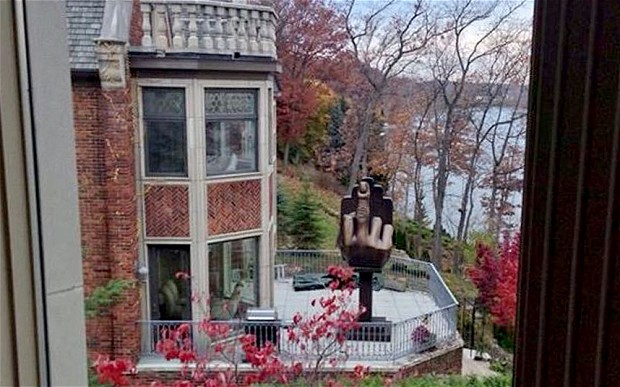
 FU statue

Lea Tuohy is suing her ex-husband, a wealthy Detroit strip club entrepreneur named Alan Markovitz, to force him to remove his idea of “karma.” This would be his 12-foot bronze statue of a hand with its middle finger extended, which he bought specifically so it could be positioned on his backyard balcony  to face the neighboring mansion where Tuohy lives with the man who (according to Markovitz) broke up their marriage.

Markovitz seems to have deftly avoided the specifics of Michigan’s public nuisance law, which  law professor Jonathan Turley discusses here. The artwork is carefully positioned so that nobody else in the neighborhood has to see it, just his hated next door neighbors, when they look out their window. It is quiet art, not obtrusive noise, or even a giant sign that says “Fuck you, Lea, and the guy you moved in with!” But in all honesty, there really is no question that this is the message he intends to convey, and is conveying, in a clever, under-stated, expensive and fanatical way. This, in itself, makes the message–which could also be translated as “I really, really hate you people!”—even more intense. Imagine buying a lakefront mansion and a $7000 bronze middle-digit just to make someone else miserable. Now that’s a grudge.* Continue reading

Is It Ethical To Take, Display and Publish Photos Of Sleeping Sunbathers Without Their Permission?

That’s what Tadao Cern did for his his art project, entitled Comfort Zone, to “explore how different surroundings can affect people’s behavior and inhibitions.”

When someone takes a photo of you in such circumstances, you suddenly find yourself in a gallery in front of  a giant photo of this, while your husband busts a gut:

Sunbather art

Of course it’s not ethical!

If you need some more hints as to why, read the tags below.

________________________

Pointer: Althouse

Source: The Guardian

Ethics Quote Of The Month: Dr. Jonathan Gruber

“We currently have a highly discriminatory system where if you’re sick, if you’ve been sick or [if] you’re going to get sick, you cannot get health insurance. The only way to end that discriminatory system is to bring everyone into the system and pay one fair price. That means that the genetic winners, the lottery winners who’ve been paying an artificially low price because of this discrimination now will have to pay more in return. And that, by my estimate, is about four million people. In return, we’ll have a fixed system where over 30 million people will now for the first time be able to access fairly price and guaranteed health insurance.”

—– Dr. Jonathan Gruber of MIT, an economics professor who is among the designers of the Affordable Care Act, a.k.a Obamacare. He was interviewed by NBC’s Chuck Todd regarding the troubled law’s problems.

lottery

Could it be that the act of getting involved with this administration turns even non-politicians into deceivers and liars? For an economist to talk so deceitfully and manipulatively is distressing. He, of all people, certainly knows how insurance works, and has to work. The insurance company accepts, in essence, wagers from its insured, in the form of premiums, that they will “win” by incurring health care costs that require more funds more than the accumulated “wagers.” The insurance company gambles that it will “win” by the insured remaining relatively healthy, so that the premiums (and whatever investment income they generate) exceed what the company has to pay in medical costs for that individual. The only way a company can keep providing insurance is to win more bets than it loses.

Saying that an insurance company is “discriminating” (in the unjust and biased sense) when it refuses to  accept a wager that is virtually certain to win is like saying that a poker player is engaging in discriminatory conduct by refusing to play with a new player who brings a royal flush to the table with him. It is not discrimination to refuse to lose money, and Gruber knows it. But  like an expert liar, as I must presume he is, he plants a false definition of discrimination at the beginning of his discussion and then treats it as an agreed-upon description of what is occurring. Not selling something to a customer who can’t afford a fair price is not discrimination, and refusing to gamble with someone who is assured of winning is also not discrimination. But discrimination is something that everyone regards as wrong, unfair, and unlawful, so that is how the lawful operation of insurance companies is framed by this clever, learned, dishonest man.

I no longer trust Dr. Gruber, nor should you.

His statement is of additional interest, however, because it starkly defines the unique Progressive definition of “fairness,” by his repeated use of lottery imagery to describe the fact that some people, through no fault of their own, have fewer advantages than others, while those others, often through no virtue of their own, have more resources and opportunities. Progressives regard this as inherently wrong and unfair, and so unfair that it must be remedied by obtrusive government interference. The rest of America regards this as “life.” Continue reading