Halloween Ethics: Fat-Shaming Kids in Fargo

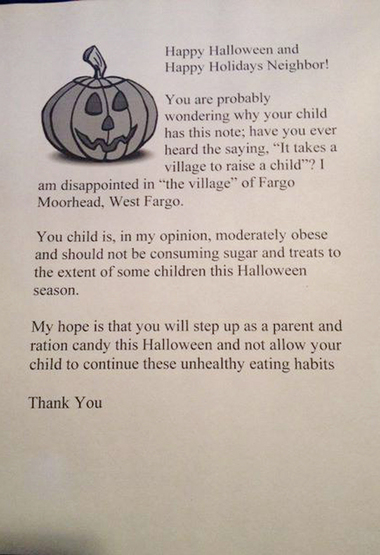
halloween letter

UPDATE: There is some persuasive, if not conclusive evidence that “Cheryl” is a hoax. As usual in such cases, my analysis is the same regarding the conduct whether it actually occurred or is merely hypothetical. All forms of media hoaxes are unethical, unless they are obvious or flagged by the perpetrator before other media picks them up as factual. I detest them, and I detest those who create them.

____________________________________

If she follows through as promised, a Fargo Morehead, West Fargo, N.D. woman we know only as “Cheryl” will be handing out fat-shaming letters to trick-or-treating children who in her unsolicited opinion are too fat. The letter, sealed but certain to be read, if not immediately recognized, given the pre-October 31st publicity, by the unlucky children receiving them tells parents of the costumed kids she considers porkers that they need to do a better job parenting.

Cheryl is a presumptuous, meddling jerk, and if I got handed such a letter by my child, Cheryl would have to worry about a lot more than toilet paper in her trees and flaming bags of poop on her doorstep. Continue reading

World Series Ethics: He Tipped His Cap

What would Ted Williams have done? We know the answer to THAT question...

What would Ted Williams have done? We know the answer to THAT question…

The Boston Red Sox won the World Series last night, making me happy. Something else happened too.

Some background is in order. The great Ted Williams used to give Boston baseball fans the biggest hat tip in baseball as they cheered him after a home run. This was when he was first known as “the Kid’ and indeed was one, as his Hall of Fame trajectory was obvious from the moment he stepped on a major league field in 1939 at the tender age of 19. Gradually but rapidly, a vicious local press and some ugly incidents in response to a few jackasses in the stands caused the Kid to sour on the admission-paying mortals who booed him when he struck out, and he decided to ignore their cheers, refusing to extend the traditional courtesy of a hat tip to the fans as he rounded the bases after a home run—which, since he was Ted Williams, happened frequently. Williams  spent his whole career in the city of Boston playing before those fans who offended him in his twenties, but right up to and after his final home run, which he hit, famously, in his last at bat, the Red Sox fans got no hat tip from Ted. He rounded the bases the final time as they cheered themselves hoarse, and never looked up or acknowledged their praise. Screw ’em.

That was Red Sox pitcher John Lackey’s attitude toward the current generation of Fenway fans, for similar reasons. He had been signed to a rich, long-term contract in 2010 to be a Red Sox mound ace, but arrived in Boston with his arm deteriorating and his abilities diminished. 2010 was a disappointing season for Lackey and 2011 was worse, as he pitched in pain for a team that was short of hurlers. The 2011 Red Sox became infamous for their late-season collapse and underachieving starting pitchers, and no one on that team was jeered on the field or savaged in the call-in sports shows like John Lackey. He missed the entire next Red Sox season recovering from arm surgery after the 2011 collapse, and thus missed the 2012 debacle that was even worse. In 2013, however, Lackey returned with a renewed right arm, a fit body and a fierce determination to finally live up to the big contract. He did, too. He pitched well all season, and became a key factor in the Boston charge to the World Series, as they rose from last place in their division in 2012 to first.

In 2013, Lackey received nothing but cheers from the surprised and grateful Boston fans. Nevertheless, he adamantly maintained the Kid’s attitude—“Screw ’em”—all season long. As he walked into to the Red Sox dugout after being relieved in another fine pitching performance and the Boston fans saluted him, Lackey refused to reciprocate with the traditional hat tip, all season long and through the play-offs. The fans were fickle hypocrites, and their loyalty conditional. They booed him when he was valiantly pitching hurt and embarrassed in 2011, and he wasn’t going to forget it. They were going to get snubbed like they deserved, and that was the way it was going to be.

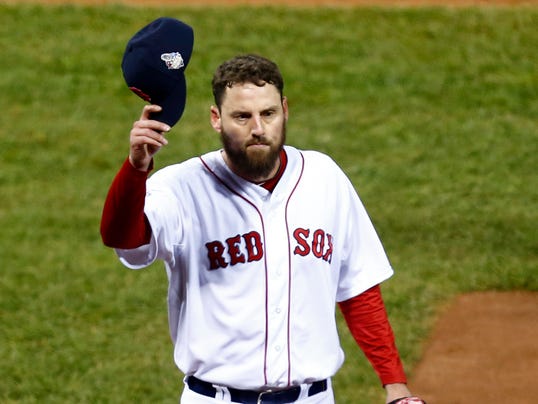
Last night the Boston Red Sox won their third World Series in the last ten years. It was the first time the home team fans had been able to witness the deciding game since 1918 (as the Fox announcers informed the presumably senile audience over and over and over again), and John Lackey was the pitching star for the home town team. The night was a love fest for Boston baseball fans, as they cheered every move of their frequently star-crossed and quirky team, and no Red Sox player was cheered more loudly than John Lackey, as he walked off the field for the final time in 2013 in the 7th inning, with his team safely ahead by five runs. They stood and applauded and chanted his name, as he moved deliberately to the Boston dugout, head down, grim, just like Ted on that gray day in 1960 when he hit homer number 521.

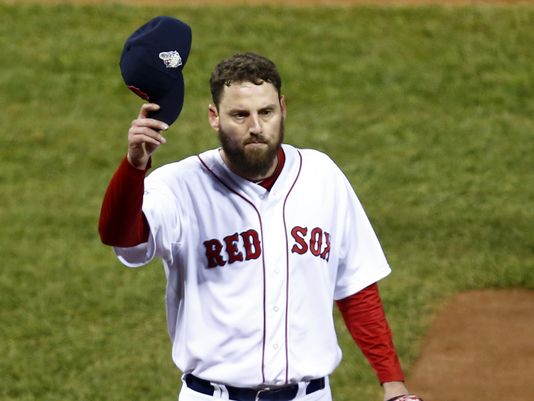
Then he tipped his cap.

It was a small thing, the smallest really, only a gesture and for most players, most of the time, an automatic one…except that it symbolized the ethical virtues of grace, forgiveness, gratitude, humility and fairness. This memorable, wonderful night for the Boston Red Sox and the grand old city it represents—my home town– was no time to let bitterness and resentment prevail. Unlike Ted Williams (who wouldn’t make his peace with Boston fans until years later, when he returned as an opposition manager), John Lackey found the strength and decency to let it go.

It was, as I said, a small thing. But it took character, and it was the right thing to do.

______________________________
Graphic: USA Today
The Thugs, The Talk Show Host, And The Obamacare Operator: An Ethics Drama

Sean and Earline

Sean and Earline

Here is what happened.

Conservative radio talk show host Sean Hannity called the Affordable Care Act 800 “Hotline” to determine what information was being disseminated there. After all, the news media, without calling the line, was misinforming the public about what awaited them: CNN Headline News’s cheery morning host Robin Meade, for example, said, “They don’t have to use the website to enroll, right? Now they can do it over the phone?” Wrong.

He called, and this transpired, as described by Mediaite (you can also hear the call at the link):

“After President Obama gave out the phone number for the official Obamacare registration hotline Monday morning, radio host Sean Hannity called in to speak with a human representative… Eventually, he made his way to a help line with a female operator named “Earline Davis.” Hannity proceeded to ask Earline questions about the difficulties experienced on HealthCare.gov, prompting her to explain that many people have called to vent their frustrations and that all she can tell them is that the site will likely experience difficulties for the next 42 hours. The radio host also asked the woman the particulars of her job: When did she begin working on Obamacare calls, how long she trained for answering calls, and whether her bosses have told her what to say when asked about the “glitchy” website. Hannity even managed to convince the woman to read the “script” aloud on the radio:

“Thanks for your interest in the health insurance marketplace. We are having a lot of visitors trying to use our website right now. This is causing some glitches for some people trying to create an account or log in. Keep trying and thanks for your patience. You might have better success during off-peak hours like later at night or early in the morning. We’ll continue working to improve the site so you can get covered.”

“And that’s the whole thing? So you went through a whole week of training so you can do that?” Hannity asked before attempting to cut her off, perhaps sensing the sensitivities involved with such a question. He then asked her questions for which she clearly had no answers: “Did you know how much the government spent on that website?” “Isn’t that crazy?” “Did you know the president promised the average family was going to save $2,500 dollars, and the average increase is $7,500 a year?” Hannity complimented for the operator for being so polite and kind, but also asked her questions that could possibly put her job on the line: “Have you ever gotten anyone who really likes it yet?” he asked at another point. “Um, not really,” she admitted, sending the radio host into a fit of laughter.

The conversation later switched to small talk about her residence in Panama City, Fla. , the weather in Florida versus New York, her non-registered voting status, and her lack of knowledge about Fox News or any major right-wing talk radio hosts.”

She was fired.

Hannity then had Davis on his radio and Fox TV shows, where she said she was fired for talking to the news media, though she had never been told that she was prohibited from doings so.  Hannity announced that he would pay her salary for the year and also help her find another job.

Now some ethics questions and answers about the incident: Continue reading

Case Study: The Botched DP, Baseball, Ethics Evolution, and “Getting It Right”

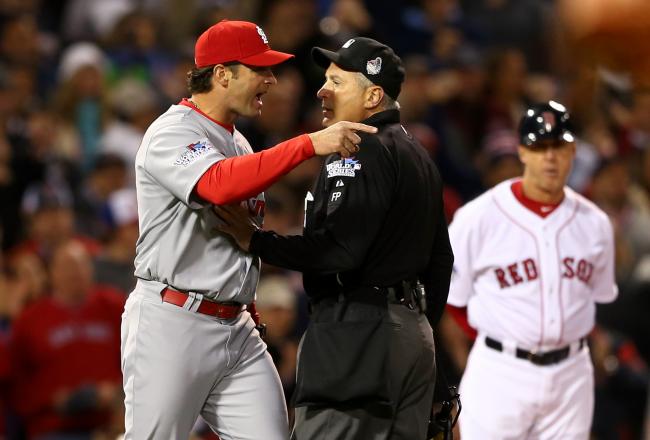
manager-mike-matheny-argues

I know this is a long essay.

Yes, it involves baseball.

Bear with me. I think it is worth your time.

Last night, in Game 1 of the 2013 World Series, embarrassingly kicked away by the St. Louis Cardinals and won handily by some team called the Boston Red Sox,  an intricate ethics drama appeared, allowing us to see the painful process whereby a culture’s ethical standards evolve and change in response to accumulated wisdom, altered attitudes and changing conditions. An obviously mistaken umpire’s call was reversed by the other umpires on the field as the Cardinals manager argued not that the original call had been correct, but that reversing it was a violation of tradition, established practice and precedent….in other words, doing so was wrong, unfair, unethical because “We’ve never  done it this way,” a variation of the Golden Rationalization, “Everybody does it.”   You should not have to appreciate baseball (but if you don’t, what’s the matter with you?) to find the process illuminating and thought-provoking. Continue reading

If Your Institution Is Named After George Washington, Shouldn’t We Be Able To Trust It To Tell The Truth?

The General is not pleased.

The General is not pleased.

Shame on George Washington University (in Washington, D.C.), not only for lying to its students and community, but also for dishonoring the name of the scrupulously ethical American icon which they presumed to expropriate as their own. Such things carry with it some crucial obligations.

For years, the GW admissions and financial aid offices have claimed in printed materials and on the University website that admissions were independent of need. The admissions process does not consider financial need during the first round of screening applications. Before applicants are notified, however the University examines its financial aid budget and decides which students it can actually afford to admit. Wealthier students are accepted, taking the spots of students who would need more financial aid from the University.

Last week, a GW administrator confessed to a student newspaper—one ironically called “The Hatchet” after the apocryphal axe little George used to cop down that cherry tree in Parson Weems’ fable—– that financial resources indeed were considered in the admissions process, and have always been considered despite University statements to the contrary.  As  recently as last weekend, admissions representatives told prospective students that their applications would be judged without consideration of their financial aid profiles. Until it was removed Saturday evening, the newspaper reports, the undergraduate admissions website read, “Requests for financial aid do not affect admissions decisions.”

That site now confirms a “need-aware” policy that has always been in place. George Washington University just had another policy of lying about it. Continue reading

“BULLY!” Is The New “WITCH!”

"Bully!"

“Bully!”

The Texas father of a high school football player would have been right at home in Salem, in the British New World colony of Massachusetts, around 1692. Then, thanks to hysteria about witchcraft, a vengeful citizen could permanently set the populace against a neighbor who had offended him, say, by winning a lawsuit, stealing a recipe or looking lustfully at his or her significant other, by accusing that neighbor of being a witch. This would inevitably spark an investigation, suspicion, infamy, maybe even a trial…and if the accusation stuck, a sadistic execution, perhaps by piling rocks on the neighbor’s witchy chest until everyone heard the sounds of squishing and cracking.

The cry of “Witch!” doesn’t work so well any more, but accusing someone of being a bully works almost as well. It can cause schools to impose punishment for words and activities that have nothing to do with school, and give law enforcement officials the power to pile rocks on the First Amendment. Now a vengeful father who watched his son’s hapless football team get the just desserts of all hapless teams—losing badly—has successfully punished the victors for being stronger, faster, and better coached, by accusing the superior team—it beat his son’s squad by a score of 91-0—of “bullying.” This mandates an investigation, so the winning team’s coach is now under a cloud, and in peril of seeing his career and reputation squished and cracked.

Mission accomplished! Continue reading

Ethics Quiz: The SpongeBob Headstones

SpongeBob Gravestone Removed

You can’t make stuff like this up.

Apparently I was last one in the nation to learn about the surreal dispute between the parents of the late Kimberly Walker, a 28-year-old Iraq War vet who was  found murdered in a Colorado hotel room eight months ago, and the owners of Cincinnati’s historic  Spring Grove Cemetery, concerning the headstones erected over her grave on October 10.

The cemetery reversed its official approval of the twin monuments, apparently bestowed by someone who had momentarily been possessed by the spirit of Chuck Jones, saying that it would be inappropriate for a traditional and historic 19th Century pastoral cemetery that serves as the final resting place of Supreme Court Chief Justice Salmon P. Chase, several Civil War generals including “Fighting Joe” Hooker, who lost the Battle of Chancellorsville, the Hall of Fame manager of the 1927 Yankees, Miller Huggins, and many others, to sport not one but two hideous 6-foot-high, 4-foot-wide, 7,000 pound slabs of granite lovingly carved to depict SpongeBob Squarepants in military gear, one of which displays Kimberly’s name on his uniform. (For those of you who are hopelessly estranged from popular culture, SpongeBob is a fictional deep sea yellow sponge who stars in a popular Nickelodeon cable TV children’s cartoon show. Kimberly, we are told, loved the show. SpongeBob is an idiot, by the way.)

The family is outraged, and feels abused. “I feel like, and we all feel like, SpongeBob should stay there. We bought the plots, all six of them. We put the monuments there, we did what we had to do and they said they could provide that service to us,’ said Walker’s twin sister Kara, who was looking forward to eventually being buried under the second headstone. “I thought it was the greatest thing in the cemetery. I even told the people there that I think this is the best monument I’ve ever seen. It’s the best headstone in the cemetery and they all agreed. It came out really nice.”

Yyyyyyyeah.

Still, putting considerations of taste aside—-and what American these days doesn’t do that daily?—the Walkers duly purchased the plots (they have four more…and just think of what might end up on them) and properly cleared the monuments.

Your Ethics Alarms Ethics Quiz for this lovely Fall day is this:

Does fairness dictate that the Walkers be allowed to erect whatever monuments they choose, including giant, garish sculptures of a cartoon character, to honor the memory of their daughter? Continue reading

Ethics Dunce: Fat-Bashing Film Critic Rex Reed

melissa_Elle

Actress Melissa McCarthy stole the film “Bridesmaids” right out from under its better known stars, including the screenplay’s author, Kirsten Wigg. In that film, her hit CBS sitcom “Mike and Molly,” and subsequent films (of varying quality), McCarthy has shown that she is s versatile, appealing comedienne with deep dramatic resources. Film critic Rex Reed, however, is mostly concerned with her weight, which is usually a component of the characters she plays and the quality, other than her talent, that sets her apart from the standard issue, impossibly thin, fit and sexy Hollywood actress.

In his withering review of her latest comedy “Identity Thief,” Reed causally refers to McCarthy as a “female hippo” and reduces her career to this: “Melissa McCarthy (Bridesmaids) is a gimmick comedian who has devoted her short career to being obese and obnoxious with equal success.” Called on his fat-bashing, Reed responded, “I have lost entirely too many friends to obesity-related diseases to pretend Ms. McCarthy’s alarming obesity is anything to applaud.”

There are two aspects of this that are striking. One is that Rex Reed, who played the pre-op Myra Breckenridge in the awful movie version of Gore Vidal’s gender-bending, and considered scandalous at the time, satiric novel (Raquel Welch, now over 70, was post-op), is still alive and reviewing, albeit obscurely until, as now, he writes something outrageous. At one time—40 years ago? Longer?— Reed was considered the most quotable and one of the most influential film critics; now, to say he is passé would be a compliment.

The other striking aspect of this incident is this:  while the culture will turn with unforgiving venom on any public figure who derides individuals for their color, sexual orientation, malady or disability, any of which would be considered cruel, bigoted, and hateful, deriding individuals because their weight doesn’t meet with aesthetic norms—among which are now out-sized breasts on otherwise fat-free frames and sharply chiseled abdominal muscles, a look that was literally freakish until the dawn of Nautilus and personal trainers—-still is largely regarded as justified and acceptable. Continue reading

The Naked Teacher Principle Strikes In Texas: The Playboy Variation

"Miss DEWEESE?? Ay Caramba!!!"

“Miss DEWEESE?? Ay Caramba!!!”

This version of the NTP is not especially close to the gray area of ethics, nor is the result surprising, though I expect a lot of teeth gnashing about it because the naked teacher in question will attract a lot of, uh, sympathy.

Dallas’s school district has apparently fired Cristy Nicole Deweese, 21, a Spanish teacher for the city’s Townview Magnet High School. Less than three years ago she posed in various provocative positions and states of undress for Playboy, in its February 2011 issue. That magazine is still available, but more to the point, the photos are easily available online. Naturally some students found them, and the core tenets of the Naked Teacher Principle had been triggered.

The Naked Teacher Principle states:

“A secondary school teacher or administrator (or other role model for children) who allows pictures of himself or herself to be widely publicized, as on the web, showing the teacher naked or engaging in sexually provocative poses, cannot complain when he or she is dismissed by the school as a result.”

I won’t keep you in unnecessary suspense. Deweese is almost dead center in the middle of the NTP. Continue reading

Scott Carpenter And Being Unfair To #2

scott-carpenter

Scott Carpenter died last week, at the age of 88. Did you notice? Did you even remember who Scott Carpenter was?

I remember who he was and what he did, but I didn’t know that he had died. The world stops when the actor who played Tony Soprano dies, but an aged American hero and explorer? The news media says “Meh.” If Carpenter was still famous or a celebrity at all, it was only in the vague, foggy sense that obscure rock artists from the 60’s and expired pop icons are famous. I think Tony Dow, Barbara Feldon and Mama Cass are about as familiar to today’s public as Scott Carpenter, if not more. I just asked my son, who is 18 and better schooled in history and culture than most of his contemporaries. He knew Mama Cass was a member of the Mamas and the Pappas. The rest? Crickets.

Yet Scott Carpenter was, unlike those people, important. He was  one of the original Mercury astronauts, and in 1961, he orbited the Earth. After he left NASA he became a different kind of explorer, challenging “inner space,” the ocean’s mysterious depths. He launched an undersea habitation called Sealab II, where he and three other men conducted experiments on how well humans  function in a high-pressure undersea conditions for extended periods. Carpenter was a deep-water pioneer, mining on the sea bottom and harvesting exotic fish and other sea creatures. He salvaged and refloated a sunken jet fighter; he built an undersea petroleum-exploration platform.

Scott Carpenter, however, wasn’t famous by the time he died, because one of his fellow astronauts and good friends, John Glenn, orbited the Earth before him. Glenn went on to become a U.S. Senator based on his fame and heroic reputation (it helped that he was a combat pilot and decorated military hero as well). Carpenter did something important, dangerous, selfless, difficult and heroic, but he did it second, after John Glenn. We don’t remember second, and the distance between the accolades and honors heaped on #1 and the shrugs that follow #2 is disproportionate and unfair. Continue reading