Comment Of The Day: “You Know, Harvard, When You Have To be Embarrassed And Shamed Into Doing What Should Have Been Your Automatic Response Anyway If You Had Any Decency, It’s Too Late To Save Face.”

Veteran commenter Tim Levier comes to the defense (sort of) of both Harvard and nuance.

Here is his Comment of the Day on the post, “You Know, Harvard, When You Have To be Embarrassed And Shamed Into Doing What Should Have Been Your Automatic Response Anyway If You Had Any Decency, It’s Too Late To Save Face.”

Can I play Devil’s Advocate here? (Maybe just devil’s half-advocate.) I mean, I think it’s delicious that Harvard is getting a first hand experience in “political correctness”, “public shaming”, and “fake news” all in one fell swoop; but this is an Ethics site and saying the truth should always be ethical.

Harvard’s endowment is $38.3 billion, but what does that mean? Endowments are donations intended not for the donation to be “used” but for the donation to be “invested”. The investment grows and pays income distributions to the target recipient. Sure, Harvard has an endowment of $38.3 billion, but that generates an annual distribution of roughly $1.9 billion. That’s a distribution during “good times”. Any bets out there that the distribution might crater this year?

Let’s assume it doesn’t. The $1.9 billion distribution is roughly 1/3rd of Harvard’s annual operating budget. That’s money that they were counting on, budgeted, and spent. Continue reading

You Know, Harvard, When You Have To be Embarrassed And Shamed Into Doing What Should Have Been Your Automatic Response Anyway If You Had Any Decency, It’s Too Late To Save Face.

The cat, as they say, is out of the bag. Harvard is arrogant, ethically inert, and avaricious. But we knew that.

Yesterday I noted that Harvard had accepted nearly $9 million from the pandemic relief package. “With a 40 billion dollar dollar endowment, Harvard is better off financially than the U.S. government,” I wrote. “There is no excuse for the school accepting the money. It is getting widely criticized for taking it, and ought to be.”

Harvard’s disingenuous rationalization was unconvincing:

“By federal formula laid out in the CARES Act, Harvard was allocated $8.6 million, with 50% of those funds to be reserved for grants to students. Harvard is actually allocating 100% of the funds to financial assistance for students to meet their urgent needs in the face of this pandemic. Harvard will allocate the funds based on student financial need. This financial assistance will be on top of the significant support the University has already provided to students — including assistance with travel, providing direct aid for living expenses to those with need, and supporting students’ transition to online education.”

My conclusion: “The only issue is that Harvard has plenty of money to do all of this without any hand-outs from the government, and many other institutions need the money more, which is an easy calculation because no institution needs money less than Harvard does.”

Others, including President Trump, chided The Greatest University In The World for its indefensible greed. The school pushed back earlier today with a word-parsing justification that made no sense. It has 40 billion dollars sitting in investments. That’s the end of the debate.

The double talk didn’t work, and by this afternoon, with the backlash growing and the episode becoming a public relations nightmare, the Crimson had capitulated. Trump and the other critics were right. Harvard was wrong. The University announced that it would not apply for or accept  emergency relief, joining Stanford and Princeton. Continue reading

Morning Ethics Warm-Up, 4/21/2020: Groundhog Day

Hi.

I was talking with a colleague about the most relevant movie to watch these days. As readers here know, the outbreak of elected officials letting power go to their heads led me to designate Woody Allen’s “Bananas” for that honor.  (And yesterday I posited the relevance of “Airplane!” )Still, it’s hard to argue against my friend’s position that the right choice is “Groundhog Day.”

In the interest of sanity, I reject “Contagion” and especially “World War Z” or “Quaranteen.” (All good movies though.)

1. Right now it’s turned face to the wall, but today I’m putting a sheet over it…My college diploma becomes more embarrassing by the day. Harvard University has accepted nearly $9 million from the pandemic relief package. With a 40 billion dollar dollar endowment, Harvard is better off financially than the U.S. government.

[Notice of Correction: I wrote “million” instead of billion in the original post. Really stupid typo. I apologize.]

There is no excuse for the school accepting the money. It is getting widely criticized for taking it, and ought to be.

A spokesman for the U.S. Department of Education said ithat Education Secretary Betsy DeVos “shares the concern that sending millions to schools with significant endowments is a poor use of taxpayer money. In her letter to college and university presidents, Secretary DeVos asked them to determine if their institutions actually need the money and, if not, to send unneeded CARES Act funds to schools in need in their state or region.”

In an episode of Spokesman vs Spokesman, a mouthpiece for the Ivy said, disingenuously,

“By federal formula laid out in the CARES Act, Harvard was allocated $8.6 million, with 50% of those funds to be reserved for grants to students. Harvard is actually allocating 100% of the funds to financial assistance for students to meet their urgent needs in the face of this pandemic. Harvard will allocate the funds based on student financial need. This financial assistance will be on top of the significant support the University has already provided to students — including assistance with travel, providing direct aid for living expenses to those with need, and supporting students’ transition to online education.”

This is an exercise in deflection and rationalization. The only issue is that Harvard has plenty of money to do all of this without any hand-outs from the government, and many other institutions need the money more, which is an easy calculation because no institution needs money less than Harvard does. Continue reading

Afternoon Ethics Alarms, 4/19/2020: Facebook, Harvard, Broadway And You Know, Morons…

Good afternoon!

1. It’s come to this…Commenter Matthew B sent me the link to an article on Facebook, and when I clicked on, it this came up…

Yes, Facebook warned me that Ethics Alarms was a “malicious site.” I especially like the part where Facebook says to contact them if I think they were in error, but also say that they won’t do anything if it is.

2. Meanwhile, regarding my  alma mater whose diploma I already have turned to the wall, here is an illustration in the latest Harvard alumni magazine for an article about how bad home schooling is:

Yes, “Arithmetic” is spelled wrong.

I bet Harvard Magazine tries to claim that this was intentional by the artist, to highlight the inadequacy of a home schooling education. That will be, of course, a lie, but there won’t be any way to prove it. You know, when you are America’s oldest and most prestigious university, you really can’t afford to be that careless, especially to your alums, and particularly when your administration has embarrassed itself repeatedly on the last decade. Continue reading

Morning Ethics Warm-Up, 3/25/2020: Lies, Liars, Fake Headlines And False Narratives.

Good morning!

What’s it like outside?

1. The Sisyphus Report. Ethics Alarms is currently at its all time high water mark for followers, a number it has reached three times previously, only to fall back, sometime precipitously.

When you are trapped in your home, you tend to obsess about such things.

2. You know why, but still…the mainstream media isn’t fact-checking or pointing out the blatant, insulting lie from Nancy Pelosi yesterday regarding the House Democrats’ alternative “stimulus” bill that “Everything we’re suggesting just relates to COVID-19. It’s not changing policy except as it applies here.” That bill included [Pointer: The Blaze]:

  • A bailout for the U.S. Postal Service
  • Student loan debt forgiveness
  • Required same-day voter registration
  • Airline emissions standards regulations
  • Study on climate change migration
  • Collective bargaining provisions
  • Increased federal minimum wage for companies that accept government loans
  • Publication of race and pay statistics for corporate boards

I’m not even mentioning things like the millions designated for the Kennedy Center, because that was technically related to addressing harm caused by the pandemic.

As I and many others noted, the Democrats’ grandstanding effort to stuff the rescue bill with progressive agenda items related to climate change, the Green New Deal and other social justice wish list items was political posturing for the base, which was forgivable as long as they didn’t try to hold the nation hostage, which they didn’t, at least for very long. But Pelosi’s denial that her party did what it did in plain sight (for anyone who bothered to read the bill about it) is the stuff of Jumbos, and the news media was obligated to let the public know.

They haven’t, and presumably won’t. Instead, journalists will continue to factcheck and scream about every lazy, non-substantive misstatement of facts by the President, and back the Democratic cant that President Trump always lies.

A party whose leadership issues pure disinformation like Pelosi’s should be estopped from using the “Trump lies”refrain.  Continue reading

Sunday Ethics Warm-Up, 1/19/2020: In Which The Conundrum Is Posed, “Can A Warmed-Up Warm-Up Still Be Called A Warm-Up?

Hmmmm…

Well, that was strange. Yesterday’s warm-up turned into the long post about Judge Staton’s disturbing dissent, and by the time I had finished it and the previous “fake news” compendium, my window for getting the Saturday Warm-Up up had slammed shut. Today’s Warm-Up is largely made up of the items that were wiped off the board by the Obama-appointed judge’s “whenever the courts really, really think national policy should be different from what it is, they have the power to change it by edict” opinion.

1. Sausage biscuit ethics. I’m fond of sausage biscuits for breakfast, but the 7-11 variety have a garbage-y taste, and the sole local McDonald’s that I’m not boycotting for ethics transgressions is mobbed in the morning. Of the frozen variety, I will not patronize a company, Jimmy Dean, which uses its dead founder as a TV spokesperson without pointing out that he’s dead. Over the holidays, I tried a lesser and much cheaper brand of frozen sausage biscuit, Tennessee Pride, and they were good enough.

Yesterday I bought another box. When I pulled out a bag of two “sausage biscuits,” I saw that the sausage was sitting between two small buns, unlike the contents of the previous box. Buns are not biscuits, but the label on the box read in large type, “Sausage Biscuits.” I did notice, however, that the photo on the box showed buns.

Would that fact be a complete defense against an accusation of false labeling? I doubt it, but it doesn’t matter. “Fool me once” is once too many.

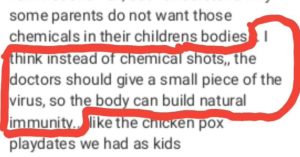
2. Res Ipsa Loquitur: “an informed public.” Twitter user @Golfergirl2018  shared a post she saw on Facebook, written by someone who sympathizes with antivaxx parents (you know…morons) who don’t want to put “chemicals” in their kids. “I think instead of chemical shots the doctors should give a small piece of the virus, so the body can build immunity,” he wrote.

BRILLIANT! Why didn’t someone think of that long ago?

Yes, it is unethical and irresponsible to publish opinions on topics you haven’t researched, don’t understand, and know nothing about. I wonder how many social media posts would survive if this were recognized as a rule of commentary? Continue reading

Not Protesters, Just A Mob

Giving a mob the dignity and legitimacy of referring to them as “protesters” just encourages them. A prime example occurred two days ago in New Haven, at the traditional Harvard-Yale game, the culmination of the Ivy League college football season. Personally, I wouldn’t have crossed the street to attend the 136th edition of “The Game,” though I witnessed the most famous of the them all, 1968’s 29-29 tie. Nonetheless, what a bunch of climate-addled demonstrators inflicted on a large group of students and alumni just trying to have a good time enjoying football, traditions, nostalgia and camaraderie  should not be romanticized. The “protesters” are arrogant, disrespectful and anti-democratic jerks. Boola-Boola.

A large mob of Yale Bowl spectators rushed the field at halftime, demanding that Harvard and Yale divest themselves of investments in fossil fuel and energy companies, delaying the start of the second half by nearly an hour, and causing the game to finish in near-darkness. Students from both schools, who didn’t care who they hurt or inconvenienced, rushed to midfield as soon the Yale band finished performing. ( At least they could have done it while the Yale band was performing…)The contest resumed after the Yale police issued 42 summonses for disorderly conduct. But the wasted hour threatened game’s finish:  the Yale Bowl lacks stadium lights, and the game went to double overtime. Yale won just before it became too dark to play.

The Ivy League referred to the protest as “regrettable.” and Yale said that while it “stands firmly for the right to free expression,” it added that “the exercise of free expression on campus is subject to general conditions, and we do not allow disruption of university events.”

So will Yale suspend or expel any of the mob? Of course not.

Protesters that set out to get attention by disrupting the lives of law-abiding citizens engaged in innocent activities are low-level terrorists. They aim to bypass democracy by creating implicit threats, hoping that their adversaries will surrender to just shut them up and avoid the annoyance. Continue reading

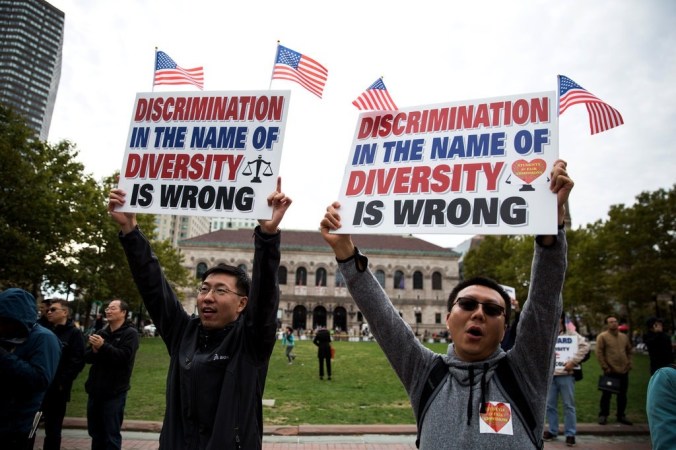
The Ruling In The Harvard Asian Discrimination Case: So What WAS “The Point”?

In response to U.S. District Judge Allison D. Burroughs’ ruling this week that Harvard University does not discriminate against Asian Americans in undergraduate admissions, two commentators issued reactions with almost themes: the ruling missed the point. In the New York Times, law professor Melissa Murray wrote that the opinion missed the point by being…

…focused on diversity as the sole grounds on which the use of race in admissions may be justified. As Judge Burroughs noted in her ruling, diversity-centered admissions policies can “enhance the education of students of all races and backgrounds, to prepare them to assume leadership roles in the increasingly pluralistic society into which they will graduate,” “broaden the perspectives of teachers” and “expand the reach of the curriculum and the range of scholarly interests.” Her words echo the standard refrains that have been deployed to defend affirmative action since Justice Lewis Powell’s opinion in University of California v. Bakke (1978). Justice Powell famously extolled the virtues of the “Harvard Plan,” which recognized that a “farm boy from Idaho can bring something to Harvard College that a Bostonian cannot offer.” The problem, of course, is that thinking about diversity in terms of what beneficiaries might contribute makes the benefits of affirmative action contingent and conditional — worthy only because its beneficiaries serve the broader needs of institutions and those who are assumed to belong.

To the contrary, Murray believes that Harvard’s race preferences out to be justified as permanent reparations, though she never uses those exact words.  (Hmmmm.…I wonder if she’s black? Let’s see…why yes, she is!):

Those who fought for affirmative action expected institutions to maintain policies that ensured continued representation of those who had long been excluded. But at least in the courts, these convictions have been largely jettisoned.

That’s because they are unethical, illegal and unconstitutional.

The momentary victory for Harvard, which was correctly accused of discriminating against Asian-Americans in admissions in order to further affirmative action goals, was the result of an ideological rather than a legal analysis. I give the judge credit for being open about his bias: how else could one interpret his reasoning? From the Washington Post:

While Harvard’s “admissions process may be imperfect,” Burroughs wrote, the judge concluded that statistical disparities among racial groups of applicants “are not the result of any racial animus or conscious prejudice.”

The law does not require “racial animus or conscious prejudice” to make  racial discrimination illegal. Discrimination on the basis of race is unfair, unjust, illegal and wrong. The judge doesn’t address that fact; he just explains why Harvard’s discrimination is the good kind, writing,  “The use of race benefits certain racial and ethnic groups that would otherwise be underrepresented at Harvard and is therefore neither an illegitimate use of race or reflective of racial prejudice.”

What does “under-represented” mean? This is a tell: Judge Burroughs is a disciple of the Left’s edict that  institutions, workplaces, benfits and distinctions are inherently suspect or harmful if they don’t closely match demographic divisions within the public in general. This essentially un-American myth requires the use of quotas while disguising their intent and function.

Affirmative action has always been an example of policy hypocrisy, engaging in present discrimination in order to combat the effects of past discrimination. It was justified, at best, as a temporary breach of core principles in pursuit of a theoretical remedy to a unique problem.

Another “the opinion missed the point” article had a more useful, if also flawed,  analysis than the law professor’s “We should keep discriminating against whites and Asians forever because of slavery and Jim Crow” argument. Richard Ford makes the case in “The Harvard Ruling Misses the Point” that the entire debate is taking place within an absurdity. Elite institutions like Harvard exist to bestow the credential of being  certified “elite,” a member of the deserving American upper class. “Democratizing” the anointment process by artificially using factors that have nothing to do with merit or achievement to bestow elitism is self-contradictory: once it becomes obvious that getting admitted to Harvard signifies nothing substantive, then Harvard’s ability to sanctify its graduates vanishes, or should.

It should. Harvard’s degree always was something of a fraud in this respect. Ford correctly observes,

The unstated assumption that folds affirmative action into a general critique of elite admissions is that acceptance should be based exclusively on individual merit (and that merit, in turn, should be measured by grades and test scores). Indeed, opponents of affirmative action often speak as if it is a departure from an otherwise even-handed and admirable meritocracy. But the Harvard case and the bribery scandal both expose—in high relief, if not for the first time—the extent to which non-racial (and hence legally unproblematic) admissions preferences dwarf those associated with race. Athletes, legacy applicants, and those otherwise likely to help universities secure large donations enjoy higher admission rates than members of underrepresented racial groups. Affirmative action is one of the more modest of many departures from numerical indicia of merit.

Continue reading

Independence Day Morning Ethics Warm-Up, 7/4/19: Jefferson, Amash, Snyder [UPDATED]

Happy birthday, USA!

1. Thomas Jefferson’s Day. Since Nike chose this time to announce that it was ashamed of the Revolutionary War flag, and Charlottesville similarly picked this week of all weeks to distance itself from it most famous and accomplished son,  it is appropriate to recall why Thomas Jefferson is the single American who should be most honored on the Fourth of July.

At the Foundation for Economic Education site (excellent site, by the way), the organization’s president, Lawrence W. Reed, offers a cogent rebuttal to those who would metaphorically (or literally) tear down Jefferson’s memorials because he could not find it in himself to stop practicing slave-holding while publicly making the case against it. Reed writes in part,

More than any other man or woman, July 4 belongs to Thomas Jefferson. As the principal author of the charter that proclaimed America’s independence and the reasons that impelled it, his spirit and his words are essentially what we celebrate on this day.

That such praise is not deemed “politically correct” in some quarters and may even evoke hostility in others is not a pleasant commentary on the state of current political dialogue. A kind of intertemporal bigotry is loose in the land. It prompts the virtue-signaling self-righteous to judge people of the past against the conventions of today. Isn’t it strange that evolution is accepted as natural in the biological world but often not in the realm of human thought?

…[H]umans didn’t support slavery one day and then oppose it when they all woke up the next. Some people never saw the light; others were against it from the moment it first entered their minds. Millions in the late 18th and early 19th centuries were somewhere in between, and lots of them evolved on the issue over the course of their lives. In other words, they learned and they changed. That’s how humanity progresses.

Thanks to visionaries like Jefferson, Americans were forced eventually to end the contradiction between the words of the Declaration of Independence and the reality around them. Jefferson’s own words were evoked to accomplish that.

Historian Jim Powell, in his FEE article of July 1, 1995, titled “Thomas Jefferson’s Sophisticated, Radical Vision of Liberty,” addressed the slavery issue thusly.

“Though Jefferson had personal failings—in the case of slavery, a monstrous one—they don’t invalidate the philosophy of liberty he championed, any more than Einstein’s personal failings are evidence against his theory of relativity. Moreover, every one of Jefferson’s adversaries, past and present, had personal failings, which means that if ideas are to be dismissed because of an author’s failings, Jefferson and his adversaries would cancel each other out. When historians finish dumping on Jefferson, they still won’t have cleared the way for Karl Marx or whomever they admire. Jefferson’s accomplishments and philosophy of liberty must be recognized for their monumental importance.”

So yes, Thomas Jefferson wasn’t perfect. And neither are his critics. They should hope that across their entire lives, they might accomplish for liberty what Jefferson achieved in a few weeks of literary genius. He marshaled the English language on behalf of ideas, and they sparked liberty’s loudest thunderclap in human history….

2. Yes, Rep. Amash is an Ethics Dunce. One reason the Tea Party movement ran out of gas is that the elected officials who rose to power under its banner were mostly unqualified, doctrinaire, simplistic grandstanders who seemed to think bumper-sticker slogans are a substitute for reasoning. Amash is typical of the breed. He recently gained the praise of the Trump Deranged by declaring that the Mueller Report proves that the President engaged in “high crimes and misdemeanors” (it doesn’t, but any effort to undermine President Trump qualifies as heroic  to “the resistance”).  This predictably attracted a furious backlash in his district and his party, and Amash’s prospects for re-election in 2020 now appear to be about on par with John McCain’s.

His solution? Amash has declared that he is “disenchanted” and “frightened” by party politics, so he is leaving the Republican Party and becoming an Independent.

Party flipping mid-term is per se unethical, as I have pointed out here before.  He has a contract with his voters to serve in the party whose banner under which he presented himself for public service, and the party that helped fund his campaign. One of the few party-switchers in political history who did the deed ethically was former Texas  Senator Phil Gramm. [CORRECTION NOTICE: I had originally written “the late” here, because I was sure Gramm was dead. He’s not. I’m glad.] From my post about West Virginia’s Governor Jim  Justice, who switched from Democrat to Republican in 2017…

Just days after  he had been reelected to a House seat  as a Democrat in 1982, Gramm was thrown off the House Budget Committee in a dispute with party leadership. In response, Gramm resigned as a Representative, changed parties, and ran for his old seat as a Republican in a special election. He won easily, and  was a Republican ever after. That’s the honorable way to do it.

Rep. Amash isn’t honorable. He isn’t ethical. And after Election Day 2020, he won’t be in Congress.

Good. Continue reading

Morning Ethics Warm-Up, 6/25/2019: The Greatest Morning Warm-Up Ever Blogged!

The movie “The Greatest Story Ever Told” was far from the “Greatest Movie Ever Made,” as the Duke’s casting as a Roman soldier demonstrated vividly.

OK, not really, but it better be good after yesterday’s potpourri never made it off the launch pad due to a series of unfortunate events. I’m using “The Greatest Legal Ethics Seminar Ever Taught!” as a title for an upcoming program I’m writing now, so the rhetoric is on my mind. My teaching partner complained that the title really puts the pressure on us to be outstanding. And that’s the point…

1. Harvard’s new President punts. Of course. The Harvard alumni magazine this month was notably light on criticism of the Ronald Sullivan fiasco, with only two critical letters on the topic, one of which made the suggestion that it might be a “conflict of interest” for someone who is defending a #MeToo villain to also serve as a residential faculty member (what was previously called a “House Master,” but that triggered some delicate students who felt it evoked slave-holders. No really. I’m serious. I don’t make this stuff up. Organizations capitulate to these complaints now, like Major League Baseball changing the name of the “Disabled List” because disabled rights activists complained). It is assuredly NOT a conflict of interest, though, by any definition but an erroneous one.

Deeper in the magazine, we learn that new President of Harvard, Lawrence Bacow, was asked during a faculty meeting about his views on the episode. His response was essentially a Harvard version of Ralph Kramden’s immortal “huminhuminahumina” when “The Honyemooners” hero had no explanation for some fiasco of his own engineering. Bacow said he would respect “the locus of authority,” meaning College Dean Rakesh Khuratna, who fired Sullivan after joining in student protests over the law professor and lawyer doing exactly what lawyers are supposed to do.

So now we know that, not for the first time, Harvard is being led by a weenie. What should he have said?  How about “I am firing Dean Khuratna, and offering Prof. Sullivan his position back. Any Winthrop House students who feel  “unsafe” are welcome to transfer to Yale”?

Most news media gave inadequate coverage to this story, and none, in my view, sufficiently condemned the university’s actions or the un-American values they represent. At least the New York Times is keeping the episode before its readers by publishing an op-ed by Sullivan titled Why Harvard Was Wrong to Make Me Step Down.”

2. Insuring the life of a son in peril. Is this unethical somehow? It honestly never occurred to me. When I had to give a speech in Lagos, Nigeria, one of the most dangerous cites on Earth, my wife tried to take out a policy on my life with her as the beneficiary. I thought it was a good and prudent idea. But in Phillip Galane’s “Social Q’s” advice column, a son writes that he is still angry, decades later, that his late father did this , writing in part, Continue reading