In this remarkable video, a park ranger explains to park visitors that while they are certainly free to enjoy the park, they can’t pick up litter while they are there.
I’m not kidding.
Is it fair to make general assumptions about federal employees and our government bureaucracies based on the babbling of this poor ranger?
Sure it is.
For one thing, anyone who has dealt with bureaucrats recognizes this mentality, although admittedly Mr. Ranger is an extreme and depressing case. Too often they don’t think, refuse to think, or are incapable of critical thought….in other words, they are incompetent for doing anything but following black letter instructions, and as soon as circumstances render those instructions less than applicable, they retreat into the Twilight Zone of Power Without Ethics.
A competent and trustworthy government doesn’t ever put its citizens in the position of having someone in authority lecture them on why it is against the rules to pick up litter in a public place because you haven’t been formally designated a volunteer. A competent and trustworthy government never places an individual this incapable of rational action and thought in a position of power over the liberty of citizens. I am not a libertarian—far from it—but if you wanted to find a video to bolster the cause of libertarian ism, you would be hard pressed to find better.
I have compassion for the poor ranger; he has no idea what to do. However, if you don’t have the reasoning skills to say, “Sure, pick up all the litter you want. Thanks” in this situation, you really have no business wearing a uniform. I agree with the commentator. The unofficial volunteers should have defied the edict, kept picking up litter. and dared the guy to arrest them, warning him that he and his bosses would be subjected to merciless public ridicule, and that he would almost certainly be fired.
This video also illustrates why, outside of Washington, D.C. and some leftist bubbles, the fact that the government shutdown has resulted in some federal employees being furloughed is not seen as an existential tragedy. They are seen, and the video shows why they are seen, as frequently under-qualified, over-paid, overly secure, definitely richly-perked people who are given too much power to constrain our choices and liberty without the sense, ability, accountability and motivation to do so well or fairly.
Increasingly, almost nobody comes here on Saturdays. For me, Saturday is when I have time to catch up on ethics issues, and that’s fun for me. Everybody else doesn’t find ethics fun? How strange…
1. Another day, another fake news story designed to thrill and energize the “resistance.” BuzzFeed published a “bombshell” about Michael Cohen, that impeccably reliable witness, telling investigators that President Trump instructed him to lie to Congress about his pre-election hotel plans—odd that, since there is nothing illegal about planning to build a hotel in Moscow. Without checking sources, without considering the media source’s record of those of the reporters (one of whom has a well-documented pattern of making stuff up), the mainstream media was off to the impeachment races, with CNN and MSNBC in particular talking about almost nothing else all day. Then, as the day edged into evening, the Mueller investigation dropped its own bombshell, taking the remarkable step of declaring the BuzzFeed story a lot of hooey. Some pundits on the Right who trust today’s incompetent news media as much as I do even suggested that BuzzFeed knew its claim was false all along, but were confident that nobody could prove it except the Mueller investigation itself, and of course it would never speak up. The same logic was behind Clifford Irving’s Howard Hughes autobiography hoax (Irving assumed that the reclusive Hughes would never come forward to expose him—but he did.)
The Daily Caller quickly compiled a list of eleven previous botched news reports related to the “collusion” narrative, and it was not all of them by any means. I haven’t checked, but I am quite sure that there were not this many mainstream media headline-generating news stories that proved to be false in the past ten Presidencies combined. What will it take for the industry to declare its performance a crisis? What will it take for even the “resistance” to conclude that their pals the journalists are hacks? Blogger Ann Althouse is so disgusted that she has taken to drawing rat cartoons and diagramming the sentences in anti-Trump screeds. “How embarrassing for the Trump haters,” she writes. “I didn’t even write about the BuzzFeed story myself. I’m so jaded about the latest impeachment bait.”
Why isn’t everybody? It isn’t just bias that makes you stupid. Hate makes you stupid too. Worse than that, it makes you LOOK stupid.
1. Why are some people missing their ethics alarms? A family member owned a horse as a pet, and when the horse got old and infirm sold it to a slaughterhouse for dog food. This caused a long-running rift with the Alexandria branch of the Marshall clan, in which my wife will capture spiders and gently release them into the wild while singing “Born Free.” However, the family horse-trader is a saint compared to Fallon Danielle Blackwood, 24, a veterinary student in Alabama, who offered shelter for rescue horses only to profit by secretly selling the animals to Mexican slaughterhouses. She was arrested on a similar charge last year in North Carolina.
Though the current charges involve just 13 horses, Stolen Horse International, a nonprofit that helps find lost or stolen horses, says Blackwood may be behind the disappearance of dozens more. Her MO was to reach out to those in need of help caring for their horses and offer the equines a loving home at her farm near Boaz, Alabama.
Well, I hear veterinary school is expensive…
2. Why do the news media and the public let Democrats get away with the “immoral and ineffective” talking point? I discussed this in detail here. The latest to use the self-contradictory rhetoric was Rep. Ilhan Omar (D., Minn.), who denounced President Donald Trump’s “quest for a racist and sinful big wall” between the U.S. and Mexico during a speech on the House floor, and followed up with a tweet calling the wall “hateful and ineffective.” Now it’s “sinful” to enforce the borders, is it? How does someone make the argument that border security is “racist” and simultaneously claim that they are in favor of border security? If trying to keep illegal immigrants out is sinful and racist, how can the claim that border security is desirable be anything but hypocrisy?
This argument depends on listeners not paying attention, being complicit in an open borders strategy, or having the IQ of a mollusk.
3. Why do people this inept keep getting elected to Congress? At a Washington reception billed as a “celebration of Asian-American and Pacific Islander (API) members of the 116th Congress,” Hawaii Democratic Rep. Ed Case said that he felt like “an Asian trapped in a white body.” How awful! Trapped in a white body! Yechh! Pooie!
Pandering to racists is a bi-partisan activity, especially in the Aloha State, where hostility to whites is open and palpable. Continue reading →
Zoe Brain weighs in with a typical (for her) carefully researched and detailed comment—two, actually, that function as one— regarding border walls as a matter of science and practicality, an obviously deserving Comment of the Day. Even if Zoe’s quoted experts were 100% correct on a factual basis, and they might be, it does not necessarily mean that a wall/fence/some kind of barrier would not have value. I particularly object to this statement from the first of the experts:
The whole situation needs to be addressed, and building a wall is a feel-good solution that is being pushed more because it pisses off Democrats than because it is a practical solution.
That’s anti-Trump bias, flat-out and undeniable, and untrue. President Trump did not propose a wall while running for President to piss off Democrats. He obviously believes a wall is necessary, and if Democrats showed that they would support a wall, he would not suddenly declare that he didn’t want a wall. At this point, he wants a wall because he promised one, and because he believes that he must fulfill that promise to keep faith with the people who elected him. There is no question, however, that the reverse is true. Democrats are willing to cause all sorts of collateral damage to deny the President a political victory and to signal to their open-borders base that they really don’t want the flow of illegals into the U.S. to stop. They could trace DACA for the wall, which would be effective, pragmatic, traditional politics. Trump would agree to that. A biased statement like the above makes me doubt the starting point of any analysis.
I also object to what follows this statement, a random list of alternative ways to spend the same amount of money. Playing that game with 5 billion dollars is intellectually dishonest, because one could easily find that amount by cutting all sorts of wasteful expenditures. NPR and PBS cost about a a half billion dollars, for example, and there is no excuse whatsoever for taxpayers to pay for commercial television and radio. It also assumes that it will be any easier getting more practical or realistic measures funded, because, again, Democrats only talk about “comprehensive immigration reform” so people can imagine whatever they want. The last time they seriously discussed stemming illegal immigration, they were talking about fences and walls. What that party has been promoting since is a “path to citizenship” for anyone who illegally enters or stays in the country and who doesn’t break other laws, and sometimes even for the ones who do. This is a message has the effect of increasing illegal immigrants, of course.
It doesn’t take a genius, an expert, an engineering degree or a lot of thought to conclude that there is a lot wrong with a border wall as long as the one proposed. However, at this point, a giant sign in multiple languages that reads,“To those who are tempted to enter the United States without following the appropriate procedures and laws, STAY OUT. You are not welcome. Your children are not welcome. We mean it.” The Government of the United States of America.
Sending that message alone is worth 5 billion dollars.
Finally, this statement (By Zoe’s Expert 1) is fatuous and dishonest:
At the same time, set up a program to accept people as economic refugees under temporary visas contingent on locating a job and keeping out of trouble. Spend some time on outreach in Central and South America to counteract rumors and misinformation about immigration to the United States. This comes back to the point about simplifying the immigration system. If you can’t explain it to a Guatemalan peasant, then saying “obey the law” is meaningless because he cannot understand the law. For that matter, you can’t understand immigration law. Immigration lawyers don’t understand immigration law. The f*cking INS doesn’t understand immigration law – ask any immigrant.
Illegal immigrants can understand THIS much: There are procedures and laws governing who is eligible to enter the United States, and if you are tying to storm the border, sneak across the border, get into the country on false pretenses and scatter, or get a temporary visa and then violate it, you’re breaking the law. I don’t think that’s too hard to “understand.”
Those entrusted with arguing for particular contentious public policy options have an obligation to do so competently and honestly. Few things in the public arena are more infuriating tha watching the wise and responsible point of view go spinning down in flames because its advocates are inarticulate, confused, repulsive (thus letting the Cognitive Dissonance scale take over), illogical, addicted to rationalizations,or stupid.
Unfortunately, most of our public policy controversies fall into this category. There might have been an intelligent social policy debate to be had over whether marriage should be extended to same-sex couples, but one the opponents resorted to religious dogma or straight-up bigotry, the argument was lost. Affirmative action is on the way to extinction in part due to blatantly hypocritical, pretzel-like arguments from its advocates: in a holiday discussion, an Asian-American woman told me that she did not support the lawsuit against Harvard for res ipsa loquitur discrimination against Asian students because the suit was being pushed by racists.
Oh.
Bye!
The debate over tightening security at our boarders is literally a no-brainer—of course the U.S. should take necessary measures to prevent illegal immigration—that is increasingly brainless. Give President Trump the prize for starting it down this route. Either intentionally or because the man simply cannot express himself with precision, he initially framed the need to enforce our immigration laws with the confounding statement, “They (that is, Mexico) aren’t sending us their best people.” Well, yes, I guess it would be nice if a better class of illegal immigrants breaking our laws and defying our procedures was getting into the country to steal as many benefits of U.S residence that they can, but in truth it doesn’t matter whether illegal immigrants are the best people or the worst people. I don’t care if every one of them is a candidate for sainthood; it’s not up to foreign citizens to unilaterally decide who lives in the United States, and they have no right to defy our sovereignty. That’s it. That’s enough. It would be nice if no terrorists could gain access to their hunting ground through the porous enforcement Democrats and cheap labor-loving business interests have inflicted on us, but it would be no less imperative to enforce out borders if there were no terrorists. There is no valid, sensible, logical or honest argument from any perspective that we should allow people who come here a) to do so and b) to avoid enforcement of the laws they broke as long as they don’t break other laws. Continue reading →
Rep. Octavio-Cortez tweeted this morning, “For those out of the loop, Republicans began to circulate a fake nude photo of me. The @DailyCaller reposted it (!) and refused to indicate it was fake in the title as well.”
Here is the “fake nude photo”…
How long will it take before nobody believes anything this silly woman says, or trusts in her judgment regarding anything? How much common sense and judgment does it take to realize that trying to insinuate a scandal based on describing an image of someone’s feet as “a nude photo” guarantees ridicule and diminished respect?
Whatever amount it is, it appears that the young Congresswoman is grievously short.
I usually hesitate to call for anyone to be fired, though there have been exceptions. In this case, however, the call is mandatory on ethical grounds. It is unethical for a school dedicated to the arts to hand oversight to an gross incompetent who doesn’t comprehend the arts she is supposedly responsible for teaching; it is unethical for someone to take on this responsibility who is wildly unqualified for the job; and it is unethical for that individual to act in a way that undermines the mission of the school she heads.
I have just fairly described Lisa Mars, currently the principal at the Fiorello LaGuardia High School, the high school “of music, arts the performing arts” made famous in the movie and TV show, “Fame.”
On opening night of a school production of “The Sound of Music,” she ordered all Nazi-themed props and set pieces struck. They are offensive, you see. Never mind that the show is set during Germany’s take-over of Austria as the Third Reich was expanding. Never mind that Nazi Germany and its officers are major elements in the plot, or that the plot is based on the real-life escape of the singing Von Trapp family from the Nazis. Never mind that theater is a representational art form. Stage deaths are not real killings, stage rape isn’t really rape, stage racism isn’t really racism, and stage representations of Nazi symbols do not promote fascism. Most grade-school actors can grasp this basic principle, but not the head of a school for the performing arts.
“This is a very liberal school, we’re all against Nazis,” one sophomore said. “But to take out the symbol is to try to erase history.” Yes, that too. “Obviously the symbols are offensive,” he added. “But in context, they are supposed to be.”
I wrestled with posting this; mocking the People For The Ethical Treatment of Animals is too easy, and it’s getting easier. On the other hand, it’s too easy, and easy can be fun. Plus there is a lesson worth emphasizing; even if your organization is fanatic, full of wackos, and without any sense of proportion or common sense, it it accepts contributions, you have an ethical obligation a) not to be flagrantly incompetent, and b) not to make donor feel like they need to wear bags over their heads, or wish they had just chucked their money into a swamp.
And I am always looking for opportunities to honor my favorite line from “Animal House.”
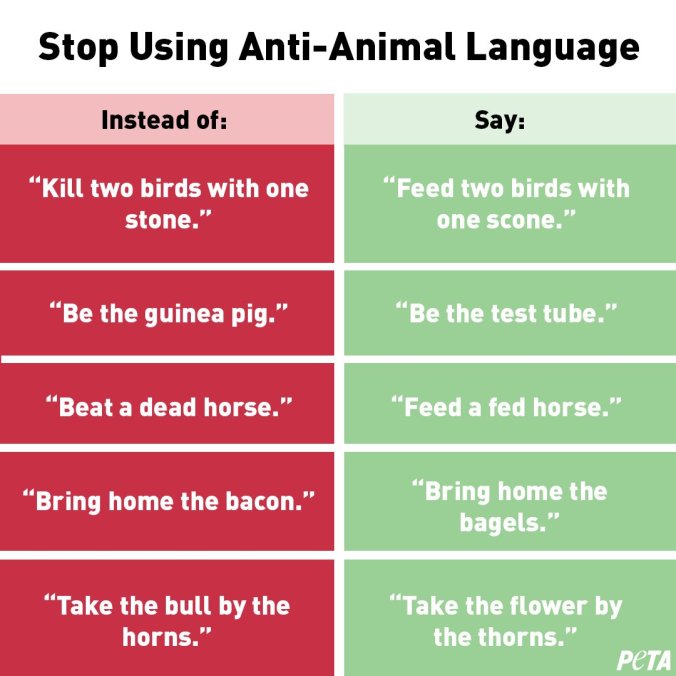
Here is PETA’s latest auto-fiasco: It tweeted out…
“Words matter, and as our understanding of social justice evolves, our language evolves along with it. Here’s how to remove speciesism from your daily conversations…”
Yes, the theory is that using animal imagery, references and metaphors is somehow unethical. There’s no explaining this logically; it makes no sense. Acknowledging the actual characteristics of animals in discourse or referring to them in metaphors advances the critical task of human communication, and does no conceivable harm to the animals involved whatsoever. Nor does it pollute human respect for goats to say, “That got my goat.” Anyway, here is PETA’s best effort—they got all their most creative, clever minds together—at retooling some common phrases for vegan sensibilities, I presume, because it would be irresponsible for a group that seeks to persuade to put forth a product created by its worst and dimmest rather than it’s best and brightest:
Yeah, I’m sure these will catch on.Was it “Visit mommy or daddy’s office day” and PETA let the kids handle the job? Continue reading →
Once again I am posting the Ethics Alarms Ethics Guide to Frank Capra’s 1946 masterpiece “It’s A Wonderful Life,” perhaps the greatest ethics movies of all time, as this blog’s official welcome to the holiday season. The film is commonly thought of as a Christmas movie, but it really is a Thanksgiving story. Unfortunately, the movie is so well known, so much imitated, so familiar in its tropes and cliches that we really don’t think about it very hard. We should.
The movie is exactly the kind of important shared cultural touch-point that I am advocating when I emphasize the importance of cultural literacy to our nation’s connective tissue. The film teaches about values, family, sacrifice and human failings unlike any other: its power and uniqueness disproves the assertion, made in one online debate here this year, that new cultural creations inevitably and effectively supersede older ones. No, they really don’t, and like copies of copies, eventually the cultural values conveyed get fainter and less influential. “It’s A Wonderful Life” would be an excellent basis for a middle school ethics course. I haven’t seen a better, richer film for that purpose come along since, and I’ve been looking.
I am also constantly amazed at how many people haven’t seen the movie. My son’s girlfriend admitted that she hadn’t at dinner today. A few months ago I gave a DVD to a pharmacist at our local CVS after I made a reference to the film and he had no idea what I was talking about. He said he would wait until the holidays to watch it with his family. I hope he does: he left the job soon after. There are some classic movies that parents have an obligation to make sure their children see. This is one. Despite the many ethics complexities and nuances that the film glosses over or distorts, its basic, core message is crucial to all human beings, and needs to be hammered into our skulls at regular intervals, far more often than once a year.
What I wrote about this message in an earlier posting of this opus still seems right to me:
Everyone’s life does touch many others, and everyone has played a part in the chaotic ordering of random occurrences for good. Think about the children who have been born because you somehow were involved in the chain of events that linked their parents. And if you can’t think of something in your life that has a positive impact on someone–although there has to have been one, and probably many—then do something now. It doesn’t take much; sometimes a smile and a kind word is enough. Remembering the lessons of “It’s a Wonderful Life” really can make life more wonderful, and not just for you.
I wondered about posting the guide again this year, as this feels like a year in which Ethics Alarms lost old readers rather than gained new ones. Then I read it again, and it reminded me of some important things I had forgotten, and I wrote it. I also, as is my yearly habit, edited and added to the commentary a bit. I’m smarter this year than I was last year, and I bet you are too…especially if you’ve been reading Ethics Alarms, just from figuring out how I’m wrong.
I hope you all had a terrific Thanksgiving, and that the holiday season is joyous for all.
And here we go:
1. “If It’s About Ethics, God Must Be Involved”
The movie begins in heaven, represented by twinkling stars. There is no way around this, as divine intervention is at the core of the fantasy. Heaven and angels were big in Hollywood in the Forties. The framing of the tale seems to advance the anti-ethical idea, central to many religions, that good behavior on earth will be rewarded in the hereafter, bolstering the theory that without God and eternal rewards, doing good is pointless.
Yet in the end, it is an ethics movie, not a religious one. George lives a (mostly) ethical life, not out of any religious conviction, but because step by step, crisis after crisis, he chooses to place the welfare of others, especially his community and family, above his own needs and desires. No reward is promised to him, and he momentarily forgets why we act ethically, until he is reminded. Living ethically is its own reward.
We are introduced to George Bailey, who, we are told, is in trouble and has prayed for help. One has to wonder about people like George, who resort to prayer as a last resort, but they don’t seem to hold it against him in Heaven. The heavenly authorities assign an Angel 2nd Class, Clarence Oddbody, to handle the case..He is, we learn later, something of a second rate angel as well as a 2nd Class one, so it is interesting that whether or not George is in fact saved will be entrusted to less than Heaven’s best. Some lack of commitment, there— perhaps because George has not been “a praying man.” This will teach him—sub-par service! Good luck, George!
2. Extra Credit for Moral Luck
George’s first ethical act is saving his brother, Harry, from drowning, an early exhibition of courage, caring and sacrifice. The sacrifice part is that the childhood episode costs George the hearing in one ear. He doesn’t really deserve extra credit for this, as it was not a conscious trade of his hearing for Harry’s young life, but he gets it anyway, just as soldiers who are wounded in battle receive more admiration and accolades than those who are not. Yet this is only moral luck. A wounded hero is no more heroic than a unwounded one, and may be less competent as well as less lucky. (This is not an observation that one should make in public, as President Trump learned when he made a lifetime enemy of John McCain.)
3. The Confusing Drug Store Incident.
George Bailey’s next ethical act is when he saves the life of another child by not delivering a bottle of pills that had been inadvertently poisoned by his boss, the druggist, Mr. Gower, who is addled by grief and drink after learning about the death of his own son. George’s act is nothing to get too excited over, really—if George had knowingly delivered poisoned pills, he would have been more guilty than the druggist, who was only careless. What do we call someone who intentionally delivers poison that he knows will be mistaken for medication? A murderer, that’s what. We’re supposed to admire George for not committing murder.
Mr. Gower, at worst, would be guilty of negligent homicide. George saves him from that fate when he saves the child, but if he really wanted to show exemplary ethics, heshould have reported the incident to authorities. Mr. Gower is not a trustworthy pharmacist—he was also the beneficiary of moral luck. He poisoned a child’s pills through inattentiveness. If his customers knew that, would they keep getting their drugs from him? Should they? A professional whose errors are potentially deadly must not dare the fates by working when his or her faculties are impaired by illness, sleeplessness or, in Gower’s case, grief and alcohol.
One could take the position that Mr. Gower “just made one mistake.” But trustworthy professionals don’t get to make such mistakes, not and still be trusted the next time. Trust is easily destroyed, and should be.
Mr. Gower also slaps George on the head several times. Today hitting a child like that is regarded as child abuse by a parent; when another adult hits a child, it’s grounds for arrest. This is one of many examples of evolving societal ethics in “It’s A Wonderful Life.” When the film was made, Mr. Gower’s conduct in beating a child employee was considered forgivable. If the local pharmacist slapped my son, I’d swear out a criminal complaint, and he still might end up shambling bum like Mr. Gower in the film’s alternate reality section.
4. The Uncle Billy Problem.
As George grows up, we see that he is loyal and respectful to his father. That’s admirable. What is not admirable is that George’s father, who has fiduciary duties as the head of a Building and Loan, has placed his brother Billy in a position of responsibility. As we soon learn, Billy is a souse, a fool and an incompetent. This is a breach of fiscal and business ethics by the elder Bailey as well a classic conflict of interest, both of which George engages in as well, to his eventual sorrow.
I see that the October jobs report this morning is spectacularly good, with 250,000 jobs added. It is amazing that so many Americans are going to vote against Republicans in the midst of such a strong economic surge following the end of Obama’s recovery-strangling policies. The lesson for future leaders, perhaps, is that the public cares more about a President constantly acting like an asshole than they do about what he accomplishes. From an ethics point of view, I would see that as a positive development, if I didn’t strongly suspect that the real reasons for apparent votes against self-interest are 1) that the news media isn’t reporting the economic news with anything like the enthusiasm it would if this were a Democratic administration, 2) that people really believe the ridiculous spin that this is somehow an Obama recovery, and 3) that so many young Americans have been indoctrinated into socialism that even as Venezuela crumbles, they are still buying the fantasy.
1. Next try: The Oprah-Jennifer Lawrence Dinner. This is pretty funny. Following the lead of other Democratic state organizations, The New Hampshire Democrats insulted the party’s two founders, Presidents Thomas Jefferson and Andrew Jackson, also two of the nation’s greatest leaders, by removing their names from the annual party dinner. For 2017, the event was renamed…wait for it!…the Kennedy-Clinton Dinner! Yup, two serial sexual assaulting misogynists, assuming it’s Jack and not Teddy being honored, in which case it’s a negligent killer, for the Party of Women. What a brilliant choice! How can anyone not vote for a party capable of a decision like that? But for some reason, as the Harvey Weinstein Train Wreck rolled along, the new name came under criticism. Who could have foreseen that? So the dinner has been renamed again; now it’s called the Eleanor Roosevelt Dinner, after the cruelly-treated wife of another Democratic icon.
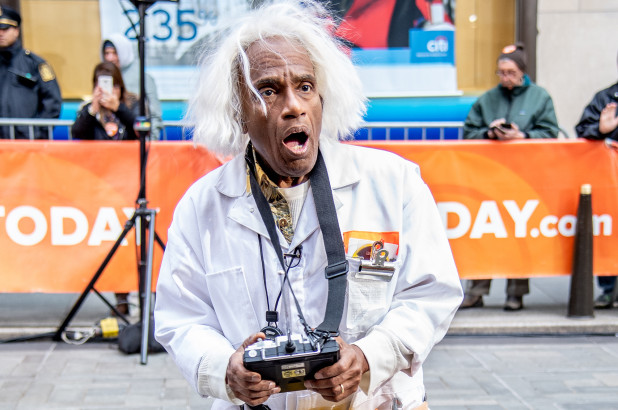
2. Who makes these rules? Why, Al Roker, that’s who! After he was called a hypocrite on social media for dressing up as “Doc Brown,” the Christopher Lloyd character in the “Back to the Future” films—Al, you will recall, helped get Megyn Kelly fired for saying that a white person could impersonate a black character using dark make-up without engaging in racially offensive conduct—tweeted,
“I’m going to say this one last time, but the folks who get it, understand and the ones who DON’T, won’t. I can be Doc Brown, and I wear the outfit and wig and not change my skin color if you’re white , you can be President Obama if you want. Just don’t color your skin!”
Wait: what about hair, Al? I’ve read that it’s racially offensive for a white person to wear a black-hair wig, like an Afro or Bob Marley hair. But it’s okay for you to wear a crazy old white guy wig?
Why, Al? For that matter, why isn’t wearing make-up that allows someone to actually look like the person or character he or she is portraying acceptable? Who makes these rules? Oh! Right! You do!
When I first saw that picture, I didn’t know who the hell Al was playing. I thought it might be Michael Jackson if he had lived, let himself go, and grew his nose back. Continue reading →






 Ethics Alarms