Passenger List On The Deadly General Motors Ethics Train Wreck

"Oops! There goes G.M again!"

“Oops! There goes G.M again!”

That great, big, all-American motor car company that the Obama Administration took bows for saving five years ago has been revealed as a thoroughly corrupt, incompetent and deadly enterprise. As the full extent of the General Motors safety scandal unfolds—and it could get worse—this is a good time to take stock of the ethics lessons and miscreants involved, on the off chance that we are interested in learning something.

Did that sound bitter? It is. There is little in this terrible story of corporate ineptitude and corruption that wasn’t known and understood decades ago. Yet here we are again.

The manifest:

  • G.M. management. It pursued the policy of paying large settlements with confidentiality agreements to those injured by ignition switch defects in their cars, never fixing the defect itself. This is the old Pinto calculation, reasoning that if it is cheaper to pay for the deaths and injuries from a design defect than to fix the defect itself, then it makes good business sense to keep doing that, indefinitely. There are three problems with this logic, of course. First, it kills people. Second, it is stupid: eventually the facts will get out, and the whole company will be endangered. Third, it is wrong.
  • The plaintiffs’ attorneys. The trial lawyers association, way back when I worked for it two decades ago, adopted the unofficial position that the practice of accepting settlements from large corporations in product liability cases that included agreements not to reveal the damages and the defects involved to regulators, the news media, and endangered consumers was unethical. Members were urged to make a rejection of such terms a condition of agreeing to represent injured parties. Speeches were given, pledges were made. All agreed that the practice undermined the mission of the plaintiffs’ bar to make America safer through the civil justice system. What happened? Greed, that’s what. Just as every plaintiff has a price, so do many trial attorneys, who received up to 40% of those secret settlements. Every single one of the lawyers who guided their clients to accepting hush money in exchange for letting unsuspecting owners of G.M. cars risk their lives and those of their families were members of the American Association for Justice, which changed its name from the Association of Trial Lawyers of America because a survey showed the term “trial lawyers” was too negative. This is why the term is negative.

Continue reading

A Shocking Legal Ethics Violation In Utah

So...would you like to revise your testimony about the harmless electric shock, Professor?

“So…would you like to revise your testimony about the ‘harmless electric shock,’ Professor?”

(The title is an uncreative and obvious pun, but on the other hand, how often do I have a chance to make it?)

I always advise lawyers that whenever they have a sudden inspiration that involves a trial tactic that they have never heard of anyone else trying, they need to stop and examine whether there are ethical issues involved. Here is a good example of why that’s a good idea.

Electricity expert Athanasios Meliopoulos, while testifying to dispute the claim of Utah dairy farmers who had sued a power company alleging that current from its plant harmed cattle grazing nearby,  said under oath that 1.5 volts could not be detected by a human being.

Don Howarth, an experienced Los Angeles litigator who represented the farmers, decided to undermine the expert’s testimony on cross-examination by giving Meliopoulos  a joke shop pen that was rigged to deliver an electric shock. Howarth told the witness that the retractable pen contained a 1.5-volt AAA battery and challenged him to click it and “tell the jury whether you feel it or not.” What he did not tell the witness, or the jury, or the judge, was that in addition to the AAA battery, the pen also contained a transformer that boosted the battery voltage to up to 750 volts, enough to deliver “a harmless powerful shock,” according to the pen’s packaging.

Meliopoulos, a Georgia Tech professor, pushed the ball-point pen’s button  and was indeed shocked enough to cause  his body to jerk and force him to drop the pen.

How unethical is this? The judge, in fining the lawyer $3000 and issuing other sanctions, listed the breaches: Continue reading

On Lawyers, Jerks, and Ethics Blog Comment Malpractice

Marilyn Ringstaff, an excellent and much-admired lawyer who has a some friends who need to learn how to write ethical blog comments...

Marilyn Ringstaff, an excellent and much-admired lawyer who has friends who need to learn how to write ethical blog comments…

In 2011, I posted this story and commenary:

Marilyn Ringstaff, a 2006 graduate of John Marshall Law School, had to pay a $250 fine as a result of a minor traffic accident when she was a first year law student. She represented herself in court, challenging Abe Lincoln’s rule that “If you represent yourself you will have a fool for a client and a jack-ass for a lawyer,” and then proved Abe correct—on both counts— when she argued on appeal that her own representation was ineffective.

Ringstaff paid the fine and sent along an obnoxious note with two smiley faces, reading, “Keep the change—put into a police/judicial education fund. I can certainly say this has been an educational experience. I am now a second-year law student and can honestly relate to what a crooked and inequitable system of ‘justice’ we have.”

Georgia’s Board to Determine Fitness of Bar Applicants took offense, and recommended that she should not be allowed to take the bar exam. It cited the note and her defense tactics, along with comments Ringstaff made during an informal board interview that “every police officer lies.”

The Georgia Supreme Court rejected the board’s conclusions, and Ringstaff’s path to a legal career is unencumbered. I agree with the opinion. Her snottiness and arrogance are hardly out of character for many in the legal profession, and at least there is a chance that she will mature, improve, and learn from this close call. More likely of course, is that a profession with more than its share of jerks just embraced another one. Continue reading

Ethics Hero: Arkansas Attorney General Dustin McDaniel

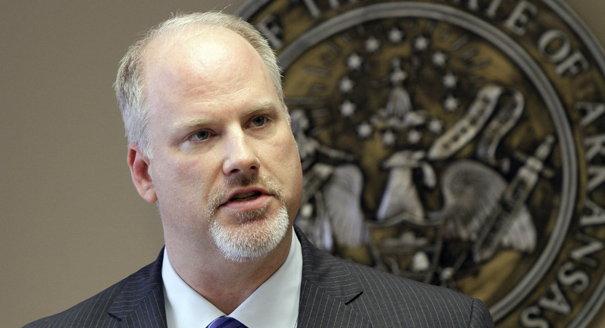
Dustin McDanielSome attorneys general understand the obligation of a state’s highest legal representation, even if the Attorney General of the United States does not.

Arkansas Attorney General Dustin McDaniel, a Democrat,told the press yesterday that he personally  he supports allowing same-sex couples to marry,  but will nonetheless continue defending his state’s 2004 ban on gay marriages in court.

The news angle, as reported, was that McDaniel, a Democrat serving his final year as the Arkansas AG, is the first statewide official in conservative Arkansas to back same-sex marriage. Ethically, however, the significance is that although he disagrees with the current law of the state that is his client, he will nonetheless do his duty according to the laws he swore he would uphold….as he should, as an ethical and honorable lawyer who is there to serve the public’s interests, not his own conscience. Continue reading

The Maryland Supreme Court Clearly Doesn’t Believe In Signature Significance

PeepingTom

But I do.

The Maryland Supreme Court just reinstated a Clayton W. Boulware, a Montgomery County attorney who had been suspended for six months after being convicted of covertly filming up the skirts of two women, one of whom was a minor, in a public place.  Boulware was suspended in September for six months with a three-year probationary period to follow the suspension.

In his defense, Boulware blamed his upskirt peeping on an “open relationship” with a younger woman, introducing him to a “swinging lifestyle” that included filming themselves having sex. But that relationship is over now, the court notes, so, hey, no problem.

The bar disciplinary board noted in its report to the court that it believed  a more lenient approach to punishing Boulware was called for because of those “mitigating circumstances.”  Lawyers are, as everyone knows, putty in the hands of swinging young women, and this always results in them shooting up other women’s skirts.

I feel like I am losing my mind. Continue reading

No “Affluenza” Defense Here: A Judge Lowers The Boom On A Teen Predator

"Well, maybe she can be rehabilitated..."

“Well, maybe she can be rehabilitated…”

Perhaps you have read about the horrific bullying case in Southern Maryland, where two teenaged girls victimized an autistic boy who attended their school who thought—indeed still thinks, apparently—that they were his friends. A recent Slate story gives you the flavor of it:

“A teenage boy identified as Michael and described as autistic started writing love letters to a pretty girl at his Southern Maryland high school. They became friends and started hanging out with the girl’s older friend, 17-year-old Lauren Bush, who was a cheerleader. On days when their parents weren’t around—mostly snow days—the girls began to toy with Michael. Bush put a knife to his throat and scared him, kicked him in the groin, dragged him by his hair, and tried to get him to have sex with the family dog. His younger “girlfriend” took video of the incidents on her cellphone. Once they got Michael to walk on a half-frozen pond. He fell through the ice, and they didn’t help him. Then, Sunday’s Post story revealed they didn’t let him ride in the warm car because he’d get the seats wet. Instead, they made him ride in the trunk.”

Nice girls! Continue reading

Ethics Musings On The Guy With “MURDER” Tattooed On His Neck….


Hey! Cool tattoo, dude! Just don't get caught actually murdering someo...oh. Bummer.

Hey! Cool tattoo, dude! Just don’t get caught actually murdering someo…oh. Bummer.

Jeffrey Chapman, who is soon to stand trial for first degree murder in Great Bend, Kansas, wants to remove the giant tattoo that spells out the word  MURDER around his neck, believing that it will prejudice the jury against him.

Ya think?

The judge will allow Chapman to have the tattoo removed before the trial, it appears. There is precedent for this: in Florida, in 2010, a neo-Nazi charged with hate crimes was permitted to have the hate-related tattoos on his face and neck, including a swastika, covered up by a professional make-up artist. It was paid for by the state, naturally.

Observations:

  • I suppose this is the necessary and fair decision by the judge. Lawyer-pundit Alan Dershowitz made some interesting points regarding the Florida case, however, suggesting that the swastika and other tattoos were an extension of tattooed defendant John Allan Ditullio’s character, and covering them could be construed as misleading the jury. “He is alleged to have attacked people on the basis of sex orientation and race. The court has the chance to make its rulings based on whether the tattoos are relevant to the case,” Dershowitz said. “It depends on what the prosecution is trying to prove. If they are saying his Nazi ideology drove him, then you could argue that seeing the tattoos is relevant.” Dershowitz noted that his tattoos were obviously the way he chooses to present himself publicly. “It’s not like the swastika was on his rear end,” he said.

Continue reading

The “Too Handsome To Rape” Defense

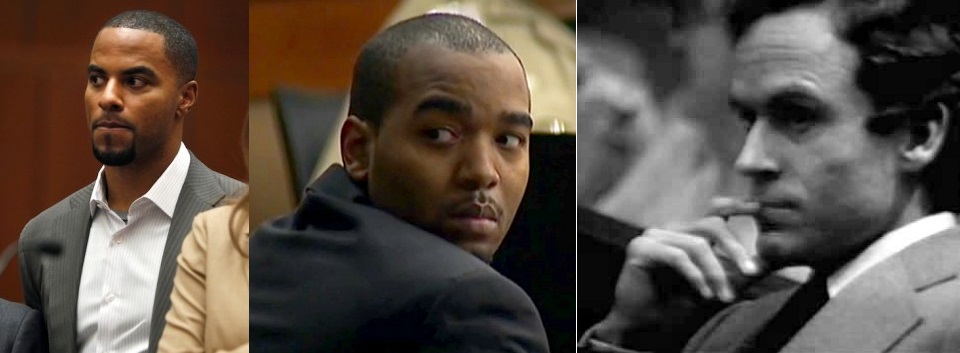
Sharper, Mathis, Ted Bundy.

Sharper, Mathis, Ted Bundy.

For whatever reason, there have been a lot of attacks on the legal profession lately—and some from within the legal profession—because of so-called “disgusting” and “frivolous” arguments by lawyers who are zealously representing their clients. These range from outrage over the so-called “affluenza” defense (which, it apparently does no good to point out, was explicitly rejected by the judge in that case), to the law suit against the Glendale, California memorial to women forced into sexual slavery by the Japanese in World War II, to the argument that Red Sox broadcaster Jerry Remy was complicit in his son’s allegedly murdering his girlfriend because Remy hired a lawyer who mounted a vigorous defense in the son’s earlier domestic abuse arrests.

Lawyers are ethically obligated to advance whatever non-frivolous arguments and theories that are most likely to achieve their clients’ objectives, whether it is avoiding prison or rationalizing the crimes of the Japanese army. That is their job and societal function, and it is essential to our avoiding a jack-boot system where any of us could be thrown in jail by popular opinion or government edict. The laws are there to be used by every citizen, even when the citizen’s objectives are unethical, or when the citizen is a cur.

Our rights are all protected well by this principle, and it’s high time we stopped bitching about it.

Undeterred by this, however, yet another defense attorney is being savaged in the news media and blogosphere, as well as by women’s rights advocates, for making an argument in defense of his client that they find offensive. In Georgia, Darriuos Mathis and his legal team are making the argument, among their efforts to show that the evidence against him is not sufficiently conclusive, that Mathis is too attractive--fit, handsome, sexy– to have to resort to kidnapping and raping a 24-year-old woman two years ago, which is what he charged with.

Continue reading

Jerry and Jared Remy, Parental Accountability, Hindsight Bias, and The Bad Seed

This is a tragic local story with vast ethics significance.

Father and son.

Father and son.

Long-time Boston Red Sox broadcaster Jerry Remy, a native Bostonian and former player who has been a vivid part of the Boston sports scene since 1977, was stunned by tragedy last summer when his oldest son, Jared, 35, allegedly murdered his girlfriend by stabbing her to death as their  ive-year-old daughter looked on. Prior to the incident, most New Englanders were unaware of Jared Remy’s problems, but his ugly past soon found its way into the newspapers.

A recent Boston Globe investigative report appeared to be the saga of a “bad seed” right out of a horror movie, for Jared Remy, son the popular, affable Jerry, had been arrested, and released, 19 times, for an assortment of alleged crimes, many of them violent. They included battering and threatening a high school girlfriend; pushing a pregnant girlfriend out of a moving car; texting death threats to her, and attempting to beat her up; threatening to kill yet another girlfriend;  terrorizing a fourth sufficiently that police were called to their apartment eight times; and involvement in steroid peddling and abuse. The Globe also obtained the testimony of a woman who alleges that Jared joined her in brutally beating a high school boy, causing him permanent brain injuries.

The Globe story (and others) raised the question of how and why the Massachusetts justice system kept releasing Jared. It is a valid question, not peculiar to his case, unfortunately. Many have speculated that Jared’s  status as the son of popular Boston sports figure played a part in getting him extraordinary leniency, but as Remy’s lawyer pointed out, several of the incidents also involved complainants and alleged victims who refused to testify or withdrew their complaints. In the realm of domestic abuse, evidently Jared Remy’s specialty, this is too common. The Globe writer, Eric Moskowitz, also insinuated that the Remys went too far in supporting their disturbed, violent and troubled son, who had learning disabilities and other clinical behavioral problems. They apparently paid for psychiatric treatment, counseling and legal fees, and helped with his rent and other expenses, though the extent of this has not been confirmed by the Remys, the only ones who could be authoritative on the topic. The rest is hearsay.

Jerry Remy, who has battled depression his whole adult life, withdrew from his role as color commentator after his son’s arrest, missing the Red Sox championship run. Outside of a brief statement condemning his son’s actions and expressing condolences to the parents of the victim, Jennifer Martel, Remy was silent until announcing this Spring that he would try returning to the broadcast booth for the upcoming season. Then, as Spring Training for the Red Sox ran down and Remy seemed, outwardly at least, capable as ever of being an affable presence with whom to watch the home team’s exploits,  the Globe story appeared. The revelations about Jared unleashed an unexpected (by me, at least) backlash against his father, and Bostonians in droves bombarded the sports radio talk shows, blogs and news media websites with the opinion that Remy should step down as Red Sox color man for cable broadcasts. How they reached this ethically indefensible position is instructive regarding how inept and unskilled most people are in day-to-day ethical analysis, how emotion becomes a substitute for objectivity and logic,  how hindsight bias makes experts and judges out of individuals with the credentials of neither, and also how ignorant most of the public is about the ethical obligations and duties of the legal profession.

Here are the reasons being cited for why Jerry Remy should give up his career:

Continue reading

Lawyer Daniel Muessig’s Clever, Effective, Legally Ethical And Thoroughly Despicable Ad

Just as I’ve been desperately trying to explain that lawyers do not represent bad people because they like them or want to loose them upon the world,  here comes innovative Pittsburgh lawyer Daniel Muessig, whose clever TV ad proclaims that this is exactly what he wants to do. Here it is:

Is this an ethical ad? According to the Pennsylvania Rules of Professional Conduct, it is within the conduct permitted by the state’s legal ethics rules. The ad isn’t misleading. It doesn’t make promises the lawyer cannot keep. It doesn’t represent dramatic recreations as fact, or use broad metaphors and exaggerations. (Lawyer ads are held to a standard of literalness that presumes the public has never see any other kinds of advertising in their entire lives.) Once upon a time the various state bar advertising regulations included prohibitions on “undignified” communications, or those that undermined public trust in the profession, but those days are long past: the standards were necessarily vague, and breached free speech principles.

So we have this: a lawyer who appeals to his future criminal clients by saying that he thinks like a criminal, believes laws are arbitrary, that other lawyers will “blow them off” and that he visits jails frequently because that’s where his friends are. He attacks his own colleagues and profession, denigrates the rule of law he is sworn to uphold, and seeks the trust of criminals not because of his duty as a professional, but because he’s just like them. Muessig is willing to undermine the law-abiding public’s belief in the justice system and the reputation of his profession and his colleagues in order to acquire clients. I’m sure his strategy will work, too. Continue reading