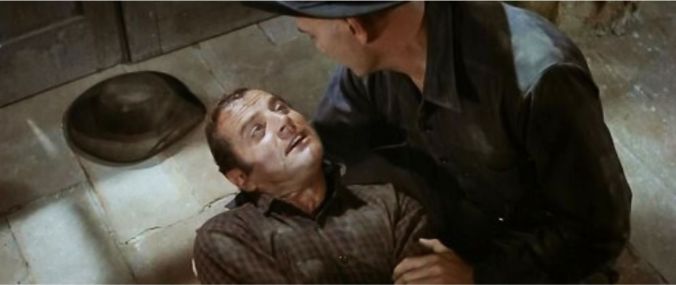
In “The Magnificent Seven,” the original classic, not last year’s disappointing re-make, Harry Luck (Brad Dexter) had always been convinced that the real reason the Seven had agreed to help a poor Mexican village fight a predatory bandit band was because the town had a secret treasure to share. (It didn’t.) Harry refuses to join the rest as they make one desperate effort to help the farmers, then at the peak of the gunfire gallops back into the village to join the battle–and is promptly shot. Dying, he begs Chris (Yul Brenner) to confirm his suspicions…
Harry Luck: Chris… I hate to die a sucker. We didn’t come here just to keep an eye on a lot of corn and chili peppers, did we? There was something else all along, wasn’t there?
Chris: Yes, Harry. You had it pegged right all along.
Harry: I knew it. What was it?
Chris: Gold. Sacks of it.
Harry: Sounds… beautiful. How much?
Chris: At least a hundred and fifty.
Harry: My cut would have been what?
Chris: About seventy thousand.
Harry: I’ll be damned. (He dies)
Chris: Maybe you won’t be.
Today’s news has another story involving lying to a dying man, a really stupid story.
Michael Garland Elliott, 75, died of congestive heart failure in his Oregon home ,surrounded by his caregivers, neighbors and friends. Right before the end, his ex-wife,spoke with him over the phone from her home in Austin, Texas.
She told him that President Trump had been impeached. “I knew it was his very, very last moments,” Teresa Elliott told reporters. “I knew that would bring him comfort and it did. He then took his final breath.”
Your Ethics Alarms Ethics Quiz of the Day is…
Is it ethical to lie to dying friends and loved ones?
Once again, a Hollywood film has political correctness furies attacking its casting. This time, it’s the sci-fi “Ghost in the Shell,” starring Scarlett Johansson.
The sad fact is, movie makers can’t win. If a black actor isn’t cast to play a white character in the source material, Hollywood is engaging in bias by eschewing “non-traditional casting,” which is necessary to remedy de facto segregation and prejudice in movies. If Charlton Heston is cast as a Mexican, as in “Touch of Evil,” it’s “whitewashing”—prejudicial and racist casting of whites to play non-whites. Of course, when Morgan Freeman, an African American, is cast to play a dark skinned Semitic character in “Ben Hur,” nobody calls that “blackwashing,” for there is no such thing as blackwashing. Casting Denzel Washington as a white character from “The Pelican Brief”: great! Who doesn’t like Denzel? Casting Denzel as the white hero of “The Magnificent Seven” in the remake, when the white hero was non-traditionally cast with the sort-of Eurasian Yul Brenner in the original, was also great, because—who doesn’t like Denzel? Casting Andy Garcia, a Cuban-American, as member of the Italian Corleone family in “Godfather III” was also fine and dandy, but not the casting of sort-of Eurasion Brenner as the King of Siam in “The King and I,” (even though he won the Tony and the Academy Award for an iconic performance)—, especially with all those great Thai musical comedy stars available. So that was–what, “sort-of-whitewashing”?
All right: how about a musical conceived with the novel conceit of having the Founding Fathers played by young black and Hispanic performers? Is that non-traditional casting? Minority-washing? Is it racist to stay with the original (brilliant) concept and tell white actors they can’t audition to be Hamilton, Jefferson, and Aaron Burr? Of course it’s not racist. After all, those actors are white. Screw ’em.
Are you seeing a theme here? Neither am I. What matters in casting a play, film or writing an adaptation is whether the final result works: How well do the actors play their roles? Is it entertaining? Does it make money?
Now the casting of Johansson as an originally Japanese character in a Japanese manga comic and animated film is being attacked as racist. Whitewashing, you know. No, in fact the words applicable here are “adaptations,” “movies,” “cultural cross-pollination” and “commerce.” In this case, not always, but in this case, the accusation of “whitewashing” is pure race-baiting.
More than forty years ago, the real life German prison camp escape engineered by captured WWII British fliers was made into the film “The Great Escape.” Brits were annoyed as production got underway, however, by the presence of heroic American prisoners in the cast, the characters played by U.S. stars James Garner and Steve McQueen. This was, British critics and veterans said, an outrage: Americans had nothing to do with the real escape. The answer by the producers contained three segments:
1. We own the film rights, and can do whatever we think will make the best movie.
2. The film is fictionalized, and makes no representations to the contrary.
3. Garner and McQueen will ensure that the film makes a profit in the U.S, plus they are both great and entertaining young stars.
Good justifications all. “The Great Escape,” as we now know, is a classic, still honored the real event, and made lots of money. Somehow, British self-esteem recovered.
The Brits also didn’t complain when Japan’s great film auteur director, Akira Kurasawa, made an all-Japanese cast adaptation of “King Lear,” which is about a Celtic king. Wasn’t this–what, “yellow-washing”? Don’t be silly: all good stories can be told in myriad ways, in many cultural contexts. “Ghost in the Shell” is a science fiction fantasy. It is not about real people, and the characters were Japanese because the author and intended audience were Japanese—you know, like the original “King Lear” was in Elizabethan English.
“Ghost in the Shell” director Rupert Sanders cast Johansson as the cyborg assassin named Motoko Kusanagi in the original and renamed the character “Mira Killian.” It is the “Who doesn’t like Denzel?” non-traditional casting principle, except the even more understandable “Who doesn’t like Scarlet, especially when she looks naked for much of the movie?” variation. The perambulations of critics trying to find something racist about the most obvious box office casting choice imaginable border on hilarious. At some point, actress Johansson decided it was more lucrative and fun being the next female action movie star than starring in solemn costume drama bombs like “The Girl With The Pearl Earring” and “The Other Boleyn Girl.” Since then, she has been rising as a bankable star in blockbusters like “The Avenger” films and “Lucy.” Quick: name another hot (I mean, of course, popular and bankable) female action star?
Treasury Secretary Steve Mnuchin has pledged “not participate personally and substantially in any matter that has a direct and predictable effect on the financial interests” of his financial holdings, without obtaining an official waiver for doing so. He also had advance notice of how a Trump administration figure could breach ethics rules when Kellyanne Conway, in the course of criticizing organized boycotts of First Daughter Ivanka Trump’s merchandise line, blurted out “Go buy Ivanka’s stuff!” during an interview on “Fox & Friends.” The Office of Government Ethics and members of the House Oversight Committee urged disciplinary action for Conway’s clear, if probably inadvertent, ethics violation. (None occurred. It should have.)
Never mind. During a C-Span broadcast interview last week, Secretary Mnuchin was asked for a movie recommendation (this was a set-up, but an easy one to duck), and said,
“I’m not allowed to promote anything that I’m involved in. So I just want to have the legal disclosure, you’ve asked me the question, and I am not promoting any product. But you should send all your kids to ‘Lego Batman.’ “
HAHAHAHAHA!!! ‘I’m not supposed to do this because it’s unethical, but I’ll do it anyway, because ethics rules are silly, the President doesn’t care about them, and besides, Kellyanne got away with it, and so will I!’Continue reading →
There were more ethics-related events and issues at the last night’s Academy Awards than usual, and that’s an understatement;
1. Jimmy Kimmel, the Oscars’ designated Johnny Carson this time around, automatically gave the ceremonies the stench of ethics blindness by his very presence. Kimmel, as this site has documented, delights in provoking parents to be cruel to their young children so he can present YouTube videos of the kids’ despair for his audience’s amusement. Kimmel, of course, being bereft of shame or decency, was the perfect choice to execute the Academy’s second most important mission of the night, which was insulting the President of the United States in an international broadcast. He did not fail his dark masters. One well-publicized “quip”:
“Maybe this is not a popular thing to say, but I want to say thank you to President Trump. Remember last year when it seemed like the Oscars were racist? That’s gone, thanks to him.”
Actually, the Oscars are racist, or at least racially biased, as we shall see, and there is proof. I’d like Jimmy to show me the evidence that the President is racist, however, other than the “resistance” talking points he gets in his e-mail.
2. More Kimmel: in a typical Kimmel “human beings are just props to me!” bit, he arranged for a group of unsuspecting tourists to be taken on a Hollywood bus tour that ended up at the Oscars. The group was escorted through the back doors of the Kodak Theater with no idea what was in store, as Kimmel had the house lights turned down. When the tourists—Awww, ordinary slobs! Look, Meryl! The little people!”—opened the doors to the stage, the lights came up and all the stars shouted, “Mahershala!” The tourists’ shocked, ope mouthed expression were broadcast live to the world, as their Hollywood betters laughed.
This is called exploitation, and using unconsenting human beings as a means to an end. Jimmy thinks its funny. Kant didn’t. I think it’s sometimes funny, and always unethical. Candid Camera asked for written consent before broadcasting its victims’ amusing reactions to gags like this.
3. Mel Gibson, justly nominated for his direction of “Hacksaw Ridge,” which also was nominated as Best Picture, sat up front. The Daily Beast tweeted “For Shame!” when the film won a statuette for editing, which it deserved. Let’s see: the theory is that the talented film editor should be snubbed for his work because Mel Gibson is an anti-Semite? Yes, that’s the theory. The Beast’s Amy Zimmerman wrote a pre-Oscar hate piece on Gibson, which really and truly contained these two sentences:
Hacksaw tells the story of Desmond Doss, a conscientious objector who enlisted as a battlefield medic during World War II. Of course, any drama that Gibson directs pales in comparison to his own behind-the-scenes odyssey: the story of an odious individual who, after years on the outskirts of Hollywood, has somehow managed to fight his way back into the mainstream.
That’s right: Amy Zimmerman thinks that the story of a religious man who volunteered to serve as a combat medic despite refusing to carry a rifle and who saved 76 wounded soldiers by dragging them to safety under enemy fire by lowering them, one by one, on a rope device he improvised on the spot, thus winning the Medal of Honor, pales in comparison to Mel Gibson’s PR problems.
Have some damn respect for those who did risked their lives incredible things so hacks like you can write garbage like that and be paid for it, you stupid, stupid fool. Continue reading →
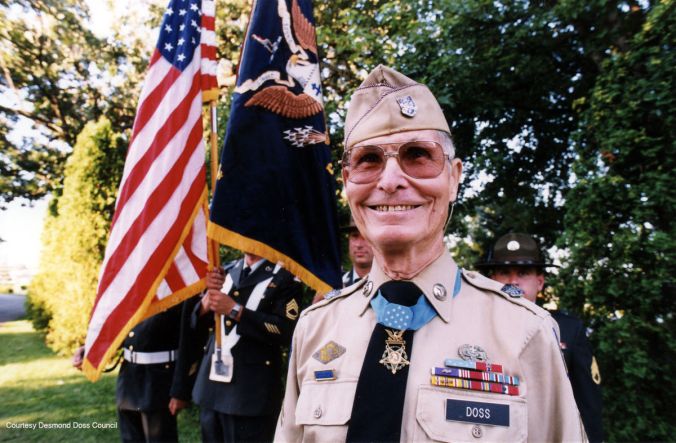
Desmond Doss, who died on March 23, 2006 at the age of 87, was the very first hero to be enshrined in the Ethics Alarms Hall of Heroes. I wrote about him before there was an Ethics Alarms, shortly after he died. I had never heard of Doss before, and I remember being angry that I had never heard of him. Everyone should know about him. There literally are no Americans who were any more heroic, and whose ethical conduct was any more astounding, than Desmond Doss.
If the values of this nation, and especially Hollywood, were healthy and correctly aligned, he would be a household name, and the film about his World War II heroism would have been made long ago. Finally “Hacksaw Ridge” was produced in 2016, and has been nominated for an Academy Award, although it will never win.
When I first read about Doss, I couldn’t get my mind around what he had done to be awarded the Congressional Medal of Honor, the only conscientious objector ever to achieve that honor during combat. During the battle of Okinawa, we were told that he survived heavy enemy fire as he struggled to carry seventy-five wounded soldiers to the sheer cliff at Hacksaw Ridge, personally picking up each one and lowering them over the edge the cliff 400 feet to safety. How is that possible? Now that I’ve seen the film, it still seems impossible.
Desmond Doss proved that principled opposition to violence against his fellow human beings need not be based on fear, self-interest or self-preservation. It is often impossible to tell whether those who oppose armed combat really object to the spilling of all human blood in battle, or only their own. With Desmond Doss, there was never any doubt. He didn’t like the term “conscientious objector,” preferring the term “conscientious cooperator.” He enlisted in the army following Pearl Harbor, believing that the war against the Axis had to be fought and wanted to be part of the war effort despite believing, as a devout a Seventh Day Adventist, that it was a sin to kill, with no exceptions. Thus he refused to carry a rifle (or shoot one, even in training) but yet insisted that he be involved in combat as a battlefield medic. He achieved conscientious objector status but would hot accept a deferment. Assigned to the 307th Infantry Division as a company medic, Doss was hazed, abused and ridiculed for his dedication to non-violence, and as the Mel Gibson-directed film shows, many of his tormentors eventually owed their lives to his astonishing heroism. All of his compatriots were amazed by his evident fearlessness under fire and remarkable dedication to duty, never hesitating to go after a wounded soldier no matter what the personal risk. As a combat medic on Guam and at Leyte in the Philippines, Doss had already been awarded the Bronze Star before the three-day battle at Hacksaw Ridge.
Many of the soldiers in Doss’s 307th Infantry, 77th Infantry Division were driven off the ridge by a furious Japanese counter-attack, and wounded G.I.s were stranded atop it. Doss remained with the wounded, and, according to his Medal of Honor citation refused to seek cover, carrying them, one by one, to the edge of the ridge in the face of enemy fire, some of them from behind enemy lines. He lowered each man on a rope-supported litter he improvised on the spot, using double bowline knots he had learned as a youngster and tying the makeshift litter to a tree stump to serve as an anchor. Every wounded man was lowered to a safe spot 35 feet below the ridge top by the 145 pound medic. Finally, Doss came down the ridge himself, incredibly, unharmed. Continue reading →
As part of its marketing campaign for 20th Century Fox’s new film “A Cure for Wellness,” the studio created and launched realistic websites for the Sacramento Dispatch, the Houston Leader, the Salt Lake Guardian, the New York Morning Post and the Indianapolis Gazette. They included a graphic displaying the current weather , and above the above the story, the standard labels, such as News, Business, Sports, Entertainment. None of these publications are real. None of them included any disclaimers or explanations.
They did contain fake anti-Donald Trump stories. One especially popular one among Trump haters on social media claimed that the President was refusing to provide California federal support as 188,000 citizens were evacuated to avoid the Oroville Dam overflow. Sanctuary cities, you know. Trump is so mean. Can we impeach him yet?
Eventually the sites and stories were discovered to be fake. When asked about the strategy, a spokesperson for Regency Enterprises, the film’s production company, explained that “‘A Cure for Wellness’ is a movie about a ‘fake’ cure that makes people sicker. “As part of this campaign, a ‘fake’ wellness site healthandwellness.co was created and the company partnered with a fake news creator to publish fake news.”
There were several possible Ethics Alarms posts that could have come out of The Golden Globe Awards last night, the obvious one involving the continuing arts community tantrum in the wake of the election of Donald Trump over Hollywood’s sweetheart, Hillary Clinton. Meryl Streep put herself in the running for “Gratuitous Cheap Shot Of The Year ” with her acceptance speech for something or other, but I decided that in a community where Rosie O’Donnell tweets “Fuck you!” to the Speaker of the House for simply completing his duty to certify the Electoral College vote, and over the weekend tweeted, “HE MUST NEVER BE SWORN IN – DELAY INAGURATION – INVESTIGATE – ARREST HIM” as her considered analysis of the proper workings of our democracy, Streep’s shot seemed like the height of restraint.
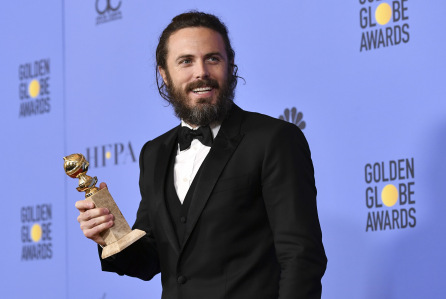
The more interesting issue on display at the Golden Globes involves actor Casey Affleck, Batman’s brother, who won the night’s Best Actor in a Film Drama award for his performance in “Manchester by the Sea.” Last year, it was revealed that the actor had twosexual harassment lawsuits filed against him in 2010 that alleged he had groped women on the set and created a generally hostile work environment while directing the film, “I’m Still Here.” Since during the campaign Hollywood was all-in using misogyny and sexual harassment as one of the many accusations against Donald Trump, some claim that honoring Affleck undermines the community’s assumed condemnation of the Trump-like conduct he was accused of.
Complicating the matter is the conundrum surrounding Nate Parker, the previously unknown black artist who was the main creative force behind the 2016 slave-revolt film “The Birth of a Nation.” As Oscar buzz was ramping up for his film—remember that the Academy of Motion Picture Sciences is more or less obligated to find plenty of nominations and awards for African Americans, regardless of objective artistic merit— new details surfaced concerning a decades old criminal case in which Parker was accused of raping a female student while both were at Penn State. He was acquitted, but the facts were ugly, and the alleged victim committed suicide. Once that was known, all of the promise shown by “The Birth of a Nation” evaporated. Although the film was a smash at festivals, it received mixed reviews,bombed at the box office, and has been poison at the various awards so far, receiving no nominations.
I just watched the 2016 horror/suspense thriller “Don’t Breathe,” in which Stephen Lang, always excellent, plays a blind veteran whose home is invaded by three self-righteous young sociopaths who intend to rob him. The movie is the latest genre movies with ethical mind-benders concocted in the House of Raimi, as Sam Raimi, the flamboyant auteur behind “The Evil Dead,” “Xena,” the first couple Spiderman movies and especially “Drag Me To Hell,” was the lead executive producer here and Raimi’s protege, Fede Alvarez, directed and wrote the script.
How do I do this without spoiling the film for someone who hasn’t seen it? I can’t. If you intend to ever see the hit 2016 movie but have not yet, then just wait for the next post. Otherwise, read on.
“Don’t Breathe” becomes one of those monster movies where you start rooting for the monster, and even that doesn’t encompass the ethical morass the movie creates. Imagine “Wait Until Dark”except that the imperiled blind woman (Audrey Hepburn) is replaced by a blind Steven Seagal (the younger, thinner version), or maybe Billy Jack, and he beats the living daylights out of or kills the three middle-aged male thugs—including a creepy evil mastermind played by Alan Arkin— who get into his house.
Got that? Okay, now replace the three thugs with three attractive twenty-somethings, including a troubled young woman trying to start a new life after an abusive childhood. Continue reading →
Ethics Alarms commenters who are honored with the annual “Commenter of the Year” title in the yearly Ethics Alarms awards have the option of joining the elite ranks of guest bloggers here. Texagg04 got the honor a couple years ago but never exercised his option. His recently posted, meticulously-researched and fascinating multi-comment addition to my 2012 post about the holiday film “White Christmas” seemed too extensive for a mere Comment of the Day, and I asked tex to edit it into a single post. He agreed, and what follows is the result. I recommend seeing the film (it’s on Netflix) either before of after reading his analysis. The 2015 update to the 2012 Ethics alarms “White Christmas” post is here.
—Jack
***
As the kids were watching “White Christmas” and I walked by, in passing, I noticed something amiss about the “military” feel of the opening scenes that seemed off ethically. So I copied and pasted the first website that claimed to be a script of White Christmas. I’m not sure what it was…if it was a working copy or a first draft, but it has significant differences from the actual filmed scenes. So, I’m forced to modify some of my assessment from the original three posts.
All the dialogue is transcribed *directly* from the listening to the movie, so I think I’m pretty close to word for word. The scene descriptions and action statements are modified versions of the script I got from the original website (which can be found here).
Before I go into commentary, I’ll insert the entire dialogue for perusal and familiarity. There are numbers to reference particular dialogue in my analysis at the end. Here are the opening scenes—General Waverly is played by Dean Jagger; Captain Bob Wallace is Bing Crosby, and Private Phil Davis is Danny Kaye: Continue reading →
There are many stories of directors crossing ethical lines by using abusive, unfair and disrespectful methods obtain a vivid performance from an actor. None are as bad as this one.
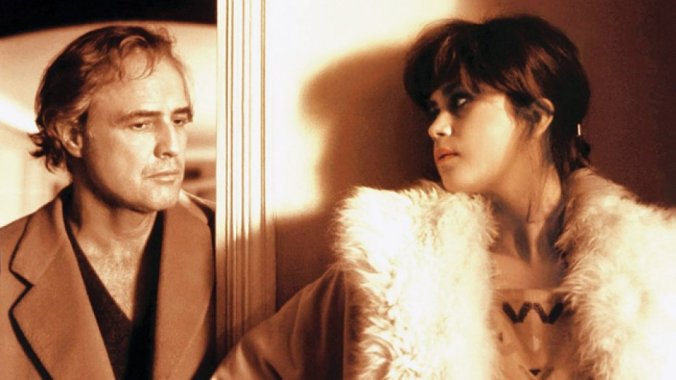
Now a video has surfaced of Italian director Bernardo Bertolucci admitting that in his acclaimed 1972 film “Last Tango In Paris,” the infamous rape scene where Paul (Marlon Brando) sodomizes Jeanne (Maria Schneider) with a stick of butter was not consented to by the 19 year-old actress, who was not warned of the unscripted sequence before it was thrust upon her, and in her. She was, in short, raped.
No wonder it seemed so realistic.
“The sequence of the butter is an idea that I had with Marlon in the morning before shooting it,” Bertolucci said in the 2013 interview at La Cinémathèque Française in Paris. “I’d been, in a way, horrible to Maria, because I didn’t tell her what was going on…I wanted her reaction as a girl, not as an actress…I wanted her to react humiliated…I think she hated me and also Marlon because we didn’t tell her.”
The film was a sensation, though and both Brando and Bertolucci received Academy Award nominations, so it was worth it.