Harvard Rejects A Convicted Child Killer: What’s Going On Here?

I have few answers, only questions and observations, regarding this story.

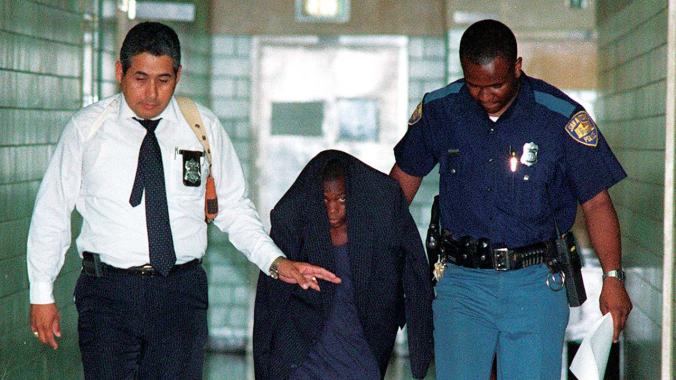
Michelle Jones, a Ph.D. candidate at N.Y.U., was released from prison in August after serving 20 years in an Indiana prison for the murder of her 4-year-old son. She very nearly was accepted into Harvard’s graduate program. In a sympathetic story in the New York Times, we learn that she rejected at the last minute.

Jones,  45, became a published scholar of American history while she was serving her time and led a team of inmates that  produced what was judged to be the Indiana Historical Society’s best research project last year.Jones also wrote several dance compositions and historical plays, one of which is slated to open at an Indianapolis theater in December.

Jones was chosen to be one of  18 successful applicants to Harvard University’s history graduate program. However, Harvard’s administration overturned Jones’s admission after some professors raised concerns that she had minimized the murder of her son in the application process. I wouldn’t be surprised; it’s an ugly story.

After. Jones got pregnant at 14, her mother beat her in the stomach with a 2×4. In a statement accompanying her Harvard application, Jones said she suffered a breakdown after years of abandonment and domestic violence, causing her to abuse her own son, Brandon Sims. The boy died in 1992, and his body was never found.  Jones admitted that she had secretly buried him, never notifying the police or Brandon’s father that he had died. At her murder trial,. Jones’ friend testified that she confessed to beating Brandon then leaving him alone for days in their apartment, until he died. Sentenced to 50 years in prison, Jones was released thirty years early based on her good behavior and scholarship.

John Stauffer, one of the two American studies professors who flagged and objected to Jones’ admission, said, “We didn’t have some preconceived idea about crucifying Michelle. But frankly, we knew that anyone could just punch her crime into Google, and Fox News would probably say that P.C. liberal Harvard gave 200 grand of funding to a child murderer, who also happened to be a minority. I mean, c’mon.” Apparently the Harvard leadership agreed. E-mails and interviews show that Harvard’s president, Drew Faust, its provost, and the deans of the graduate school vetoed the positive disposition of Jones’ application over fears of criticism by rejected applicants, conservative news outlets and parents.

Observations and Questions: Continue reading

From The Ethics Alarms “Law vs Ethics” Files: The Deadly Hexes Of Sally Quinn

In a newly published memoir, Sally Quinn, the famous journalist who married iconic Washington Post editor Ben Bradlee and became a D.C. society matron, then a religion columnist, reveals a lief-long obsession with mysticism and the occult. Ouija boards, pentagrams, witchcraft, charms, spells, seances, messages from the dead (like Ben), voodoo, the whole thing: Quinn writes that she has had an  “epiphany” revealing that “believing in magic is as legitimate as any religion or faith.”

I’ll buy that. I wouldn’t say that the next step is an application to Hogwarts, however.

So these are the people who presume to tell Americans what to think, eh? Good to know.

But I digress. In a recent Washingtonian Magazine profile contrived to puff the release of  “Finding Magic,” Bradlee’s widow says that she not only believes in hexes, she’s used them. And they work!

She reveals that, in her less mellow days, she put hexes on three people who promptly wound up having their lives ruined, or ended.

The first, cast in 1969, was spurred by old-fashioned jealousy. Some exotic beauty at a Halloween party inspired lust in Quinn’s beau at the time—and then killed herself just days after Sally cast her spell.

Her second victim was Clay Felker, the longtime editor of New York magazine who oversaw a brutal profile of Quinn in 1973, just before her catastrophic debut on the CBS Morning News. Quinn hexed Felker not long after flaming out at CBS and returning to Washington. “Some time afterward, Rupert Murdoch bought New York magazine in a hostile takeover, and Felker was out,” she writes. “Clay never recovered professionally. Worse, he got cancer, which ultimately caused his death.”

Target number three: a shady psychic who, the autumn after Quinn Bradlee was born, ran afoul of Sally’s maternal instincts. The woman dropped dead before year’s end.

This raises a classic ethics question that I nearly posed today as an Ethics Quiz. I didn’t, because I know the answer and have no doubts about it. (If it’s an ethics quiz, I at least have doubts.) The question would have been:

Ethically rather than legally, is there any difference between Sally Quinn and a murderer?

The answer is no.

I’d say that the first two victims make her the ethical equivalent of someone who is guilty of manslaughter, and the last one, after her first two hexes led to her targets’ deaths, was, again ethically rather than legally, premeditated murder.

Sally says that after the psychic dropped dead, she swore off her Death Hex. That’s admirable. The fact remains, however, the while believing an instrumentality would lead to harm when employed against specific individuals, she employed it, got her desired results, and believed that she was the cause of their subsequent deaths. She also doesn’t express any remorse or regret. Continue reading

Boy, I Bet That Cruel, Xenophobic, Trump Administration Will Deport This Poor Kid…

None of my captions for this photo of Oliver Funes-Machado are in good taste. Pass.

I don’t know about you, but I’m thoroughly sick of the daily media stories about the hardship of illegal immigrant families being “torn apart” when a parenty finally is held accountable for breaching our borders and breaking U.S. laws. Here is a refreshing story about a likely deportation that everyone can get behind.

I hope.

ICE officials in North Carolina confirmed that Oliver Funes-Machado is an illegal immigrant, and I bet the news media makes sure the “illegal” is included when reporting on his case, if they do.  The 18-year old has been charged with cutting off his mother’s head with a butcher knife.

This is unethical, by the way.

Originally from Honduras, Oliver is accused of repeatedly stabbing his 35-year-old mother before beheading her. He then walked outside, holding her head in one hand and the knife in the other, as he waited for Franklin County deputies to arrive. He  called 911 to report the crime, just like a good citizen should .

Well, that’s a mitigation, I guess.

The teen told the 911 dispatcher that he killed his mother “because I felt like it.”

I don’t think Honduras is sending us their best people.

I’m sure he is a Dreamer, but I still think he should be deported.

Ethics Quiz: Punishing The 12-Year-Old Killer

debrow

Texas Monthly this month has a troubling profile of Edwin Debrow, who is 37 years old,  has been behind bars since he was 12, and may have to stay there until he is 52. On September 21, 1991, Debrow shot a San Antonio school teacher named Curtis Edwards in the back of the head. Edwards’ body was found sprawled across the front seat of a taxi that he drove part-time at night. Edwin, police determined, had shot Edwards during an attempted robbery. Above is the photo of the 12-year-old in custody.

Texas law, you will not be surprised to learn, allows very harsh punishment for  juvenile offenders.Other states will sometimes try 12-year-olds as adults. Last year’s documentary “Beware the Slenderman” tells the strange story of Anissa Weier and Morgan Geyser, two 12-year-old Wisconsin girls who attempted to stab another 12-year old girl to death in 2014. Under Wisconsin law, Weier and Geyser will be tried as adults for attempted first-degree intentional homicide, and if convicted, they could be sentenced to up to 65 years in state prison.

Your Ethics Alarms Ethics Quiz of the Day is this:

Is it ethical for society to punish children with such long prison sentences, no matter how serious the crime?

Continue reading

The Michael Slager Trial: When The Ethical Course Is To Not Exercise a Right

shooting_of_walter_scott

Michael Slager is the white North Charleston police officer who stopped African American Walter Scott for a taillight violation on April 4, 2015, and in the ensuing events, ended up fatally shooting Scott as he fled the scene, in the back, as recorded on a cell phone video. Of all the many police-involved shootings, this is the least equivocal. Slager is guilty of murder of one kind or another: in South Carolina, there is only one kind, and  mitigating circumstances are reflected in the sentence. He could receive life in prison, or much less time.

But every criminal defendant has the right to be tried by a jury of his peers before the law finds him guilty, and Slager is taking full advantage of the right. In doing so, he is forgoing his last clear chance at redemption. The former officer—he has already been fired for the episode and not just put on paid leave, as is usually the case—is understandably trying to avoid a conviction and jail time, even though, should he be acquitted by some miracle or act of mass hypnosis, it would be certain to provoke even more anger and distrust in the black community, and, I would hope, among non-African Americans as well. A justice system that finds, no matter how it reaches such a conclusion, that an officer who shoots a fleeing man dead like Slager did is not guilty needs to be blown up and seeded with salt. When Slager’s first lawyer saw the video, he quit.

Do you think an acquittal is impossible? Don’t. All that is needed is a jury full of people who “think,” and I use the word generously, like the signers of this petition. I’m pretty sure that there are more than twelve of them available. Continue reading

Presenting Rationalization 21A: The Criminal’s Redemption or “It’s Just A Small Part Of What I Am!”

I have to get this one in before I forget.

"See? The bad part is that little light blue section at the top! What are you making a big deal about it for?"

“See? The bad part is that little light blue section at the top! What are you making a big deal about it for?”

In the interest of non-partisanship and fairness, I resisted the temptation to call 21A “The Planned Parenthood Excuse.” It was a close call, for it was a Planned Parenthood debate that made me realize that this rationalization was missing from the list.

Opponents of Planned Parenthood who want to see the organization defunded believe that abortion is morally and ethically wrong. In 2013-2014, Planned Parenthood performed 327,653 abortions. Arguing that this should not cause even abortion opponents to seek to defund the organization, its defenders inevitably argue: “Abortions are just a small part of what Planned Parenthood does.”

The Washington Post’s factchecker examined various claims about what proportion of Planned Parenthood’s activities involve abortions, which misses the ethical point entirely. If abortion is wrong, indeed unnecessary homicide in most cases, then it doesn’t matter what else an organization does in addition to 327,653 abortions, or what proportion of its total activities taking 327,653 innocent human lives is. “Abortions are just a small part of what Planned Parenthood does” is a ridiculous defense, except to those who believe that abortions are nothing to get upset about, and the equivalent of removing a polyp. That is not, however, the perspective of those who oppose abortion, so the argument isn’t an argument at all.

For someone who accepts that abortion is a legal but unnecessary and therefore unethical taking of life, “Abortions are just a small part of what Planned Parenthood does” is a pure rationalization: a lie that makes people feel better about their own wrongdoing, or the wrongdoing of someone else.

In the interests of not getting social policy mixed up with the rationalization, however, we’ll describe the new entry without reference to abortion.

Rationalization 21A. The Criminal’s Redemption, or “It’s Just A Small Part Of What I Am!”

Continue reading

Ten Observations On The Trump Assassination Attempt

Huey Long assassination

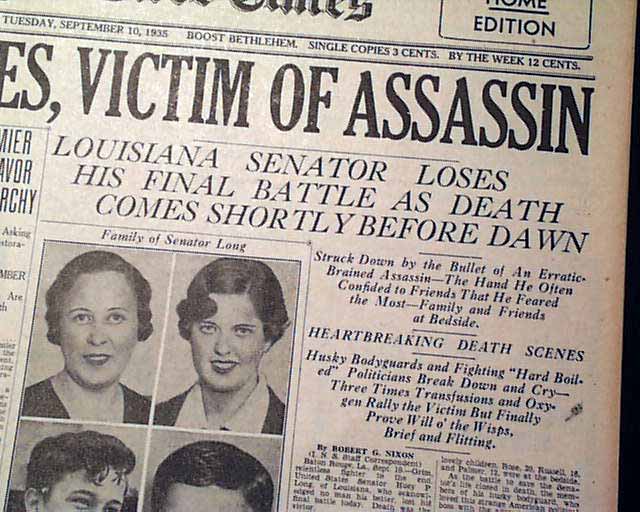
Perhaps you missed it? Someone tried to shoot Donald Trump. From the Associated Press:

“A British man arrested at a weekend Donald Trump rally in Las Vegas tried to grab a police officer’s gun so he could kill the presidential candidate after planning an assassination for about a year, according to authorities. U.S. Secret Service agents said Michael Steven Sandford approached a Las Vegas police officer at the campaign stop to say he wanted Trump’s autograph, but that he then tried to take the weapon.”

Observations:

1. Wow. Talk about being incompetent at your chosen avocation! This guy has been “planning an assassination for about a year” and the big plan was “try to get a police officer’s gun”?

Assassins, like everything else, just aren’t what they used to be.

2. Remember, however, that the only difference between a failed assassination attempt and a successful one is moral luck.

3. The Washington Post asks why the incident didn’t provoke more news coverage. Isn’t that a strange question to come from one of the news organizations responsible for the lack of coverage? Why doesn’t Callum Borchers just ask his own editors at the Post?

The answer seems clear to me: the news media doesn’t want any public sympathy going Trump’s way, or to give him what would amount to positive publicity. This is the double standard we are being told that we need to get used to. Does anyone want to make the case that an assassination attempt on Hillary’s life would be a multi-day story, with a repeat of the U.S. Representative Rep. Gabrielle Giffords shooting mass accusation, now holding  that Republican “hate speech” and anti-Hillary rhetoric nearly resulted in a tragedy?  Rush Limbaugh and Sarah Palin were being fingered as the reason why a deranged man went on a killing spree in Tucson. Why not blame a Trump assassination attempt on Paul Krugman or Elizabeth Warren? Or me? Continue reading

Final Thoughts On The “Turn Back Time” DirecTV Ad, The Response To My Post, And Callousness Toward Life

It’s not on TV any more, but to refresh your memory:

http://www.youtube.com/watch?v=3FX6wh6wr9g

I’m usually a poor judge of the posts that attract controversy here.  The Ethics Alarms commentary about the Jon Bon Jovi DirecTV ad showing the fading rock star singing the virtues of a “turn back time” feature that will allow subscribers to the satellite service to watch shows from the beginning after they have already run is now five weeks old, and it is still drawing traffic and–I also didn’t see this coming—abusive responses. I haven’t changed my mind about the ad being gratuitously and smugly callous and promoting societal indifference toward children, but I have learned some things from the responses to my pointing it out, especially the angry ones.

This blog isn’t called Ethics Alarms for nothing. Its objective is to help people be more sensitive to ethical issues and the right way to handle them, as well as to give them tools to keep their ethics alarms in working order. My ethics alarms were always unusually sensitive–being raised by my father will do that—and have become progressively more sensitive with attention, trial and error, and study. They aren’t perfect, but when they go off, they go off. If I can find out what they are ringing…training and experience help with that…then I will often write a post about the reason they rang out. My alarms went off every time that DirecTV ad came on, but it took me about four viewings to analyze why.  Then I wrote the post.

The commercial has Bon Jovi explaining what’s so great about being able to “turn back time”: in addition to letting you watch the show you missed, he notes that you can have the mild salsa you turned down for a spicy variety, and retroactively decide not to have that second child you now regret. The child is shown drawing on the wall with crayons, and he vanishes as the crayons he was holding fall to the floor. The parents smile. Bon Jovi smirks.

I wrote,

“Why isn’t it immediately obvious that this shows antipathy to children, boys, and human beings generally? The human being who was made to go away because he was inconvenient and burdensome couldn’t have been a girl, because it would be a “war on women,” and the family couldn’t be Hispanic or black, because that wouldn’t have been funny, but a white couple erasing their son from existence because he misbehaves—now that’s comedy gold.”

The comments to the post made me realize that there is antipathy to children, and the concept of turning back time to eliminate an unwanted life is acceptable, and thus no big deal, to a large portion of our culture. Continue reading

From “The Ethics Incompleteness Theorem” and “The Ends Justify The Means” Files, The Pautler Case: My Favorite Legal Ethics Dilemma Ever!

"Irena's Vow" Pictured L to R: Maja Wampuszyc, Tracee Chimo, Tovah Feldshuh (kneeling), Gene Silvers

The Sundance Channel was doing a “Law and Order” marathon this week, and I happened to see an episode from 2002 that I had missed. It was based on the Pautler case in Colorado from the same year.

In “DR 1-102,”  Assistant DA Serena Southerlyn (Elisabeth Rohm) deals with a hostage crisis in which a man suspected of bludgeoning two women to death claims he will release his captive, held at knifepoint (above), if he can consult with an attorney. Southerlyn volunteers to enter the scene, and obtains both the hostage’s release and the killer’s  surrender, but only by deceiving him into believing that she is his lawyer, and not a prosecutor working for the police and the State. Although Southerlyn is hailed as a hero, the bar seeks to disbar her, charging her with violating Disciplinary Rule 1-102 (now New York RPC 8.4 d., which prohibits lawyers from lying.  .

Actually, Serena did a lot more than that, as did her model, Mark Pautler, the Jefferson County (Colorado) assistant D.A. whose real life conduct created a legal ethics dilemma that is debated to this day.

On June 8th, 1998, Chief Deputy District Attorney Mark Pautler  arrived at a gruesome crime scene where three women lay not just murdered, but chopped in the skull.  All had died from hit in the head with a wood splitting maul. The killer was William Neal, who had apparently abducted the three murder victims, one at a time, and killed them over a three-day period. Now, police said, he was at another locale, having released three hostages he had held in terror for about 30 hours. Neal left in the apartment a tape recording that detailed all of his crimes, including a fourth murder and rape at gun point.

Neal contacted police at the apartment using his cell phone and personally described his crimes in a three-and-a-half hour conversation. The officer speaking with Neal took notes of the conversation and occasionally passed messages to Pautler and other officers at the scene. A skilled negotiator, she urged the maniac to surrender peacefully. Efforts to ascertain the location of Neal’s cell phone were unsuccessful, and it was feared that if Neal did not surrender, others would die.

Neal made it clear he would not surrender without legal representation. The police did not trust the public defenders office to handle the situation, fearing that a defense counsel’s advice might lead Neal not to place himself in police custody. Pautler also believed that a public defender would advise Neal not to talk with law enforcement. Neal was savvy enough, he felt, that a police officer could not effectively pretend to be his lawyer, so Pautler agreed to impersonate a defense attorney over the phone He told Neal that his name was was “Mark Palmer.”

Though in the ensuing phone conversation Pautler tried to avoid giving direct legal advice, it was clear that Neal believed “Mark Palmer” worked for the public defender’s office and represented him. And the deception worked: Neal eventually surrendered without further incident.

Not surprisingly, the Colorado Bar had problems with Pautler’s conduct. He was charged with violating two ethics rules, the equivalent of the one used in the “Law and Order” episode and also Colorado Rule 4.3, which requires a lawyer to inform an unrepresented party so it is clear that he isn’t representing him, and to give no legal advice other than to get an attorney. They could easily have charged him with violating others. like Rule 1.3, requiring diligent representation (Call me a stickler, but trying to trick your client into surrendering to police isn’t what the rule has in mind), Rule 1.4, which requires a lawyer to keep a client informed (“Oh: I’m really a prosecutor!“), Rule 1.6, Confidentiality (Pautler shared what Neal told him with police; a lawyer can’t do that! ) Rule 1.7, Conflicts of Interest (Ya think?) and Rule 4.1, which prohibits lawyers making false statements of fact, like “I’m here to help you.” Continue reading

From The “I’ll Take My Tiny Victories Where I Can Get Them” Dept., A DirecTV Update

DirecTV is now running a new version of the “Turn Back Time” ad featuring Bon Jovi. It looks just like the earlier one, except that now turning back time re-unites the female side of the satellite TV-watching couple with her old boyfriend, as her current partner looks on in horror. This is a major improvement over the first version, as it doesn’t make a wall-drawing kid vanish into the ether as his parents smile at ridding themselves of an unwanted child.

Maybe this is just an effort to vary the theme. I’d like to think, however, that enough ethics alarms went off among viewers and maybe even DirecTV executives that they realized that the original ad was more ugly than funny, and pulled it for a more ethical version that doesn’t tell us that this corporation thinks vaporizing children is hilarious.

Don’t disillusion me. I can’t always feel like I’m screaming in the wilderness here.