Ethics Dunces: The Catlettsburg (KY) Police Department

punisher-logo2

This story does not fill one with trust and respect for the judgment of our warriors in blue.

The Catlettsburg, Kentucky, Police Department placed large decals on its police vehicles that show the comic book character “The Punisher’sskull logo emblazoned with the “Blue Lives Matter” slogan. Behold:

punisher-logo

The city council and mayor approved the design and decals, which were funded by local taxpayers.

Morons.

The Punisher is a Marvel Comics anti-hero who is a murderous vigilante.  He summarily executes bad guys. From Wikipedia (which apparently they don’t get in Kentucky)…

The Punisher (Frank Castle) is a fictional character appearing in American comic books published by Marvel Comics. The character… is a vigilante who employs murder, kidnapping, extortion, coercion, threats of violence, and torture in his war on crime.

Exactly the image that police departments want to convey to the public!

The Punisher’s  logo has become a symbol of “Blue Lives Matter,” featured on merchandise and Facebook posts supporting police officers against the “forces of evil,”  as in those who view the police as enemies of minorities and justice.  “American Sniper,” the 2015  film based on Navy SEAL  Chris Kyle’s life, popularized the Punisher comics, which Kyle admired. Catlettsburg Police Chief Cameron Logan thought it was just  a “warrior logo,” and didn’t know it was associated with the vicious and lawless comic book character, even though the comic itself was featured in the film. He knows now, though.

“We’re getting so many calls, and they’re saying that the Punisher logo [means] we’re out to kill people, and that’s not the meaning behind that,” Logan says. “That didn’t cross my mind.”

Wait…mind?

The logo is a death’s head! What do you think a death’s head means?

Now that his police have removed the car decals, the Chief say he regrets using the image, calling it an oversight, and  promises that in the future he’d do “a little more research” …before emblazoning death symbols associated with lawless killing on his vehicles.

That’s nice.
 

Is This A Lie, False Assertion, Mistake, Sarcasm, Jumbo, Or A Statement Requiring Investigation? The Case Of The Runaway Pants

Where did his pants go, and how?

Where did his pants go, and how?

The statement in question: “They took off running by themselves without me,”  when “they” refers to the speaker’s pants.

It is perhaps germane to the matter that the speaker, 52-year-old Charles William Raulerson, was naked and blasting music from his vehicle in a car wash parking lot. When confronted by police and asked about the reason for the conspicuous absence of his pants, Raulerson allegedly uttered his remarkable explanation. Police ultimately felt it necessary to tase him.

Today I returned to this offering by the most prolific of my crack ethics issues scouts, Fred, after four plus hours with The Ethical Arts Players, in which I expounded on the best ways for an organization to develop a culture that discourages sexual harassment. I was grateful for something completely different, though I will note that if Mr. Raulerson were inside the car wash and a manager there, this episode might qualify as creating a hostile work environment.

Fred suggested that “My pants took off running by themselves without me” is “a lie that is obvious and absurd.” In truth, it is not.

It does not qualify as a Jumbo, because the statement, unlike “Elephant? What Elephant?” does not deny what is undeniable. If his pants were in plain view, immediately disproving Charles’ statement, then it would be a Jumbo. (If, upon having the pointed out, he responded, “Oh! The devils! I hadn’t noticed! They came back!”, we would be returned to square one.)

Nor is the statement a lie. It just isn’t. We cannot say with certainty that it is a lie until we know that Charles doesn’t believe that his pants ran off, and is deliberately trying to deceive. That would make it a lie, but we simply don’t know that. The fact that he’s in public without pants creates a rebuttable presumption that he might, for example, be hallucinating, and really believes that his pants ran away like the dish ran away with the spoon. (Is that nursery rhyme a lie?) Continue reading

Ethics Quiz Follow-Up (And An Ugly One): The Congressional Art Competition Winner’s Painting [UPDATED]

clay-painting-back

Well now we have a definitive answer to the Ethics Alarms Ethics Quiz that asked whether  it was responsible, fair, and ethical for Congressman Lacy Clay (D-Mo) to have the painting above displayed in the U.S. Capitol, and we don’t even have to use the ethics decision-making process I included in the post. (I note ruefully that readers were challenged to use the method to reach a conclusion, and none did.)

We don’t have to use it, because we now know some things we didn’t know at first, or at least I didn’t. Based on news reports when I first posted, I assumed that the work by high school senior David Pulphus was chosen by a designated committee, and that Clay was bound by the terms of the contest to hang the winning painting in the Capitol. That would have made the treatment of the obviously inflammatory artwork, which depicts the false Black Lives Matter narrative that Mike Brown was gunned down in Ferguson by a racist cop without cause, an ethics conflict, pitting the First Amendment and the obligation to fulfill  a commitment against the inclusion of racially divisive art in the Capitol, which is irresponsible.  Now we know, however, that Clay himself helped choose the painting, and that he did so despite the fact that the painting directly violated the rules of the contest, and thus was ineligible:

“While it is not the intent to censor any artwork, we do wish to avoid artwork that is  potentially inappropriate for display in this highly travelled area leading to the Capitol.Artwork must adhere to the policy of the House Office Building Commission. In accordance with this policy, exhibits depicting subjects of contemporary political controversy or a sensationalistic or gruesome nature are not allowed. It is necessary that all artwork be reviewed by the panel chaired by the Architect of the Capitol and any portion not in consonance with the Commission’s policy will be omitted from the exhibit. If an entrant is unsure  about whether a piece of artwork is acceptable, he or she should contact the staff of his or her  Member of  Congress; the congressional staff can speak with personnel who can determine whether the artwork would be accepted.”

The painting is beyond question  “depicting subjects of contemporary political controversy or a sensationalist or gruesome nature.” In allowing the painting to be entered, participating in selecting it, seeing that it was chosen as the winner, and hanging such an inflammatory work in the Capitol, Rep. Clay was… Continue reading

Ethics Quiz And Analysis Exercise : The Congressional Art Competition Winner’s Painting

ferguson-painting

The painting above, by high school senior David Pulphus, is now hanging in the U.S. Capitol complex, its award for being selected as the first place prize-winner in Missouri Democrat Rep. Lacy Clay’s annual Congressional Art Competition last May.  It is not clear whether Clay personally selected “Untitled #1” as the winner or had a part in the section, but the African American congressman  praised the work according to a press release:

His visually stunning acrylic painting on canvas entitled, “Untitled #1” will be displayed at the U.S. Capitol Complex.  Pulphus will travel to Washington, DC, courtesy of Southwest Airlines, to unveil his winning entry.  The painting portrays a colorful landscape of symbolic characters representing social injustice, the tragic events in Ferguson, Missouri and the lingering elements of inequality in modern American society….

In his remarks to the overflow crowd of young artists, parents and teachers who gathered at Webster University’s new downtown St. Louis campus in the historic Arcade Building, Congressman Clay said, “Tonight, we are celebrating our sixteenth year of recognizing outstanding young artistic talent. As you can see from the artwork on display here, the level of talent is truly impressive. Your work is inspiring, and I encourage all of you to continue to develop your creative abilities.”

Your first Ethics Alarms Ethics Quiz of 2017 is to answer this question:

Was it responsible, fair, and ethical for Congressman Clay to have this painting displayed in the U.S. Capitol?

I think it is a tough question. In fact, it’s an excellent opportunity to begin the year by practicing and applying one of the ethics decision-making processes, like this one from the Josephson Institute,  in the Tools section: Continue reading

A President Was Right, The Bunker Hill Indiana Police Are Wrong…And Also Ethics Dunces:

bunker-hill-police-2016-12-14

In Bunker Hill, Indiana, the police department resigned en masse over complaints about mismanagement and alleged unethical requests from the town council.
Town Marshal Michael Thomison submitted his letter of resignation and the resignation letters from his four unpaid deputies during the regular meeting of the town board last week.

Thomison alleged in his “I quit! Write your own damn parking tickets!” letter that the town board asked him to be involved in “illegal, immoral and unethical conduct,” as well as cutting police support and refusing to communicate with the officers. The Bunker Hill town council issued a statement denying the accusations, but it doesn’t matter what the provocation was. The police were in the wrong. This was settled long ago, by a wise man who clarified a bedrock principle of public service. Doing so helped make him President of the United States.

In 1919, as America recovered World War I, prices were rising faster than wages. With soldiers returning from Europe flooding the U.S. labor market, the burgeoning labor movement seized the nation. One-fifth of the country’s workers went on strike that year. New York’s harbor workers, textile workers in Massachusetts,  dressmakers, phone workers, elevated train workers— a general strike in Seattle closed all businesses from February 6 to 11. Some feared a Communist take-over.

The Boston police force was at the end of its forbearance. Starting pay for new officers had not risen in 60 years; police wages were  lower than those of unskilled factory workers. Officers worked seven days a week, with a day off every other week. They could not leave town without special permission. The typical work week for police was between 72 and 98 hours, and officers were required to sleep in the station houses, where conditions were uniformly horrible, with sub-standard sanitation, baths, beds, and toilets.

By June of 1919, with their legitimate grievances unaddressed, the police tried to unionize. The Massachusetts governor and his attorney general put forward legislation to make unionization illegal for public employees. The police responded  by voting 1,134 to 2 in favor of a strike, and scheduled it to start at evening roll call the next day.

On September 9, 1919, the Boston Police Department officers went on strike. Boston descended into lawlessness, with everything from petty crimes to looting and riots, and the  harassment of the striking officers. The mayor and the governor called out the State Guard, with the governor being adamant that there would be no settlement of grievances until the police returned to their jobs. To show he wasn’t bluffing, he eventually had  5,000 State Guards guarding the city with  mobile units using machine guns. His blunt and unequivocal statement made him nationally famous:

“There is no right to strike against the public safety by anybody, anywhere, any time.”

The police strike collapsed. By mid-December, the police commissioner had hired a new police force with higher pay, better working conditions, and additional holidays.

Police didn’t even have to pay for their own uniforms any more.

The next year that stalwart governor was nominated as Vice President on the Republican presidential ticket. By 1921, he was Vice President, and by 1923, President of the United States. His famous pronouncement about strikes against the public safety was one of his least concise statements. He was, of course, Calvin Coolidge.

Silent Cal was right in 1919, and he’s still right. Whatever the provocation and however just their cause, the Bunker Hill police were harming the public when they quit without notice or warning, and violated the public trust.

Meanwhile, Miami County Sheriff Tim Miller says that county deputies will patrol the town and respond to calls until a new police department can be hired.

___________________

14 Ethics Musings On The Death Of Francisco Serna

keith-scott

Scott and Serna.

From The Washington Post:

Slightly after midnight on Monday, police in Bakersfield, Calif., received a call concerning a man thought to be brandishing a weapon in a residential neighborhood.

Shortly after police arrived, 73-year-old Francisco Serna — who family members said was suffering from the early stages of dementia — walked out of his home and into his driveway. When Serna, who was unarmed, did not comply with officers’ orders to remove his hands from his jacket pocket, one officer fired seven shots at him, killing him.

During a canvass of the premises that lasted at least until the following afternoon, police did not find a firearm on or near Serna. Instead, they found a crucifix.

Questions and Observations:

1. The shooting occurred two days ago, on December 12. There have been no organized protests, or community groups, family lawyers or anyone else suggesting that the shooting was murder, or an example of police animus toward the community. Why not?

2. The circumstances of the shooting were notably similar to the police involved shooting of Keith Scott in Charlotte, North Carolina, except that in the case of Scott, the officer believed the victim had a gun, and he did have a gun. Nonetheless, that shooting triggered two days of rioting. Why?

3. In the Scott shooting, both officer and victim were black. In the recent shooting in Bakersfield, officer and victim were white. Why did one shooting become a racial incident and the other not, when the conduct of the police officers were essentially identical, and the provocation for the shootings  were similar as well?

4. One difference in the two episodes is that in Charlotte, a false narrative was launched by a family member to make the shooting appear to be a case of excessive force with a police cover-up. Is it just felicitous that this did not occur in Bakersfield, or was the Charlotte episode different in some way that caused events to resemble the aftermath in the Ferguson and Freddie Gray police-involved deaths?

5. If Francisco Serna had been black and all other facts the same, is there any reason to believe that the aftermath, including recriminations, accusations and attacks on police, the justice system and the nation’s culture, would have been any different than they have been every time an unarmed black man, or a black man who was reported as being unarmed, has been shot by police? If there is not, what does that tell us? Continue reading

No Charges In The Keith Scott Shooting, And An Ethics Test For Black Lives Matter

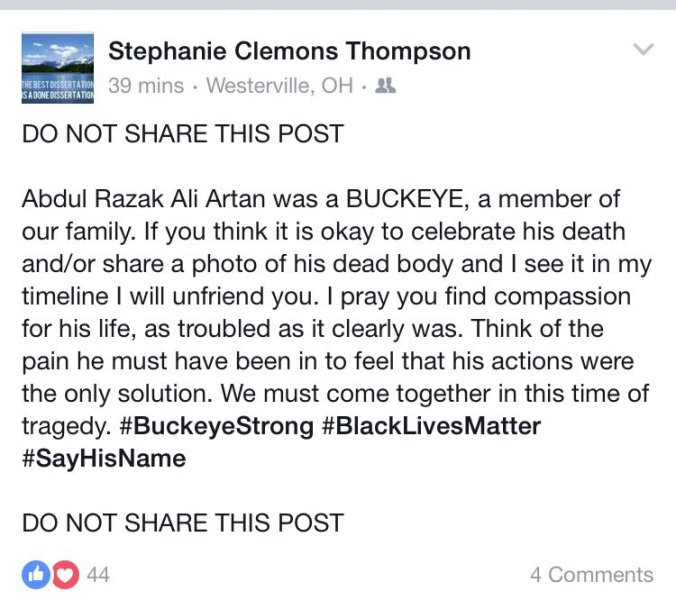
stephanie-clemons-thompson-fb-post

Yesterday,  Mecklenburg, North Carolina District Attorney Andrew Murray announced that the investigation into September’s fatal police shooting of Keith Lamont Scott had found no legal wrongdoing. This meant, in addition to the fact that officer Brently Jackson, who is black, would not face trial, that the two-days of riots inflicted on Charlotte after the Scott’s death were even more inexcusable than riots generally are. People who claimed on social media that they had seen the shooting and that Scott was unarmed admitted to investigators that they hadn’t seen what they said they saw. Evidence in the case showed that Scott stepped out of his SUV  holding a gun—his DNA was retrieved from the weapon found at the scene—and ignored at least ten commands from the five officers on the scene to drop it. Individuals who behave like that are likely to get shot, and deserve to be. No case, no outrage, no systemic racism.

Following the shooting, however, this was a Mike Brown encore, complete with angry, loud, false accounts and social media rumors focused on making Scott’s death another rallying point for race-hucksters, politicians who felt they could benefit from dividing the country by color, and irresponsible pundits.

From the Ethics Alarms post on September 21: Continue reading

The Michael Slager Trial: When The Ethical Course Is To Not Exercise a Right

shooting_of_walter_scott

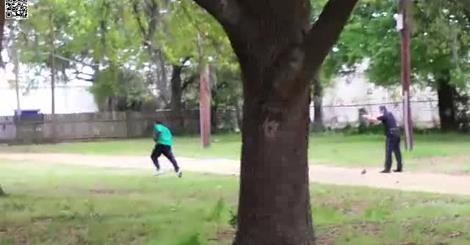
Michael Slager is the white North Charleston police officer who stopped African American Walter Scott for a taillight violation on April 4, 2015, and in the ensuing events, ended up fatally shooting Scott as he fled the scene, in the back, as recorded on a cell phone video. Of all the many police-involved shootings, this is the least equivocal. Slager is guilty of murder of one kind or another: in South Carolina, there is only one kind, and  mitigating circumstances are reflected in the sentence. He could receive life in prison, or much less time.

But every criminal defendant has the right to be tried by a jury of his peers before the law finds him guilty, and Slager is taking full advantage of the right. In doing so, he is forgoing his last clear chance at redemption. The former officer—he has already been fired for the episode and not just put on paid leave, as is usually the case—is understandably trying to avoid a conviction and jail time, even though, should he be acquitted by some miracle or act of mass hypnosis, it would be certain to provoke even more anger and distrust in the black community, and, I would hope, among non-African Americans as well. A justice system that finds, no matter how it reaches such a conclusion, that an officer who shoots a fleeing man dead like Slager did is not guilty needs to be blown up and seeded with salt. When Slager’s first lawyer saw the video, he quit.

Do you think an acquittal is impossible? Don’t. All that is needed is a jury full of people who “think,” and I use the word generously, like the signers of this petition. I’m pretty sure that there are more than twelve of them available. Continue reading

Thanksgiving Ethics From The “Fear Of Being Shot Causes Broken Ethics Alarms” Files

Bridgeport, Connecticut police stopped cars on the day before Thanksgiving, and surprised the motorists by handing them turkeys rather than tickets.

Awww!

Too bad it’s per se unethical conduct, an abuse of power and position, and a dangerous precedent. This is unpleasant déjà vu, for I’ve written this post before, more than once, and as many times in this year than the previous seven years combined. It’s pretty obvious why. Police, who were being shot and ambushed all over the country last week, are desperate to endear themselves to citizens and validate their role as a beneficent force in the community, which needs no validation.

“It’s a way of giving back, reaching out to the community and making sure everyone has a meal for thanksgiving,” says Bridgeport Police Capt. Roderick Porter, not getting it at all. I wonder what would have happened if one of those turkey stops was a fleeing felon. Would objections have been raised if the white cops only stopped black motorists, to say “We like you! We really like you! Here’s a turkey!”

Here comes the déjà vu again: As I wrote about the ice cream caper, which was pretty much the same thing: Continue reading

The Charlotte Riots: Good Work, Everybody! It Is Now Officially Impossible For Police Officers To Do Their Jobs…Now What?

Thank you,  George Zimmerman. Thank you, Mike Brown, and Freddie Gray. Thank you, Marilyn Mosby, Barack Obama, Ta Nihisi Coates. Thanks, Charles Blow, and Al Sharpton, MSNBC, Sabrina Fulton,  Lezlie McSpadden, and the Democratic National Committee. Thanks, Baltimore Police, Ferguson Police, and Bill DeBlasio.  Thanks, Eric Holder. Thanks, Black Lives Matter. And thanks to you too, Michael Slager, Timothy Loehmann, and the other trigger-happy cops who made their fellow officers around the country vulnerable to accusations of racism and murder by your incompetence. Thanks to all of you and others, it is now impossible for police to do their jobs without fear of being demonized and destroyed if they are wrong, or sparking riots and violence if they are right.

Now what are we supposed to do?

 A Charlotte, North Carolina police officer named Brentley Vinson, an African American, shot and killed Keith L. Scott, 43, after he posed an “imminent deadly threat” to police officers by refusing to drop the weapon he was carrying when ordered to do so.  The shooting sparked night of rioting and violent confrontations between police and “protesters.”

According to police, officers were searching for a suspect with an outstanding warrant. Around 4:00 pm yesterday, police observed Keith Lamont Scott inside his car. (Scott was not the person being sought.) Scott exited the vehicle carrying a firearm, got back into his vehicle, and when officers began to approach his car, got back out of it, again carrying his handgun. Officers ordered him to drop it, and he did not.  The officers fired their weapons at Scott, who was hit and fell. They immediately requested medial assistance and began performing CPR.

Following the pattern of the Ferguson and Freddie Gray incidents, unverified reports spread through social and broadcast media that the victim was a disabled man, holding only a book and no weapon. A woman claiming to be the victim’s daughter used Facebook Live to give her angry, emotional and quite possibly fanciful account of what was transpiring. About a hundred protesters arrived at the site of the shooting. #KeithLamontScott began to trend on Twitter.

Continue reading