Continued Still…From The Ethics Alarms Mailbag: “What’s Your Reaction To Various Ethics Controversies, Including The Use Of The White House, During The Republican National Convention?” Part 3: The White House

The question that spawned this long post [ Part 1 is here, Part 2 is here] was, “What’s your opinion of Trump using the White House as a political prop?”

D. The White House

Senate Minority Leader Chuck Schumer said that Trump will further “destroy” American precedents if given a second term in office. “This is what we can expect in a second Trump administration,” Schumer said. “All the rules, norms, values that have made this country great, Donald Trump will destroy them. He doesn’t care. He only cares about himself. The rules are you shouldn’t sit in the White House and give a speech at a convention. Donald Trump says, ‘I want to do it.’ So they do it.”

There’s no such rule. The President isn’t covered by the Hatch Act, and given all the political uses of The White House by previous Presidents, I’d love to hear the argument that a speech being delivered to a virtual convention during a pandemic using the White House as a backdrop is unconscionable, or even unethical.

Professor Julian Zelizer, whose field is history and public affairs at Princeton University, said that  using the White House as a “prop” at a party convention is “unprecedented” in recent times. “There still is a boundary between politics and governing, and the Oval Office and White House are a public site meant for the country that isn’t meant to be a political backdrop,” Zelizer told ABC News. “To just use it as the major site for a convention speech seems like a lot with President Trump — you just take all the guardrails down.”

Cite, please. That something is “unprecedented” doesn’t make it unethical. The White House has been used as a political prop many times, just not at a convention. Nothing has been quite as grubby as Bill Clinton selling nights in the Lincoln bedroom for big money donations, but way back in the Kennedy Administration, the nation gushed over lovely Jackie Kennedy  hosting a televised tour of her “home,” bolstering the developing legend of how graceful and refined the young First Couple were. (Jack was probably banging a starlet while Jackie was being filmed.) Go ahead, tell me that “special” wasn’t “unprecedented” or political. Continue reading

Oh Great. The Ethicist Goes Woke.

Boy, look at all that social distancing!

The New York Times Magazine’s Kwame Anthony Appiah, aka “The Ethicist,” chose to respond  to a question about the fictional ethical conflict posed by a Black Lives Matter supporter who is so torn. Should she follow her sense of moral outrage to participate in protests against systemic racism and police brutality (as proven by a single death -by-cop in Minnesota that had nothing to do with race, and a botched no-knock police search with a warrant that had nothing to with police brutality or race), even though it risks spreading the Wuhan virus?

It’s not a tough question in ethics terms. It really isn’t. Even leaving aside the clear (at least to me) verdict that the George Floyd protests themselves are unethical, being contrived, dishonest, destructive, and aimed at substituting one kind of racism for another while unfairly demonizing police, it’s no contest as a utilitarian calculation. The protests are accomplishing nothing positive while harming many and much, and would be unethical to participate in even if they did not contribute to the Wuhan virus resurgence—and if they don’t, then public health officials have been lying to us all along.

This isn’t a difficult balancing problem at all, but sadly, the usually rational Appiah tied himself into rhetorical knota to avoid saying, “Are you kidding me? Stay out of mobs! How could you even ask such a thing?” Continue reading

“The Great Stupid” Chronicles: Dumb Tweet, Unintelligent “Intelligencer”

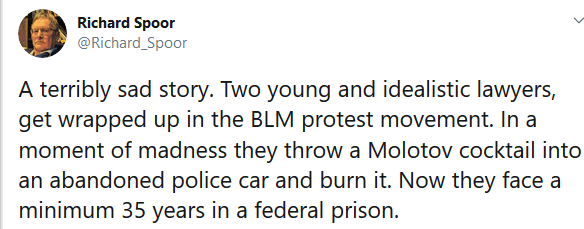
Richard Spoor, he tells us, is a public interest lawyer with a special interest in land reform, mines and communities and compensation for occupational diseases, and a “militant non-racialist,” whatever that means. His tweet is addled in so many ways:

  • The fate of these two lawyers turned terrorists is no more “sad” than any story of previously law-abiding citizens whose ethics alarms stop working as they knowingly break the law.
  • The fact that they are “young” makes it no more sad than if they were older, like 50. They’re not kids: both are over 30. They cannot claim immaturity or lack of experience. My son nearly ruined his life with a terrible, spur of the moment decision that could have killed him and others, but he was a teenaged male. He was also lucky.  Truly young people like he was wreck their lives with bad decisions every day. That’s sad. Adults doing it is something else.
  • Participating in a riot and throwing a Molotov cocktail is not the act of an “idealistic” person by definition. Breaking the law, engaging in violence, and trying to destroy property for no good reason does not embody “ideals.” They embody the opposite of ideals. If the two lawyers  were really idealistic, this wouldn’t have happened.
  • They didn’t “get wrapped up” in BLM’s racist movement, they joined it. It isn’t something that just happened to them.
  • “Moment of madness” is another version of Rationalization #19, The Perfection Diversion, or “Nobody’s Perfect!” and “Everybody makes mistakes!” People don’t suddenly throw Molotov cocktails and go “Ooopsie! What was I thinking?” That’s not “a mistake,” it is the culmination of many intentional acts leading up to a serious crime.

Continue reading

Morning Ethics Warm-Up, 6/6/2020: No, We’re Not On The Eve Of Destruction. Stop Saying That!

But thanks for an excuse to play the #2 most stupid psuedo-profound pop song of all time, #1 being, of course, “Imagine.” Take it away, Barry!

1. Mouse in the house. In the 30 years our home was patrolled by Jack Russell terriers, we virtually never saw a mouse (though Rugby literally wouldn’t hurt a fly). Lately, however, we have seen several, including a really, really cute one who is amazingly bold. This tiny mouse has big black eyes and little pink ears, with reddish brown fur. He also seems to like my wife, whom he crept up on the sofa to sit by repeatedly last night while she was napping. Ethically, we are at an impasse. I keep thinking about “Ben and Me,” the Disney cartoon about Ben Franklin’s apocryphal mouse pal, and my wife can’t bear the thought of killing her new fan. But we can’t have mice running around the house.

2. From the Ethics Alarms mail bag: Guess the rationalization! Steve Witherspoon aks what rationalization General Mattis’s fatuous statement, “We must not be distracted by a small number of lawbreakers,”  from his attack on the President evokes. Several, in fact. It’s a clear #22. The Comparative Virtue Excuse: “There are worse things,”  as well as the suddenly popular #64. Yoo’s Rationalization or “It isn’t what it is.” Riots in dozens of cities, arson, looting and attacks on over 100 police cannot be called “a small number of lawbreakers.” It’s also a neat #59. The Golden Rule Mutation, or “I’m all right with it!” As long as those “small number of lawbreakers” aren’t threatening Mattis or his family, he’s willing to accept what happens…to other people being victimized by rioters. Continue reading

“What’s Good For The Goose Is Good For The Gander” Isn’t “Good” For A Lawyer

New Jersey lawyer Brian LeBon Calpin might still be practicing law instead of serving a suspension for a year if he had only perused the Ethics Alarms Rationalization List. Or if he had followed ABA ethics opinions. Or if he had properly functioning ethics alarms.

A former client, a massage parlor owner, had  given him negative online reviews of legal skills and acumen. In retaliation, Calpin posted a negative review of her business, which he later defended with the “what is good for the goose is good for the gander” line. (It’s “sauce for the goose,”not “good,” you illiterate clod!) Calpin wrote,

“Well, Angee is a convicted felon for fleeing the state with children. A wonderful parent. Additionally, she has been convicted of shoplifting from a supermarket. Hide your wallets well during a massage. Oops, almost forgot about the DWI conviction. Well, maybe a couple of beers during the massage would be nice.”

Unfortunately, as Calpin would have known if he attended my last ethics seminar, the ABA has clarified in a recent ethics opinion what other state bar associations have held, which is that just because information about a former client is published and available to someone looking for it, unless it is is generally known as in “widely recognized by members of the public in the relevant geographic area”or “widely recognized in the former client’s industry, profession or trade,” the information is still protected by attorney-client confidentiality, and cannot be disclosed by the client’s lawyer. That’s the professional ethics prohibition on what Calpin did. The Ethics Alarms list explains what’s unethical about “sauce for the goose is sauce for the gander” in Rationalizations 1, 2, 2A, 7, 11A, 17, 24A, 40A, 53, and 59.

As is usually the case, Calpin’s career shows other evidence of flawed ethics alarms. The disciplinary board noted that he had previously violated ethics rules regarding neglect, diligence, keeping clients informed, delivering client funds or property, and returning client property after representation. He’s lucky that he’ll get his license back after only a year.

Whether New Jersey residents should consider that lucky is another issue.

The Ethics Alarms Directory Of “Fake News”: Prelude

The first use of the tag “fake news” on this website was on March 4, 2015. That’s more than three months before Donald Trump announced his candidacy for President on June 16, 2015; the oft-published claim that Trump launched the term “fake news” to deride the news media for criticizing him and his Presidency is, ironically enough, fake news.

The 2015 piece was about CNBC publishing as legitimate news a press release by an anti-vaxx group, a category of fake news called “Hearsay news” in today’s directory to come. I posted three more articles tagged “fake news” before Trump was elected. One of them was the Mother of All Fake News episodes, when the Boston Globe hit the news stands and front walks on April 10, 2016 featuring a satirical front page with headlines about a fictional, dystopian Donald Trump Presidency. “This is Donald Trump’s America. What you read on this page is what might happen if the GOP frontrunner can put his ideas into practice, his words into action,” went the introduction. I wrote in part

This is a spectacular  failure of professionalism and a journalistic disgrace. A newspaper is pledged to report the news, not imagine it. It is not ethically entitled to morph into Saturday Night Live or the Onion because it really, really, really feels strongly about an issue….No paper published such a “future news” piece about the world under Nazi rule, or the race war if civil rights laws didn’t change. No respectable publication predicted a similar dystopian future under President Huey Long, or Joe McCarthy, or what a U.S. with open borders would look like, or what a Ron Paul style US with heroin for sale off drug store counters would lead to. That is because this means of political advocacy and commentary is reserved for the features and entertainment sections, not where facts are supposed to be, and where readers must be able to expect a reasonable attempt at truth, not a showboating effort to distort it.

The episode marked, as it turned out, the beginning of an epidemic of metaphorical canaries dying in the poisoned mine of American journalism. Continue reading

“You Keep Using That Word, ‘Ethics.’ I Do Not Think It Means What You Think It Means…” [CORRECTED!]

The Wisconsin Ethics Commission is a supposedly essential and honorable government agency whose mission is “ to promote and strengthen the faith and confidence of the people of Wisconsin in their government, support the operation of open and responsible government, preserve the integrity of the governmental decision-making process, and protect the rights of individuals through the administration of Wisconsin’s campaign finance, lobbying, and ethics laws, and through readily available and understandable disclosure of information.​”

Democrat Scot Ross was named to Wisconsin’s state Ethics Commission last week.  What are his qualifications? Well, he’s a career partisan journalist and bare-knuckles political activist, neither of which are occupations that tend to build strong ethics alarms, or, as they are currently conceived, have any use for them. They do have a tendency to vomit out people like Ross.

This week,  the new ethics commission member retweeted a photoshopped image —Do I really have to show it to you? I guess I do— Continue reading

Unethical Quote of the Month: Speaker Nancy Pelosi

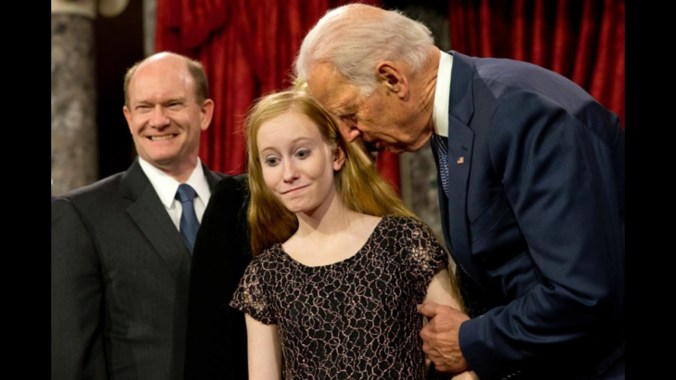
There’s Joe, being Joe Biden again!

“Here’s the thing. I have complete respect for whole #Metoo movement, I have four daughters and one son. And there’s a lot of excitement around the idea that women will be heard and be listened to.There is also due process and the fact that Joe Biden is Joe Biden.”

 Speaker of the House Nancy Pelosi, on why Tara Reade’s sexual assault allegations against Joe Biden couldn’t possibly be true, as she responded to a question about how she justified treating Biden’s accuser differently from Bret Kavanaugh’s accuser.

“Joe Biden is Joe Biden.”

“Joe Biden is Joe Biden”????

Is there any conceivable reading of that statement that isn’t unethical?

Does she mean that Joe Biden isn’t Bret Kavanaugh, so he should be subject to a different standard? Unethical.

Does she mean that Joe Biden, being Joe Biden, is such a boon to American society that he deserves to get away with sexual assault?  That’s Rationalization #11, The King’s Pass. Unethical. Continue reading

Rationalizations From The Victim Of A Tragedy

A week ago, I briefly discussed the report on the 2017 death of major league pitcher Roy Halladay who crashed his plane into the Gulf of Mexico  on Nov. 7, 2017. The 13-page report said Halladay had 10 times the recommended level of amphetamine in his system, plus an antidepressant, a muscle relaxant, a sleep aid and morphine.  He was also attempting aerial acrobatics and stunt flying.

Now his widow, Brandy Halladay, has issued a statement through the now Hall of Fame pitcher’s last team, the Philadelphia Phillies. She wrote,

“Yesterday’s NTSB report on Roy’s accident was painful for our family, as it has caused us to relive the worst day of our lives. It has reinforced what I have previously stated, that no one is perfect. Most families struggle in some capacity and ours was no exception. We respectfully ask that you not make assumptions or pass judgment. Rather, we encourage you to hug your loved ones and appreciate having them in your lives.”

From one perspective, it seems unkind to be critical of the lament of a grieving family member in the wake of such a tragedy. From another—mine—I can’t let public endorsements of multiple rationalizations like that one pass. I just can’t, and I have an obligation as an ethicist not to. It’s a dirty job but someone has to do it: the reason so people make terrible decisions by defaulting to rationalizations rather than ethics is that the culture marinates them, day after day, in these excuses for bad conduct. After a lifetime of hearing the contrived arguments , most people accept such self-deceptions as true. In turn, they engage in conduct, or excuse conduct in others, that causes extensive harm. Continue reading

“Pay What You Can” Ethics

A question in an advice column asked if it was unethical to pay nothing for a product or service that was priced at “pay what you can.” It reminded me of an ongoing disagreement I had with the board of my theater company regarding holding a “pay-what you can” performance in each production’s run. Many of the other Greater Washington theaters were employing the tactic, and one of the main arguments  for our theater doing the same was “Everybody does it.” You know what I think of THAT logic.

There was an altruistic, community spirited argument, of course: provide an opportunity for people who couldn’t afford typical theater prices. That sounds good, but in practice the theory was more ideology than reality. When we tried the gimmick, almost all of the attendees were people who regarded it as a chance to pay less than they usually did, as in “almost nothing.” People who don’t go to theater mostly aren’t interested in theater. Our prices were under 30 bucks a ticket, far less than many of our competitors, and children were admitted free, another concession to the needs of theater-loving families with limited budgets. Again, almost nobody took advantage of that benefit.

My objections to “pay-what-you-can”: Continue reading