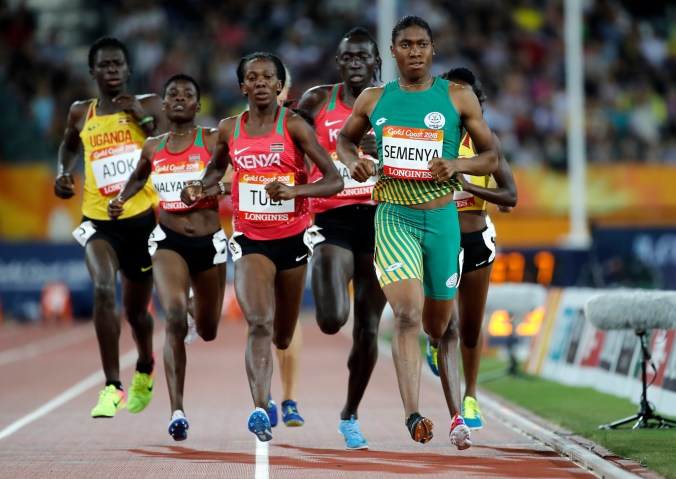
Here we go again.
Since the infamous Soviet Press sisters dominated their events in Sixties Era Olympic games, both looking like Hulk Hogan in a dress, and the female East German swimmers won medal after medal while sporting shoulders that would make an NFL draftee feel proud, the issue of hormone levels in female competitors has been contentious. The confounding complications of intersex and transitioning competitors has only made the mud muddier. What’s the right thing to do?
Last week, track and field’s world governing body passed new rules limiting women’s events to athletes with testosterone levels that are “capable of being produced solely by ovaries.” These rules apply across the board to athletes regardless of what gender they were presumed to be at birth. These new rules could force female athletes with naturally elevated testosterone levels to have to lower their hormones with medication or have to compete against men in certain Olympic events.
Initially the limitations will be enforced in middle distance races of 400 meters to one mile, events requiring the kind of speed, power and endurance that testosterone assists. I assume that if this compromise, for a compromise it is, gains acceptance, then the substitution of hormone levels for biological sex will travel to other realms of sport, as it should.
Duke law professor Doriane Lambelet Coleman makes a strong argument for the new rules in a column today in the New York Times. She writes in part,
“In competitive sport, winning and room at the top are what ultimately matter, so relative numbers are irrelevant. It doesn’t matter that there are 100 females and three males in a girls’ race if the three males win spots in the final or on the podium because they are males. The unusually high incidence of intersex athletes in the women’s middle distances and their reported 100 percent win share in the women’s 800 meters at the Olympic Games in Rio show their disproportionate power. Indeed, it is because they clustered in the middle distances that these events are the initial focus of the rules. Their supremacy was proof of principle. Testosterone readings outside of the female range were also found in the throws, but these were attributed to doping, not intersex conditions.
The I.A.A.F. is requiring that affected athletes lower their testosterone levels to within the female range if they want to continue competing in the middle distances in the women’s category. By definition, the required hormone therapy causes medically unnecessary physiological change, and no one should be forced to take drugs they don’t want or need.”
Taking the opposite position, Alice Dreger, the author of “Galileo’s Middle Finger: Heretics, Activists and One Scholar’s Search for Justice,” argues that the new rules are discriminatory and cruel: Continue reading







 Ethics Alarms