Another Santa Assassin

In Nanuet, New York, a teacher ruined Christmas for her  second-grade class this week by presuming to alert them that their parents were liars, and that there is no Santa Claus. This presumptuous act occurred during a lesson about the North Pole. You can read the whole story here. This occurs every Christmas season, in many locales and perhaps with increasing frequency. I stated my position on the matter in 2005, in an essay entitled, “The Attack of the Santa Assassin.” The recent story prompted me to revisit it. My opinion hasn’t changed:

“The parental conspiracy to support Santa Claus mythology as an excellent rebuttal to the Kantian contentions that all lies are unethical. Here is a fantasy told to the very young that imbues them with a sense of magic and wonder, and greatly enhances their enjoyment of a holiday having great social, historical, and cultural significance. It draws families together, and produces a uniquely memorable series of annual rituals that become a focal point of childhood: the late night parental setting of the scene around the tree, a child waking parents at dawn to see what Santa has brought, the first sight of the presents, and the subsequent ecstatic moments of unwrapping, surprise, and discovery. If there are children who feel that they had been mistreated by their parents perpetuating the Santa fantasy until it was no longer credible, they are a distinct and peculiar minority. Even Natalie Wood in “Miracle on 34th Street” wanted to believe in Santa Claus.

“But Theresa Farrisi, a substitute music teacher at Lickdale Elementary School in Lebanon, Pennsylvania, just couldn’t bring herself to participate in this vile falsehood. So as part of her assigned duty of reading “The Night Before Christmas” to a first grade class (!), Ms. Farrisi took it upon herself to explode the myth, spill the beans, and break the spell. Continue reading
“It’s A Wonderful Life” Ethics, Part 2 (of 3)

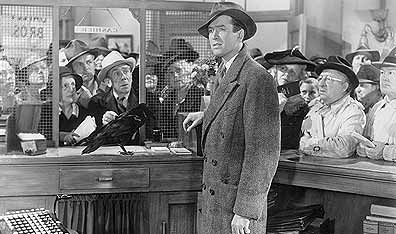
When we last saw George Bailey, he was defending his father’s dubious loan practices. In this, Part 2 of the three installments of  “It’s A Wonderful Life” Ethics, we take the saga up the fateful Christmas Eve when George Bailey meets his guardian angel.

6. George’s Fork in the Road

George Bailey’s decision to give up his plans to go to college to save the Savings and Loan is clearly not motivated by his personal dedication to the institution; he doesn’t like the place. He says so over and over again. He admires his father’s motivations for starting it. Had Potter not sparked his resentment with his nasty comments about George’s late father, George would have been out the door. But his passionate speech in rebuttal of Potter’s words put him on the spot: after those sentiments, turning down the Board’s appointment of him to be the new operating manager of the S&L would have made George a hypocrite in his own eyes, and rendered his passion  laughable. If George had integrity, then he had to accept the appointment.

It is one of the most interesting ethical moments in the film, because it represents a realistically complex ethical decision. George does what he does for selfish reasons as well as altruistic ones, and irrational reasons as well as considered ones. He wants to respect himself; he fears what might happen to his family and the community if Potter becomes the only financial power in town, and knows he will feel guilty if the consequences are bad. He feels like not staying will be taking Potter’s side over his father’s—completely irrational, since his father had given his blessing to George’s college plans, and wasn’t alive to be harmed by whatever he chose to do anyway. A large proportion of George’s decision seems to be motivated by non-ethical considerations, for he doesn’t like Potter—even hates him, perhaps—and wants to stick it to the old tycoon by foiling his victory. There are few ethical decisions in real life that are made purely on the basis of ethics, and Capra makes George’s decision wonderfully impure. Continue reading

“It’s A Wonderful Life” Ethics, Part I (of 3)

“It’s A Wonderful Life” made its now traditional holiday season appearance on network television, and naturally, I watched it. The movie is one of the great ethics movies of all time, as well as being one of the great American movies of all time, perhaps director Frank Capra’s masterpiece. One of the markers of a classic film is how one can find new things in it upon every viewing, and that is certainly true of “It’s A Wonderful Life.” I was struck this time around by how many ethics issues are raised in the screenplay, some, no doubt, unintentionally.

1. “If It’s About Ethics, God Must Be Involved”

The movie begins in heaven, represented by twinkling stars. There is no way around this, as divine intervention isat the core of the fantasy; heaven and angels were big in Hollywood in the Forties. Nevertheless, the framing of the tale advances the anti-ethical idea, central to many religions, that good behavior on earth will be rewarded in the hereafter, bolstering the theory that without God and eternal rewards, doing good is pointless.

We are introduced to George Bailey, who, we are told, is in trouble and has prayed for help. He’s going to get it, too, or at least the heavenly authorities will make the effort. They are assigning an Angel 2nd Class, Clarence Oddbody, to the job. He is, we learn later, something of a second rate angel as well as a 2nd Class one, so it is interesting that whether or not George is in fact saved will be entrusted to less than heaven’s best. Some lack of commitment, there—then again, George says he’s “not a praying man.” This will teach him—sub-par service! Continue reading

What’s Fair To Herman Cain Now?

I love this Cain-trapped-in-amber image, except that the idea of a future entrepreneur creating an island attraction where former disgraced presidential candidates are cloned from their preserved DNA to roam free is terrifying.

Herman Cain has withdrawn from the GOP presidential nomination competition in the wake of Ginger White’s claims that he and she engaged in a 13-year long romantic affair. He withdrew in a particularly deceitful way, saying that his campaign was being suspended. Like most of his recent conduct and statements lately, this resort to face-saving euphemism does not speak well of his character. Yes, it’s true, his quest for the White House is suspended. It is also what is technically called toast. A more honest, courageous, candid and accountable man would have said so. I think we can safety say that one way or the other, this campaign took the measure of Herman Cain, and found him to be as wanting in character as he is inexperience and diligence. The system, ugly as it is, worked.

What else can we now fairly say of Herman Cain? I believe we can fairly conclude that… Continue reading

Ethics Quote of the Week: David Argenter, of the Illinois Supreme Court Commission on Professionalism

"Yes, she's my legal secretary. Yes, she's exactly what I advertised for. Why are you looking at me like that? What??"

“Often, issues of ethics and professionalism raise complicated questions, involve shades of grey, and require serious thought and contemplation to resolve.  Sometimes, however, all it takes to figure out whether a given action or decision is the right one is to ask: ‘Is this stupid?'”

David Argenter, attorney and member of the Illinois Supreme Court Commission on Professionalism, commenting on the mind-boggling case of a lawyer recently suspended from the practice of law for one year for several ethics violations, including one that will live in legal ethics infamy.

Hold onto your hat.

The lawyer in question sought secretarial assistance for his law office on Craigslist.  Oddly, he posted his ad in the “Adult Gigs” section of the site, with the heading “Loop lawyers hiring secretary/legal assistant.” The ad continued…

“Loop law firm looking to hire am [sic] energetic woman for their open secretary/legal assistant position. Duties will include general secretarial work, some paralegal work and additional duties for two lawyers in the firm. No experience required, training will be provided. Generous annual salary and benefits will be provided, including medical, dental, life, disability, 401(k) etc.”

The ad also requested asked for “a few pictures along with a description of your physical features, including measurements.”

Hmmm!

When an applicant  responded with an e-mail inquiring about the “additional duties” referred to in the ad, the lawyer responded,

“As this is posted in the “adult gigs” section, in addition to the legal work, you would be required to have sexual interaction with me and my partner, sometimes together sometimes separate. This part of the job would require sexy dressing and flirtatious interaction with me and my partner, as well as sexual interaction. You will have to be comfortable doing this with us.” Continue reading

Clark Gable, Loretta Young, and the Betrayal of Judy Lewis

Clark Cable is the one on the right.

Judy Lewis died this week, at the age of 76. She survived and flourished despite being brought up in a community that conspired to hide the truth from her, and famous parents who refused to acknowledge her as their own. The community was Hollywood, and its treatment of Judy Lewis demonstrates the depth of its ethical failings. Her parents were Clark Gable and Loretta Young, and it is difficult to look at them the same way once you have learned what they did to their daughter.

Lewis was a love child, conceived during a movie set fling in 1935 when Gable, married at the time, and the single Young co-starred in “The Call of the Wild”. When Young became pregnant, she hid herself away, had her child, and entrusted her to a nunnery until the little girl was two. Then Young faked an adoption. Throughout her childhood, Lewis (the last name she took from Loretta Young’s first husband, who refused to adopt her) did not know the true identity of her famous parents, or why Gable, then known as “The King” of Hollywood, mysteriously showed up at her boarding school one day for an unannounced visit—the only time she ever saw him in person. Continue reading

The Murderer and the Governor

When a politician announces that he is taking a "moral stand," watch out.

Guess who has more integrity: Gary Haugen, the convicted double murderer whose scheduled execution in Oregon had been scheduled for next week, or Oregon Governor John Kitzhaber, who blocked his execution?

It’s Haugen. The resident of Oregon’s death row had waived his appeals and was voluntarily submitting to his court-decreed fate when Kitzhaber stepped in, declaring his moral objections to capital punishment. But like many politicians’ objections to that other divisive social policy issue, abortion, Kitzhaber’s supposedly moral stand has more fine print than a gym membership. He didn’t commute Haugen’s sentence, or end the death sentences of the other men who have been condemned. The Governor went half way, essentially staying the executions for the term of his governorship, and pledging to seek reforms of what he called a “broken system” in 2013. Why 2013? It’s after the election, of course. Continue reading

Ethics Dunce: Sports Grid Blogger Dan Fogarty

Civility is doomed. Civilization is doomed. Propriety is doomed.

What's the concerned father of the injured cheerleader thinking about? Why, what any cool dad would think about---how good her butt looks!

And Taylor Young, a cheerleader for the Michigan State Spartans, may well be doomed, as it is impossible to tell how badly her character, values and common sense have been warped by being brought up in a household containing her father, Charles. After Young took a hard fall during the halftime show in a game against Florida State, requiring her to receive medical attention (she was OK), her father posted this astounding Facebook comment, which, naturally, has gone viral:

“I’m glad to see your booty isn’t gettin big ….. no one likes a chick with a big butt ….. love you.”

Idiotic? Check. Sexist? Check. Insulting to women? Check. Embarrassing to his daughter? Double check. Demonstrating a stunning lack of understanding of the internet? Check. Displaying a disturbing tendency to sexualize his own daughter?

Check, and Yuck.

But to Dan Fogarty, writing on Sports Grid, this offensive post proves that Young is a “cool Dad,” and Young goes on to cite other “experts” who believe this is “quite possibly the funniest ‘Dad Moment’ in Facebook history.”

Really? Is this really the current state of the culture? A father makes salacious comments about his daughter’s “booty,” suggests that “chicks” without similar booty quality are unloved and unlovable, and that’s cool?

If Fogarty is in step with the culture and I’m not, 1) then American society is coarsening faster than I thought, and 2) which way to Mars?

My condolences to Taylor Young for the boorish conduct of her father, and if she sees nothing wrong with it either, she has my intense condolences—because she has been severely damaged.

As, perhaps, have we all, if Fogarty is right.

The Fat Kid, the Slippery Slope, and the Cliff

"Bill! They're putting me in foster care! How will you make THAT funny?"

Several recent ethics issues have raised the slippery slope question, which is itself a slippery slope. The rationale for any reasonable principle or act can usually be ratcheted forward in degrees until it becomes malevolent, dangerous or repugnant, including freedom, trust, loyalty, charity and honesty. Thus the easiest argument, at least for the mentally dexterous, that anything is unethical is the dreaded slippery slope.

The simple rebuttal to this is usually “let’s wait and see.” To claim that conduct is unethical for what it might lead to rather than for what it actually does is often, perhaps even usually, based on an unwarranted assumption, or a worst case scenario specifically concocted to foil otherwise unobjectionable conduct. When it is not based on an unwarranted assumption, however, is when proposed conduct or a new policy permitting it shatters a social norm or cultural standard that had previously been considered sacrosanct. In these cases, the slope isn’t merely slippery—which suggests “Be careful where you step next!”—but greased, meaning there is no longer any traction at all to stop a rapid slide to the bottom. A better cliché to use in such cases is “opening the floodgates.” Or perhaps “off a cliff.”

The recent post about the Dartmouth researchers who suggested that all manipulations of graphic images of celebrities be labeled as such is, I would argue, more floodgates than slippery slope. There is no obvious delineation point to stop the principle behind this oppressive constraint on illusion from spreading far beyond its origin. Similarly, the argument being made by the family of the mother with Stage 4 cancer that US Air is ethically obligated to refund the non-refundable tickets they could not use because of her terminal illness has no clear limits or coherent application. Are the refunds required because the mother is terminal? If she goes into remission, would the family be obligated to give the money back? What if she was only paralyzed? If the whole family was squashed by a boulder, would the airline be obligated to refund the money to their next of kin? What if the mother wounded herself terminally in a suicide attempt—would that change US Air’s supposed obligation of compassion? If so, would that mean that if the mother’s Stage 4 breast cancer occurred because she neglected to follow a physician’s recommended treatment, US Air could then refuse to refund the money without being pilloried for it? Sometimes that greased slope carries us into a swamp.

Now from Cleveland comes the story of the 200 lbs. + 8-year-old Cleveland Heights boy who has been taken from his family and placed in foster care because county case workers decided that his mother wasn’t doing enough to control his weight.  Continue reading