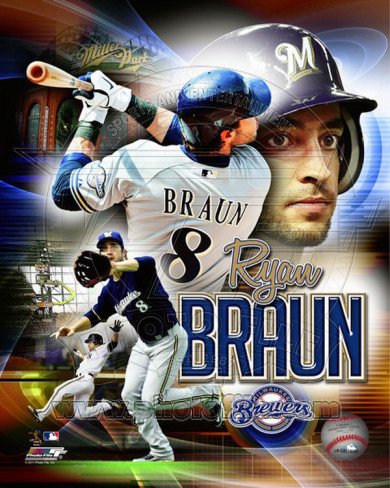
 Ryan Braun, the Milwaukee Brewers star who has just accepted MLB’s decision to suspend him without pay for the remainder of the 2013 season for violating baseball’s anti-drug policies, issued the kind of public statement that helps us understand why the athlete thought using banned substances to improve his performance was acceptable. It is the statement of someone’s whose ethical instincts are not merely underdeveloped, but malfunctioning on an epic scale.
Braun released this mea culpa in the wake of the announcement of his disgrace, which also pretty much ends the already faint chances of his team for a successful season:
“As I have acknowledged in the past, I am not perfect. I realize now that I have made some mistakes. I am willing to accept the consequences of those actions. “This situation has taken a toll on me and my entire family, and it is has been a distraction to my teammates and the Brewers organization. I am very grateful for the support I have received from players, ownership and the fans in Milwaukee and around the country. Finally, I wish to apologize to anyone I may have disappointed – all of the baseball fans especially those in Milwaukee, the great Brewers organization, and my teammates. I am glad to have this matter behind me once and for all, and I cannot wait to get back to the game I love.”
This is about what one would expect from a guy who avoided being busted for steroids by the skin of his teeth two years ago on a technicality, and reacted by not only playing the martyr, but also by impugning the character of the man who handled his incriminating urine sample. Let’s look at this non-apology apology’s various and nauseating features. As usual, my comments are in bold :
- “As I have acknowledged in the past, I am not perfect.”
Ah! So you were honest with us all along, Ryan! This is rationalization # 18 on the Ethics Alarms list, and one of the most transparently dishonest of them all. Sure nobody is perfect, but most imperfect people manage not to cheat their way to multi-million dollar salaries. Acknowledging he is imperfect doesn’t mean Braun warned us that he was a lying cheater on an epic scale.
- “I realize now that I have made some mistakes.”
Yes, he “realizes” this because he’s been caught, it will cost him millions, and his reputation is shot. In his mind, Braun’s mistakes are directly related to his failure to pull off his deception without negative consequences. His statement is blatant consequentialism: if the conduct doesn’t work out, it’s a mistake; if it’s successful and nobody finds out, then it is not a mistake, it’s a masterstroke. Braun has apparently been profitably cheating for years, and intentionally so, with full knowledge of the implications of his conduct. That’s no “mistake.”
- “I am willing to accept the consequences of those actions.”
Gee, that’s mighty big of you, Ryan. In fact, you have no choice but to accept the consequences: you’re trapped. This is spin, portraying capitulation in the face of the inevitable as some kind of a noble and courageous act of voluntary accountability.
- “This situation has taken a toll on me and my entire family, and it is has been a distraction to my teammates and the Brewers organization.”
Poor baby! There’s nothing as revolting as a miscreant trying to generate sympathy for a situation he is 100% responsible for creating. It’s not “the situation” that has hurt Braun’s family and harmed his team. His own calculated, selfish actions have. This is an effort to deflect responsibility.
- “I am very grateful for the support I have received from players, ownership and the fans in Milwaukee and around the country.”
Yes, cheaters and liars are usually grateful for their enablers and those who debase themselves and embrace corruption out of misplaced loyalty.
- “Finally, I wish to apologize to anyone I may have disappointed – all of the baseball fans especially those in Milwaukee, the great Brewers organization, and my teammates.”
The misconduct isn’t that Braun has disappointed people. The misconduct is cheating. The misconduct is embarrassing the sport that made Braun a celebrity and more money than most of your fans will see in a lifetime. The misconduct is wrecking a baseball season, and causing young fans to become prematurely cynical and jaded, or worse, to cause them to side with Braun and rationalize cheating because “everybody does it…including my hero, Ryan Braun!”
- “I am glad to have this matter behind me once and for all..”
This is perpetuating the soothing myth, much loved by habitual crooks like Marion Barry and scoundrels like Bill Clinton, that a fake apology clears the slate. It does not. Nobody in their right mind should trust Braun again.
- “…and I cannot wait to get back to the game I love.”
Baloney. If Braun truly loved the game, he wouldn’t have tarnished it for money and fame.
Braun’s is a level #10 apology on the Ethics Alarms Apology Scale, “an insincere and dishonest apology designed to allow the wrongdoer to escape accountability cheaply, and to deceive his or her victims into forgiveness and trust, so they are vulnerable to future wrongdoing.” Braun also neglected to apologize to the person he directly harmed in the process of covering up his actions, sample handler Dino Laurenzi.
Craig Calcaterra, the lawyer/baseball blogger on the NBC Sports website, is one of the cleverest , most perceptive baseball analysists around, and I admire him greatly, but boy is he dead wrong on this story. Calcaterra argues that Braun doesn’t owe his fans an apology, writing,
“Athletes don’t owe their personal integrity to the fans or the public at large. We have created a romantic fiction that fans “believe” in superstars, but they mostly don’t. They believe in athletic exploits and winning and the vicarious satisfaction they get when “their team” does well. Brewers fans rooted for the team before Braun played there and they will once he’s gone. They rooted for Braun after last year’s appeal — they may be the only ones — and it’s not a rooting based on “belief” in any real sense. He’s their guy. They defend their guy because he helps their team win. If there are those who truly believe in Braun — the “say it ain’t so” crowd — well, I’m sorry. They’re deluded. Kids included. Charles Barkley was right: athletes are not role models. They should not be. Parents shouldn’t encourage that. Athletes are like any other people: they’re flawed and often awful.”
How someone can follow sports and not understand this aspect of sports—and life in general— is a mystery to me, but there it is. The phenomenon of supporters rationalizing away the flaws and misconduct of the public figures they admire and support is how cultures are built and societies are corrupted, and sports heroes have as much impact in this as parents, bosses, mentors, friends, teachers, icons, other celebrities and leaders of all kinds. It is futile and foolish to say that sports figures shouldn’t be role models: they are role models, and will always be role models. They are paid heroes, as Bill James has said. That’s their job. Saying that fans don’t root for individuals is nonsense, and a player who causes a fan to cheer him is also causing a fan to excuse or embrace that player’s values.
Will many fans still cheer a wife beater, an accessory to murder or someone who tortures pitbulls? Sure–apparently Craig will, for example—and such fans desensitize themselves to those forms of misconduct by doing so. That is the well-proven phenomenon of cognitive dissonance, one which apparently Craig Calcaterra has never encountered. If a supporter of Charles Rangel is going to admire him as much after learning about his corrupt activities, then that supporter is going to have to convince himself that what Rangel did wasn’t so bad. Heroes who misbehave do real harm: they are supposed to model good behavior and have the power and influence to encourage it,but instead lead their fans into darkness. Craig says this shouldn’t be true: well, that’s a useless observation. It is true. Craig says that athletes are no better than other people, and that’s true too. But if they accept the job of a highly paid, highly visible paid hero, they also accept the obligation of behaving better than most people, just like elected leaders do.
When elite athletes fail to meet that obligation, they owe their fans and supporters an apology….a real one, not the poor excuse for one Ryan Braun just issued.
____________________________________
Sources: USA Today, ESPN, NBC Sports
Graphic: All Posters Images
Ethics Alarms attempts to give proper attribution and credit to all sources of facts, analysis and other assistance that go into its blog posts. If you are aware of one I missed, or believe your own work or property was used in any way without proper attribution, please contact me, Jack Marshall, at jamproethics@verizon.net.
 Ethics Alarms
And think how much Braun paid his enablers, er, agents, image consultants and crisis management experts to compose “his” statement. Maybe the league will reimburse him for that as part of the settlement. Wait a minute, maybe the league wrote “his” statement for him. At their expense.
I guess my point is there’s something terribly wrong about people reading “apologies” that are written for them by other, usually paid, people. It’s the same problem with “talking points.” How can anyone know what anyone thinks when no one ever simply speaks theri mind any more? People just read the work of others. Of course, that begs the next question: “Do people in the public eye think any more?”
If every comment has been “tested” with a “focus group,” all people ever say is what has been determined to be what their “target audience” wants to hear. There’s no market place for ideas, just an echo chamber. This is not good for a civilized society or a participatory democracy.
I also think the paid consultants bear much of the responsibility for this situation. They’ve convinced pols and celebs that they can’t afford to open their mouths without reading expensive, professionally prepared comments.
Deny, deflect and obfuscate.
And let’s face it, Jack, lawyers need to take some of the blame for this situation. The Clintons are lawyers.
“How do you tell a lawyer is lying?”
“His lips are moving.”
Yes, this bothers me. I hope Braun wrote that himself. If he didn’t, he was cheated.
Au contraire. I’m sure he didn’t write it. He has people. And I suspect he’s more than convinced he got his money’s worth. Pathetic.
This, again, is the classic case of the thief who is not at all sorry he stole, but is terribly, terribly sorry he’s been caught.
A question for you, Jack… Why do marijuana and cocaine users get terms in jail, while the equally illegal steroid “star” need only lose his millions and make an apology? Why not make these guys live in jail for a while and see what “illegal drug use” really means?
I think these guys find MDs who will prescribe these drugs for them. Which MDs are allowed to do. The rules they break are those established by their sport. I could go to the Biogenesis place in Miami and get shot up with steroids legally, if I could afford it or needed to to secure a big sports contract or endorsement deal. I think I’ll just have my old head photo-shopped onto the torso of Michelangelo’s David instead.
The MDs do have problem with their boards though. And they guys who buy the stuff over the internet or in Mexico or the DR or Venezuela without prescriptions are also law breakers. Your point applies to them.
A question for you, Jack… Why do marijuana and cocaine users get terms in jail, while the equally illegal steroid “star” need only lose his millions and make an apology? Why not make these guys live in jail for a while and see what “illegal drug use” really means?
***************
There are legitimate uses for steroids.
I just had an injection into my shoulder joint last week.
These athletes make a contract with their governing organizations promising not to use steroids under any circumstance.
Another problem is all of the unregulated supplements that are loaded with steroids.