I was chided over the weekend for mocking a misspelling in one of the cuckoo online comments cheering on Texas Governor Greg Abbott’s ridiculous “monitoring” of U.S. military exercises in his state. The thrust of my critic’s argument was that picking on such modes of expression was not only a cheap shot but an elitist cheap shot. I generally deplore the “You wrote ‘teh!'” school of online debate, and in my view, that wasn’t what I was doing when I pointed out this particular Texas paranoid’s spelling of government as “goverment” twice . His “position” didn’t require any rebuttal, as it was self-evidently batty; I alluded to “goverment” because I concluded that it was not a typo, but rather an indication that the commenter was as ignorant as granite block. If you can’t spell government, you haven’t read about government enough to have an opinion on it worth inflicting on the rest of us.
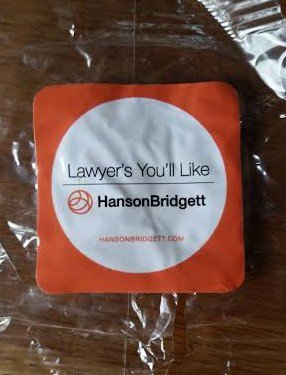
It led me to ponder, however, when a typo has undeniable ethical significance, and mirabile dictu, Above the Law today provided the excellent example you see above.
This is part of the marketing for a law firm—you know, those organizations that provide lawyers to ordinary citizens who need help negotiating the complexities of our nation’s increasingly impenetrable laws and regulations in order to live and prosper? Lawyers are supposedly trained in the precision of language, as the presence or absence of a comma or semi-colon in a statute, a motion or a brief can mean the difference between a client being a criminal or a free man, and an unnoticed typo in the draft of a contract, will, trust or settlement can decide the fate of millions of dollars, the ownership of disputed property, the existence of a prenuptial agreement, and other momentous, life-altering consequences.
The very existence of an embarrassing law firm marketing device like this one—I think it’s a coaster—leads to many conclusions:
1. It tells us that the law firm’s managing partners are inattentive to details, and in law, details are everything.
2. It tells us that the lawyers in the firm inadequately supervise the non-lawyers who work for the firm, and the ethics rules demand that lawyers be especially attentive to such employees and contractors.
3. It tells us that at least one firm lawyer, whoever approved the thing, either is illiterate or can’t be trusted to check the text of documents, even documents containing only three words.
4.It tells us, in short, that this law firm, and by extension the lawyers it employs, cannot be trusted to exercise care, competence and diligence when they are representing themselves.
How can it possibly be trustworthy when it is representing others?
__________________
Pointer and Source: Above the Law
 Ethics Alarms
Absolutely.
And of course it’s not just lawyers – accountants, consultants and other would-be professionals make what they’d like to claim are typos, but are in fact solid evidence of neglect at best, ignorance at worst.
For ten examples:
http://trustedadvisor.com/trustmatters/bloggers-top-10-annoying-spelling-errors-spellcheck-wont-save-you
You know how much this stuff drives me crazy, Jack. I find it astonishing how often I must wear my Grammarian hat with supposed professionals. But the ones who don’t care — the ones who think that we should get with the new age of grammar/spelling, the age of smart phones and email where everything is done quickly — these “professionals” who seem to have graduated from college — some from grad school! — and who think that it’s ok to throw something up on an organization’s website or an organization’s official Facebook page, with errors abounding — these are the ones that I want to send back to elementary school. With nuns. I suspect that the people “responsible” for your example fit into this category.
Amazing. I took the LSAT a while back, and I came to the conclusion, especially with the reading comprehension section, that anything less than a very high aptitude for grammatical nuance would result in not being offered a seat. How on Earth could you make it through law school, ANY law school, with this kind of slop?
And then there’s “lie” and “lay.” as in “Now I’ll lie down” vs. “Now I lay me down.” Not to mention all those who try to put qualifiers on “unique,” which means “one of a kind.” Something is either unique or it isn’t. It can’t be very unique; it can’t be most unique. I’m quitting before I work myself up into a grammatical lather.
I have no problem with “very unique.” Each snow flake may be unique, but not very unique. Each Edward Albee play is VERY unique.
Some animals are more equal than others.
I suppose no one ever considered that the photo was taken BEFORE the offending coaster was thrust upon the world for all to revel in the depth of their collective incompetence. The product was produced by a third party. Since most law firms with the budget to justify such marketing niceties are usually very busy doing actual legal work for clients, it was also likely the result of a telephone conversation where the product and slogan was described orally, either suggested by the salesman or the buyer. All this could easily and commonly occur without anyone in the firm seeing the final result before production, and with the firm competently preventing distribution after they received delivery of the first shipment. Since the photo appears to display the coaster lying on top of common plastic wrapping and a nice finished table or desk, it suggests the photo could have been AT THE FIRM upon delivery. But then that scenario would upset the arrogant superiority speech that so many here seem to relish. This sort of rush to judgment is tiresome.
“I suppose no one ever considered that the photo was taken BEFORE the offending coaster was thrust upon the world for all to revel in the depth of their collective incompetence.”
I considered it: I have it on good authority that this was not, in fact, the case. But it doesn’t matter. Is the existance of such an embarrassing item bad for the firm? Yes, and I explained why. Should it have ever been allowed, by firm management, to exist? No, and I explained why there, too. If your theory is that someone mocked it up to harm the firm, well, OK, that’s plausible, barely.But the post was about the implications of typos in legal practice, using the likely implications of this incident as an example. It is not about the firm per se.
The product was produced by a third party.
So what? It was produced by a third party to represent a law firm, and someone at the firm is still responsible. You’re spinning. Why?
“Since most law firms with the budget to justify such marketing niceties are usually very busy doing actual legal work for clients, it was also likely the result of a telephone conversation where the product and slogan was described orally, either suggested by the salesman or the buyer.”
Which simply confirms the point of the post. Are you kidding? I have been responsible for a lot of print jobs, and “doing it over the phone” is incompetent and irresponsible, a recipe for disaster.
“I hate people when they’re not polite” (Psycho Killer, by Talking Heads)
Wow, you are cranky today.
Jay, did you miss that she made a typo of her own in pointing out your error? Thus compounding her own. Here’s her quote:
“In fairness to the grammar king (you), I wanted to let you know that you to have a typo on your bio.”
The good old “to” vs. “too” vs. “two.” Gets ’em every time.
I actually have my own theory – that government and “goverment” are not, in fact, the same thing. Government is the highly flawed but ultimately essential tool by which we maintain our society; “goverment” is the bogeyman via which a tyrant will send his Navy Seals in their black helicopters to take your guns, enforce Agenda 21, and make you eat your vegetables.
I think you’re on to something, but it’s spelled “govermint“.
Or just gummint
That’s how it sounds without teeth.
gubmint.
Their has bin no gud speling sinse TEXTING. An nobady hoo duz it wil hav a brane sune. Makes me lol my hed in shayem. (oops)
It’s funny you say that because even when I’m texting or chatting via IM services, I reflexively check my text/post for typos and consider egregious spelling errors to be disrespectful, especially in the age of instant spell-checking.
“404”. Hmmm.
Are we sure it’s a coaster? It’s not a whoopie cushion?
By way of illustration, in that sentence there should be either a comma after “and” or no comma after “law”. (That’s just illustration – I know perfectly well that this instance here isn’t a matter of significance like the ones coming up in matters of law.)
Why? That punctuation works just fine…it uses the comma as a pause, which is legitimate. Your punctuation doesn’t change the meaning one bit, nor does my different choice it impugn my attention to punctuation to anyone, uh, normal. The coaster, on the other hand, using a possessive inappropriately, is undeniably wrong.
And since I didn’t use the post as a marketing device and put it on a coaster, it doesn’t relate to the post anyway. How did you reach the conclusion that a non-typo (whether you like it or not, my punctuation was 100% intentional) that has no ethical significance is relevant to a post called “When Typos Have Ethical Significance”?
Jack is correct.
“If a dependent clause, or an introductory phrase requiring to be set off by a comma, precedes the second independent clause, no comma is needed after the conjunction.” – William Strunk, Rules of Usage
And this is the noble soul who had the job of correcting my spelling and punctuation for years!
No, Jack has got hold of the wrong end of the stick, and then passed it to you. That use of commas caught my attention when it broke the flow of his limpid prose, so I brought it up as an illustration of inattention to detail – and only as an illustration of inattention to detail, not as a grammatical error. And I thought I went to some trouble to point out that it wasn’t important in itself but only as an illustration, so why he chose to criticise it as not being aimed at anything as consequential – giving rise to consequences – as the lawyers’ failure that he rightly criticises I do not know.
I regret any misunderstanding. Indeed, I regret all misunderstanding. That is why I seek to dispel it when I encounter it.
Sigh. And there I was, going to all that trouble to point out that that was only an illustration, that that pattern of commas there wasn’t particularly important. (You do read things in brackets, don’t you?)
Look, commas-as-pauses are all very well and good – just like the ones up until here in this reply – but that is not all the work that commas do, and indeed the fact that they do other things is why they don’t work properly when just scattered around in that pattern. They also do some work in the way of letting people know what is coming, and they do some work by way of setting off something to one side when the parts before and after two consecutive commas run more freely if thought of together rather than as something with the middle part; in some ways, that is like a bracketing. Readers use them as cues, and if writers use them to mark where they themselves paused it is as unhelpful as Australian driving signalling rules that require drivers on roundabouts to signal according to whether they are using the roundabout for a left turn, a right turn, or straight ahead (British rules require signalling according to whether the car is going to turn off the roundabout at the next chance, or to keep going for several exits – which is much more helpful for letting others know what the car is about to do).
So, as a matter of style – not as style in the sense of subjective taste, but as style in order to achieve more effective communication – it would be better to have either a pair of commas there or none. The very fact that “no commas” is possible – does work grammatically – shows that there is no requirement in grammar to have a pair of commas there. However, having just that single comma causes a break in the reader’s flow, in that it makes the reader backtrack looking for a matching comma that would mark where the train of thought lines up. If, that is, the reader has come to use such cues (and notice that those last two commas are an example of what I mean by “setting off”).
Your choice of where to put commas was poor in that way (you may prefer “poor” to “wrong”, since you misunderstood me to mean grammatical error by “wrong”).
Your position, if it is a position, is too silly to argue with. The sentence was clear. The commas were correct. My post wasn’t a legal document, or representative of someone who writes legal documents.
As seen on a T-shirt:
Let’s eat Grandma.
Let’s eat, Grandma.
Commas save lives!