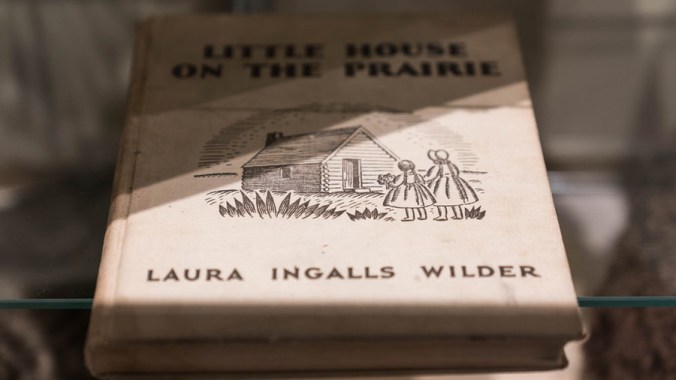
From the New York Times:
The American Library Association is dropping Laura Ingalls Wilder’s name from a prestigious children’s literature award in order to distance the honor from what it described as culturally insensitive portrayals in her books.
The decision was made out of a desire to reconcile the award with the organization’s values of “inclusiveness, integrity and respect,” representatives of the association said in a statement on Monday. The award is given out by its children’s division.
“Wilder’s books are a product of her life experiences and perspective as a settler in America’s 1800s,” the association’s president, Jim Neal, and the president of the children’s division, Nina Lindsay, said in the statement. “Her works reflect dated cultural attitudes toward Indigenous people and people of color that contradict modern acceptance, celebration, and understanding of diverse communities.”
…Despite their popularity, Ms. Wilder’s books contain jarringly prejudicial portrayals of Native Americans and African Americans. In the 1935 book “Little House on the Prairie,” for example, multiple characters espoused versions of the view that “the only good Indian was a dead Indian.” In one scene, a character describes Native Americans as “wild animals” undeserving of the land they lived on.
“Little Town on the Prairie,” published in 1941, included a description of a minstrel show with “five black-faced men in raggedy-taggedy uniforms” alongside a jolting illustration of the scene.
Hmmmm.
Your Ethics Alarms Ethics Quiz for today:
Is it fair and reasonable to remove Wilder’s’ name from the award, essentially taking away an honor despite no new information or evidence arising?
I think this one is a close call.
On one hand, it is obviously presentism and cultural airbrushing. Using this standard, no author who wrote in less enlightened periods will ever be appropriate for a permanent honor. The statue-topplers are relentless. There seem to be only two mutually exclusive options. Decide that honoring past figures of prominence are appropriate, and hold their now-discredited attitudes are historical relics of their times that should be understood and tolerated in the context of their larger body of work, or accept that the powers of oppressive political correctness will seek constant retribution for the failure of figures in the past to foresee the evolution of attitudes and values to come years or decades in the future.
On the other hand, it is a children’s book award. Such an award should be an author’s whose work is appropriate to be read by children, no?
On the third hand, I haven’t read any of the books. How many offensive statements are in the Wilder books? How pervasive are the “jarringly prejudicial portrayals ” of minorities? The Times writer apparently couldn’t find a genuinely “jarring” description of blacks: a description of a minstrel show with “five black-faced men in raggedy-taggedy uniforms” isn’t even a reference to African-Americans, is it? Which is the racist part? Is writing about mistral shows racist? Presumably they did have black faces and “raggedy-taggedy” outfits. Someone is looking to be offended. Someone always is.
 Ethics Alarms
Do any of these apply?
https://ethicsalarms.com/2018/04/12/president-mckinleys-statue-and-revisiting-the-newland-fountain-principles/
“Is it fair and reasonable to remove Wilder’s’ name from the award, essentially taking away an honor despite no new information or evidence arising?”
No, it’s not fair. The people who did this are idiotic social justice warriors that are showing us how emotion trumps critical thinking.
To my recollection, I don’t think there is any reference in anything that Laura Ingalls Wilder wrote that gives the impression that she was racist or a bigot, the references that these people talk about is when Ms. Wilder was passing on her memory of what others had said. This is history from her eyes and that includes things she saw and heard. Striping her name from the award is *Salem Witch Trial School of Thought and absolutely absurd.
History is not always a pretty thing; however, when society forgets its own history it is doomed to repeat it.
* Salem Witch Trial School of Thought: are underlying thoughts of a person(s) that cause them to throw out all logical reasoning, conclude the absurd, and then make decisions based on their absurd own conclusions.
What are the chances this whole episode was sparked by some SJW seeing “Laura Ingalls” and being triggered into thinking about “Laura Ingraham”?
Daniel Abrams wrote, “What are the chances this whole episode was sparked by some SJW seeing “Laura Ingalls” and being triggered into thinking about “Laura Ingraham”?”
I think zero.
Ah, good point, Daniel – it IS fair to suspect Niggardly Principles in this case. This Ingalls case is just like we’ll see again, when someone tries to publish a biography, or movie, about a fictional billionaire-elected-President who had never previously held any elective office, named Ronald Gump. Leftist racism against whites – especially, against whites, even fictional ones, who are not leftists – is VERY sneaky.
You’re free to disagree with me but I really, really don’t suspect Niggardly Principles in this case.
Laura Ingalls Wilder being mistaken for Laura Ingraham I just don’t see it. To cross Laura Ingraham with Laura Ingalls Wilder would take a brand new kind of stupid and the results of that stupid would never have crept all the way to officials stripping her name off the award.
This is social justice warriors going completely off the rails of reality.
To your point, my post was not meant to be taken seriously. Just a joke — maybe not that funny…
Dan Abrams wrote, “To your point, my post was not meant to be taken seriously. Just a joke…”
That blew right over my head. Gotta laugh at myself, I think my Cranial Power Generation Potential just increased a little bit. 😉
Just an idle observation: Mark Twain’s Tom Sawyer And Huckleberry Finn contain multiple references to ‘niggers’. In referring to the explosion of a boiler on a river boat, Mr. Clements writes “Wasn’t nobody hurt, though…just a couple of niggers”. When does the left go after him, or do they, and how successful will they be (at least while Hal Holbrook still lives)?
Individual schools were trying to ban Huck Finn back in the 80s. Not sure how far they succeeded but I remember the controversy when I was a kid.
Later was also a debate over whether “Heather has Two Mommies” belonged in the public library. Our library had a copy on display so people could decide for themselves. It was supposed to paint a very rosey picture of Heather’s awesome life with two cool moms, but I just felt sorry for her for that her dad wasn’t around.
Isaac, you must have learned at some point in your life that it is futile to assume (as opposed to imagine, if you like) that something is missing or should be present, or is lurking in the shadows of a book, play, music lyric, or is a whispering among your friends that stops suddenly when they see you. You have no way of knowing if Dad is dead or an anonymous sperm donor, or an astronaut currently exploring Proxima Centauri b with an eye to colonizing it, much less how his non-presence affects Heather. You didn’t write the book. There are plenty of others to deal with a whole constellation of families: fiction… autobiographies… documentaries… realities. To quote the author of this one, “The most important thing about a family is that all the people in it love each other.”
Save your pity for yourself.
Touchy touchy, Penn.
You are criticizing someone for talking about how they felt (good or bad) about a fictional character. You are also making some assumptions, like how old Isaac was when this occurred, and the circumstances around his experience at that time. Did he know of a family that lost their father, and how it impacted them? Maybe his own father was absent at times in his life?
Compassion is never wrong. (What you do about it can be wrong, but that is another story) You denigrate someone who was moved by another’s plight, fictional or not.
Without empathy and compassion, our society fails.
@PennAgain, I concur with SW, that Issac was talking about controversies he remembers while a kid, from his perspective then.
Save you self-righteous condemnation for the present day. (If that sounds mean, then reread your tag line).
Seriously, Penn, you’re arguing against what a child (at the time) thought while reading a work of fiction? As I understand it, the “where’s your daddy?” question is even brought up in the story.
Get a grip.
I’ll be honest, I re-read his first sentence 5 times and I still don’t understand it.
But yeah, I was like, 10, and remember exactly zero details about the book. Not that anything in it would alter the fact that all else being equal, a Daddy and Mommy are superior to two of either one.
I have a recent reprinting of “The Adventures of Tom Sawyer”. The first use of “nigger” contained a footnote, which explained that the publishing house did not endorse the use of the word but kept in the original text to give context to the story and that “nigger” was used commonly in the 1800s and not always pejoratively.
jvb
Having read Laura Ingalls Wilder many times throughout my childhood, this is nothing but bunk. Sure, she reported the prejudices of the times. So did just about any other author who wrote when prejudices were common. Am I no longer allowed to tell my children about the stories of their many great grandparents when the stories have less than PC punchlines, like the Norwegian girl who was found pregnant without a husband and so was shipped off to Carbon, a ghost town in old Wyoming Territory, to “have the baby with the other savages”? Note that said Norwegian girl died in her old age in a fairly new, fairly empty graveyard that was closed due to max occupancy by at least 1905. Family history and a faded gravestone rubbing don’t quite add up by two or so years. The story isn’t about ancient prejudices, but understanding the prejudices not only improves our understanding of our history, but makes parts of the story more amusing. Little House books are about a family of settlers, with their tales, not much different from my own. I always wanted to make my own Maple syrup candy more than I worried about some comments made about the Indians. Back then, such comments were common and my mother, who tried to take an active role in my education, used them to help me learn.. I have actually heard a progressive suggest that while Huckleberry Finn is classic literature, it needs to be rewritten to remove all semblance of racism. If they take Wilder down, I truly believe, as a previous poster stated, that Twain is next.
Apparently *Little House On The Prairie* stressed the virtue of self reliance and was anti big government. Perhaps that’s why the liberals dislike the book. It could have been titled *It Takes A Village On The Prairie* to make liberals more comportable reading fot them.
I thought literary awards were given to or named for writers of superior talent. These writers are those that cause the reader to feel as though they are transported into world of the characters they create. These writers engage and capture the reader’s imaginations to such a degree the reader voraciously consumes each syllable. How do we develop great writers if awards are named for or based on the ideology of current protagonists of the social justice movement. If we teach young writers that the correct ideology is more important than quality of content great writers will soon be exinct. Perhaps that is the goal. If they can eliminate writers that can reach out and touch their readers through their printed words they can control the other narratives.
I think it’s unethical for all those long-dead authors to have written without using using their psychic abilities to scry the mores and preferences of future societies. How inconsiderate!
I love Willem’s sarcasm there! (no sarcasm intended)
“…for example, multiple characters espoused versions of the view that “the only good Indian was a dead Indian.” In one scene, a character describes Native Americans as “wild animals” undeserving of the land they lived on.”
Ummmm…were those things said by SYMPATHETIC characters? Is the reader supposed to agree with them? That’s kind of critical information they’re withholding, while expecting us to just accept that these books are racist and join them in grabbing pitchforks.
Anne Shirley is next: Lucy Maud Montgomery wasn’t real impressed with the French.
I read Mrs. Wilder’s book again and again, have been to a couple of her historical sites and have read much background information.
She did not begin writing her books until the 1930s. By then, she was in her 60s and had to jog the memories of her other sisters and relatives for information. Some of the details were changed to make the books more readable for children. Children of the 1930’s anyway.
The real Laura Ingalls was too young to remember the family’s trip to Indian Country – aka Kansas – which is chronicled in the second book in the series, “Little House on the Prairie”. She made the character of Laura a little older than she actually was in order to make it more reflective of a child’s memories.
The second book seems to be the biggest issue among the naysayers. The real Ingalls family were squatters in the territory, believing the government would open up the land to settlers eventually. They were forced off of it about a year later.
During that time, they encountered Indians. In chapter 4, Ma and Laura have a conversation about how Ma doesn’t really care for Indians and won’t tell Laura why. There’s nothing specifically racist about the conversation. Ma is a woman out in the middle of nowhere with young daughters. She was likely more afraid of the Indians than hostile to them.
In more than one chapter, Indians come to the house. Sometimes they demand food; sometimes they take things that don’t belong to them; sometimes they look threatening. In all but one case, Ma and the girls are home alone.
In chapter 17, “Pa Goes to Town”, a neighbor, Mrs. Scott, visits the family and starts talking about the Indians, “‘Land knows, they’d never do anything with this country themselves. All they do is roam around over it like wild animals. Treaties or no treaties, the land belongs to folks that’ll farm it. That’s only common sense and justice’. She didn’t know why the government made treaties with Indians. The only good Indian was a dead Indian. The very thought of Indians made her blood run cold”. When Mrs. Scott starts talking about an Indian massacre back home, Ma shushes her since the children are present.
Some news sites are incorrectly reporting that it is Ma that said, “The only good Indian is a dead Indian”, instead of Mrs. Scott. As unpleasant as her opinion is, it was not uncommon for settlers to believe that. Laura’s story reflects that.
In chapter 18 “The Tall Indian”, there is a friendly encounter with an Osage who eats Pa and Ma’s dinner and smokes with Pa. Ma wishes the Indians would keep to themselves; Pa points out the Indian was perfectly friendly and they won’t have problems with the Osage if they are treated well. Pa sings a song about an Indian woman which leads Laura to ask where Indian woman went at the end. This causes a conversation about how the government makes the Indians go further west each time and that it will probably happen here, too. Laura wonders if that won’t make the Indians angry.
In chapter 23, “Indian War Cry”, after a frightening night of Indian activity, it is revealed that the Osage argued against murdering the white settlers. Pa points out to Mr. Scott that he doesn’t believe that the only good Indian is a dead Indian.
In the penultimate chapter 24, “Indians Ride Away”, the Indians are moving on. Laura spies a papoose and demands to be allowed to keep one. Pa admonishes her the Indian mother wants to keep her baby. The departure is depicted as sad.
In the final chapter, the Ingalls and the other settlers are ejected from the land by U.S. soldiers.
I can find nothing racist about the Ingalls family’s opinion about the Indians beyond Ma’s understandable fear of them. None of the offensive statements were said by a member of the family, but by others and reflected a very prevalent belief at the time. In some cases, the characters are sympathetic toward the Indians.
I read those books many times over the course of my childhood and this matches my memories. In a child’s viewpoint and memories, the POV character was frightened by strange people, but everything was fine and there was no violence advocated by family. Every settlement from the ‘Big Woods’ to visiting early San Francisco in ‘West From Home’ covered problems from blizzards and droughts without much whining from anyone but small children.
I suspect the people behind the banning 1) never read them, 2)assume the tv version was the same but wasn’t as clean, and 3) most importantly cannot forgive earlier eras for having different beliefs. I wish I could shake these people and show them how much their grandchildren will think their beliefs are just as insane and unforgivable. The cycle of life is not just a song, but a lesson.
Selective reading seems to be a part of it.
It rather reminds me of the backlash against the game “Ring Around the Rosie” which allegedly originated during the Plague. There is nothing about the plague in the rhyme and children don’t know about the origins if they’re not told of them. It’s just a fun game now.
They read a meme on Facebook, don’t verify it, pass it and the indignation on. This is so prevalent now, that people just jump on any old soapbox without doing any research of their own. I’d be willing to bet that few, if any, of them have actually read the books.
A.M., thank you for that wonderful summary. You’ve saved me the search to dig out my copies, and the time it would have taken me to find those passages.
Thank you, A. M. Golden, for exposing how the latest censorship involving the “Little House” books squares with racist airbrushing of white people’s history – because NOBODY should EVER know that ANY white people in North America were EVER undocumented immigrants in ANY part of that continent, who were merely seeking a better life in a new and resource-rich land but were opposed by monstrous, racist immigration policies and racist oppressors that ripped children from the arms of their parents.
Excellent breakdown AM! I grew up in Minnesota where the Ingalls stories of survival was part of grade school education. A school trip took us to an Ingalls historical site where I learned what it meant to be intrepid. I also learned some Native Americans were not gracious victims but sometimes violent to settlers.
My childhood perception of the noble Indian was altered from the Ingalls accounts and that was a good thing. It helped me understand there are no groups or races that are wholly good or bad. That meant I still had to do the work to be a contributing citizen and not rest in some paradigm of cultural supremacy. Both whites and Indians in the Ingalls stories were imperfect and were therefore humanized. These stories taught me life & interactions with others can be complicated – but we should always strive to be our best, which includes learning from mistakes including bigotry.
Oh well. At least we still have The Origin of Species: Or The Preservation of Favored Races in the Struggle for Life. Though that subtitle is conveniently missing in Darwin’s books of late.
Ah childhood memories, the stories, the joy the blatant racism, from before we knew better! Ok I was a weird kid, I took to reading like a duck to water, and my grandmothers house were both filled with books, I read hardy boys novels with copyright date earlier then Wikipedia claims they started wish I had the book to prove it still. My dad had 3 older sisters who grew upin the 20’s and 30’s so his mother had first editions of all those Wilder books, and growing up in the 60’s and 70’s I once got in trouble with Sister Paraclatease,( still one of my favorite teachers) when I did a book report from one of those early editions instead of the one she had in the school library. I had seen the differencefirst hand, and Sister explained to me the world was hanging for the better,(my dad use to refer to her as that hippie nun) Is it fair probably not as Laura Ingals Wilder did update the books with the changing times or her editors did, but she did apologize for the original assertions about native Americans, though we were still calling them Indiana’s the time. We should remember her writing skills were what was being celebrated, not her ignorance. Which was society wide back then. I as a kid learn to appreciate how things and views change I went though a phase that I read my grandfathers editions of hardy boys, my dads, and my own, twenty years ago looked though my nephews. I need to go get one for my grand nephew. Wonder if they have added dna evidence yet..
And Jack original copyritedate for little house on prairie book is 1932 I just had my niece look at the copy, which should be problematic as her twins are mixed race. Thanksgiving at the Claassens looks like the UN.
Yes, in a later edition, Laura changed a line that had originally described Indian Country as “having no people, only Indians” to “having no settlers, only Indians”. But children are unlikely to have the original edition now.
The examples cited do not, in fact, involve negative portrayals of Native Americans. They involve characters displaying negative attitudes towards Native Americans. No work of historical fiction, whatever era it was actually written, can be true to history if it pretends people at the time did not hold such attitudes, or that they were confined to a few villainous deviants. Not only would that be a jarring whitewashing of history, but agreeing to such a standard would require us to reject from Uncle Tom’s Cabin to The Help that demonstrate the wrongs of racism through characters who hold racist views.
I don’t know what other examples they have, but the ones cited fall flat.
Well, I am at the point of turning against the censors of Little House (because that’s what the ALA award-removers are: censors – if not also anti-white racists), by letting them have their way.
You see, doing what those racist censors are doing, but especially, letting them get away with it, will guarantee that someone else will come along, eventually, and censor all the nice literary things that the Ingalls censors approved, disapproved, modified, and celebrated. Sometimes, repetition of history provides the best justice.
I agree with Zoltar’s comments of June 27 at 7:46 pm. I do not agree with Jack that this Ingalls-censorship is a close call. I write this freely, knowing that someone, somewhere, someday, will censor it. (They’ll get theirs.)
I found this comment pithy, intriguing, and humorous.
Good job, luchy!
The character that said it was the narrator who incidentally was the character based on the author, that said she revised it several times as our society changed. Taking away the honor of the award when she grew to understand her earlier views were were problematic makes the award seems petty. I fear for the Mark Twain award. And his language was not cocidered offensive at the time of his writing, but considered progressive, the friendship between Jim and Hunk had many people at the time hate the book. Every so often some suggests fixing the language, that would. Dispel the sense of history we get from it. The fact that librarians are suggesting any form of censorship is problematic as they should be defending the authors voice, to the death. To give in to this sort of censorship or to encourage it, well somewhere, those fictional librarians that are parsons of the profession, Like Marian Purue,and Barbra Gordon are crying. And I wouldn’t piss off Barbra
I read the books as a young child, probably 7 years old when I read Little House on the Prairie and 8-9 when I read the rest of the series. Even at that young age, in the early 90s, I recognized Ma’s fear as danger of the unknown and feeling vulnerable alone with her children rather than inherent badness of the “Indians”. I was moved by the descriptions of the native families being forced from their land as the Ingalls family watched them pass. Pa was presented as a wise man to be emulated, and he spoke of the Indian visitors to their home calmly and respectfully, in contrast with the neighbor’s quote. I read the books for pleasure with no teacher or curriculum to guide me through the nuances here, but I think children are more perceptive than given credit for.
As for blacks in the series, they very rarely appear. The biggest standout is the real-life Dr. George Tann, a black doctor who provided care to the Indians and who treated the Ingalls family in the “Little House on the Prairie” book when they came down with Malaria. Hardly a racist description.
Jack wrote, “I think this one is a close call.”
No, It is not even close. Striking her name from the award is sterilizing history and literature, declaring that Ingalls is no longer worthy of literary recognition. It is wrong and censorious.
Ray Bradbury got it wrong: The Firemen are the ones burning books; the firemen are the ones sterilizing and purifying the past to conform to modern thoughts. If that is the case, then let’s abandon “The “Iliad”, “The Odyssey”, “Beowult”, any and all Shakespeare, Jane Eyre, Bequer, Miguel de Cervantes, and a whole host of other long-dead writers.
jvb
I would agree that removing her name from the award is a first step in stigmatizing her. Will school libraries be more cautious about stocking her books? Will woke parents avoid buying them for their children?
Careful what you wish for: each of those could be vilified by the current crop of coddled progressives into triggering events, which would require eradication.
May the left continue eating it’s own.
I’ve never read any of the books, so I can’t speak to what’s there. But my concern, really is where does this revisionism all end? Does it even matter that the world was different when many of these writings, actions, and spoken words were produced? Does it even matter that by the standards of the time, none of these things were considered even remotely racist or prejudicial by anyone?
How are we to maintain a meaningful history if we keep trying to revise it by removing the offensive parts? As you’ve said many times, it won’t be long before there are movements to reshape all historical monuments, and now even texts, to reflect modern judgments on morality and propriety, and airbrush the rest out of existence lest someone’s panties be put all in a bunch.
Somehow, we have to remind ourselves that while we all have the right to be offended, we don’t have the right to demand those offenses be redressed.
Trigger warning: This is provocative.
I think Progressives and social justice warriors are actively trying to cleanse society by demonizing anything and everything that can be remotely connected to anything that they oppose, truth be damned, in preparation for creating their delusional society where everyone is programmed/forced to think the same. These things can start so innocently with such good intentions and cause such horror in the world. This is what the Nazis did, this is what the Taliban did, this is what ISIS did, this is what the Khmer Rouge did, and those are only a few of the maniac genocidal ideologies in the history of the world that tried to have total control over their population. Progressives and social justice warriors are slowly becoming the United States version of the delusionally consumed ISIS or Nazi’s. How long do you think it will be before these delusional people start justifying the killing those they ideologically disagree with?
I wonder how Progressives right now feel about Progressive ideology being talked about in the same breath as other delusionally consumed genocidal ideologies in the violent history of the world?
Remember…
First they came for the Socialists, and I did not speak out because I was not a Socialist.
Then they came for the Trade Unionists, and I did not speak out because I was not a Trade Unionist.
Then they came for the Jews, and I did not speak out because I was not a Jew.
Then they came for me and there was no one left to speak for me.
MARTIN NIEMÖLLER
Rats, bad wording…
I wonder how Progressives feel right now about Progressive ideology being talked about in the same breath as other delusionally consumed genocidal ideologies in the violent history of the world?
They don’t recognize that. Yesterday, a Facebook friend was pondering which European country she could move to that wasn’t on the verge of becoming an authoritarian regime. All because the Supreme Court decided to uphold the Travel Ban.
Many current progressives do not see themselves as being authoritarian. Their way is right. People who oppose them are wrong and are not worth listening to. Anyone who compares them to totalitarian movements is trying to deflect attention from themselves. Like Robespierre and the Terror, extreme attitudes like that will cause the whole thing to implode.
This is so weird because just yesterday I sold a copy of that very book.
The deciding factor was whether it was illustrated by Garth Williams — it was and so she bought it.
Btw, if memory serves, it was indeed copyright 1935, with the Garth Williams illustrations being added in 1953.