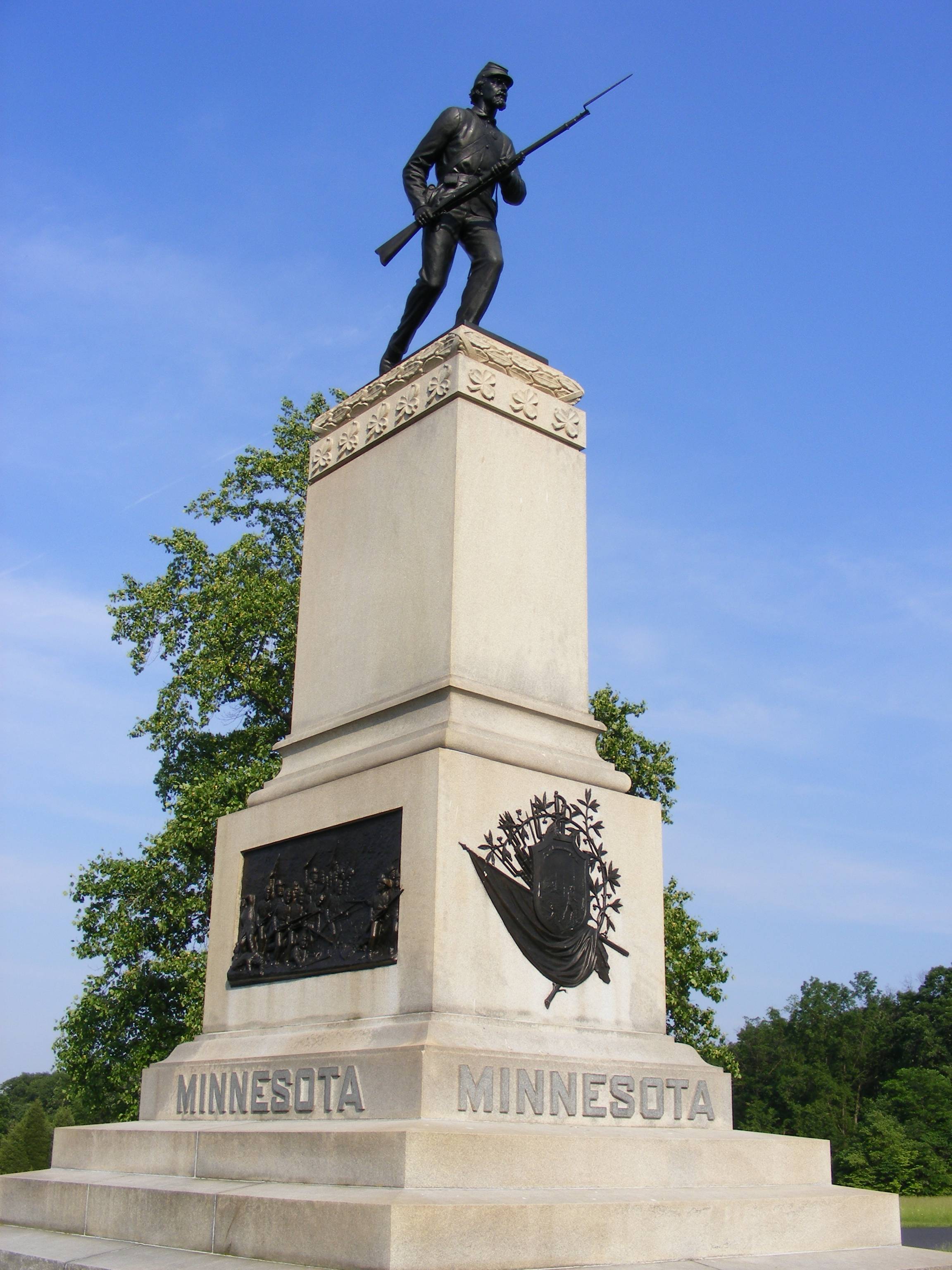
If you know anyone from Minnesota or is unfortunate enough to have to live in that ethically-addled state today, pause in your appropriate contempt for the blight on the Republic the Land of Lakes has become in recent years. Express your gratitude for their state, whose brave soldiers in this day in 1863 may have quite literally saved the United States of America and made this 250th celebration possible.
I know, I know. Minnesota has gone completely nuts. It has an incompetent, silly, uber-woke governor; its Attorney General is an anti-white racist and probably a criminal, the Mayor of Minneapolis is an Ethics Villain, it has an anti-Semitic Congresswoman who has openly admitted that her first loyalty is to Somalia, its opposition to ICE operations represents more of a genuine insurrection than anything that occurred during the 2021 Capitol riot, and the state is in a tight race with California, Washington, Oregon, New York and Maryland for the booby-prize of “Most Embarrassing State .” But ’twas not always thus.
July 2 was the second day of the decisive Civil War battle at Gettysburg, Pennsylvania, and the most complicated and wide-ranging day in the conflict. So much of desperate significance was going on at Seminary Ridge and Cemetery Ridge, on Little Round Top, the Peach Orchard, Devil’s Den and a half dozen other key features on the battle field that whether an instance of heroism was recorded or forgotten is as much a matter of chance as anything else. Even determining what was the turning point in the day’s conflict, which ultimately was won by the forces of the North, is an exercise in searching for order in chaos.
There is no question, however, that the First Minnesota Volunteer Regiment’s astonishing heroics stand out even among the many other examples of gallantry on that day. The battlefield monument to the First Minnesota is the largest erected to any Union regiment, and yet it has not guaranteed our cultural memory of the epic sacrifice those soldiers made. Other second day exploits, due to sometimes arbitrary choices made by historians and film makers, have taken up the limited space available in the public’s attention to the details of the Civil War.
This is a massive injustice. As the battle raged for Cemetery Ridge, crucial high ground occupied by Union forces but under siege by the Grays, General Winfield Hancock saw a serious breach in the Union line. He realize, in horror, that Wilcox’s Alabama Brigade was on the verge of breaking through, possible dooming Meade’s army to defeat. The attack had to be blunted and and its advance stalled until he could round up sufficient reinforcements to repel the rebels.
Hancock ordered the First Minnesota to charge the brigade and hold the position, even though its 262 men was outnumbered by a force of more than 1200. It wasn’t quite the hopeless odds face by the defenders of the Alamo, but the regiment’s prospects were grim enough.
“Every man realized in an instant what that order meant; death or wounds to us all, the sacrifice of the regiment, to gain a few minutes’ time and save the position and probably the battlefield,” wrote Lt. William Lochren, one of the regiment’s few survivors. The Minnesotans charged over 100 yards over open ground to meet the Alabama Confederates, holding them off for more than 10 minutes of bloody and desperate hand-to-hand fighting.The regiment’s flag fell five times only to rise again each time as another hero grabbed it off the ground to rally his comrades. The furious struggle provided more than enough time for Hancock to find his reinforcements and march them into place to seal the breach in the lines. The Confederates retreated.
Of the 262 Minnesotans who made the desperate charge, 215 fell, including the regiment’s commander, Colonel Colville. Who lived, who died, who was mortally wounded and who was crippled for life were all a matter of moral luck. The First Minnesota’s 83% casualty rate is believed to be the largest loss by any surviving military unit in American history during a single engagement.
General Hancock, himself a hero of the battle for his quick thinking and decisive action, wrote:
“I had no alternative but to order the regiment in. We had no force on hand to meet the sudden emergency. Troops had been ordered up and were coming on the run, but I saw that in some way five minutes must be gained or we were lost. It was fortunate that I found there so grand a body of men as the First Minnesota. I knew they must lose heavily and it caused me pain to give the order for them to advance, but I would have done it [even] if I had known every man would be killed. It was a sacrifice that must be made. The superb gallantry of those men saved our line from being broken. No soldiers on any field, in this or any other country, ever displayed grander heroism.”
Winfield Hancock is another important American figure almost no Americans remember or honor now, even though he was the Democratic candidate for President, losing to James Garfield in 1880.
The epic heroism of the First Minnesota didn’t make it into the best movie about the battle, Ted Turner’s epic “Gettysburg,” because the event was occurring almost at the same moment as the 10th Maine’s miracle stand on Little Round Top, which was a focus of “The Killer Angels,” the book on which the movie was based. I don’t believe this part of the battle has ever been portrayed on screen at all.
The monument to the 1st Minnesota at the Gettysburg National Battlefield Park, the largest monument on the battlefield, bears the following inscription:
“On the afternoon of July 2, 1863 Sickles’ Third Corps, having advanced from this line to the Emmitsburg Road, eight companies of the First Minnesota Regiment, numbering 262 men were sent to this place to support a battery upon Sickles repulse. As his men were passing here in confused retreat, two Confederate brigades in pursuit were crossing the swale. To gain time to bring up the reserves and save this position, Gen Hancock in person ordered the eight companies to charge the rapidly advancing enemy. The order was instantly repeated by Col Wm Colvill. And the charge as instantly made down the slope at full speed through the concentrated fire of the two brigades breaking with the bayonet the enemy’s front line as it was crossing the small brook in the low ground there the remnant of the eight companies, nearly surrounded by the enemy held its entire force at bay for a considerable time and till it retired on the approach of the reserve the charge successfully accomplished its object. It saved this position and probably the battlefield. The loss of the eight companies in the charge was 215 killed & wounded. More than 83% percent. 47 men were still in line and no man missing. In self sacrificing desperate valor this charge has no parallel in any war. Among the severely wounded were Col Wm Colvill, Lt Col Chas P Adams & Maj Mark W. Downie. Among the killed Capt Joseph Periam, Capt Louis Muller & Lt Waldo Farrar. The next day the regiment participated in repelling Pickett’s charge losing 17 more men killed and wounded.”
The oft-rescued flag of the First Minnesota Volunteer Regiment now hangs in the Rotunda of the U.S. Capitol.
If I were one of President Trump’s advisors, I would strongly urge him to make a formal statement today (not just another Truth Social post) recognizing and honoring this currently Trump Derangement infected state. Not because doing so will have any salutary effect on the millions of people who hate him there, of course, but because the rest of the country probably has no concept of what July 2, 1863, and the sacrifices of that Minnesota regiment meant for the United States of America. Heck, I doubt that the President knows the story.
But now you do.
Thank you, Minnesota.


Thanks for the history lesson, Jack. One of the many things I appreciate about this blog.
Second!
PWS
and connected to this could be Minnesota’s refusal to return the Virginia battle flag that it captured at Gettysburg.
https://en.wikipedia.org/wiki/28th_Virginia_battle_flag
possible Ethics Quiz: should Minnesota give it to Virginia or to the United States?
the Wikipedia entry provides a lot of interesting background on the return of civil war flags
-Jut
Evidently all other battle flags in possession of the United States (via the war department) had been returned around the turn of the century in celebration of the cooperative attitude in war between all the states in the Spanish American War.
The only exception being this battle flag as somehow it had gone missing from the war department and made it to Minnesota.
The wonder of the Antebellum republican army and general officer longevity.
General Winfield Scott Hancock: named at birth for the only-2-years-prior retired General in Chief of the United States who, nicknamed Old Fuss and Feathers, had already won fame for himself 50 years prior in the war of 1812.
Thank for mentioning that. It almost made the post.
Unfortunately my comment here will seem to detract from the heroism of the Vincent Strong’s Brigade (which included the 20th Maine).
It should be noted that their position was essential to securing the Union line but it should also be noted that the Confederate forces attacking them had just arrived at the battlefield after about a day or two of grueling forced marches (not stopping to sleep) with the final few miles being essentially at a slow but increasingly quicker jog to try to effect the flanking maneuver. They were out of water in the summer heat as well and rolling right into formation maneuvers over extremely broken ground on very steep slopes taking fire from many directions.
While the defense became desperate for the Union soldiers, it seems silly to overlook the incredible odds the southern troops would have had to overcome to win.