Comment Of The Day: “Ethics Quiz: ’13 Reasons Why'”

More important than giant chickens, more susceptible to compassionate solutions  than North Korea, and more worthy of our consideration than Debbie Wasserman Schultz because anything is, the teen suicide problem generated excelled responses to a post about it here, and was, as topics are so often, quickly buried by other controversies and events.

Lets’ discuss this a bit longer, shall we? It’s worth it. A good way is to recall one of the best comments the post about the Netflix series dramatizing a fictional teen’s suicide and its effect on her friends.  Here is Rip’s Comment of the Day on the post, Ethics Quiz: “13 Reasons Why”:

OK— this issue is one I have spent years delving into. I spent the better part of a decade doing volunteer work; developing interviewing techniques at Georgetown hospital with student actors to help train pediatric medical students on how to find youth that are engaging in or thinking about behaviors that put themselves at risk.Doctors Abrams and Hawkins have done amazing work on developing tools to reach at risk adolescents

I hope to return to  this at some point, but my volunteer work is currently on hold. Here is what I know.

75% of teen deaths, including suicides, in this country are avoidable if there is intervention in time. Suicide is the second leading cause of youth death, and LGBT youth are 4 to 6 times more likely to commit the act. Thank god for the Trevor Project and It Gets Better campaigns: they help. In the 90s when I tried to create suicide prevention programs through theater, I was told by administrators that we could not do this, as it might give the kids “ideas.”

Ugh. The statistics show they already have the ideas. Continue reading →
Ten Further Thoughts On The “The Taunting Girls Softball Team”

Well! I returned from my seminar to find an excellent discussion underway regarding this Morning’s Ethics Warm-up, wholly devoted to the Virginia girls softball team that was hammered mercilessly for the raised middle fingers of six teammates to send off their vanquished foes in the semi-finals. Here are some further thoughts after reading the comments:

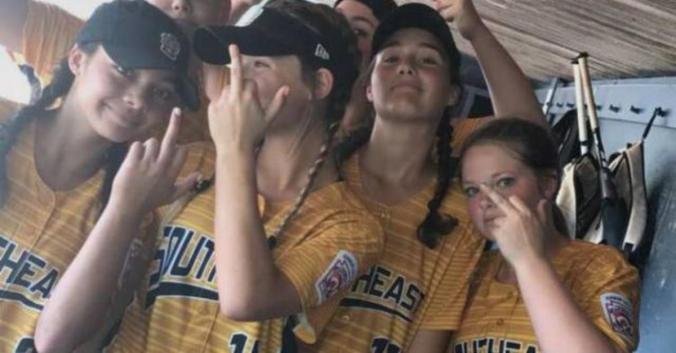
1. There is no question that the conduct of the girls concerned the game, the sport, and the League. They were in uniform. The message directed the “up yours” gesture to the other team. This is not a case where personal expression via social media was punished by an outside authority. Ethics Alarms has been profuse in its rejections of efforts by schools to punish students for their language, ideas or other expression on platforms like Facebook and Snapchat. Those are clearly, in my view, abuses of power, parental authority and free expression. This is not like such cases in any way. If a cheerleader squad, wearing the uniforms, colors and emblems of a school, behaved like these girls, punishment by the school would be appropriate, right up to the “death sentence” of dissolving the squad.

2. Would the reaction to the photo be different if it were a boy’s team? I just don’t think so.

3. The comparison has been made to the earlier post about Matt Joyce, a major league player, being suspended by the league for a comment made to one fan during a game in a heated exchange. For the life of me, I cannot figure out what anyone would think is similar about the two episodes, the primary difference being the fact that in one case, an adult was disciplined for professional misconduct on the field of play, and in the other, children were disciplined for breaching conduct their sport and organization exists in part to teach, reinforce and convey. The punishment of the player was $60,000 in lost income for a single word, not broadcast via social media. The team was not punished except to have to play without his services for two games, but then it was not colorably a team offense by any stretch of the imagination. I don’t even want to think about what an MLB team would do to six players who, in uniform, made the same gesture the girls did to “our fans.” They might all get released. Continue reading →

Morning Ethics Warm-Up: 8/8/2017: The Taunting Girl’s Softball Team

Good Morning!

I’m squeezed today like fresh orange juice!

I have an early morning ethics seminar in about 90 minutes, so one topic is all I have time for. But it is a good warm-up, reaching an ethics issue—the proper level of punishment for civility breaches in sports— recently discussed here, but with very different factors and ethical considerations involved.

Here and Virginia, many are steaming over the harsh punishment handed down to the victorious Atlee Little League girls’ softball team, which was kicked out of  the Junior League World Series,  featuring the best 12-to-15-year-old girls teams in the world, only hours before its players were about to take the field on national television. The team’s offense: an unsportsmanlike social media post, taunting its last opponent.

Atlee prevailed in a week long tournament in Kirkland, Washington, culminating in tense 1-0 victory in the semifinal game against the host team. Apparently resentment between the teams ran high, and the game featured a controversy over the Kirkland team stealing signs. (Stealing signs in a girls’ softball game? Wow. I didn’t even think there were signs in girls’ softball!)

After the victory, the carptain of the Atlee team used Snapchat to post a photo of showing six members of the team flipping the Fuck You Finger at the Kirkland team.

The Atlee manager Scott Currie heard about the post and had it deleted. Then he arranged for his team to deliver a formal apology in person  to the Kirkland players the same evening. Nonetheless, it was too little, too late. The next morning the head office of the Little League World Series disqualified Atlee from the tournament, and awarded Kirkland the berth in the title game.

The Junior League  issued the following statement:

“After discovering a recent inappropriate social media post involving members of Atlee Little League’s Junior League Softball tournament team, the Little League® International Tournament Committee has removed the Southeast Region from the 2017 Junior League Softball World Series for violation of Little League’s policies regarding unsportsmanlike conduct, inappropriate use of social media, and the high standard that Little League International holds for all its participants.”

Not surprisingly, supporters of the Atlee team, and the team itself, feel that the punishment is excessive.

Observations: Continue reading →

Ethics Quiz: “13 Reasons Why”

“13 Reasons Why” is a Netflix  television series based on the 2007 novel “Thirteen Reasons Why” by Jay Asher. A high school student receives a box containing 13 cassette tapes recorded by his friend Hannah Baker, before she committed  suicide. The show has been a critical and popular success (although the Times didn’t like it much) , and a second season is planned.

But Researcher John Ayers of San Diego State University has studied the results of the show on the culture by monitoring discussions of suicide on the internet following the debut of “13 Reasons Why.” The phrases “how to commit suicide” and “commit suicide”  have experienced a 26% and 18% increase in searches. Ayers sees no other explanation for this other than the show.  Searches for the phrase “suicide hotline number” also jumped, by 21%

Ayers now says, “Our worst fears were confirmed That is, thousands of people, thousands more, are searching online about ways to kill themselves.”

Ayers wants the first season to be re-edited to discourage suicidal behavior, and argues that the second season should be postponed. “Psychiatrists have expressed grave concerns because the show ignores the World Health Organization’s validated media guidelines for preventing suicide. The show’s staff instead continue to prefer their gut instincts,” Ayers says.

Your Ethics Alarms Ethics Quiz of the Day is this head-scratcher…

Is it ethical for Netflix to continue running the series in light of Ayers’ research and recommendations?

Continue reading →

The Bikers vs. The Bullies

I need an uplifting ethics story about now. How about you?

Fort Wayne, Indiana sixth grader Phil Mick’s was dreading his his first day of sixth grade last week. The 11-year old was routinely a target of bullies at DeKalb Middle School. Family friend Brent Warfield of KDZ Motorcycle Sales & Service learned about the child’s problem over the Christmas holidays last year, and vowed to help him solve the problem…a solution that did not involve, as it so often does with bullying, a slippery slope-courting suppression of free speech principles.

Warfield used his connections in the biker community to promote a motorcade for Phil that would show any ill-wishers that he had friends that could reform bullies in a memorable and emphatic manner if so required. Getting the word out on Facebook and elsewhere on the web ( there is a non-profit organization called Bikers Against Bullies), Warfield attracted about 50 bikers from around the state. They gathered at a local restaurant for the motorcade, and the roaring throng took a thrilled Phil Mick to his first day of school. School principal Matt Vince said that the sound reverberated off the exterior brick walls.

Vince told reporters that he commended the motorcyclists for supporting Phil while making a statement against bullying “in a positive way.”

My father, who had to change schools often during the Depression as his single mother sought work and affordable lodging, told me that as a chubby, unethletic-looking, quiet kid who refused to be submissive to anyone he was bullied at every single new school he attended. It was a ritual of his childhood, and Jack Sr.’s only available response was to fight his larger tormentors using his fists.

“Oh, I always lost,” he told me. “But I got some good shots in, and that was enough. Bullies don’t like to keep bothering the kids who fight back;’ it’s too much trouble.”

“Plus they were afraid of my dog [a big Airedale named Bumbo].”

Phil Mick’s method is even better.

The Unabomber Had A Point. [UPDATED]

FX has a new limited series about the hunt for the Unabomber, Theodore John Kaczynski. I didn’t pay much attention to the story when it was going on; I just thought it was one more Harvard-grad-turns-serial-killer episode, and that was that. I certainly didn’t pay attention to his “manifesto.” The series, however, enlightened me.  As I understand it, Ted believed that technology was destroying society, making us all slaves to it, and taking the joy out of life. I have yet to see how blowing people up addressed this problem, but then he shouldn’t have to be right about everything. The evidence has been mounting since 1995, when he killed his final victim,that  the Unabomber  wasn’t quite as crazy as we thought.

I could bury you in links, but will not.  We are slaves, for example, to passwords. I teach lawyers that their devices containing client confidences should, to be properly protective of them under ethics standards, have passwords of at least 18 random letters, characters and numbers, with the password for every such device being different, and all of them changed every month. Or you can go the John Podesta route, use “password.” and get hacked, and eventually disciplined by your bar association, once they decide to get serious.

[CORRECTION: In the original post, I relayed a link to a site where you can check your password to see if it’s been compromised. I had been forwarded the link by another tech-interested lawyer. But as I was just alerted by a commenter (Than you, Brian!) It’s apotential trap and an unethical site, making you reveal your password to check it. I apologize for posting it. See how dangerous and tricky this stuff is? See? SEE?.I fell for the trap of depending on technology to protect us from technology! Ted warned us about that, too.]

Then there is this feature in The Atlantic. An excerpt: Continue reading →

File This In The Niggardly Principles Files: The Family That Helped Build Portland’s Public School System Is Condemned To Oblivion Because The Schools Are Afraid To Teach

I really hate this story, and all stories like it. I hope you do too.

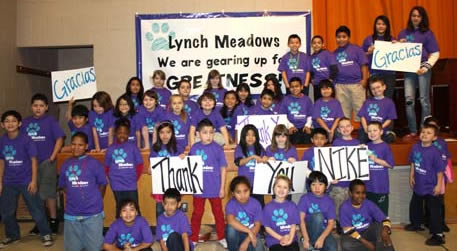
In a perfect and perfectly disgraceful breach of the First Niggardly Principle, the Centennial School District in southeast Portland will be excising “Lynch” from three schools before the beginning of this school year: Lynch Meadows, Lynch Wood, and Lynch View elementary schools. The schools were named to honor the family that originally  donated land for the the  schools to be built upon over a century ago. What, however, is the obligation to appreciate and honor those who selflessly seek to assist public education, compared to the need to cater to those whose education was inadequate? Nothing, apparently.   Superintendent Paul Coakley explains that “many newer families coming into the district associate the name with America’s violent racial history.”

Well, that should settle it, then! Why burden these narrow-minded and easily-triggered products of the victim culture with facts, knowledge and perspective?

More from Coakley: “There were an increasing amount of questions and some complaints from families of color around the name…there is no connection between the Lynch family and the practice associated with the term” but the name has still “been a disruption for some students.”

Here’s a creative alternative solution: educate them. How about that? Is that too challenging for the students? For Portland’s schools? From Wordorigins.com: Continue reading →

Bad Ethics Chess: The Insufficiently Diverse High School “Sound of Music”

The real mystery here is how the school administrators and teachers could not have seen this coming. Thus the ethical value at issue is, as it often seems to be with public education, competence, or rather the lack of it.

In April of 2016, Marshfield High (in Wisconsin) presented its annual musical.  The production involved a cast of 40 students with 30 more in the crew and orchestra. Students from two elementary schools were in the cast. The show? Rogers and Hammerstein’s “The Sound of Music,” based on the story of the Von Trapp singers and their escape from Austria when the Nazis took over.

In March 2016, a complaint was received from a parent alleging that  the musical’s casting violated the district’s non-discrimination policy.  The parent asked why the cast did not “represent the demographics of the school district” and why a deliberate effort was not made “to ensure diversity in the cast.” The parent further said that even if the organizers of the play did not intend to discriminate, they did so “in the most overt and egregious manner.” For more than a year, district officials tried to keep the complaint and the resulting investigation out of the news. Now the investigation is out, and it found that indeed the casting did violate the policy.

I didn’t have to read the whole article, or much of it at all, to guess what happened. All I needed to know was that a high school with a diverse student body had chosen “The Sound of Music” as its annual musical. Everyone has seen the movie, and knows that it is about the cutest Austrian family on Earth stocked with a group of brothers and sisters whose ascending ages and heights constitute the most vivid visual image of the play.  High schools seldom produce this musical, for exactly these reasons. A theater department barging ahead with this Rodger and Hammerstein classic will be instantly risk appearing to exclude anyone who isn’t so white that their brilliant gleam will blind the audience (and African-American Nazis are even more jarring than  Hispanic-American and Asian Austrians), or it must commit to the most show-undermining non-traditional casting imaginable. There isn’t even a true choice: if you produce this show in a public school, you have to be ready to cast a black Maria, brown Nazis, Asian Austrian nuns and a brood of Von Trapps that suggests that the Captain was rather naughty in his travels, if admirably open to amorous affections regardless of race, color or creed. Continue reading →

Morning Ethics Warm-Up: 7/30/17

Good Morning!

(I’m starting this post just a few minutes before noon, thank to a WiFi outage. I’m sorry.)

1. I finally saw “Passengers,” which most people and critics seemed to hate. I see no obvious inferiority to the over-praised and honored “The Martian” or “Gravity,” especially the latter, which bored me to tears, but never mind: it’s an ethics movie. It is also a moral luck movie, and that drove me crazy. I’ll bet so many viewers (SPOILER ALERT!) saw the film and came out saying, “She had to forgive him, because if he hadn’t awakened her prematurely to keep him company, everyone would have died!”

No, no, no! His (Chris Pratt’s) conduct toward her (that’s Jennifer Lawrence, and anyone who wrongs Jennifer Lawrence deserves the torments of Hell) was just as bad–and it was horrible—whether it turned out well by chance or not. Subsequent discoveries or unpredictable events cannot make an unethical act retroactively ethical.

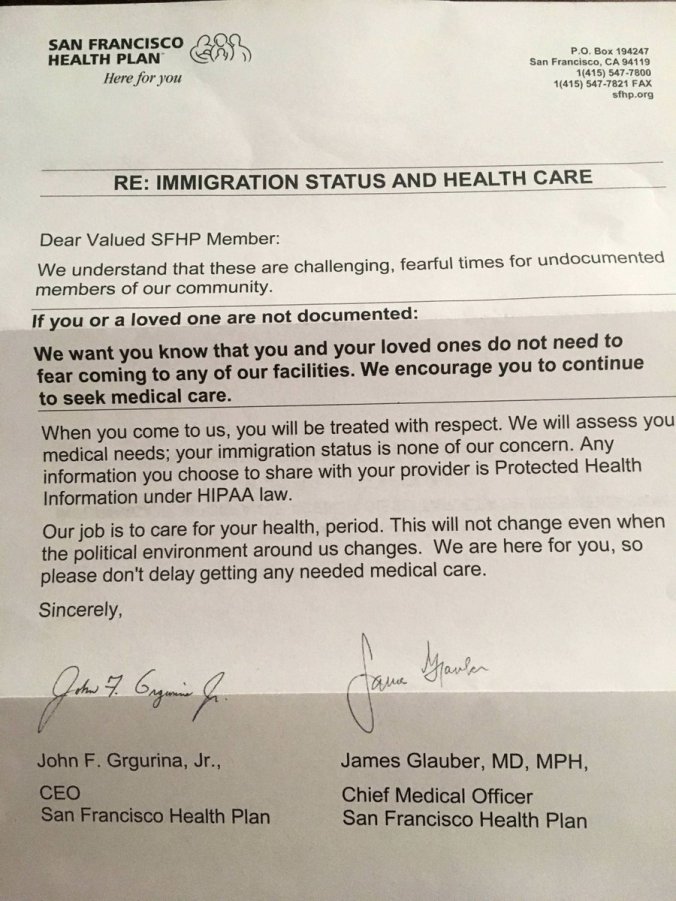
2. San Francisco’s Medicaid program sends illegal immigrants this letter:

When the anti-Trump deranged argue that the President is “crazy,” my stock answer is going to be that nothing he has said or done is as “crazy” as the position that it is right and just to officially encourage foreign citizens to breach our borders, defy our sovereignty and break our laws….and the people trying to use the 25th Amendment to execute a coup are exactly the people who think the letter above is compassionate and right. (Believing that a coup is in anyone’s interest is also demonstrably nutsy-cuckoo, but that’s another issue.)

3. I am really going to be disappointed if NPR and PBS don’t get zero-ed out of the budget. I may be stuck with biased and incompetent journalism, but I shouldn’t have to pay for it.

In a segment of NPR’s “All Things Considered” this week (Yes, I generally think the show is excellent, but that’s not the point) about the “restorative justice” approach to campus sexual assault, reporter Tovia Smith quoted Columbia University graduate Emma Sulkowiczs, aka “Mattress Girl,” as a “survivor” of rape.

She’s not a survivor; she was a harasser, and Columbia just paid a financial settlement to her victim for permitting her to proclaim him as a rapist when the evidence didn’t back the claim. Columbia doesn’t believe Sulkowiczs was raped, and her accusation has been thoroughly discredited. Why in the world would NPR choose this cruel and discredited woman to profile while discussing actual campus sexual assault, and how could it be ethical journalism to still refer to her as a rape survivor?

Smith’s tweeted response to criticism was as damning as the choice of “Mattress Girl” itself:

“Sulkowicz considers herself a survivor & we ID her as such. We’ve clarified that their school found the student she accused ‘not responsible.” Continue reading →

Morning Ethics Warm-Up: 7/28/17

Good Morning!

Thanks for dropping by.

1. Does anyone else wonder how John McCain would have voted last night if President Trump hadn’t gratuitously insulted his military service and suffering as a prisoner of war? I do. I know how much veterans care about their service and sacrifice on behalf of their country, and how deeply a public insult like Trump’s must have hurt. McCain has been seething all of this time. Maybe last night was a vote based on principle; probably McCain thinks it is. There is no doubt, however, that he hates Trump’s guts intensely, and that kind of bias is almost impossible to banish entirely. He is also probably more than a little angry that his colleagues and his party allowed someone who would treat him that way to be the nominee.

The astounding foolishness of Trump’s initial insult to McCain was framed as an insult to veterans, but the fee for his gratuitous nastiness was always going to come due in a setting like last night. Human nature can’t be taken out of politics; in fact, politics relies on human nature. These people aren’t automatons. It would be ethical to put grudges aside, but nobody should count on it.

The President reportedly called McCain to argue for a “yes” vote. I wonder if the Senator said, Scaramucci style, “Mr. President, this unheroic prisoner of war says, with all due respect, ‘Go fuck yourself.'”

I also wonder if Trump learned anything.

Nah. Continue reading →