Comment Of The Day: “Weekend Morning Ethics Warm-Up, 1/28/23: ‘The Usual’”

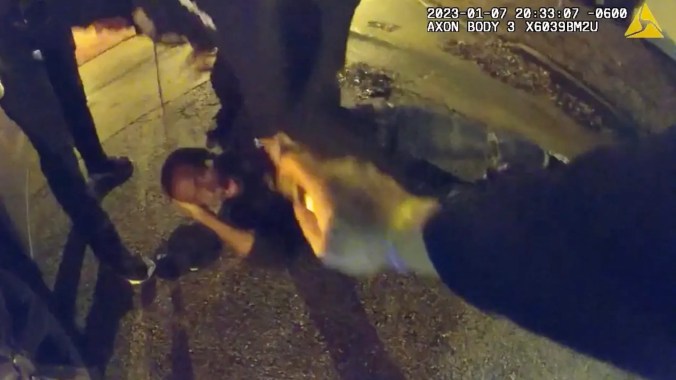
So far, the threshold ethics question that should begin any ethical analysis has not been answered regarding the horrific beating of young Tyre Nichols after a traffic stop. Five police officers were involved. That questions is, “What’s going on here?”

Emily, in her Comment of the Day on Item #1 of the post, “Weekend Morning Ethics Warm-Up, 1/28/23: ‘The Usual’,” has some thoughts…

***

I’ve been thinking about this, and the ethical breakdown that led to it. Why did the ethics alarms not ring?

The tragic state of policing Jack mentioned is part of it. But what keeps coming to mind is something Jack has brought up many times regarding dog attacks: that when they’re part of a “pack,” even otherwise well-mannered dogs become dangerous as instincts take over.

Dogs are not the only animals that hunt or defend territory in packs. Continue reading

Comment Of The Day: “In The Dispute Over The Fate Of The Elgin Marbles, It Is Time For The Brits To Choose Ethics Over Law”

Last week, Ethics Alarms confidently presented the ethics verdict that it was high time—more than high time, in fact—for the British Museum to finally return the so-called “Elgin Marbles” to Greece. As the priceless art was literally ripped off the Parthenon, I didn’t think the question justified an ethics quiz. I still am unconvinced by the arguments that the Brits should hold on to their ill-gotten gains, but I am the grandson of a Spartan, after all. There were several excellent comments asserting ethical grounds for the British position; this one was outstanding.

Here is P.M.Lawrence’s epic tutorial, rebuttal, and Comment of the Day on the post, “In The Dispute Over The Fate Of The Elgin Marbles, It Is Time For The Brits To Choose Ethics Over Law”:

***

“In the early 1800s, Lord Elgin, a British aristocrat, shipped to England treasures of Greek antiquity that he had strip-mined from Greece, including the carved frieze panels that had decorated the Parthenon. Supposedly this was done with the permission of Turkey, which was then ruling Greece, which is like your home invaders giving neighbors permission to take the art off your walls…”

There is a little more to it than that:-

– On the legal maxim of “nemo dat quod non habet”, of course the Turks couldn’t convey title. But they didn’t, they offered a quitclaim, as it were; they removed themselves from obstructing.

– As regards any original owners, there simply weren’t any left. The last remaining ones were ended by rounds of persecution of pagans, centuries earlier.

– As far as any generic claims of common heritage of western civilisation go, and those claims only go for want of better (there being no direct heirs), what better place to put the items than in a museum furthering that common heritage? Are the British somehow less heirs of that than are the Graeculi? Particularly considering how much safer the items were in that museum(those not taken have suffered horribly from war, corrosion, and what not). And, of course, the very word “museum” proclaims that furthering that common heritage.

Now, none of that conveys title to the British Museum, but adverse possession in the years since does – adverse, in that no better claimant came forward. Just as today’s Greeks feel an understandable connection to these items, as they do to the Lions of St. Mark’s, so too do today’s British – and as today’s Venetians do to the Lions of St. Mark’s. They are as intertwined with the histories of each place as of the other.

The Solomonic solution would be to sand blast the items to the condition of those not taken if any effort to transfer them were ever made. But I expect the Sir Humphreys will loudly assert ownership while underhandedly arranging a loan in name only with no means of foreclosing, just as they have with foundational documents that ought to have remained in British archives. That would satisfy none but the Sir Humphreys.

Continue reading

Comment Of The Day: “DeSantis, The NHL, And The Duty To Confront”

We don’t get much hockey ethics on Ethics Alarms, and it is one of the sports i don’t pay much attention tp despite going to a high school that was considered a hockey power in the ice-crazy Boston area. Arthur in Maine, another, more typical New Englander, does know the sport, and in this Comment of the Day on the post, “DeSantis, The NHL, And The Duty To Confront,” he gives us valuable perspective on why hockey, perhaps more than most sports, has a legitimate need to seek more “diversity.”

Incidentally, I couldn’t name the teams affiliated with more than half those logos. I bet Arthur could identify them all.

***

I have rather mixed feelings on this one… because as baseball and the Red Sox are to you, Jack, hockey and the Bruins are to me.

Hockey was the only team sport I played growing up (and I was terrible at it). But I did love it. At the time, you basically stood no chance of advancing in the game if you weren’t Canadian, preferably Quebecois. That’s largely because only Canada had made the investment into developing young players, starting around age four and moving up with organized league play from there. (Apropos of nothing, the first black player to reach the NHL was Canadian Willie O’Ree, who played for the Bruins in 1958 and again in 1961, though most of his long career was spent in the minors).

Let me stipulate that as a matter of both law and ethics, I consider DeSantis to be on very firm ground here. But it’s also worth noting that hockey has made a long and concerted effort to bring more people into the fold. It arguably started when Europeans and Russians were recognized as terrific players (those nations had development programs) and started receiving NHL contracts. Although the players are still mostly white, black players are no longer a curiosity and have proven some of the best players in the past decade (most of them are Canadian by birth). Today, there are practicing Muslims and players of Asian heritage in the league. Any player who has the skills and the heart to play at the NHL level has a shot at a contract (side note: some European players have a little trouble adjusting to the NHL game, because although North American rinks are roughly the same length as European ones, they’re considerably narrower).

It goes beyond that. In addition to active youth hockey programs all over the northern hemisphere, there’s remarkable development of girls’ and womens’ hockey as well, with serious collegiate programs, world championships and Olympic competition. There are programs for paraplegics and amputees. All in all, hockey as a sport – and it’s been an international effort – has become far more diverse and inclusive, and that process started long before any of the current wokeness. One could argue that it’s merely because this is good for business. I have a friend with two girls in middle school, both of whom are extremely active (and reasonably talented) players. Both know there’s no chance they’ll ever play in the NHL, but that doesn’t stop them from playing their hearts out now (and screaming their heads off when Dad takes them up to see the Bruins, where he lays out big $$ for tickets, refreshments and fooferaw – and that doesn’t touch what he pays each year for equipment and ice time for his girls).

Comment Of The Day: “Climate Change Media Hype, 2022”

I was feeling guilty about taking so long to give this spectacular Comment of the Day by Ryan Harkens the exposure it deserves, but I am glad I did. I’m pretty sick today, and getting a fourth post up was really going to be a challenge; Ryan’s profound essay is better than anything I was going to be able to produce…indeed, it’s better than most of what I write here.

Ryan’s’ topic is science, and climate science in particular. I’m honored that he vewed this forum worthy of such thoughtful and profound work.

Here is Ryan Harkens’ Comment of the Day on “Climate Change Media Hype, 2022”:

***

In the analysis of any phenomenon, there are several layers to peel back:

1. Is the phenomenon real?
2. Is the phenomenon being measure accurately?
3. Is the phenomenon on a whole beneficial or deleterious?
4. Are the causes of the phenomenon understood?
5. Are there solutions to the phenomenon?
6. Do those solutions cause more problems than the phenomenon?
7. How should those solutions be applied?

We have to understand that science is about creating hypotheses about the real world and testing them. Science collects data, analyzes data, makes predictions about the data, and then observes whether those predictions come true. Thus science can help to a certain degree with the first 6 items on the list, but it has much less to say on the 7th. But even for the first 6, science does not necessarily provide definitive answers, certainly not enough to say that any “Believe the science!” mantras should be heeded. In more detail:

1. Science can offer a tentative answer to whether a phenomenon is real. Upon testing and retesting, it can assert with a certain degree of confidence (never 100%) that a phenomenon is indeed real. But there could always be further data discovered that shows the phenomenon was not real, or at least what it was was much different that was proposed. In the case of climate science, we have observations since the 1970s that show a general warming trend. It seems very reasonable to accept that we’ve seen a general warming trend since then. However, even now there are some factors that could still upset that conclusion. The urban heat index could be greater than we imagined; the fact that most of the temperature gauges we’ve used around the world are located in first world countries, leaving much of the world unmeasured; and the reliance on satellite data (while currently of high confidence) might have some undiscovered error that invalidates 50 years of data collection. (I’m not saying this is the case or I have any evidence satellite data is flawed, just that that would be an example of how even our belief that the world has been warming could be in error.)

2. Science can only measure to a certain degree of accuracy. Again, the issues of urban heat index and the location of various temperature gauges could skew the data, and while global warming could be a real phenomenon, the degree to which the world is warming can be misrepresented by poor measurements. Similarly, efforts to reconstruct historical climate patterns based on ice core samples, tree rings, and other methods could be helpful, but still inaccurate, and thus lead to different conclusions about current warming or cooling trends. Furthermore, there is the question of whether we are truly measuring the right things? We need to measure air, land, and water temperatures at a variety of elevations, and we have to properly measure the incoming energy in the earth’s systems, as well as the outgoing energy of the earth’s systems, and this leads to literally hundreds of thousands of data points for one timestamp. Multiply that by years of data, and we are talking about an enormous amount of data, and we could still be missing a crucial measurement that we didn’t think we would actually need to measure. Continue reading

Comment Of The Day: “The 2022 Ethics Alarms Companion To ‘Miracle On 34th Street'”

Of the three Ethics Alarms ethics companions to classic Christmas movies, the “Miracle on 34th St.” edition has attracted the most criticism. That’s strange, because 1) it is my favorite of the three and 2) I am more critical of the ethics features of “It’s a Wonderful Life,” and even “Miracle’s” biggest fans ( I’me one of them) have to concede that IAWL is a great work of art, while the tale of Kris Kringle is “just” excellent entertainment. P.M. Lawrence is the only Ethics Alarms reader who attempted to jot down substantive objections to the post, and that alone made his comment COTD-worthy. He also did a good job, as usual, and his critique did not include a hint of “How dare you?”

I addressed those critics in a coda last year that I omitted in the 2022 version, beginning with one commenter’s  I suspect we could poke holes in any film with respect to morality and ethics if we wanted to,” a commenter wrote last year”.

My retort:

  • I want to, because it’s my job
  • Movies are excellent for tuning up ethics alarms
  • Christmas movies, which are seen by children, have a special obligation to teach the right lessons, both prominently and subliminally, and
  • No, in fact you can’t poke holes in any film, at least not fairly.

I agree that this film is a classic. It is also clear that the story was constructed to reach the climactic trial gimmick, and scant attention was given to consistency or playing fair. I am a legal ethics specialist, after all. You can’t expect me not to analyze a crazy trial like that.

I will never try to “poke holes” in the greatest of all Christmas stories or its film adaptations,  arguably the greatest ethics story of them all, “A Christmas Carol.” That is because it is pretty close to perfect. There are other holiday films and ethics films that are written superbly, and have few if any ethics holes to find. Among these are “Toy Story,” “Finding Nemo,” “Mary Poppins,” “The Sound of Music,” “Babe,” and even “Groundhog Day.”

I’m not the Grinch, as even a perfunctory perusal of this blog’s endorsement of the Christmas holiday over the years will show. If you set out to make an ethics movie, though, you had better pay attention to ethics.

Here is P.M. Lawrence’s Comment of the Day on the post, “The 2022 Ethics Alarms Companion To ‘Miracle On 34th Street'”:

***

Continue reading

Comment Of The Day: “At Least This Time They Didn’t Blame Pitbulls…”

Happy Boxing Day, for those of you who have servants, butler and and the like! Do make sure your underlings enjoy a Christmas-like experience a day late, after caring for you and your family yesterday!

Ethics Alarms will kick off its Boxing Day festivities with another terrific Comment of the Day by Mrs, Q. I’m hopping it over two other COTD in waiting, in part because I feel guilty: her post was stuck in moderation because I was “making a bit merry yesterday” (Source?) and neglected the blog comments. I apologize to Mrs.Q and my readers. Her comment was stuck because it included many invaluable links to additional information.

She addressed the horrible incident discussed in yesterday’s commentary regarding a fatal dog attack last week that took the life of a couple’s newborn child. Mrs. Q concentrates her ethics marksmanship on an aspect of the story that I mentioned, but only broadly: the parents’ accountability for the tragedy.

Here is Mrs. Q’s Comment of the Day on the post, At Least This Time They Didn’t Blame Pitbulls…

***

Perhaps I’m being harsh, but I do think the parents and every parent or guardian this happens to, should be charged.

We have an incredibly irresponsible ethos going on in the world of dog ownership. People who willingly choose to have a dog, of any size dog, around small children, without educating themselves on danger behavior signals, is complicit in spreading such violence.

The killings of children is just a part of it. 50% of kids under 12 have been bitten by dogs. Most dog bites children experience happen over 70% of the time on the face and neck. Continue reading

Comment Of The Day: “Still More Twitter Ethics: Musk’s Cynical Poll And Another Twitter Files Summary”

I’m a bit behind in posts covering the Twitter Files; I’m also behind in posting Comments of the Day. Ethics Alarms veteran Glenn Logan authored one more than a week ago, and had it not been for a recent comment that rang my “Glenn Logan” alarm, this one might have been lost.

Here is Glenn’s Comment of the Day on the post, “Still More Twitter Ethics: Musk’s Cynical Poll And Another”Twitter Files” Summary”…

***

Jack wrote:

Musk can’t run Twitter by poll, though, if he is truly devoted to promoting free and open public discourse.

No, you’re right about that. It needs to stop. The optics are very poor to anyone not invested in Twitter at the expense of rational thought.

“The past seven years (or more) make the conclusion unavoidable that the FBI is untrustworthy, partisan, corrupt,dangerous, and a threat to undermine the Republic. That is not a news that easy to process or accept, but it can’t be ignored or shrugged off any more…”

The FBI has always been a problematic venture. It was corrupt nearly from birth, and we are surprised that it somehow has changed its spots over the decades? Sure, there have been a few stretches where it was less corrupt than at others, but at its core, it is a functioning federal bureaucracy with a law enforcement component, largely governed by political partisans.

That partisanship has clearly been allowed to filter down to at least middle management and even the rank-and-file. Throw in the “You’re either with me or against me” politics of the social media age, and how can you not have a corrupt catastrophe?

Disbanding the FBI root and branch would be a huge public service. Continue reading

Comment Of The Day: “Ethics Quiz Of The Day: ‘Gotcha!’ Or ‘Benefit Of The Doubt’?”

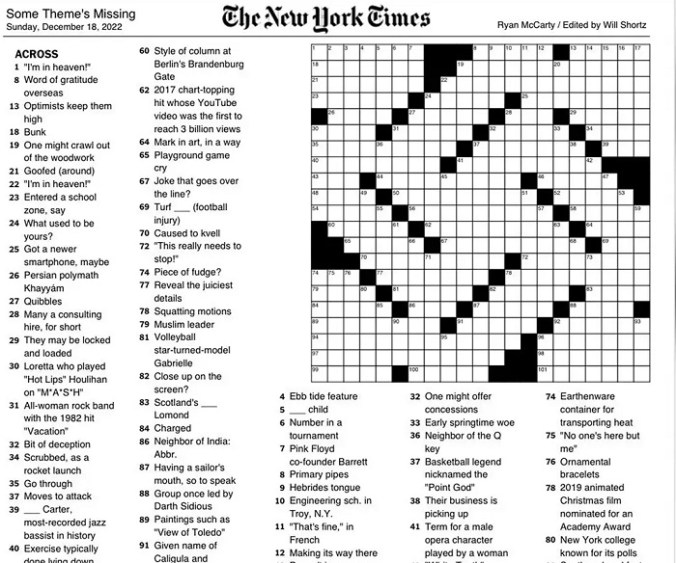
The recent ethics quiz about the apparent swastika pattern in the New York Times Sunday crossword puzzle triggered many fascinating responses, none more so than curmie’s Comment of the Day. Here (again) is the provocative puzzle:

…and here is curmie’s COTD on the post, “Ethics Quiz Of The Day: ‘Gotcha!’ Or ‘Benefit Of The Doubt’?”:

***

This one is fascinating. Were I still in the classroom, I’d definitely be using it as an example of the way the postmodern idea of meaning being created by the receiver rather than the sender plays out in real life as well as in art per se.

There’s a little bit of Hanlon’s Razor, a little bit of Paul Simon’s line in “The Boxer” that “a man hears what he wants to hear, and disregards the rest.” However we frame it, it seems to me that an individual’s response to this stimulus tells us more about the respondent than it does about the creator of the puzzle. I say this as neutrally as possible: there are those, like Steve Witherspoon, to whom “the white outlined swastika jumped off the page.” There are those, like P.M. Lawrence, who struggle to see the design even when knowing what to look for.

Two observations, both of them important. First, neither response is wrong, although they seem totally at odds. Second, I am not suggesting that an individual’s response is necessarily linked to an ideology or demographic. That is, having a positive or negative view of the NYT, leaning to the left or the right politically, being Jewish or not… any of all of these considerations might influence our reactions, but I’d be surprised if there aren’t a significant number of people from every combination of these factors on both sides of this issue. Continue reading

Comment Of The Day: “Comment Of The Day: A Language Ethics Quiz: Regarding ‘Groomer’”

This is complicated. Humble Talent’s Comment of The Day, in addition to being sparked by Mrs. Q’s comment, also responded to the comment on Mrs. Q’s Comment of the Day by dekerivers, whose quote begins Humble Talent’s post. All are relevant to the assertions about the term “groomer” made by RL Stroller, which are discussed here.

Got all that? Good…now, as my dad used to say in such situations, explain it to me.

***

“From my perspective as a gay man, teachers and school programs today are designed to foster a child to see themselves as who they are and allow for the expression of their individualism, which includes sexual orientation and identity.”

From my perspective as a gay man, if that actually all they were doing, we probably wouldn’t be having this conversation. Oh sure, there are legitimately Americans who still hate the fact that gay people exist, so *a* conversation would be going on, but it wouldn’t be this one.

And that, I think, basically encapsulates my disagreement with you: You ignore too much. you accept to much. You have done what so many people who identify with the acronym have done and taken in some awful people who have done shitty things and wrapped them up in the protection of inclusivity.

Just recently, during the Balenciaga SNAFU… There was a contingent of people saying that the moral panic du jour over pedophilia was an attack on LGBTQ people. Now, I believe that was a poorly designed shock campaign gone bad… But no one mentioned gay people. No one mentioned groomers. This is something the LGBTQ community took upon themselves, and I’m left standing at the outside of that, horrified at the implication. I don’t know how much lifting that + does for you, but it apparently does some heavy lifting elsewhere. I make it simple: Pedophiles don’t get to sit at my table. I don’t see an attack on pedophiles as an attack on me. I don’t know what exactly went on in Balenciaga’s office space, but it was fucking dumb, and no skin off my ass if they get called out.

Continue reading

Comment Of The Day: “A Language Ethics Quiz: Regarding ‘Groomer’”

And now an important word from Mrs. Q that I wish could be circulated and read far and wide, on the post, A Language Ethics Quiz: Regarding “Groomer.” (I’ve just got to find a way to get more readers here. I’m sorry, Mrs. Q. You deserve better.)

***

Gays Against Groomers is not a conservative group at all. The people in GAG are mostly gay or trans and stand against sexually inappropriate indoctrination of youth as well as against modifying the bodies of kids in the name of gender theory. This group has been denied services from several companies including payment processing and merchandise makers.

GAG’s crime, of course, isn’t that they’re “conservative” but that these renegade gays and trans citizens aren’t going along. In the world of progressivism, not knowing your place as a minority is even worse than being conservative. This is why people call GAG an “anti-gay transphobic hate group”— which of course makes no dang sense.

The Department of Justice has used the word Groomer for years. I read some of the DOJ’s reports on school grooming by teachers and other staff. This has been an unsaid issue for decades. The difference now is that the grooming is more diffuse in schools and done by woke staff who don’t see any issues down the road with exposing kids, including LGBT kids, to sex and gender identity concepts that are not age appropriate and that should be discussed with parents first.

Yes, this is grooming because such exposure seeks to eliminate innocence and circumvent parental moral teaching.

Continue reading