Ethics Hero: Julio Diaz

[This story, from National Public Radio’s Storycorps, is three years old. But an Ethics Hero is an Ethics Hero whether Ethics Alarms recognizes him or not, and this is a Dickensian tale if there ever was one, about a man whose ethical instinct are so impeccable that they make me feel terribly inadequate. Ethics Alarms reader and commenter Tim LeVier brought it to my attention….thanks, Tim, once again.]

In February of 2008, 31-year-old social worker Julio Diaz, as he often does,  ended his hour-long subway commute to the Bronx one stop early so he could have dinner  at his favorite diner. Diaz was walking toward the subway stairs when a teenage boy with a knife stopped him and demanded his wallet.

“Here you go,” said Diaz.  As the teen walked away, Diaz added, on an impulse, “Hey, wait a minute. You forgot something. If you’re going to be robbing people for the rest of the night, you might as well take my coat to keep you warm.” The mugger was stunned. “He asked me, ‘Why are you doing this?'” Diaz’s reply: “Listen, if you’re willing to risk your freedom for a few dollars,  you must really need the money. I was going to get dinner and if you want to join me,  you’re more than welcome.” Continue reading
Ethics Quiz: The Case of the Fake But Accurate Social Security Card

A conundrum I have been asked to solve:

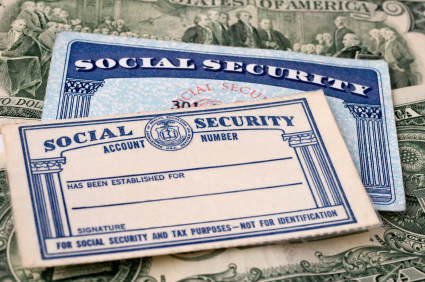
A mother is working to get her foreign adopted child a new copy of his Social Security card, which was lost. The child is a citizen since infancy, and a SS number has been assigned to him, but the process for a naturalized alien to get another is long and fraught with red tape, delays and frustration. So far, replacing the card has taken ten months, though it was supposed to take three. Now the son is waiting for the card to be issued. Social Security says it is waiting for final approval from Immigration, and Immigration says that there is a bottle neck, but not to worry.

Meanwhile, the boy has a standing job offer for a job that he is excited about and that would help family finances considerably. He cannot be processed without a Social Security card, however. And the job will not be held open forever.

For $250, a friend of the mother’s can get a counterfeit Social Security card with the son’s real number on it. He can have it in a week,

Your Question, in the last Ethics Quiz of 2011:

Granted that getting such a fake card is illegal, is it unethical?

None of the agencies involved dispute his citizenship, that he is enrolled in Social Security or that his number is valid. He has a document from Social Security that lists his number. The fake card would not assert anything that wasn’t true, except that he actually had the official card. He would be offering fake proof, but fake proof of something that is undisputed and true.

Is this one of the rare cases when conduct would be both illegal and ethical?

I’ll take your responses and update this with commentary later.

A Inconvenient Question About the Death of Walter Vance

"He's everywhere! He's everywhere!"

I have little to add to the tragedy of Walter Vance that can’t be found in the list of 15 Ethics Alarms about failures to rescue that I posted during the recent Penn State discussions. Vance was the shopper who collapsed in a South Charleston, West Virginia Target store during the Black Friday rush and was ignored by dozens of other shoppers, some of whom stepped over his body to seek more bargains. Vance later died.

I do have one little question, though.

I wonder how many of those shoppers who callously reacted to Vance’s peril with indifference told everyone who would listen earlier this month that had they witnessed Jerry Sandusky’s sexual assault on a child in the Penn State showers like Mike McQueary, they would have rushed to the rescue, even if it meant battling Sandusky.

My guess?

Every single one of them.

[More thanks to Rick Jones, who writes about the Vance episode here, and nudged me to comment on it too.]

Ethics Quiz: Apologies For A Sandusky Joke?

My uneasy relationship with the TSA continues.

Yes, I've sunk so low that I actually seek this out...

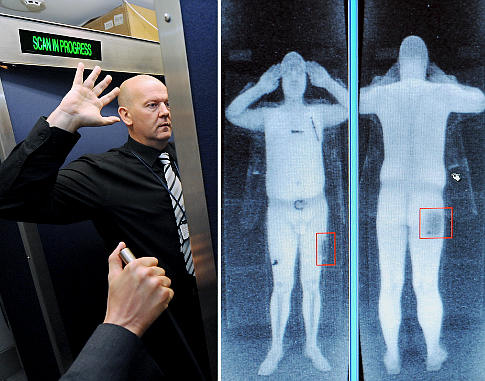
Today I was returning home from Atlanta, and its monster of an airport has one the cattle pen systems for going through security–a long, ling, line to all gates that keeps dividing and dividing, ultimately sending you down one of about 20 chutes to be scanned, stripped and yelled at. It is difficult to pick your chute, but in my case, it is crucial: Atlanta doesn’t have the full-body scanning devices in every line, and without it, I get gated, beeped, and sexually molested, thanks to my artificial hip.

It took ducking under a couple of barriers, but I finally got to an x-ray conveyor belt near a scanner, and had removed my laptop (separate bin) belt, jacket and shoes (not allowed in a bin in some cities, allowed in others) and lined them all up with my bag and brief case when an agent (none too politely) told me that they were closing that line, and directed me to another one, two lanes over. I lugged the three bins, bag and brief case over to that line, only to discover that it didn’t have a scanner.

That did it. I erupted at one of the agents, telling her that I did not care to be felt up at 8 in the morning, thanks, and had made a good faith effort to direct myself to a scanner, being foiled by the agent and by the fact that there are no signs warning people like me where a testicle massage is the only option.

“Why aren’t there signs?” I asked.

“I don’t know. There should be,” she said, as she helped me move my stuff to a scanner accessible line. “You should write the TSA and the airport.”

I laughed bitterly. “I’m sure that will do a lot of good. Do you all jsut like feeling up passengers? Is that the reason?”

A woman behind me laughed and said, “It sure seems like it!”

“Well, you know,” I said to her, “I hear Jerry Sandusky is trying to get a job as a screener!”

Her guffaw was interrupted by 7’8″ TSA agent, who said, loudly, “No he’s not, and I’m offended by that statement.”

My response, after a second’s consideration, was this: “I’m sorry I offended you. But I’m not apologizing.”

Your ethics quiz of the day: Should I have apologized? Continue reading

Ethics Dunce: An Unknown Diner

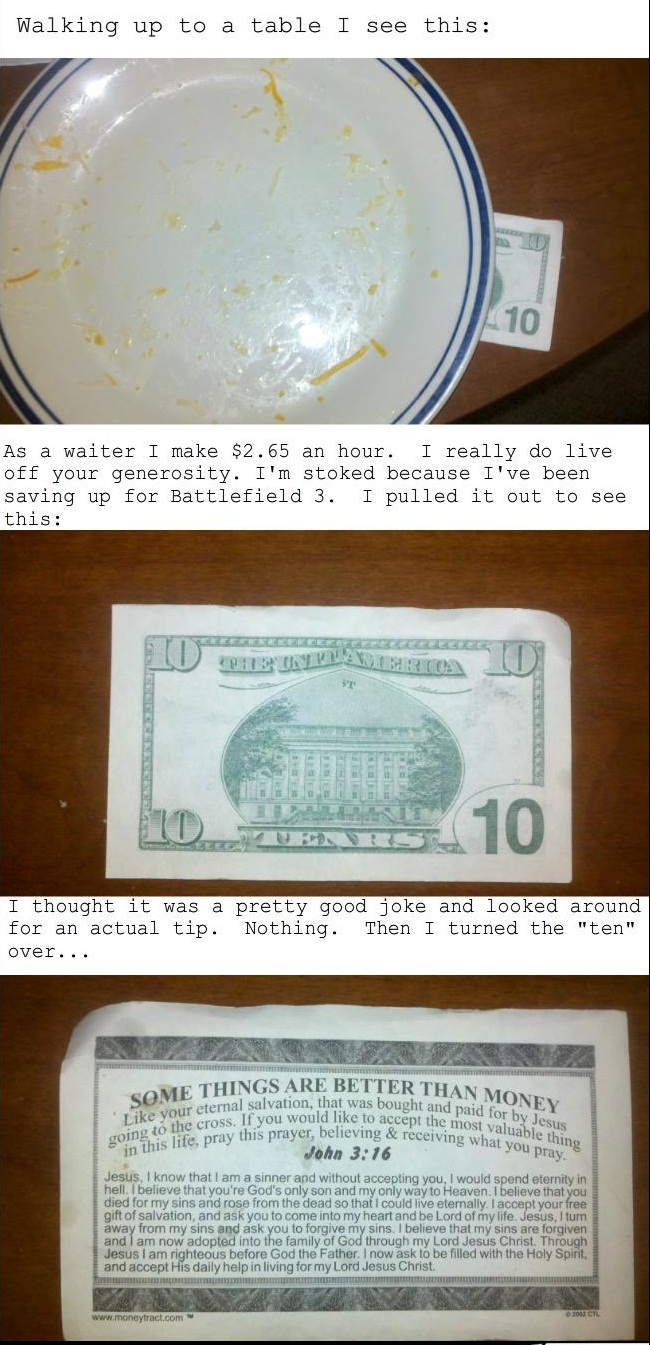
A waiter’s tale from a website called An Orange Box:

The waiter vows vengeance.

Here’s tip to the Faithful: this isn’t the way to convert anybody.

Judging McQueary: Child Rape Bystander Ethics

You have no excuses, Kal-El. But the rest...

“It was cowardly for a 6′4″ graduate assistant to witness the rape of a child by an older man and not only take no action to stop it but also not even call the police,” writes David French in the National Review.

He is, of course, referring to Mike McQueary, then a 28-year-old graduate student assistant coach for Joe Paterno at Penn State. Others have declared that it was an “absolute moral imperative” that McQueary physically intervene to stop the sexual assault.

It is interesting that the absolute moral imperative is nonetheless linked to qualifiers. French references McQueary’s size and the fact that the alleged assailant, Jerry Sandusky, is older. Some critics have focused on his gender. Still others, making the argument that McQueary failed to intervene because he didn’t take a child rape seriously enough, have suggested that he would have acted differently had Sandusky been beating, rather than raping the child. Of all the ethical debates surrounding the Penn State scandal, the question of how much scorn should be heaped on McQueary for not acting immediately to stop the rape in progress has been the most fascinating, and to my mind, the most disingenuous. It appears that every commentator, male or female, young or old, fat or fit, is convinced that would have charged in and battled the 57-year-old former wide-receiver, pummeling him into wet submission while the child escaped. Maybe. Studies and anecdotal evidence indicate that in fact, most people wouldn’t physically intervene. Perhaps sportswriters and op-ed writers are made of sterner stuff that the rest of the public.

Yes, that must be it.

None of this is to suggest that physically stopping a child rape in progress isn’t the right thing to do; it is. For his part, McQueary reputedly didn’t take any action to stop the assault,* which in order of effectiveness would be… Continue reading

My 15 Hollywood Cures For A Paterno-Penn State-Sandusky Hangover, Part 2

Part 1 listed the first seven of my 15 cinematic remedies for Penn State-inspired ethics ennui. Part 2 includes the final eight. Please don’t take the order too seriously; I could have shuffled the whole batch. I also tried to include as many genres as possible. When it comes to ethics, good lists can be compiled using all Westerns, all sports movies, all war movies, courtroom drama or science fiction. Here we go…

8Spartacus (196o)

The raw history is inspiring enough: an escaped gladiator led an army of slaves to multiple victories over the Roman legions in one of the greatest underdog triumphs ever recorded. Stanley Kubrick’s sword-and-sandal classic has many inspiring sequences, none more so than the moment when Spartacus’s defeated army chooses death rather than to allow him to identify himself to their Roman captors (“I am Spartacus!”)

Ethical issues highlighted: Liberty, slavery, sacrifice, trust, politics, courage, determination, the duty to resist abusive power, revolution, love, loyalty.

Favorite quote: “When a free man dies, he loses the pleasure of life. A slave loses his pain. Death is the only freedom a slave knows. That’s why he’s not afraid of it. That’s why we’ll win.” [Spartacus (Kirk Douglas)] Continue reading

Penn State Primer: 15 Ethics Alarms on the Duty to Rescue and the Bystander Problem

Tiring of the smug and remarkably vicious Paterno defenders who have designated Mike McQueary for infamy because he failed to stop the Penn State child rapist in action, and who have accused me of supporting such inaction in rescue situations when my position, record, writings, belief and life experience proves the opposite, I offer these previous Ethics Alarms posts on the topics of rescue and bystander inaction. It is a useful, if sometimes disturbing review of various aspects in a complex issue. I don’t really expect the commenters previously referenced to allow rational thought to interfere with their certitude and vendetta, but most visitors here are not so wired.

A new post, focusing especially on McQueary, will be along soon, but today is Veterans Day, and I have my own duty to attend to: honoring Maj. Jack Marshall, Sr., 1920-2009, WWII veteran, Silver Star, Bronze Star and Purple Heart veteran, a true hero his entire life, in every way imaginable.

I am quite confident that he would not only have stopped Jerry Sandusky from molesting the boy, he might well have shot him.

Here are the 15 selected essays: Continue reading

Comment of the Day: “Mike McQueary and Me”

Some recent Ethics Alarms commenters

Joseph Edward bought me some time with this superb Comment of the Day, because I am writing a post on the same topic. Mike McQueary’s conduct in the locker room, when he allegedly witnesses Jerry Sandusky raping a boy,  has generated some of the most self-righteous and, I may say, annoying comments I’ve encountered on Ethics Alarms, characterizing my commentary (in “Mike McQueary and Me”) on why McQueary might have acted as he did with excusing his conduct. Most of these, I’m relatively certain, are motivated by those who want to shift responsibility for the Penn State debacle away from Joe Paterno.

One particularly persistent and vociferous commenter has decreed that it was an “absolute moral obligation” for McQueary to physically intervene to stop the assault he witnessed. Joseph touches on that dubious contention; I’ll have more to say about it soon. Meanwhile, here is his Comment of the Day, on “Mike McQueary and Me”: Continue reading

A Close Call at Integrity Junction


What might have been...

It’s so easy to violate your integrity. It also can become a habit. I just had a close call at Integrity Junction myself, and, of all things, another blogger saved me. In part, this account is to thank him.

It was inevitable that the daily task of highlighting and discussing ethical issues and the ethical choices of others would generate some backlash, and it certainly has. As a lawyer, I know where most of the landmines are, but the danger of a deep-pockets corporation that has been properly chastised budgeting enough money to ruin you with a spurious lawsuit is always a possibility. In eight years of writing online about ethics, I have only been successfully bullied into taking down one post, that one regarding a viatical settlement company that was even more sleazy than the industry generally. The article relied heavily on direct quotes from the company’s own website, yet I received a stern “cease and desist” letter from the company’s toady of a general counsel, accusing me of libel and defamation.

2005 was a tough year at ProEthics, which was just getting established; the mortgage was a monthly challenge, and we had several financial emergencies. It was no time to spit in the wind, especially in defense of a web post that would probably get a total readership approaching the roster of a weekend bowling team. I pulled the article. It has bothered me ever since. But as a remarkable number of commenters on the “Mike McQueary and Me” post seem to be unable to comprehend, real world, pragmatic and yes, selfish considerations do factor into ethical decisions. The trick is to know how to do the factoring, and even more important, to have prepared yourself to do the analysis quickly when the time comes.

I recently received another cease-and-desist letter, demanding that I take down a post I wrote a few months ago, based on an AP story about the mismanagement of several 9-11 charities. One of the operators of the charities mentioned in the story and in my post has hired a reputation-cleaning outfit that is doing all of the dubious tasks such companies do, including complaining, harassing and threatening websites and blogs that include negative opinions or facts about their clients. The hit-group assigned to me has added bogus comments to the post (failing to mention that their opinions were bought and paid for), and repeatedly sent me ominous e-mails hinting at impending legal action. Continue reading