Let’s Get The Week Off To A Positive Start With Encouraging Ethics Stories! Like…Oh. Never Mind…(Part I)

I try. I really do. In 2016, it was about this time when I started getting complaints that too many of the posts were about political topics…what I needed to do was write more about people in lobster hats.

I search the most obscure sources to try to find non-political ethics topics. I’m so sick of the politicizing of everything I could spit—in fact, I think I will. There. Just let me wipe off the screen… The final straw may have been having to look at “Black Lives Matter” in the center field bleachers in Fenway Park. I’m about to grab my machete and run amuck.

However, the attempt by the Democratic Party, “the resistance,” and the mainstream news media to try to first, rig the 2016 election, then to undo the 2016 election, then to deny the legitimacy of the President elected, then to try to engineer a soft coup, and now to use disinformation, and social unrest to corrupt the 2020 election, in total a general assault on democracy and our culture of democracy itself, is the most important ethics  story of the past half-century by far.  It is among the three most consequential ethics stories of the last hundred years, along with the civil rights movement and the Red Scare/McCarthyism.  This is an ethics blog. I have to write about it.

But I promise to keep searching for as many non-political stories as I can find. I do miss the assistance of now retired crack ethics story scout Fred, who somehow sniffed out issues and controversies from the damnedest places, but many of you are helping out. Keep looking.

1. What’s going on here? Why isn’t it obvious to everybody?  In Illinois, leaders in education, politics and other areas gathered in Evanston yesterday to demand that the Illinois State Board of Education….wait for it!… eliminate history classes in public schools statewide.  State Rep. LaShawn K. Ford held a news conferences to argue that current history books create a racist society and overlook the contributions of women and minorities, so school districts should immediately remove history books that “unfairly communicate” history. “It costs us as a society in the long run forever when we don’t understand our brothers and sisters that we live, work and play with,” Ford said, explaining that he is sponsoring a bill that would require elementary schools to prioritize teaching students about the civil rights movement.

Of course, this is an open demand for propaganda rather than education,  advancing the core belief of Black Lives Matter that Fac’s Don’t Matter. What is significant is that Ford and others are so transparent about it. Those who have actually read about history—it’s not as if schools competently teach it now—know that fanatic movements keep pushing for increasingly extreme demands as long as as those in power and the public hesitate to say “No. That’s irresponsible and ridiculous.” Continue reading →

Friday Ethics Footnotes, 7/31/2020: 1619, Dumber Lawyers, And Trader Joe’s Stands Up For “Trader Ming’s”

1. Psst! This doesn’t send a message that is complimentary to minorities...The California Supreme Court, which oversees the state bar, agreed to lower the passing score for the exam. The objective is to raise the number of black and Hispanic lawyers. 40 % of California’s population is white, and 60% are not. But 68% of California lawyers are white, according to a new report by the State Bar of California.

Well, so what? Maybe more whites want to be lawyers; whatever the reason, lowering the standards for getting a license seems like a poor way to improve the situation, since it promises to add more dim attorneys. Why do all professions have to have identical demographics to the population at large?

“There is absolutely no evidence that shows having a higher score makes for better lawyers,” said UCLA School of Law Dean Jennifer L. Mnookin. “There is significant evidence that it reduces the diversity of the bar.” Yeah, I’m pretty sure letting people get law licenses by playing beanbag would also lead to a more diverse bar. There is no way to determine whether having higher scores on the bar exam correlates with being a “better lawyer,” but I guarantee not being able to pass the bar exam correlates with being significantly slower on the uptake that a lawyer who can.  Mnookin is saying that intelligence and critical thinking skills don’t factor in the practice of law. What an interesting thing for a law dean to say. Do you think she really believes that?

No one has been able to show that the bar exams anywhere have a racial bias, but since other explanations for comparatively low passing rates among African-Americans are not politically palatable, the George Floyd Freakout has led to this. California will now have dumber lawyers of all colors. Progress! Continue reading →

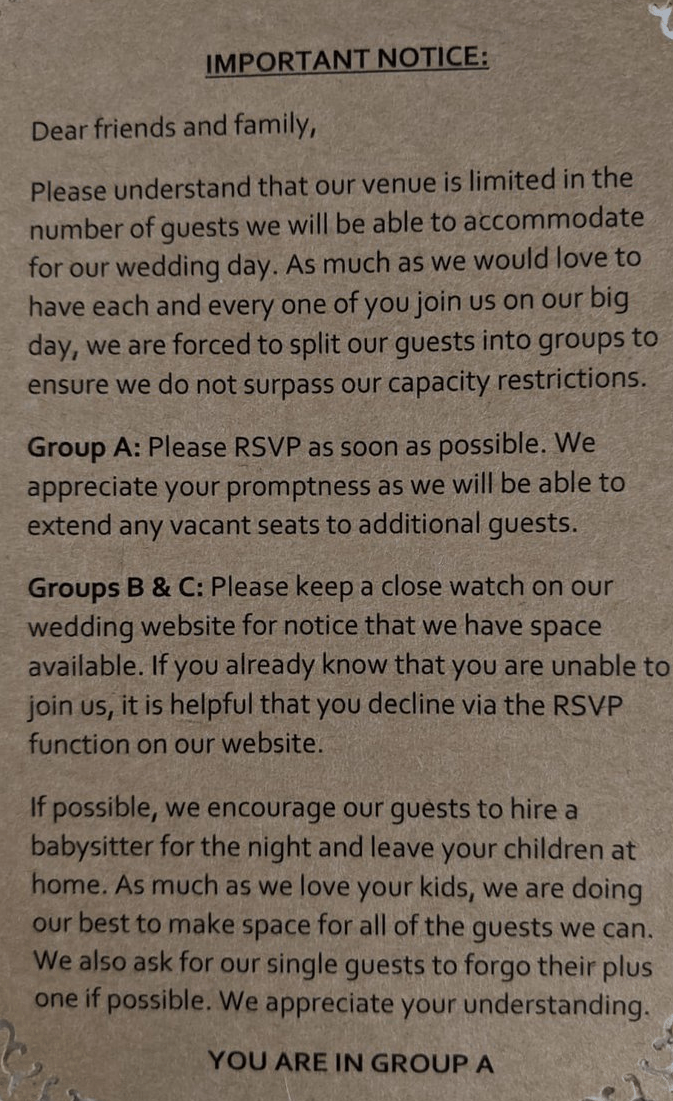
Ethics Quiz And Poll: The Wuhan Wedding

Yes, that’s a real wedding invitation that has “gone viral” on social media.

Your Ethics Alarms Ethics Quiz of the Day is…

Is this a fair, responsible and respectful way to handle this situation?

Continue reading →

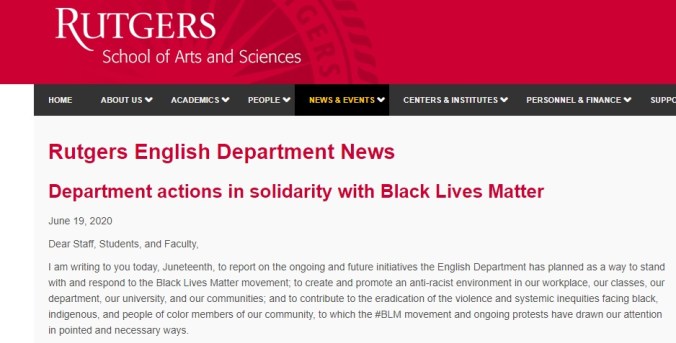
Update: The Rutgers Grammar Letter. What’s Going On Here?

Yesterday, I wrote about  Rebecca Walkowitz, the English Department chair at Rutgers University, sending  an email to the Rutgers community titled “Department actions in solidarity with Black Lives Matter.” In order to “contribute to the eradication of systemic inequities facing black, indigenous, and people of color,” she announced, the English Department will begin “incorporating ‘critical grammar’ into our pedagogy.” “Critical grammar” pedagogy “challenges the familiar dogma that writing instruction should limit emphasis on grammar/sentence-level issues so as to not put students from multilingual, non-standard ‘academic’ English backgrounds at a disadvantage,” her email states. “Instead, it encourages students to develop a critical awareness of the variety of choices available to them w/ regard to micro-level issues in order to empower them and equip them to push against biases based on ‘written’ accents.”

This, I concluded, was one more example of the solution to “systemic racism” being rammed down our metaphorical throats by the World’s Woke consisting of removing any standards that any segment of black America found the lest bit inconvenient or challenging—you know, like competing for jobs, SAT scores and having to obey lawful directives from police officers. I wasn’t the only one, though the report on this initiative came from the College Fix, a conservative site that reports on the leftist nonsense in our institutions of higher learning. There has been literally nothing about this episode in the mainstream news media. The New York Post—but that’s a Murdoch publication, so thus presumptively eeeevil—did have a brief editorial note about the matter:

“….Rebecca Walkowitz, vowed to incorporate “ ‘critical grammar’ into our pedagogy,” which will challenge “the familiar dogma that writing instruction should limit emphasis on grammar/sentence-level issues,” so as not to put students with poor “academic” English backgrounds “at a disadvantage.” Another goal: “decolonizing the Writing Center.” How does lowering standards serve justice? Executive dean Peter March and spokeswoman Dory Devlin didn’t respond to request[s] for comment.”

Two esteemed Ethics Alarms readers, however, argued that I, as well as the College Fix and others, got her intent backwards. Heeere’s commenter Here’s Johnny (emphasis mine):

[I]n saying “Critical grammar pedagogy challenges the familiar dogma”, they are doing the right thing. The familiar dogma being challenged is that proper grammar is not important. That dogma came into play to cut some slack to students whose grammar was not perfect, for cultural, or native language, or other reasons. In challenging that dogma, Rutgers is saying that the phrasing of a message must be looked at critically. It may be that slang, or cultural ways of speaking are appropriate, or it may be that standard grammar is necessary. Students must know the difference and use what is right for the message and the audience.

Continue reading →

“The Great Stupid” Rampages On: Rutgers Decides That Allowing Bad English Will Help Cure Systemic Racism.

You know, when I was being sued for defamation by He Who Must Not be Named, the plaintiff told the Massachusetts judge in our hearing that (I’m paraphrasing here, just in case he’s lurking and wants to sue me again) Ethics Alarms was an insane, far-right blog with robotic followers who would march into the sea if I so instructed. This was right before he went on a rant that I was sure would end with him taking out two small metal balls and start rolling them in his hand. This is not a far-right blog, and calling it such is like calling someone who opposes Black Lives Matter a racist. I  can’t help it if almost all the ethical breaches are emanating from progressives lately, but it should not require a conservative orientation to condemn them for what they are.

A case in point: The Rutgers University English Department recently announced a list of “anti-racist” directives and initiatives, including an pledge to de-emphasize correct  grammar. Rebecca Walkowitz, the English Department chair at Rutgers University, sent the email on “Juneteenth” —she’s so woke!“—titled “Department actions in solidarity with Black Lives Matter.”

[I shouldn’t have to point this out, but I will pause to do so anyway: no department of any institution should develop policies in “solidarity” with any organization or movement. That is not their job or function.]

In order to “contribute to the eradication of systemic inequities facing black, indigenous, and people of color,” among other steps, she wrote, the English Department will begin “incorporating ‘critical grammar’ into our pedagogy.”

“Critical grammar” pedagogy “challenges the familiar dogma that writing instruction should limit emphasis on grammar/sentence-level issues so as to not put students from multilingual, non-standard ‘academic’ English backgrounds at a disadvantage,” her email states. “Instead, it encourages students to develop a critical awareness of the variety of choices available to them w/ regard to micro-level issues in order to empower them and equip them to push against biases based on ‘written’ accents.”

They have no “choices.” They have to learn to communicate clearly, or they will not succeed. Continue reading →

Tales Of The Great Stupid, Niggardly Principles Chapter

I am most grateful—I think—to  Ethics Bob Stone for bringing this story to my attention. It gives me hope, it really does, that we are quickly arriving at the point where the George Floyd Ethics Train Wreck will be revealed to all as being driven and enabled by people so silly and stupid, that there will be an ear-splitting slapping sound across the land, as Americans of sense and perspective bring their palms to their foreheads in the humbling realization that they have been taking seriously the blathering of fools and ignoramuses.

And with a ripple of embarrassed laughter, the suddenly enlightened  will immediately begin going about life as they once did, devoid of self-flagellating guilt for believing in  a land and a system where people are, or should be, judged by their talents, enterprise, accomplishments and the content of their character, and not, whether black, Black, white or other hues and shades, the color of their skin, their ancestors, or what their ancestors did or didn’t do. Thereafter this period of unrestrained hate and statue-toppling, the cancel culture,  fear, groveling, virtue-signaling and grandstanding will come to be known as “The Great Stupid,” and we will collectively wonder, as with the Dutch Tulip Mania of the 17th Century and Disco, how the Hell something so mad could have happened, and for so long. Continue reading →

Ethics Catch-Up, 7/23/2020: Waiting For Baseball Edition [Corrected]

This moment in “Field of Dreams” was how I started off my baseball and culture presentation this week. Ironically, the speech has always irritated me, because of its stagey blocking, and because it is a speech that sounds like a  speech, and is essentially right out of the book the film was based on. In the novel, “Shoeless Joe,”,the “Terrence Mann” character played by James Earl Jones was real life (and then, still living) recluse author J.D. Salinger. I dislike the speech, but the scene always moves me, for a personal reason.

As Terrance Mann stands, giving his speech, the ghostly players of the past silently assemble behind him in Ray Kinsella’s (Kevin Costner, of course) magic corn field. One of the players behind him has been identified in the film as Smokey Joe Wood, a 30 game winner with the World Champion 1912 Boston Red Sox. Just a few years before the film was made, I had been in the Fenway Park grandstands as  Smoky Joe, feeble, in his mid-nineties and in a wheel chair shortly before his death, barely threw out—more like dropped—the first pitch at a Red Sox Old Timer’s game, to a standing ovation.  And here he was, in that  corn field, but young and vital again.

Gets me every time….

1. Ethics query: is it ethical to perform “Piggies”? I just caught an old concert clip in which George Harrison and Eric Clapton performed the obnoxious pseudo-Marxist ditty “Piggies” (from the White Album) to thunderous applause.

[Notice of correction: I originally wrote that “Piggies” was a Lennon composition. All these years I assumed it was, heavy-handed and juvenile politics that it was. I am stunned that the song was George Harrison’s doing; I thought better of him.]

This was well after the Manson murders: I had never heard anyone perform the song in decades. Admittedly, it is just moral luck that a madman seized upon the White Album Beatles songs as his inspiration to mastermind the slaughters of  Sharon Tate, her unborn child, and her house guests, as well as supermarket executive Leno LaBianca and his wife Rosemary the following night. However, “Piggies” was the one song referenced directly in both murders. It is not inconceivable that if the White Album had omitted that song—no great loss, either–at least the LaBianca murders might not have taken place. I know I can’t hear the song without picturing carnage, and it seems to me singing the song is like a celebration of Manson’s work. I wouldn’t ban it; I don’t believe in banning anything.  I just think it’s bad taste to play it or perform it.

Is that inconsistent with my objection to “canceling”  “Dixie,” “My Mammy,” “Rockabye Your Baby with a Dixie Melody,” “When Johnny Comes Marching Home,” “Oh Susanna!” and other songs that are redolent of the Old South? I would argue that those songs have the virtue of being great tunes and important cultural touchpoints…in other words, works of musical art that justify themselves. “Piggies,” in contrast, is musical junk, like about 20% of the White Album filler. Continue reading →

More Speech Suppression And Intimidation On The Campus: The Juniata Affair

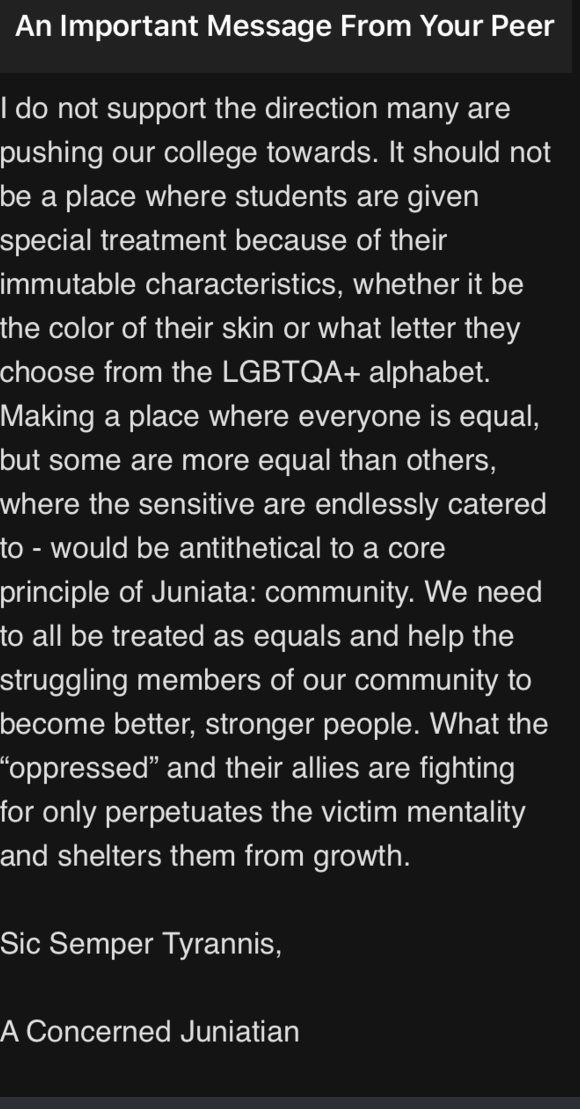
The “Concerned Juniatian” was a student named Colin Daly. This was the very end of a much longer screed (You can read the whole, very long letter here) that the Juniatia College student sent to his campus community anonymously. Juniata is a small Pennsylvania liberal arts college affiliated with the Church of the Brethren, a Christian denomination. It is also apparently devoid of respect for such values as free speech, individuality, and dissent.

Daly, a senior, wrote the email without including his name but accidentally “left identifying information on the system he used to distribute his post to all of Juniata’s email accounts,” according to PennLive.

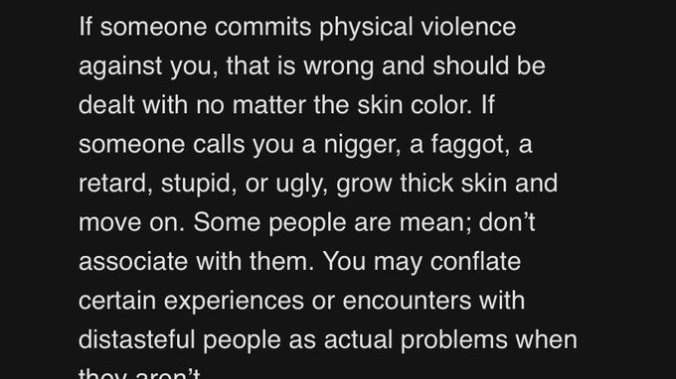
Before it identified Daly as the author, the college’s President James Troha wrote in a statement that the email contained “slurs, hateful language, and intimations of violence directed at members of our community on the basis of their identity.” There is no threat of any kind in the letter, and the “slurs” are words referred to as slurs, not used as slurs. Here’s the section of the letter I assume Troha is referring to:

I’d like to see Daly sue Troha for libel; I think he’d have a strong case.

The next day, after it was determined that Daly was the author, the college released a new statement. claiming that “law enforcement agencies are continuing their own investigations of the matter,” and suggesting that the letter’s author student may have broken state and federal laws.

That’s some education students at Juniata are getting. Continue reading →

Colleges Have Become An Existential Threat To Free Speech, Thought, And Democracy. They Have To Be Opposed And Reformed [CORRECTED]

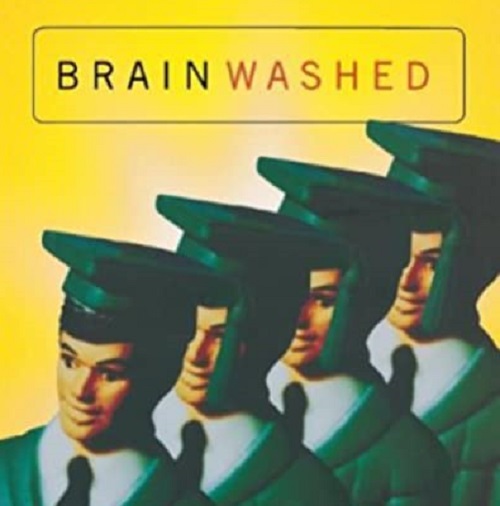
From the cover of Ben Shapiro’s book. Of course, most campuses won’t allow Shapiro to speak there, and explain how students are being brainwashed…

And that will take determination, character, and guts.

Two horrifying stories from our campuses illustrate the urgency of concerted, relentless opposition.  Warning: the second is even worse than the first:

1.University of Connecticut

The president and vice president of the University of Connecticut’s Undergraduate Student Government rejected the will of the students who voted them them into their positions four months ago, and announced that they were resigning. The reason, they said, was that it was inherently racist for white people to lead. Of course, it is racist by definition to claim that one race or another is more qualified to do anything, but this is the apparent quality of a UConn education on display.

VP Alex Ose , according to The Daily Campus,  quit while citing “the climate and incidents of racial injustice across the country and at the university,” and added,

I feel that it is my duty to step down from my position to make space for BIPOC (black, indigineous and people of color) voices to truly rise and be heard. It is my responsibility to make space, not to create an echo.

Fascinating. The fact that she is so devoid of critical thinking skills as to state something like this publicly is, ironically, a good reason for her to resign, but wanting to “make space” for “black, indigineous and people of color”—she misspelled indigenous—regardless of their qualifications, intelligence, judgment ability and experience is not.

As noted here earlier, this is the emerging “answer” to Question 13 (“What is the “systemic reform regarding race in America” that the George Floyd protests purport to be seeking?“): installing a color-based system that excludes merit, and designating whites as a subordinate class. UConn has apparently done an excellent job indoctrinating white students into accepting that second-class status. Go Huskies!

President Joshua Crow’s explanation for his resignation was slightly less idiotic, but still entirely based on race rather than any rational distinction. He said, “It is important in this time to ensure that marginalized groups have the platforms they need.”

Whatever that means. Need to do what? President of the student government isn’t a platform, it’s a job. What does “ensure” mean? Apparently it means ignoring the votes of students, and deciding what is “needed” by edict. If white people are marginalizing themselves, does that still make marginalizing unethical?

To be fair, college students have the excuse that they are young, inexperienced, prone to being influenced by emotion and peer pressure, and, as this nauseating display of virtue-signaling shows, badly educated. College administrators and faculty, however, have no such excuse, which is why the next account is even worse. Continue reading →

Ethics Observations On The National Museum of African American History and Culture’s Retreat

The Smithsonian’s National Museum of African American History and Culture (NMAAHC) endured only a day of searing criticism before it removed its racist chart on “whiteness” from  its website. The site replaced the graphic, which Ethics Alarms reproduced here and here and never wants to see again, with this statement:

At the National Museum of African American History and Culture, we believe that any productive conversation on race must start with honesty, respect for others, and an openness to ideas and information that provide new perspectives. In that context, we recently unveiled “Talking About Race,” an online portal providing research, studies, and other academic materials from the fields of history, education, psychology, and human development.Our goal in doing so was to contribute to a discussion on this vitally important subject that millions of Americans are grappling with. Since yesterday, certain content in the “Talking About Race” portal has been the subject of questions that we have taken seriously. We have listened to public sentiment and have removed a chart that does not contribute to the productive discussion we had intended. The site’s intent and purpose are to foster and cultivate conversations that are respectful and constructive and provide increased understanding. As an educational institution, we value meaningful dialogue and believe that we are stronger when we can pause, listen, and reflect—even when it challenges us to reconsider our approach. We hope that this portal will be an ever-evolving place that will continue to grow, develop, and ensure that we listen to one another in a spirit of civility and common cause.

Observations: Continue reading →