Finally, in the last of today’s opening trio of outstanding and varied Comments of the Day, Arthur in Maine, whom I did not know until this comment was a former chef, whips up a filling and pleasurable examination of of the issues raised in “Your 4th Of July Ethics Quiz: Food Racism?”...
There’s no longer any doubt in my mind: people are actively looking for ways to be offended. In the case of BLM, for example, the belief is clearly simple-minded rage at the rank-and-file level, but among those further up the chain it’s obviously about power and the grift. Calibrate your outrage correctly, and one can lead quite a handsome life.
Racism (and its first cousins misogyny and homophobia) is the perfect charge to level to achieve this (lucky souls like Lori Lightfoot can, and do, score the trifecta by claiming all three).
As a recovering professional chef (I haven’t lifted a pan for a paycheck in more than 30 years, and still miss it almost every day) I can tell you that serious pro cooks may be able to wow you with the complexity of their offerings. But the foods most of them prefer to eat generally trace back to poverty foods – those developed in poor cultures, where most people ate what the rich folk wouldn’t.
Most Americans, regardless of when or how their ancestors first showed up, simply don’t understand that in most other parts of the world NOTHING goes to waste. We give our scraps to cats and dogs. But very few other places do that. Thus, it’s little wonder that someone figured out a way to make duck feet in a way that actually tastes good. For the record, I would order those in a heartbeat, with full knowledge, just to try them! But in a place like China centuries ago, wasting protein like that was unthinkable, so you did what you could to make them tasty and that’s what’s for supper.
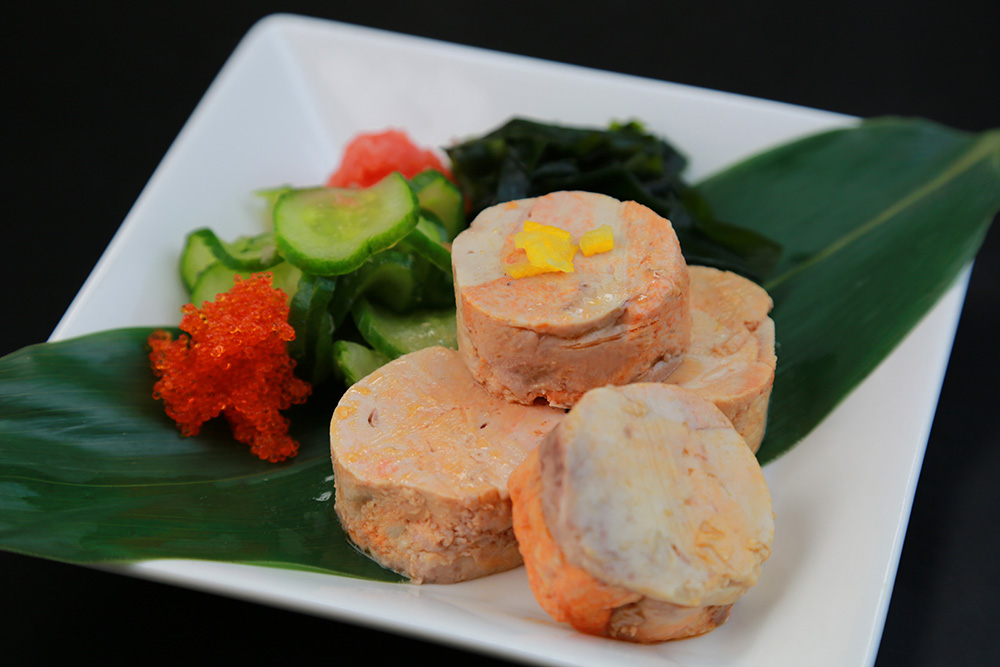
This doesn’t mean I like everything – not by a long shot. I find tripe revolting, and it’s extremely popular in first-world France. As a true afficionado of sushi, I’ll try anything – and just about the only thing I’ve ever been horribly disappointed in at a great sushi bar was ankimo – which is steamed monkfish liver. [Above] It was described to me as the “foie gras of Japan,” and I can see why. But it was still vile. I like foie gras, but not when it’s overlayed with the aroma of a cod-liver-oil-based ointment my mother used to use on us when we were small.
Some cultures happily eat grubs – no thank you. Others eat various insects; again, I’ll pass, but you’re welcome to my helping. The fact is that every culture has its culinary oddities and we’ve all got different tastes. This doesn’t mean our distaste for something is racist. It merely means that it’s so far outside of our culinary comfort zones that we just can’t get our heads around the idea. Many cultures find the American fondness for huge slabs of meat served up with starch baffling, for a variety of reasons.
This, by the way, extends beyond ingredients. There are those only too happy to make accusations of “cultural appropriation” when it comes to food. It is not. When I cook Chinese or Thai or Indian or Mexican food, I do so as a student, not as an appropriator. I do it because I’ve had the good fortune to taste these wonderful cuisines done properly. I want to understand how they’re done, partly because cooking professionally makes you fascinated by differing techniques and ingredients, and partly because I love to eat them and access to these foods locally, prepared by those from that region, is sharply limited. In the case of Chinese, especially, Chinese-American food has been so heavily adapted to North American tastes that it bears little resemblance to the real thing – and almost all of the adaptation has been done by Chinese cooks and restaurant owners. I really want to try the real thing.
Far as I’m concerned, when I make up a dinner of low-country shrimp and grits, the last thing on my mind is contempt for the poor Blacks for whom this was subsistence food. Rather, I’m thinking “this is absolutely ingenious. They took cheap stuff (grits) and free stuff (shrimp) and whatever else they had lying around and made it transcendent!” For me to cook it is not appropriation – it is the deepest possible respect.
I could make a similar argument with music, but I think you folks get my drift. This is “The Great Stupid” and “A Nation of Assholes,” to use Jack’s terms, colliding head-on to form a Great Nation of Stupid Assholes. We’d better come up with a way to pull out of this dive, and quickly.