Finance
Wuhan Virus Ethics Updates, Part 1

1. Why keep calling it the Wuhan virus? Because the largely successful news media and political correctness assault on the completely legitimate (and non-racist) label continues to bolster Chinese Communist propaganda and blame-shifting, and because the effort emerged as yet another use of Big Lie #4: “Trump Is A Racist/White Supremacist.”
As for me personally, I will keep using the term because I resent being told that what cannot possibly be racist is racist, especially when my capitulation enables similar political correctness bullying. See the Third Niggardly Principle.
2. Because it’s so darn difficult to maintain social distancing while playing tennis... About 200 yards from my home in Alexandria, Virginia, the public tennis courts have their nets removed by another proto-fascist. Yesterday, I saw two people playing on one of the courts using a self-rigged net. Good for them.
3. The problem is, you can’t force bank employees to come to work. Our bank, a large national chain, has all of its offices closed in this area, Banking is certainly an essential service, but the fact is that you can’t do banking completely remotely, though the bank is pretending you can. Its website asks for a social security number at the same time as scammers are sending out fake emails that lead you to an authentic-looking clone of the bank’s site so they can steal your personal data. Try to call to clarify or address any problem, and you get a message about how wait times are longer than usual. I’ll say they are: to try to get a fraudulent $4000 charge to our account cancelled, I had to wait for an hour and 40 minutes, then be transferred to wait another 35 minutes, then be cut off when a transfer failed.
Meanwhile, the bank’s on-hold music is played at an unbearable volume, and is an endless loop of some hellish arrangement of a melody that would have been rejected for a theme park ride. I am certain that the recording is designed to make you hang up, or, in the alternative, go crazy and run into the street naked. It is exactly like the deliberately uncomfortable seats and garish color schemes fast food outlets use to ensure you vacate the premises the second you finish eating. I swear that there cannot be a single person on the globe who would find this music anything but torture. The genre is “loud, abrasive, repetitious semi-music,” and there is no market for that. It makes hip-hop seem like Chopin.
Banks are essential, and rather than stopping stores from selling “non-essential” items, the government ought to require really essential services to have open outlets to serve depositors and bank customers experiencing their own emergencies. If a 7-11 clerk can come to work, so can a bank employee. Banks have my property within their control, and in exchange for the privilege, they are obligated to respond when I need service related to that money. Continue reading
Ethics Dunce, But He Doesn’t Care: Senate Intelligence Committee Chair Richard Burr (R-NC)

I know this is unfair, but in almost every non-posed photo I found of Burr, he looks like he’s hiding something.
The Chairman of the Senate Intelligence Committee, Senator Richard Burr, sold off between $628,000 and $1.72 million of his stock holdings on February 13 in 33 separate transactions. At the time, Burr had received the government’s most highly classified Wuhan virus briefings. About a week after Burr unloaded stocks that figured to be affected, the stock market began its dive and has lost about 30% of its value since
Today NPR revealed a secret recording from February 27 in which the Senator gave a GOP group at an exclusive social club a gloomy preview of the economic impact of the approaching pandemic. According to the NPR report, Burr told attendees of a business executives group luncheon held at the Capitol Hill Club:
“There’s one thing that I can tell you about this: It is much more aggressive in its transmission than anything that we have seen in recent history … It is probably more akin to the 1918 pandemic.”
Comment Of The Day: “Robert Bowman Redux, Times Two, But Ohio’s Nicer Than New York”

And now for something completely different, or at least not involving pandemic freakouts or politics. Isn’t that refreshing?
Reacting to the tale of the aspiring Ohio law grad with over $900,000 in student loan debt, Chris Marschner offered some guidance on how to look at student debt.
Here is his Comment of the Day on the post, Robert Bowman Redux, Times Two, But Ohio’s Nicer Than New York:
I would suggest a different approach. Instead of financing students’ education, we begin allocating funding that gives preference to programs that develop talent. This is not to say that if a person truly wants to go into some esoteric field that may have little market value they cannot do so.
I only mean that those programs should not be subsidized, to keep tuition down as we could use those funds for those in programs of study that in fields that are graduating too few to keep pace with demand for those fields.
We always seem to approach labor cost issues from a demand management side instead a supply side. What if government subsidized the cost to become a medical doctor, engineer or scientist to equilize the cost of those programs to equal the upfront costs of an MPA, MFA or MBA. I would have no issue if the baseline subsidy rate was the cost associated with obtaining a quality Liberal Arts degree that included proficiency exit exams in math, science, reasoning, English and foreign languages.
We do not need thousands of General Studies majors that require no organized program of study. If you want to get a degree in Gender Studies or “Sports Management,” go for it— but don’t ask to have taxpayers subsidize it by guaranteeing your student loans and a reduced interest rate when the market for such occupations is relatively minute. Continue reading
Dead Wrong: The Withdrawn Bequest Share
That is, the advice columnist’s answer to an easy ethics question last week was dead wrong. Once again, the advice-giver in question is Philip Galanes, the Times proprietor of Social Q’s, essentially that paper’s version of “Miss Manners.” Galanes, I now see upon googling him, is a novelist and a lawyer. That explains, perhaps, his unfamiliarity with some of the more nuanced aspects of ethics. Here’s the question he received in its entirety:
My brother died last year and bequeathed his entire (small) estate to me. He had one child, a daughter, to whom he left nothing. Feeling sorry for her, I told my niece I would give her half of the estate. (None of this becomes official until April.) But my circumstances have changed dramatically. My husband was recently diagnosed with pancreatic cancer. He is undergoing treatment, but we face a very uncertain financial future. I would now like to keep the entire estate. My niece is doing well financially, with many earning years ahead of her, unlike me. Is there a way to tell her I’ve changed my mind so she won’t hate me forever?
The Social Q’s verdict: “…Say, ‘I’m sorry if your father’s will hurt you. I promised you half of my inheritance out of love for you and hoping to heal any pain the will caused. But my husband is seriously ill, and I can’t afford to give you the money now. If I can make it up to you later, or in my estate, I will do it.’….For readers worrying about a verbal contract here, let’s assume B’s promise falls into one of several exceptions that requires agreements to be in writing….”
Yeccchh.
Here’s the ethical answer: Continue reading
Comment Of The Day: “More Evidence That Arthur Herzog’s Novel ‘IQ 83’ Is Coming True—”
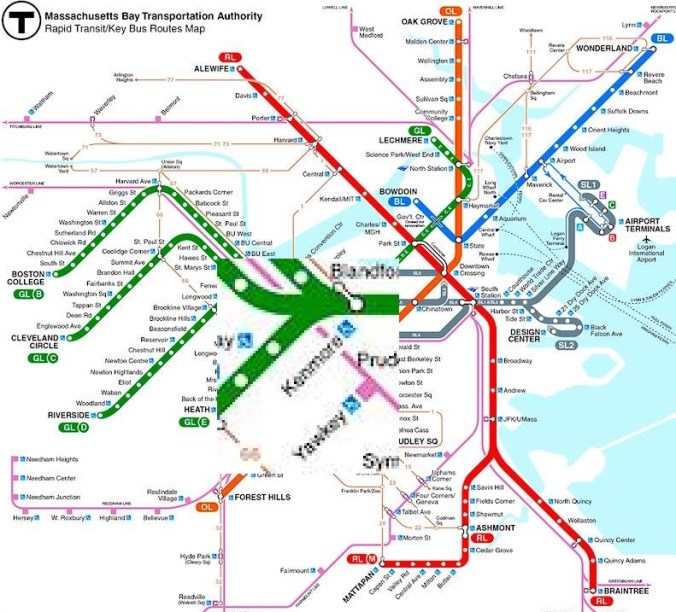
(I enlarged the two Fenway Park stops for your convenience…)
I grew up rising the buses and subways in Boston, and later oversaw a huge U.S. Chamber of Commerce study on transportation infrastructure funding problem (hopeless then, much worse now) , so the Boston Councilwoman’s fascinating theories about how making public transit in Beantown free to riders immediately interested me…since I knew it was crap.
I probably should delve into this issue more frequently, so I was pleased and relieved that fellow New Englander Rich in CT gave us this Comment of the Day on the post, “More Evidence That Arthur Herzog’s Novel “IQ 83” Is Coming True—Beside The Fact That Bernie Sanders Is Leading The Race For The Democratic Nomination, That Is”:
The economics of public transportation are counter intuitive, and this plan is not as insane as it sounds. However, for a city like Boston, it would be absurd to eliminate ridership fare.
Let’s look at my hometown. We have one bus hourly from 7 AM to 10 AM, and 2 PM to 6 PM, that connects to a neighboring city. The farebox recovery ratio is about 15%: For every dollar spent on the service, customer fares return $0.15 – 15 cents on the dollar.
The bus is provided as a bare bones courtesy for those who need it. If the bus company raises the fare, ridership will go down, because people cannot afford to use it anymore (they then cannot get to work…). Fare recovery goes down with an increase in fare, but the cost of running the shuttle remains the same. The very population it is meant to serve is not served. We’d be running an empty bus back and forth.
In all truth, my town subsidizes 100% the cost of the shuttle under its contract with the city; the $2.00 fare effectively pays for the transfer to a city bus. Eliminating the bus fare only modestly increases the necessary public subsidy; any expansion of hours or geographic distance would also require an increase in subsidy.
If we look at a city like Boston, the economics are very different. The service is still provided for those who need it, but a great many more need it. The fare box recovery is closer to 30%-50%. The cost of the service is the same whether people are on it or not, so the city offers discounts for bulk purchases to attract people who would otherwise use a car. This has the positive effect of increasing ridership and improving the fare box recovery slightly; it also has the perverse effect that the people who need it the most pay the most for it. Continue reading
Morning Ethics Warm-Up, 2/17/2020: The Presidents Day Edition
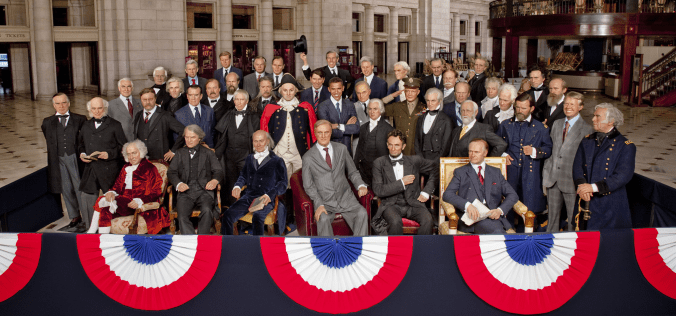
Good morning, guys!
Thank-you for your service!
In honor of our Presidents, Ethics Alarms is posting some of the best and most important Presidential speeches during the day. We’ll see how many I get up; there are a lot of excellent ones to choose from.
In all of these cases, whichever I post, a President was acting in one of the non-partisan functions of the office, when the President’s job is to represent all of our nation’s citizens. It is a disturbing fact that the current President has been virtually blocked from discharging these duties, as part off the long, relentless effort by the A.U.C.—the Axis Of Unethical Conduct: Democrats, the “resistance,” and the mainstream media—to deny his Presidency’s legitimacy and to reduce his support among the public to the point where it becomes politically feasible to remove him without an election.
The nation needs those non-partisan Presidential moments, because they symbolize unity and strengthen, rather than weaken, our bonds: throwing out the first pitch of the baseball season, attending the funerals of distinguished Americans, hosting the Kennedy Center Honors. It is not this President’s fault that he had been prevented from doing his job.
1. Why look! Here’s another example! Yesterday President Trump, having been invited to serve as grand marshal for the Daytona 500, uttered the traditional “Gentlemen, start your engines!” and boarded his official limousine, nicknamed “The Beast”, and, with a U.S. and Presidential flag on the front fenders flapping in the wind, headed out onto the track, pacing the full field of cars.
The Horror. Tweeted Maggie Halberman, the usual co-author of New York Times front page features—inevitably negative– on the Trump administration,

Nah, there’s no mainstream media bias! Obama and Bush throwing out the baseball season’s ceremonial first pitches, Obama using his limo for a Jerry Seinfeld comedy bit, and prominently attending an NCAA basketball tournament game–all good! President Trump serving as grand marshal at a NASCAR event? Unacceptably political.
This is smoking gun bias from the journalist the Times uses to inform its readers about what this President does.
2. Now Trump’s stupid tweets, however, are another matter entirely. Politico reports on what District Judge Reggie Walton, a Reagan appointee, had to say about President Trump’s gratuitous social media commentary on the McCabe investigation: Continue reading
Comment Of The Day: “Ethics Observations On The ABC Pre-New Hampshire Primary Democratic Candidates Debate”

Joel Mundt picks up his second Comment of the Day opining on the ever-green and always perplexing ethics controversy of slavery reparations, which was again broached in the recent Democratic candidates debate in New Hampshire. The topic has had a resurgence in recent years due to the advocacy of the current rock star of race-baiting , Ta Nihisi Coates, who regards the mass white to black wealth transfer as a the only way to solve America’s persistent economic gap among the races.
It has also had a long record of debate on Ethics Alarms, notably in the commentary on this 2019 post, where I admitted that I had momentarily lost my mind in this one from 2016, in which I made…
“….no sense whatsoever. While again rejecting the concept of reparations (“the hell with that. [The idea is] to punish [whites] for the sins of slavery committed by their ancestors by arranging a massive transfer of wealth based on principles of tort law and damages. This has always been a pipe dream of civil rights extremists, couched in the language of revenge, as if the nation and the nation’s white citizens have made no efforts, sacrificed nothing, expended no resources or wealth, to try to undo the legacy of slavery and Jim Crow. Reparations are not going to happen, as the concept itself is unjust….”), I proposed a solution….that was indistinguishable from reparations…”
I concluded that mea culpa post by writing,
I’m better now. I am also, unfortunately, also back at Square One, my “Do something!” phase regarding race in America having accomplished nothing, as “Do something!’ arguments always do, and I still see no solution on the horizon.
I still don’t. Joel’s perspective can’t address that.
Here is Joel Mundt’s Comment of the Day on the post, Ethics Observations On The ABC Pre-New Hampshire Primary Democratic Candidates Debate:
The issue of reparations has tied numerous candidates up in knots. Now it’s Steyer’s turn, though I think he’s a knot-head regardless. I firmly believe that reparations have already been paid. If the practice of slavery had been cut off solely by Presidential decree or Executive Order, or because the South simply decided to halt it, one could make an argument, however painful and convoluted, that financial reparations had a place at the table of discussion.
But I believe that slavery was ended with bloodshed. Those who supported slavery and secession from the Union paid dearly for it. Hundreds of thousands of Confederate soldiers died for their cause, cities were razed and burned, and their newly-formed government was terminated. And the North paid, too, with the lives of hundreds of thousands of young men who fought to save the Union and ultimately, to end slavery.
And now, 160 years later, people like Steyer (and Buttigieg, and others) say that’s not enough. They are, in effect, telling those soldiers, “Thanks for the sacrifice, but this is more about money than you getting eviscerated by cannon shot and having your body eaten by gangrene.” I’m not sure spitting on their graves is worse.
But it does get worse. Continue reading
More Evidence Of The Ethics Void That Is Elizabeth Warren.
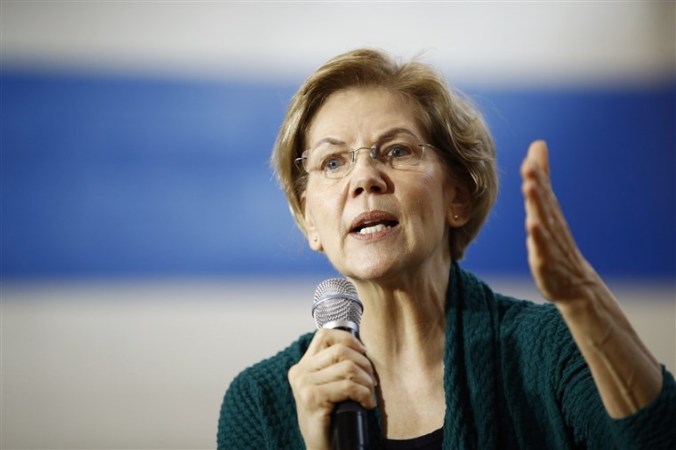
As America waits for the results of the epically botched Iowa caucuses, the fact that Elizabeth Warren still attracts any support at all is more testimony to the fact that 1) a lot of people are just as dumb as Warren thinks they are, and 2) Democrats just aren’t paying attention.
In an awful field for the Democratic Presidential nomination, Warren stands out for her Machiavellian manipulation, pandering and abuse of her presumed authority as a scholar. After I posted on Facebook about her head-explosionworthy promise to let trans teens have a veto over a cabinet position, maybe the most ridiculous pledge I’ve ever heard from any candidate regaring anything, a Facebook friend wrote that I appeared to be biased against Warren. It’s true—I am irrationally biased against politicians who say things they obviously don’t mean in order to get votes, and who are shameless, lying, demagogues.
Liz had a particularly revealing few days before the caucuses. The Wall Street Journal reported: Continue reading
Elizabeth Warren Is Confronted With The Injustice Of Facile Giveaways
Good.
Res ipsa loquitur.
Go ahead, Senator, explain how this is fair. I’d love to know.


Veteran commenter Tim Levier comes to the defense (sort of) of both Harvard and nuance.
Here is his Comment of the Day on the post, “You Know, Harvard, When You Have To be Embarrassed And Shamed Into Doing What Should Have Been Your Automatic Response Anyway If You Had Any Decency, It’s Too Late To Save Face.”