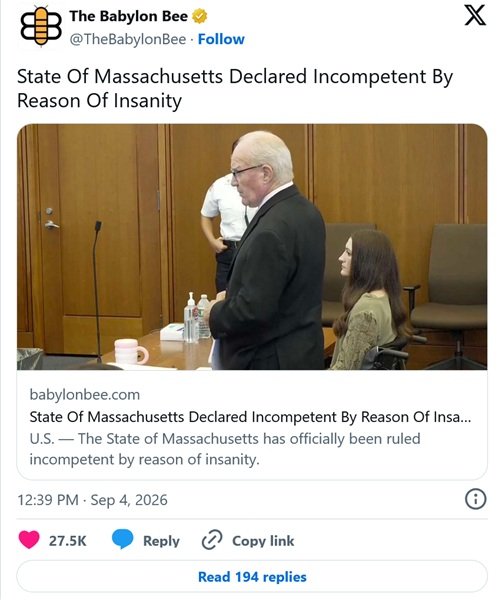
Things are not as simple as the Babylon Bee would have us think. Ethics Alarms already posted two essays on this case, here and here. The latter, a Comment of the Day by Tim Levier, concluded by describing the protesters and demonstrators thusly:
The Protestors / Defenders / Supporters – Providing financial and material support to someone with whom they have no prior connection.
These people are deranged and one has to question where they came from and who has time to commit to such folly at a time when everyone and their mother is complaining about the cost of things. Why would anyone protest due process? She’s making her case in a court of law and the fair process will play out resulting in a judgment. This isn’t an area for “opinions” and to influence an outcome. Its meddlesome and the act of a narcissist that believes in one’s own “greatness” or “importance” over that of an impartial judicial institution.
Clancy’s trial, presumably the first of two (at least), ended in a mistrial yesterday due to a hung jury. A single juror, widely believed to be one of the three men on the 12 juror panel, was apparently refusing to budge from his unshakable belief that the woman who has confessed to murdering her three children is guilty of murder. I dunno, that seems like a defensible verdict to me, but I wasn’t in the courtroom during the trial.
But I digress. Here are recent ethics-related developments and observations:
I was going to use Marlon’s “The Horror!” clip, but he’s been over-exposed here lately. I decided to use a shot of the 1926 Sesquicentennial of American Independence half-dollar, which carried the face of that infamous autocrat and self-promoting narcissist, President Calvin “Silent Cal” Coolidge. That coin caused no controversy at all; in fact, I’ve read three Coolidge biographies and not one of them thought it was worth mentioning…because it isn’t. But a commemorative coin bearing the current President’s face (you know, to provide historical context?), now THAT is scandalous. For the U.S. 250th Commemorative coin was released yesterday, and the Axis of Unethical Conduct is furious.
Michael J. Gerhardt, a professor of law at the University of Pennsylvania Carey Law School, says that the coin “violates both federal law and historical practice.”
I smell the Axis “norms” canard again!
“The Department of Treasury is bound to follow federal law. Its efforts to maneuver around federal law are illegal,” Gerhardt tells said. “The fact that the coin is commemorative does not immunize it from being covered by relevant federal law.”
As far as I can see, it does follow Federal law. The Trump Deranged keep pointing to the federal law that states: “Only the portrait of a deceased individual may appear on United States currency and securities.” Commemorative coins are not currency, however, but collectables. If you spend one of the 250th coins on—what costs only a dollar now?—you’d be an idiot, because they cost more than twice that, and presumably will gain in value over time.
Wow, it takes some impressive ineptitude to get two “Incompetent Elected Official of the Month” designations in less than 30 days, but this creep was up to the challenge.
Yesterday the House voted 413-2 to censure Edwards. The House Ethics Committee recommended the action after it found last month that he had engaged in unprofessional and inappropriate behavior with two former female staffers. EA wrote about that stage of this episode here.
Edwards then stood up and sort-of-kind-of apologized, but not really, saying,
“I want to say something directly and publicly to the two women who have been at the center of all of this. I am sorry. I’m sorry that my actions, my judgement or the way that I expressed a friendship ever put either of you in an uncomfortable position. My intentions were only grounded in what I understood our friendship to be and in genuine admiration and respect that I had for each of you. Not only as professionals, but as people. I ask each of you, Republican and Democrat alike, to look beyond the headlines and examine what the committee actually found. I am not asking for special treatment, I am asking for fair treatment. I am asking you to decide if the punishment before you is supported by the evidence proportional to the conduct actually established.”
It is only fair to flag this idiocy, since I routinely call out the Times’ progressive and Democratic Party propaganda under the “Nah, there’s no mainstream media bias!” banner and leave the Post, which I stopped subscribing to a decade ago because it was so infuriatingly biased, relatively unscathed, :
One of my few non-Trump Deranged Facebook friends posted that tweet today with the wry legend, typical of him, “I don’t see the problem…”
This wasn’t among my planned posts for today, but after picking on the Times in the previous post, I feel ethically obligated to point out that the Washington Post is an “enemy of the people” too.
I’m getting this Comment of the Day by Tim LeVier up about a week late. Fortunately, I was reminded of the topic because essays and articles about the weird outpouring of support for a child-killer keep coming. Here’s the beginning of one I read today in The Free Press:
“Struggling, sleep-deprived moms are propping up their phones in their bathroom, hitting the record button and throwing ice at it while screaming for a whole minute. “Instead of having a screaming match with my toddler,” one mom wrote in a social media post, “I throw ice into my tub. It allows me to feel angry without being destructive.” Moms are also setting up ring lights to film themselves hysterically sobbing in front of their small children. Others are filming their crying babies with the caption “Me too, Lindsay,” in solidarity with Lindsay Clancy, the Massachusetts mom who killed her three children—ages 5, 3, and 8 months—and is currently on trial for murder. This brain rot has spread like wildfire, as the algorithms made sure it would, and in the momosphere—the network of TikTok moms and mommy influencers and mom bloggers—it has been almost universally embraced as a healthy, liberating way for mothers to exhibit their rage.”
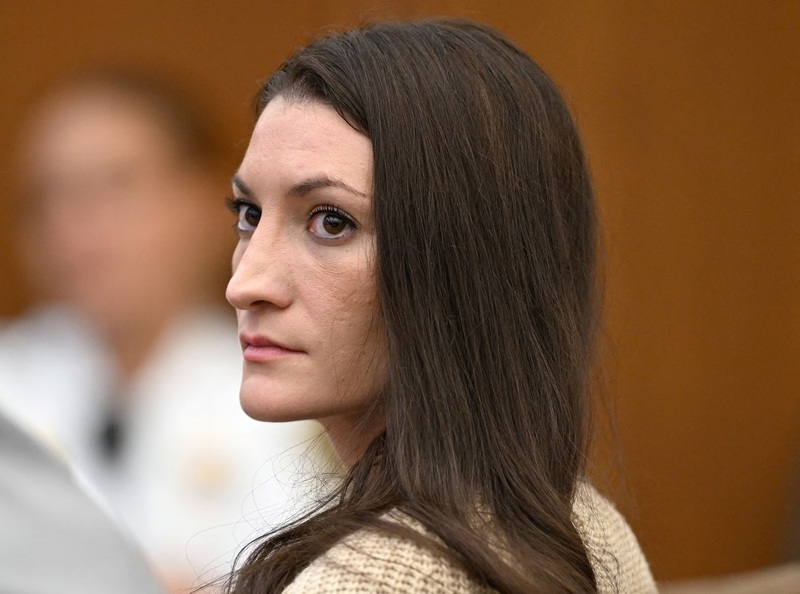
Tim’s analysis is as useful as I found it to be last week. Here is his Comment of the Day on the post, “On The Lindsay Clancy Support Movement: ‘What’s Going On Here?’”….[Oh…I know it’s foolish and biased to judge people by countenance, but boy, if I were casting Medea—or Lizzie Borden—that face would be irresistible.]
***
I have to break down any comment by the groups involved:
1. L. Clancy – She’s on trial. She did the deed. By her plea, I would say that’s an admission of being the one to have done the deed, her defense is not that she didn’t do it, her defense is that there’s disagreement to the severity of the charge due to her mental health. That is a proper question and should be settled by the courts / justice system.
2. The Parents and their Fundraisers – As I had heard it, money was being raised to support her parents through this and provide them with a place to stay because 3 years of motel rooms adds up.
It is a noble enough goal for the parents to attend the trial and confront the facts and reality of what is determined regarding your child. The people legitimately raising funds and supporting only this goal are probably showing some kind of exemplary ethics in being able to overlook the “Ick Factor” of the case and demonstrating a duty to care. How much easier would it be for the parents to not confront reality and wipe their hands of their daughter?
3. The Grifters – Ostensibly, there must be online grifters that have their own interests in play. They find hot button issues to sell some t-shirts and signs and whatever else will turn them a profit. They’ll lie about donating money and they’ll fan the flames to market and sell their wares.
These people are scum and not real people. They likely use AI generated video characters to fan these flames and profess their own special kind of virtue.
4. The Protestors / Defenders / Supporters – Providing financial and material support to someone they have no prior connection.
These people are deranged and one has to question where they came from and who has time to commit to such folly at a time when everyone and their mother is complaining about the cost of things. Why would anyone protest due process? She’s making her case in a court of law and the fair process will play out resulting in a judgment. This isn’t an area for “opinions” and to influence an outcome. Its meddlesome and the act of a narcissist that believes in one’s own “greatness” or “importance” over that of an impartial judicial institution.
I am something of a persona non grata on the Association of Professional Responsibility Lawyers (because I’m on to them, and they know it) listserv, but the list still has its uses. For example, one of the more ethical ethics lawyers circulated a question he received from a student in his legal ethics class regarding the use of artificial intelligence in class:
I try to avoid the Sunday talking-head shows now (once upon a time, my late wife and I would watch them all). For some reason I lighted on CNN’s “State of the Union with Jake Tapper and Dana Bash” this morning and caught the hang-dog, sour-faced Bash trying to bash Trump Administration illegal immigration policing czar Tom Homan.
Bash: “Do you feel at all bad about sending Haitians back to a country where your own administration considers conditions dire?”
Ethics Verdict: Stupid, manipulative, and irresponsible. “Feelz” are not valid considerations in law enforcement, nor are they legitimate topics for inquiry by serious journalists, of which we have approximately none; certainly not Dana Bash.
What exactly does she propose, importing the whole population of Haiti because that accurately labeled “shit-hole country” hasn’t managed to get its act together for its entire, miserable, violent existence since it became independent in 1804? Holman, who has a terrible poker face on which we could see his disgust with each one of Bash’s questions that had the unstated implication that he, and President Trump, of course, are heartless racists. Homan answered this one by saying that he doesn’t feel badly and shouldn’t when he is enforcing the immigration laws as passed by Congress. He also made the obvious, though not to Bash and all the other “Good Illegal Immigrant” bleeding hearts, point that millions of people across the globe are in line to come to “the greatest country on earth” the legal and right way, and there is no justification for allowing those who came here or remain here illegally to block their paths.
“Do you watch the news? Do you listen to the radio? Do you read anything about what’s going on in the world? Because the problem with lawyers relying on AI hallucinations is an above-the-fold story every single day.So either you have buried your head in the sand … and that’s an intentional choice to be uninformed, or you took a gamble, and neither of those are consistent with the code of conduct.”
Aarons’ brief included references to imaginary witnesses and fake testimony from at least one real witness. That AI bots are likely to make up case cites and even statutory language has been recognized and publicized widely, not just in legal publications but in the general news media since early 2024. Lawyers, including those with large national law firms like Morgan & Morgan and even the Justice Department continuing to file these bogus bot-authored court documents is amazing to me. And they are too stupid, ignorant and lazy to even proof-read what the bots wrote! One judge recently railed specifically at using ChatGPT for legal work, which he compared to using Mad Magazine as a legal reference.
Bacon threw the metaphorical book at Aarons, removing him as attorney from the case of a 60-year-old man convicted last year of murdering his wife, found him in contempt of court, ordered him to pay $5,000 to a client protection fund, and referred him to the bar for potential discipline. The murder appeal will be handled now by a public defender.
It isn’t just lawyers, of course, who deserve tongue-lashings like this. Teachers, professors, newspaper editors, legislators, politicians, screenwriters, and, yes, judges to name just a few of the affected groups have an obligation to keep up-to-date on the AI revolution, and a disturbing number of them are not even close, which is inexcusable.
Two veteran members of Congress, Sen. Ed Markey of Massachusetts and Rep. James Clyburn recently indicated that they were ill-informed regarding AI. That this is, frighteningly, not unusual shouldn’t give us any comfort. Lawmakers are notorious for taking an inordinate amount of time to understand new developing technology, as when the late Senator Ted Stevens, while chairman of the Senate Committee on Commerce, Science and Transportation, described the internet as a “series of tubes.” Like the internet but perhaps even more so, however, artificial intelligence is a civilization-altering (and perhaps -threatening) phenomenon moving at the speed of light. Those who are too dim, indolent, unimaginative and irresponsible to keep up need to get out of the way and retire to some nice, safe, quiet pursuit like beachcombing or golf.
Oh…it’s the Rules of Professional Conduct, Your Honor, not the “code.” Judges have ethics codes. Lawyers haven’t been governed by a “code” for 40 years.
The New York Times is in a tender mood over I.C.E. deporting illegal immigrants who haven’t killed, raped, robbed or otherwise turned to a life of crime—at least as far as we know— being deported by I.C.E. In the deliberately deceitfully-headlined “ICE Arrests Soar as People With No Criminal Record Are Increasingly Targeted” (Uh, no, illegal immigrants are being targeted. I, for example, qualify for the group “People With No Criminal Record,” and I am not being “targeted”), the New York Times writes today,
A majority of the immigrants arrested in July were people who were accused of violating civil immigration laws but who had not been charged with or convicted of a crime, an analysis of newly released federal data shows. The share with a past violent criminal conviction fell to less than 4 percent. Overall, immigration arrests rose to record highs with 43,000 ICE arrests in June and 49,000 in July. Two fatal shootings involving Immigration and Customs Enforcement agents, in Texas and Maine, drew outrage but did not meaningfully slow the pace of arrests…ICE now appears closer than ever to meeting a recent goal of 2,000 daily arrests…Immigration arrests are near all-time highs in almost every state. Even sparsely populated Montana and Vermont saw spikes, with arrest rates more than doubling…
…Deportations have averaged well over 1,000 people a day since last summer, and there are signs that they are picking up speed. The number of deportation flights began rising in the spring, and in July reached a record of at least 329 flights out of the country, according to ICE Flight Monitor, a tracking effort run by Human Rights First.
My one word analysis of that report, which the New York Times presumably thinks will outrage its readers: Good. (And why would, or should, two fatal shootings involving ICE agents slow down appropriate law enforcement?)
Hey, but just for perspective and giggles, let’s see what appreciative Times readers (there are some sane comments in there too) are saying about the article:
“[T]he majority misses the Government’s actual objective: to secure our imprimatur for its effort to foment chaos ahead of the November elections.”
—-Justice Justice Ketanji Brown Jackson, again putting into black-and-white her intolerable political bias and lack of judicial decorum in her dissent to the 6-3 majority SCOTUS decision, a 10-page, unsigned opinion staying an injunction by a federal judge against the implementation of President Trump’s executive order imposing restrictions on mail-in voting.
I won’t pretend to know enough about the substantive law underlying the majority decision, and after trying to read Justice Jackson’s seemingly endless dissent, my brain hurts. However, I can say with ethical certainty that a judge who is automatically inclined to ascribe sinister motives to an elected President’s actions should be disqualified from weighing in on any controversy regarding those actions.
I read Trump’s EO regarding mail-in ballots as consistent with his oath of office and the definition of his powers under the Constitution. Mail-in ballots threaten the integrity of Federal elections and therefore the Constitution itself. There are limits to state sovereignty in determining election regulations and procedures, something Justice Jackson refuses to acknowledge. Gee, I wonder why only 23 states have challenged the EO. Which states might they be?
Elsewhere in her “War and Peace”-length dissent, Jackson complains that the claim that mail-in ballots risk election integrity hasn’t been proven. In fact, some courts have taken judicial notice of the fact, and it is a fact and an obvious fact, that mail-in ballots are unacceptably vulnerable to fraud. But I digress. The ethics issue now is that a Supreme Court Justice begins her analysis of an Executive Branch controversy with the biased presumption that the President of the United States is not pursuing what he believes is in the best interests of the nation under the Constitution. Justice Ketanji Brown Jackson has again demonstrated that she is a dangerous blight on the Court, the Separation of Powers, and the functioning of U.S. constitutional government.